
Hostaway vs Lodgify 2026: An Honest Head-to-Head for Operators
Hostaway and Lodgify end up on the same shortlist constantly, and the comparison usually flatters neither, because they were built for different people with different problems. Hostaway is software for a management company that is adding doors. It assumes several channels, several staff, several owners, and an operator who wants the machinery to keep running while nobody is watching it. Lodgify is software for a host or small brand who wants their own booking site to look good and take reservations properly, with the platforms kept in sync behind it.
Both marketing pages claim the whole category, which is how buyers end up choosing on a feature grid and regretting it eight months later. The honest split is this: scale and operational control on one side, simplicity and direct bookings on the other. If you have twenty homes belonging to eleven different owners, the site design is not your bottleneck. If you have four cabins and a growing Instagram audience, an integration marketplace you never open is not either.
The second thing that separates them is how you find out the price, and it matters more than the feature lists. Lodgify publishes its tiers, and the cheapest of them takes a percentage of every reservation it processes, so the real cost tracks your revenue rather than your unit count. Hostaway publishes nothing: you book a demo, and the quote is assembled from how many listings you run, typically with a one-time onboarding fee attached. Those two models feel roughly comparable in month one and pull apart sharply by the second season, and no sales conversation walks you through that arithmetic.
This head-to-head goes through who each one is built for, channel depth, the website and booking engine, the two pricing models, automation, integrations, and the onboarding effort nobody quotes. Then it covers the part both leave completely alone, which for a management company is where the growth actually is.
Vendor pricing reflects published or third-party-reported figures as of August 2026; Hostaway does not publish public rates, so check both vendors directly before budgeting.
Hostaway vs Lodgify at a glance
| Dimension | Hostaway | Lodgify | Zoye |
|---|---|---|---|
| Built for | Scaling management companies and co-hosts | Hosts and small operators chasing direct bookings | The business around the bookings |
| Core strength | Channel depth, automation, integrations | Website builder and booking engine | Owner pipeline and follow-through |
| Channel management | Deep, strong on complex multi-unit inventory | Solid on the major OTAs, simpler inventory | None, by design |
| Direct booking site | Included and functional | The centre of the product | Not a website builder |
| Pricing model | Quote only, based on listing count | Published tiers, based on rental count | Flat for the workspace |
| Fee per reservation | Subscription only, no commission reported | Percentage fee on the entry tier | None |
| Onboarding | An implementation project, usually a one-time fee | Mostly self-serve, days not weeks | Same day |
| Staff and cleaning tasks | Native task management | Lighter | Assigned and chased automatically |
| Owner reporting | Native statements and reporting | Thinner | Owner invoicing and per-property costs |
| Homeowner acquisition | Not covered | Not covered | The pipeline and the chasing |
Who each one is really built for
Hostaway reads like software written by people who have run a management company. The defaults assume you are not the only person logging in, that different staff need different access, that a reservation triggers work for someone other than you, and that the owner of the property will eventually ask for numbers. That orientation shows up everywhere: the unified inbox exists because two people answer guests, the task engine exists because a checkout means a turnover, the reporting exists because eleven owners want to know how their house performed.
Lodgify reads like software written by people who watched hosts lose margin to commission. The website is not a bolt-on module, it is the reason the product exists, and everything else is arranged to support a guest arriving on your own page and paying you directly. The channel manager is there so your own calendar stays truthful while the OTAs keep selling, not so you can run a twelve-property complex with three room types.
The practical test is who your customer is. If you sell management services to homeowners, you are running an operations business and Hostaway is aimed at you. If you sell stays and want more of them to come without commission, you are running a marketing business and Lodgify is aimed at you. Plenty of operators are somewhere in the middle, which is exactly where a vacation rental CRM sitting next to either platform earns its keep, because the middle is mostly relationships and follow-up rather than reservations.
Verdict: Hostaway for management companies and co-hosts with staff and owners. Lodgify for hosts and small brands whose growth plan is their own website.
Channel management: depth versus coverage
This is the dimension buyers ask about first and where the difference is most often overstated. Both platforms sync availability, rates and reservations with the major OTAs, and both have been doing it for years. Neither is a hobby project.
Hostaway's advantage is depth rather than a longer logo wall. It handles complicated inventory with more control: multiple unit types under one property, room-level setups, several properties sharing rules, and finer settings over exactly what gets pushed where and when. It also supports a broader set of channels beyond the big three, which matters if you are testing distribution or working with regional platforms. For an operator with thirty doors across two towns, that control is the difference between a channel manager you trust and one you check every morning.
Lodgify's channel management is capable and, for simple inventory, genuinely enough. A host with six apartments listed on Airbnb, Booking.com and Vrbo will not find a wall. What they will find, if they grow into more complex arrangements, is less granularity in how rules are expressed and a slightly narrower channel list. Reviewers do occasionally report sync edge cases on both platforms, which is true of every channel manager ever built, because the OTAs change their APIs and everyone downstream absorbs it.
The honest framing is that channel depth is capability you either need or pay attention to unnecessarily. Ten doors of straightforward inventory does not exercise the top half of Hostaway's channel settings, and a buyer who chooses on this dimension alone at that size is choosing on a feature they will never open.
Verdict: Hostaway on depth and complex inventory. Lodgify is sufficient for simple portfolios, and sufficiency is not a criticism.
The website builder and booking engine
Here the ranking flips, and it flips clearly. Lodgify's site builder is the strongest reason to pick Lodgify. The templates look like they were designed this decade, the property pages are properly structured, the booking flow and payment handling are built in, and a competent non-technical operator can have a real site live on their own domain within a couple of days. For anyone whose plan is to reduce OTA dependence, that is not a nice extra, it is the whole strategy in one module.
Hostaway includes a website and booking engine too, and it works. It will take direct reservations, it stays in sync with your calendar, and for many management companies that is all the direct channel needs to be, because their demand comes from the platforms and from owners rather than from search and social. What it is not is a design-led site builder, and most operators who care deeply about how their brand looks end up either accepting something functional or building a separate site and connecting it.
There is a strategic point behind the feature comparison. A direct booking site only pays off if something catches the enquiries it generates, and a large share of them arrive as messages rather than completed checkouts: a form, a WhatsApp message, an Instagram reply asking whether the dates are still open. The prettiest booking engine in the category does not answer those at 11pm. Both platforms hand you the demand and leave you the reply.
Verdict: Lodgify, comfortably. If direct bookings are the growth plan, this dimension outweighs several others.
Want to see it in action?
Watch how Zoye automates your daily workflow - from lead management to team collaboration.
See How It WorksPricing: a quote you negotiate versus a tier that takes a cut
This is the most useful section in any Hostaway vs Lodgify comparison, and almost every article skips it because it requires saying that one of the two prices is not knowable in advance.
Hostaway is quote-only. There is no public pricing page. You request a demo, and the number that comes back is built around your listing count, with independent reviewers consistently reporting a one-time onboarding fee in addition to the subscription and a monthly minimum for the smallest portfolios. Comparison sites publish estimated ranges, and those ranges vary widely because the quotes vary widely by size, region and negotiation. Treat every figure you read, including the ones on review sites, as a third-party estimate as of August 2026 rather than a published rate. Two consequences follow: you cannot compare it on a spreadsheet before talking to a salesperson, and the price is at least partly negotiable, which cuts both ways.
Lodgify publishes tiers, priced by how many rentals you have, and the model has one detail that changes the whole calculation. The entry tier adds a percentage booking fee on reservations processed through the platform, while the higher tiers remove it in exchange for a larger subscription. Check Lodgify's own pricing page for the current numbers, because tiers move.
Now do the arithmetic that the tier table does not do for you. A percentage fee is a share of revenue, so it grows exactly when your business is working. Run 250,000 in bookings through an entry plan that carries a booking fee and the fee alone runs to thousands for the year, many multiples of the subscription you chose it to save. The same fee on 40,000 of bookings is a rounding error, and nobody would move plans for that. This is why the entry tier is a good deal for a small operator testing direct bookings and a quietly expensive one for a growing brand, and why the upgrade decision should be a spreadsheet rather than a feeling. Work out your annual direct-booking volume, multiply, and compare against the difference between the tiers.
Hostaway's model has the opposite shape. Priced on listing count, it does not care how much revenue flows through it, so a strong season costs you nothing extra and a weak one gives you no relief. That is better for a business with high revenue per unit and worse for a seasonal operator with quiet months, and the one-time onboarding fee means the first year always costs more than the steady state.
Verdict: Lodgify is cheaper to start and can become the more expensive option at volume. Hostaway is more predictable per unit and impossible to compare without a demo.
Automation and daily operations
Automation is where Hostaway earns the price you cannot see in advance. Guest messaging sequences triggered by booking, check-in and checkout, task creation for cleaners and maintenance driven by the reservation calendar, assignment rules, review requests, upsells and rate rules through connected pricing tools. For a management company running turnovers across several properties, this is the machinery that keeps a weekend from becoming a series of phone calls.
Lodgify automates the essentials: templated and scheduled guest messages, calendar and rate sync, payment collection and reminders. It covers the host doing everything themselves rather than the operator coordinating a team, which is consistent with the rest of the product. If your cleaning rota lives in a group chat and works, Lodgify does not disturb that. If your rota needs to be assigned, confirmed and evidenced across four cleaners, you will feel the gap.
Both share a boundary worth naming. Their automation acts on reservations. It fires when a booking is made, changed, arriving or ending, which is enormously useful and also means the work that has no reservation attached is invisible to it. The homeowner you met at a viewing, the enquiry that never became a booking, the management agreement that is still unsigned, the owner who has not been invoiced: none of those events exist in the reservation lifecycle, so no rule in either platform will chase them.
Verdict: Hostaway on operational automation, clearly. Both stop at the edge of the reservation.
See what Zoye can do for you
From CRM and deal tracking to AI-powered task management - explore everything Zoye offers in one workspace.
Explore FeaturesIntegrations and the rest of the stack
Hostaway's integration marketplace is one of its genuine strengths and one of its honest weaknesses at the same time. Strength, because it connects to the tools operators actually use: dynamic pricing, cleaning and inspection platforms, smart locks, insurance and damage products, accounting, e-signature, and an open API for anything else. Weakness, because that breadth is partly a design choice to lean on specialists rather than build depth natively, which means the stack you end up running is Hostaway plus two or three paid subscriptions, and the total cost is bigger than the quote.
Lodgify integrates with a narrower set, covering the main dynamic pricing tools, payment providers and the usual accounting and automation connectors. For a small operator that narrowness is mostly fine, since the tools you would connect at four properties are few. If you already run a specialist cleaning-operations platform or a particular revenue manager, check the connection before you commit rather than after.
The buying lesson from this dimension applies to both. Vacation rental software comparison exercises tend to compare two platforms as if either one is the whole stack, and neither is. A realistic 2026 stack for a small management company is a PMS with a channel manager, a dynamic pricing tool, something for cleaning operations, the direct booking site, and a business layer for owners, enquiries and back office. Price the stack, not the platform.
Verdict: Hostaway for a wider ecosystem, with the caveat that some of that ecosystem is billed separately. Lodgify for a simpler stack with fewer moving parts.
Onboarding: the effort nobody quotes
Lodgify is largely self-serve. You sign up, connect your channels, build the site from a template, and you are taking bookings in days. There is a learning curve and a weekend of fiddling with property descriptions and photos, but there is no implementation project and nobody has to be trained.
Hostaway is an implementation. Reviewers describe guided onboarding with a specialist, which is a genuine benefit for a company migrating twenty listings with live reservations, and which comes with the one-time fee mentioned earlier. Expect to spend real hours mapping properties, importing history, configuring messaging templates, defining tasks and setting permissions before it feels like yours. Done properly it repays that time. Done half way, you have paid for a platform running on defaults.
Two practical notes for either direction. First, migrations with live bookings should be scheduled in a quiet window and double-checked on both sides for a fortnight, because a double booking costs more than any subscription. Second, the thing that most often fails to migrate is not data, it is habit: the messages your team improvises, the spreadsheet that tracks owner promises, the WhatsApp group where the real coordination happens. Those come with you unless somebody deliberately replaces them.
Verdict: Lodgify for time to value. Hostaway for a supported migration you should budget hours for.
Who outgrows which
Operators outgrow Lodgify in a specific direction. It is rarely the website, which stays good, and rarely the channel sync for ordinary inventory. It is the operational and owner-facing half: coordinating staff properly, giving owners statements and reporting they respect, running more complex inventory, and needing the automation to cover a team rather than a person. That usually arrives somewhere between ten and twenty units, and faster if you manage for other owners rather than yourself. This is also the point where the entry tier's booking fee has quietly become a serious number, so the two pressures tend to land together.
Operators outgrow Hostaway in the other direction, which sounds odd until you have watched it. They discover they are paying for depth they never use, that the quote-only model makes it hard to know whether they are being charged fairly against a smaller peer, and that the annual renewal is a negotiation they do not have the leverage for. A three-property host who bought Hostaway because it was recommended by someone with forty properties is over-tooled, and that shows up as an invoice, not as a missing feature. If that is where you are, the shape of the market is worth a fresh look, and the same is true in reverse if Lodgify is what you have outgrown.
There is a third pattern that is neither. Some operators do not outgrow their PMS at all. They outgrow the parts of the business their PMS was never built to hold: the owner leads, the enquiries that never converted, the agreements, the invoices, the follow-up. Switching platforms does not fix that, because both platforms are correct to ignore it.
Verdict: Grow past Lodgify on operations and owner reporting. Grow past Hostaway on cost efficiency at small scale. Neither growth is a criticism of the product you leave.
What neither one runs: the business around the bookings
Both platforms do their job well, and their job stops at the reservation. Everything before a guest books and everything about the owners whose homes you manage sits outside them, and for a management company that is not a small remainder. It is the growth.
Say it plainly, because this is where comparison articles usually get vague. Zoye holds no availability calendar and sets no nightly rates. It syncs nothing to Airbnb, Booking.com or Vrbo, ships no channel manager, runs no booking engine, does not host the OTA guest inbox, and produces no trust-accounted owner statements. Hostaway or Lodgify keeps doing every one of those things, exactly as it does today. Zoye is the layer next to it, running the business the reservation system was never asked to run.
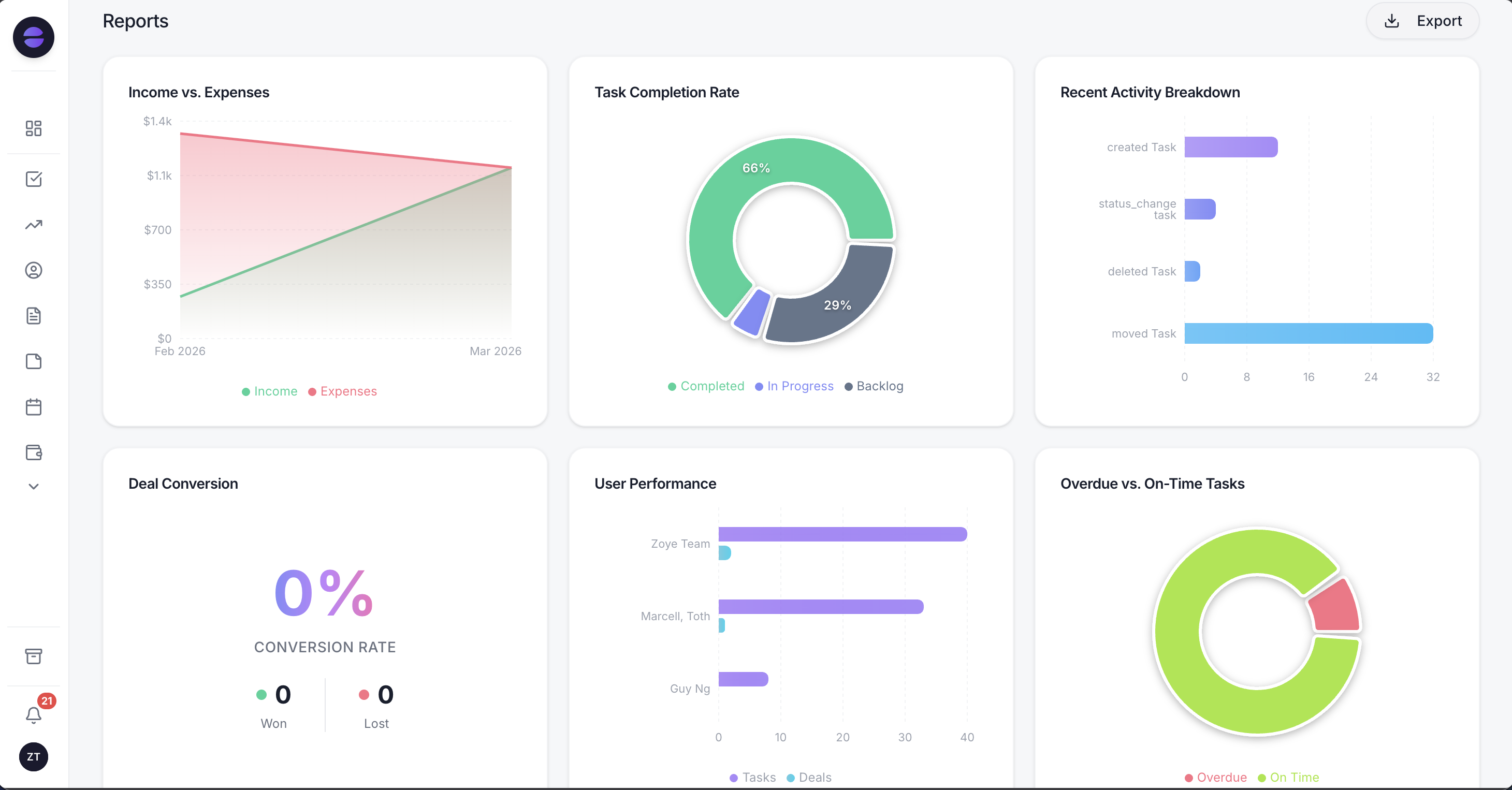 Zoye reports: which owner conversations are still open, how fast enquiries got answered, and which channel produced them, in one place instead of five spreadsheets
In practice that means four things. The homeowner pipeline is a real pipeline with stages, next actions and dates, so the three owners you met at a viewing are records with a follow-up rather than a memory, and the one who went quiet in week three gets chased. Enquiries land as leads with their source attached, whether they came from the website form, WhatsApp, Instagram or a referral from a cleaner, and the assistant answers and follows up on the ones nobody has replied to. The paperwork lives on the record: management agreements, owner documents, per-property notes, so nothing depends on which laptop it was saved to. And the back office is one system: cleaner and staff tasks assigned and chased, owner invoicing, per-property expenses, and reports you can ask for in a sentence.
The other difference is how you operate it. You can talk to Zoye, including over WhatsApp, which matters when you are standing in a property rather than sitting at a desk. Dictate "new owner from the marina viewing, two apartments, chase on Thursday" and the record is created with the reminder attached to it. Ask which owner conversations have had no contact for over a week, read the list back, then tell it to write to each one. Describe a routine in a single sentence, such as chasing any management agreement still unsigned after five days, and that becomes the behaviour, with no builder and no weekend spent configuring it.
Pricing is flat for the workspace instead of charged per seat, so bringing a cleaner, an assistant or a co-host into it leaves the invoice where it was, and the current plans live on the pricing page. Since a large share of rental enquiries arrive as chat messages, the fuller argument for running an operation that way sits in our guide to the best WhatsApp CRMs.
Ready to streamline your business?
Zoye brings AI-powered CRM, task management, and automation into one workspace.
Get StartedPick Hostaway if, pick Lodgify if
Pick Hostaway if:
- You manage properties for other owners and have staff who log in
- Your inventory is complex enough that channel settings matter to you
- Turnovers, cleaning and maintenance need to be assigned and tracked, not remembered
- Owners expect statements and performance reporting from you
- You are comfortable with a demo-gated quote and an onboarding project, and you will use the depth you pay for
Pick Lodgify if:
- Direct bookings are your growth plan and your site is your best asset
- You want to be live in days without an implementation
- Your inventory is straightforward across the main OTAs
- You would rather have one clear published price than negotiate a quote
- Your direct-booking volume is still low enough that a percentage fee is cheaper than the higher tier, and you will do that sum again next season
Pick neither, or rather pick one and add the business layer, if:
- What keeps slipping is the owner you never followed up with, not the calendar
- Enquiries arrive across four channels and get answered at three different speeds
- Agreements, owner documents and invoices live in email and a shared drive
- Cleaning rotas and owner numbers are in spreadsheets only you can open
- You want the follow-up to happen without anyone having to remember it
Frequently asked questions
Not in the abstract. Hostaway is the stronger platform for a management company running homes for other owners, because the channel depth, the automation and the task management are built for several staff and several channels at once. Lodgify is the better choice for a host or small operator whose growth plan is direct bookings, because its website builder and booking engine are the centre of the product rather than an extra module. Asking which is better is really asking which of those two shapes your business has.
Hostaway does not publish public pricing. You book a demo and receive a quote built around how many listings you run, and independent reviewers consistently report a one-time onboarding fee on top of the subscription, with the monthly figure scaling by listing count and a minimum for the smallest portfolios. Any number you find online is a third-party estimate rather than a published rate, so treat it as a rough range as of August 2026 and get your own quote before you budget.
On its entry tier, yes. Lodgify publishes its plans, and the cheapest one adds a percentage booking fee on reservations processed through the platform, while the higher tiers remove it. That single line is the most important thing in the comparison, because a percentage fee is invisible at low volume and becomes the largest part of your software bill once revenue grows. Check Lodgify's own pricing page for current figures.
Hostaway, in most cases. At twenty doors you have multiple channels to keep in sync, cleaners and staff to coordinate, and owners expecting statements and reporting, and that is the workload Hostaway is designed around. Lodgify can run twenty units, but you will feel the thinner reporting and the lighter operational tooling sooner than you will feel any limit in its website builder. The exception is a twenty-unit brand whose bookings come mostly from its own site.
It is good enough for most small operators and less deep at scale. Lodgify syncs the major OTAs reliably for straightforward inventory, which covers a host with a handful of properties. Hostaway supports more channels, handles complex multi-unit and room-type setups with more control, and gives you finer settings over how rates and availability are pushed. If your inventory is simple, that extra depth is capability you are unlikely to use.
No, and it is not built to. Zoye holds no availability calendar, sets no nightly rates, syncs nothing to Airbnb, Booking.com or Vrbo, ships no channel manager or booking engine, does not host the OTA guest inbox, and produces no trust-accounted owner statements. Whichever platform you pick keeps doing all of that. What Zoye handles is everything on either side of the reservation: winning and onboarding homeowners, catching and answering enquiries, holding the agreements and property paperwork, keeping the cleaning rota moving, and invoicing owners.
The bottom line
Hostaway and Lodgify are both good products, and the choice between them is a choice about which business you are in. If you sell management to homeowners and coordinate people, Hostaway is built around your day and worth the demo, the quote and the onboarding hours. If you sell stays and want more of them booked on your own site, Lodgify gives you the best website in the category and the fastest route to live, provided you keep an eye on what its entry-tier booking fee costs once volume arrives.
What neither one will do is grow your portfolio. The reservation system is downstream of the part that decides whether you have twelve doors next year or twenty: the owner conversations, the enquiries answered while the guest is still deciding, the agreement that got signed because somebody followed up. Both platforms are correct to leave that alone, and most operators fill the gap with spreadsheets, a shared inbox and their own memory.
That is the half Zoye runs, alongside whichever platform you choose: every enquiry captured with its source and chased, the homeowner pipeline with the follow-up happening on its own, the agreements and owner documents on the record, the staff tasks and owner invoices in one place, all of it operable from a WhatsApp message while you are standing in a property.
Try Zoye alongside your property management system and see what stops falling through.
For more context, see the vacation rental CRM for property managers, our Guesty vs Hostaway comparison, Lodgify vs OwnerRez, the best vacation rental software, the Hostaway alternatives worth knowing about, and the rest of the Zoye blog.