
The Best Vacation Rental Software in 2026: The Whole Stack, by Category
Most searches for the best vacation rental software are really a search for one tool that does everything. Calendars, channel sync, rates, the website, the cleaners, the guest messages, the owner statements, and the pipeline of homeowners you are trying to sign. That tool does not exist, and the demos are very good at implying it does.
What actually exists is a stack of about seven jobs, and the vendors overlap in confusing ways. A property management system usually includes a channel manager, sometimes includes a website builder, occasionally includes owner statements, and almost never handles the part of the business that happens off the booking. So operators buy the biggest platform they can afford, discover it covers roughly two thirds of the work, and then run the remaining third out of a shared drive and four spreadsheets that only one person can open.
This guide maps the category properly. Each section explains what a job is for, when you actually need it, and which tools are genuinely good at it. Hostaway, Guesty, Lodgify, OwnerRez, Smoobu, Hostfully and Beds24 compete for the property management slot and suit different sizes and regions. PriceLabs and Breezeway own adjacent jobs. Zoye covers the business layer and, to be clear from the start, is not a property management system and does not replace one. The audience here is a small operator, roughly 5 to 40 properties, usually managing homes for other people.
Vendor pricing models are described as published or as commonly reported by independent reviewers as of August 2026. Two of the largest platforms in this category do not publish simple public pricing at all. Confirm current figures on each vendor's own pricing page before you buy.
The mistake: shopping for one tool instead of a stack
Three symptoms show that a search has gone wrong before any software has been bought.
The feature checklist keeps growing. Every demo adds two capabilities to the list, so the shortlist drifts towards whichever platform has the longest brochure. Length is not the same as depth, and depth in an area you do not use costs you money and onboarding time.
Nobody has separated the guest side from the owner side. For a management company these are two different businesses. The guest side is high volume and low value per transaction, and software has solved it well. The owner side is low volume and very high value, it decides whether you grow, and almost nothing in this category touches it.
The unglamorous work is invisible during evaluation. Nobody demos the management agreement you cannot find, the cleaner rota that lives in one person's phone, or the owner invoice that goes out four days late. That work does not disappear when you buy a PMS. It just stays where it was, which for most operators is a spreadsheet. That gap is what a vacation rental CRM is for, and it sits next to the PMS rather than instead of it.
The fix is to buy by job. Below, each job gets its own section, and the last one is the job most operators do not know they are missing.
The vacation rental software stack at a glance
| Job | What it does | Leading options | Pricing model | Needed at 5 to 40 units? |
|---|---|---|---|---|
| Property management system | Calendars, reservations, rates, guest messaging on confirmed stays, reporting | Hostaway, Guesty, Lodgify, OwnerRez, Smoobu, Hostfully, Beds24 | Published plans, revenue share or quote-only, depending on vendor | Yes, this is the core |
| Channel manager | Two-way sync of availability and rates with Airbnb, Booking.com, Vrbo | Usually native inside the PMS; standalone specialists exist | Bundled with the PMS in most cases | Yes, but rarely as a separate purchase |
| Direct booking site | Your own commission-free booking channel | Lodgify, OwnerRez, Smoobu, Hostfully, plus the PMS booking engine | Included in the PMS or an add-on tier | Yes, once you have repeat guests |
| Dynamic pricing | Nightly rates that react to demand, events and lead time | PriceLabs, plus vendor-native pricing tools | Per listing per month, usually published | Yes, this is the fastest payback |
| Cleaning and turnover ops | Scheduling cleans, checklists, inspections, damage reporting | Breezeway, plus lighter task features inside the PMS | Per property, often quoted | Above roughly 10 properties |
| Guest communication | Automated messaging across the stay lifecycle, review requests | Hospitable, plus native PMS automation | Published per-listing plans | Yes, usually already in the PMS |
| The business layer | Owner pipeline, enquiry follow-up, agreements, staff tasks, owner invoicing | Zoye | Flat monthly plans for the whole team | Yes, and it is the piece most often missing |
Category 1: the property management system
The PMS is the operational core and the decision you should spend the most time on, because everything else plugs into it. It owns the calendar, the reservations, the rates, the guest messaging on confirmed stays, and the reporting. Switching later is genuinely painful, so buy for where you will be in two years rather than for this month.
Seven platforms dominate the conversation for small and mid-sized operators. They are all competent. They differ on who they were designed for, and that is the thing to match.
Hostaway
Hostaway is built for management companies that are scaling, and it shows in the automation and the integration marketplace. Channel management across the major OTAs is solid, the automated messaging and task rules are among the more flexible in the category, and there is a large ecosystem of connected tools for pricing, cleaning, insurance and guest verification.
The honest caveats are two. Hostaway does not publish simple public pricing: it is quote-only after a demo, priced on listing count, and independent reviewers commonly report a one-time onboarding fee on top of the subscription. Any figure you read on a comparison site is a third-party estimate, not a published rate. Second, the breadth comes partly from third-party integrations rather than native features, so a capability that looked included in the demo may be a separate subscription and a second bill.
Best for: growing management companies that want strong automation and a wide integration marketplace, and are comfortable with a quoted price.
Guesty
Guesty is the enterprise end of this list. It is built for larger portfolios, with native accounting features, multi-unit and multi-property handling, owner reporting, and a deep operations toolset. If you are heading past 100 units with several staff, it is on the shortlist for good reason.
Two things to weigh. Guesty also does not publish simple public pricing, and its model is commonly described as a combination of a percentage of booking revenue plus fixed components, which makes the annual cost hard to predict before you have a quote. And while Guesty includes CRM-style features, reviewers frequently describe that built-in CRM as clunky, which matters if you were hoping it would cover your homeowner pipeline. Support levels also vary by tier, which is worth clarifying in the quote.
Best for: larger portfolios and multi-market operators that need depth and native accounting, and can absorb a variable pricing model. There is a fuller treatment in our Guesty vs Hostaway comparison.
Lodgify
Lodgify comes at the category from the website side, and that remains its strongest card. The site builder produces a genuinely presentable direct booking site quickly, with a booking engine, payments and templates that do not require a developer. Setup is among the easiest here, which is why solo hosts and small brands like it.
The structural detail to understand before you sign up: Lodgify's entry plan carries a booking fee on reservations, and you move to a higher plan to remove it. That is not a hidden cost, but it changes the maths completely once your direct bookings grow, so model it against your actual booking volume rather than the headline monthly price. Beyond the website, the management depth is lighter than Hostaway, Guesty or OwnerRez, particularly for a company running homes on behalf of other owners.
Best for: hosts and small brands whose priority is a good direct booking website with a fast setup. See also our Hostaway vs Lodgify comparison.
OwnerRez
OwnerRez is the choice of operators who want control and are willing to learn a system to get it. It is unusually deep on the things management companies actually ask for: owner statements, accounting integration, configurable messaging and rule templates, quoting, damage protection, and hosted or WordPress-based direct booking sites.
Two honest limits. It is flat-priced and publishes its rates, scaling with property count, which many operators prefer to a revenue share, but the interface is functional rather than beautiful and the configurability comes with a learning curve. It is also distinctly US-centric: the tax handling, payment processing and integrations are strongest for North American operators, and European or Middle Eastern managers will find gaps.
Best for: US-based operators and management companies that want deep control, owner statements and predictable flat pricing. Compared head to head in Lodgify vs OwnerRez.
Smoobu
Smoobu is the pragmatic European pick. It publishes straightforward pricing, sets up in an afternoon, and covers the essentials properly: channel manager, unified calendar, a simple website builder, guest messaging, and a guest guide. For a host with two to ten units who wants the calendar problem solved without a project, it is hard to argue with.
The limit is scope rather than quality. As a portfolio grows into management on behalf of owners, the reporting, owner-facing statements and operational depth are thinner than Hostaway, Guesty or OwnerRez, and the automation is simpler. Many operators start on Smoobu happily and migrate when the owner side gets serious.
Best for: European hosts and small portfolios that want the essentials working quickly at a published price.
Hostfully
Hostfully is two products that share a brand. The property management platform covers the expected ground for small and mid-sized operators, and the digital guidebooks are the best known in the category, genuinely reducing the number of "where is the parking" messages you answer at 10pm.
The caveats are that the guidebooks are frequently the real reason people buy, and they are available separately, so be clear about which product you are paying for. On the PMS side, plan tiers scale with property count and some capabilities sit in higher tiers, so map the features you need against the tier before comparing prices with anyone else.
Best for: operators who want a solid mid-market PMS plus best-in-class guest guidebooks, or just the guidebooks alongside another PMS.
Beds24
Beds24 is the specialist's tool. It is extremely configurable, API-first, priced low relative to the category, and will connect to more channels and do more unusual things with rules and rates than most platforms twice its price. Operators with an odd setup, a mixed portfolio, or a developer on hand can build almost anything in it.
The trade-off is honest and well known: the interface is dated and the learning curve is steep. Nothing is guided, terminology is its own, and getting it right usually means reading documentation rather than following a wizard. If you want to be up and running comfortably in a day, this is not the pick. If you want power per pound and do not mind the work, it is excellent value.
Best for: technically confident operators who want maximum flexibility at low cost.
Want to see it in action?
Watch how Zoye automates your daily workflow - from lead management to team collaboration.
See How It WorksCategory 2: the channel manager, and why it is usually not a separate purchase
A channel manager keeps availability, rates and reservations in two-way sync with Airbnb, Booking.com, Vrbo and any other listing site you use. It is the thing that stops a double booking, and it is non-negotiable the moment you list the same property in two places.
Here is what buyer guides tend to bury: for almost every operator under 40 units, the channel manager is already inside the PMS you just chose. All seven platforms above include one. Buying a second, standalone distribution tool means paying twice for the same sync and creating a second system that can disagree with the first about whether next Tuesday is free.
Standalone distribution specialists do exist, and they are the right answer for a narrow set of cases: portfolios listing across many niche or regional channels the PMS does not connect to, operators with unusual rate structures across a large inventory, or businesses that want to keep distribution independent of the PMS on purpose. If none of those describe you, treat the channel manager as a PMS feature to evaluate rather than a line item to buy.
What to check during the PMS demo: which channels are supported natively in your market, whether the sync is genuinely two-way for rates as well as availability, how conflicts are surfaced, and how quickly a change propagates. Those four answers matter more than the number of logos on the integrations page.
Category 3: the direct booking site
Every booking through an OTA carries a commission. That is a fair price for reaching a guest you would never have found and a poor price for the same guest's third stay, which is the entire argument for owning a direct channel.
You have three realistic routes. The PMS booking engine, which every platform above provides in some form, letting you embed availability and checkout into a site you already have. The PMS website builder, where Lodgify leads on quality and speed, with Smoobu, Hostfully and OwnerRez all offering capable versions. Or a separate site, usually WordPress or a modern site builder, with the PMS booking engine embedded, which gives you full control of content and search performance at the cost of maintaining it.
For a small portfolio, the builder inside your PMS is usually the right first move. It gets a real page per property live in days rather than months, and the direct channel starts paying for itself with repeat guests. The upgrade path matters later: as content and search traffic become a growth channel, a standalone site gives you room that a template does not. If ranking that site is the next question, the structure, schema and page-level work are covered in our guide to vacation rental SEO.
One thing no website builder does: answer the enquiry the site produces. A form that sends an email to a shared inbox nobody owns is a leak, not a channel. Decide where those enquiries land before you launch, not after.
Category 4: dynamic pricing
This is the shortest section with the biggest payback. Static nightly rates leave money on the table in high demand and empty nights in low demand, and no amount of good photography fixes either.
PriceLabs is the category standard for small and mid-sized operators. It sets rates by listing, reacting to demand, seasonality, day of week, lead time and local events, with market dashboards that tell you what comparable properties are doing. Pricing is published, charged per listing per month, and it is one of the few tools in this stack that reliably pays for itself within a season. It integrates with every PMS on this list.
Some PMS platforms include native pricing tools, and those are worth testing before adding a subscription, particularly at a small property count. The honest comparison is on rule depth and market data: a native tool that adjusts by season and weekday is better than nothing, and a dedicated engine that reacts to a festival announcement three months out is a different product.
Two cautions. Set floor and ceiling prices deliberately, because an unattended algorithm will happily sell a peak-season week cheaply. And review the output monthly rather than annually, since a rule set that worked last summer may not match this one.
Category 5: cleaning and turnover operations
Below roughly ten properties, turnover coordination lives in a group chat and mostly works. Above that, it becomes the operational risk that generates your worst reviews, because a missed clean is a guest arriving to an unready property and there is no recovering that.
Breezeway is the specialist. It handles scheduling against the reservation calendar, structured checklists with photo verification, inspections, damage and maintenance reporting, and cleaner-facing mobile workflows. Pricing is per property and typically quoted rather than published in full. For operators with real cleaning teams and quality problems to solve, it is the tool that fixes them.
Most PMS platforms also include task automation that generates cleaning jobs from checkouts and assigns them. That is often enough at a smaller scale, and it is the right thing to try first. The signals that you have outgrown it: cleans get missed or double-booked, nobody can prove a property was ready, maintenance issues are reported by guests rather than staff, and you are the person coordinating every exception personally.
There is a third layer that neither category covers well, which is your staff as people rather than as jobs on a calendar: who is trained on which property, who is available next weekend, who has not been paid for last month's extra work. That belongs with the business layer below.
Category 6: guest communication
Guest messaging splits into two jobs that get confused. The first is messaging around a confirmed stay: booking confirmation, check-in instructions, mid-stay check, checkout reminder, review request. The second is answering a stranger who has not booked yet and is deciding between you and two similar properties.
Every PMS on this list automates the first job, and Hospitable is the best known specialist at it. Hospitable is strong on automation: message rules across the stay lifecycle, review handling, team access and an AI-assisted reply layer, with published per-listing pricing. Operators frequently run it alongside a PMS specifically because the messaging is more reliable and easier to configure than a native equivalent.
The second job is where the money is, and it is not a guest messaging problem at all. An enquiry arriving on Instagram at 11pm, a website form, a WhatsApp message, a phone call from a referral: none of those are reservations yet, so they do not exist in your PMS. They sit in five different inboxes, get a partial answer, and scroll out of sight. That is an enquiry pipeline problem, and it belongs in the next category.
A practical test for any guest communication setup: could you name every enquiry from last week that never got a reply? Most operators cannot, which is why the demand their marketing creates quietly converts somewhere else.
See what Zoye can do for you
From CRM and deal tracking to AI-powered task management - explore everything Zoye offers in one workspace.
Explore FeaturesCategory 7: the business layer, the part nobody buys
Here is the job that is missing from almost every stack. Your PMS runs the bookings. Something has to run the business around them, and for most operators that something is a folder of spreadsheets and their own memory.
Concretely, this layer holds four things. The homeowner pipeline, meaning every owner conversation as a stage with a next action and a date, because losing an owner you met at a viewing is almost never about the pitch, it is that nobody followed up in week three. Every enquiry with its source attached, guest or owner, from whichever channel it arrived in, with follow-up that happens whether or not anyone remembers. The documents, management agreements, owner onboarding paperwork and per-property files, in one findable place rather than across email, a shared drive and someone's laptop. And the back office, cleaner and staff tasks, per-property expenses, and owner invoicing that goes out on time.
Zoye is built for exactly this layer, and it is important to be precise about what that means. Zoye is not a property management system and will not replace one. It has no channel manager, no OTA sync with Airbnb, Booking.com or Vrbo, no availability calendar, no nightly rates, no booking engine, no OTA guest inbox, and no owner statements with trust accounting. Keep Hostaway, Guesty, Lodgify, OwnerRez, Smoobu, Hostfully or Beds24 for all of that. Zoye sits alongside it.
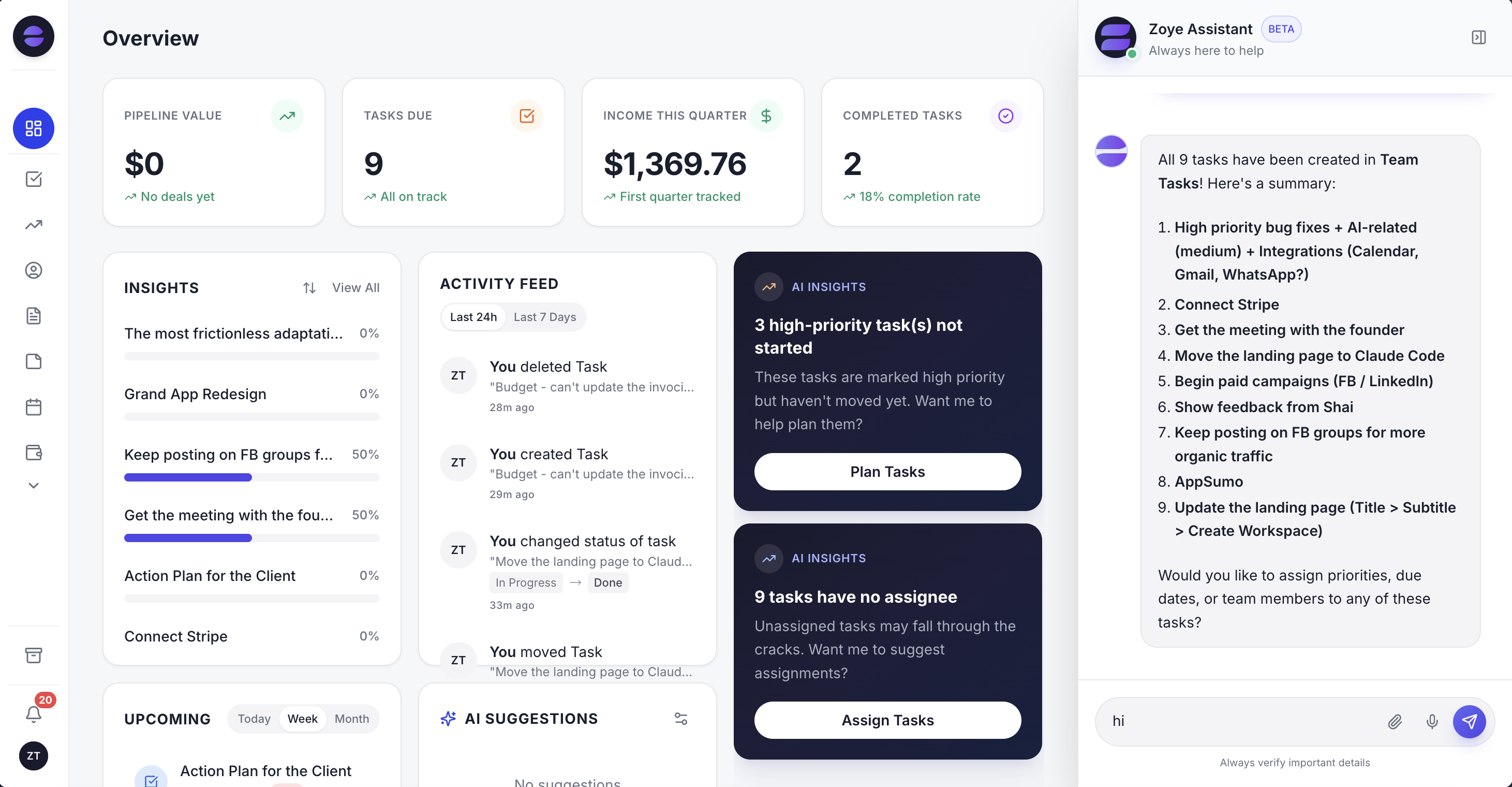 The Zoye dashboard: owner leads, enquiries, staff tasks and this month's numbers in one place, next to the PMS that runs the calendars
What it does instead is act rather than store. Zoye is an AI operator you instruct in plain language: say "add the owner I met at the marina viewing, two apartments, follow up Thursday" and the record exists with the reminder set. Ask which owner leads have gone quiet for more than ten days, get the list, then tell it to message them, and it does. An enquiry arrives from Instagram or WhatsApp and lands as a lead with the channel attached, and the follow-up runs at the interval you set instead of depending on you being at a desk. You can run all of it over WhatsApp, which matters when you are standing in a property rather than sitting in an office.
Underneath sits the rest of what the spreadsheets were doing. Management agreements and owner documents attached to the owner record. Cleaner and turnover tasks assigned, chased and visible on a board or a calendar. Owner invoices and per-property expenses. Reports you ask for in a sentence rather than rebuild each month. Pricing is flat for the whole workspace rather than per seat, so adding a cleaner or an assistant does not change the bill; current plans are on the pricing page. If most of your enquiries arrive as messages, the wider case for operating from chat is in our guide to the best WhatsApp CRMs.
Vacation rental software comparison
| Tool | Category | Pricing model | Strongest at | Watch out for |
|---|---|---|---|---|
| Hostaway | PMS | Quote-only after a demo, priced on listing count; reviewers commonly report a one-time onboarding fee | Automation depth and a large integration marketplace | No published pricing; breadth often comes via third-party integrations that bill separately |
| Guesty | PMS | Not published simply; commonly described as revenue share plus fixed components | Larger portfolios, native accounting, operational depth | Cost is hard to predict pre-quote; reviewers describe the built-in CRM as clunky |
| Lodgify | PMS plus website | Published plans; entry plan carries a booking fee, higher tiers remove it | The best fast route to a presentable direct booking site | The booking fee changes the maths as direct bookings grow; lighter management depth |
| OwnerRez | PMS | Published flat pricing, scaling with property count | Owner statements, accounting, configurable rules and control | Functional interface, real learning curve, US-centric |
| Smoobu | PMS | Published plans | Fast setup and the essentials done simply | Thinner reporting and owner-facing depth as you scale into management |
| Hostfully | PMS plus guidebooks | Published tiers by property count | Digital guest guidebooks, solid mid-market PMS | Two products; check which one you actually need and which tier holds your features |
| Beds24 | PMS | Published, low relative to the category | Flexibility, channel breadth, API-first configurability | Dated interface and a steep learning curve |
| PriceLabs | Dynamic pricing | Published, per listing per month | Rate automation and market data; fastest payback in the stack | Set floors and ceilings deliberately and review monthly |
| Breezeway | Cleaning and turnover ops | Per property, typically quoted | Cleaning scheduling, checklists, inspections, quality proof | Overkill below roughly ten properties |
| Hospitable | Guest communication | Published, per listing | Automation of stay-lifecycle messaging and reviews | Handles confirmed stays, not pre-booking enquiries |
| Zoye | Business layer | Flat monthly plans for the whole workspace | Owner pipeline, enquiry follow-up, agreements, staff tasks, owner invoicing | Not a PMS: no channel manager, OTA sync, calendar, rates, booking engine or trust accounting |
Who should pick which
A host self-managing two to five units. Smoobu or Lodgify, depending on whether you care more about a fast calendar fix or a good website. Add PriceLabs once you have a season of data. Skip Breezeway. Your business layer can genuinely be a notes app at this size, and the moment it cannot is the moment you take on a property for someone else.
A co-host or small manager with 5 to 15 properties for other owners. Lodgify or Smoobu still work operationally, and OwnerRez becomes compelling if you are in the US and want owner statements. This is where the business layer starts to matter more than any PMS feature, because you now have owners to keep informed, agreements to find and new owners to sign. A PMS plus Zoye is the common shape.
A management company with 15 to 40 properties. Hostaway or OwnerRez, with PriceLabs and Breezeway once cleaning quality becomes a real risk. Guesty is worth a quote if you are heading past 50 units quickly or need native accounting. Whichever you pick, the owner-acquisition pipeline and the back office will not be covered, so plan for that as a deliberate purchase rather than a spreadsheet.
A US operator who wants control and predictable costs. OwnerRez, comfortably. Flat published pricing, deep configurability, real owner statements. Accept the interface and budget a week to learn it properly.
A European or Middle Eastern operator. Smoobu or Hostaway are the more natural fits, and check payment processing, tax handling and local channel coverage carefully during the demo, since this is where US-first products quietly fall down.
An operator with an unusual setup. Beds24, if you have the patience or a technical person. Nothing else in the category will bend as far for the money.
Anyone whose real problem is growth rather than operations. If your calendars work and your bookings are fine but you are not signing new owners, more PMS is not the answer. The pipeline is, and that is a different purchase.
Ready to streamline your business?
Zoye brings AI-powered CRM, task management, and automation into one workspace.
Get StartedHow to buy in the right order
Buying the stack in the wrong sequence is expensive, because each layer assumes the one below it works.
First, the PMS. It is the hardest to switch and everything integrates with it. Demo three, and take the demo seriously: bring your own properties, your own channels and your own two most awkward scenarios. Ask directly about total first-year cost including any onboarding fee, and about which of the features you saw are native versus a partner integration with its own bill.
Second, dynamic pricing. It has the fastest payback of anything here and needs almost no operational change. Start with conservative floors and ceilings.
Third, capture and follow-up. Before adding any more marketing or any more properties, make sure every enquiry from every channel lands in one place with its source attached and gets chased without anyone remembering to. This is the cheapest improvement in the whole stack and the one most consistently skipped, because a lost enquiry never appears in a report.
Fourth, cleaning operations, when the pain is real. Missed cleans, unprovable readiness, guests reporting maintenance. Until then, PMS task automation is fine.
Fifth, the rest of the back office. Agreements in one place, owner invoicing on a schedule, staff tasks visible. This tends to get bought after a bad month, and it is better bought before.
A useful budgeting habit at each step: write down the annual cost of the tool plus the hours per week it will take to run. The second number is the one that gets forgotten, and it is why platforms with the longest feature lists sometimes cost the most.
Frequently asked questions
There is no single best tool, because the category is really seven jobs: a property management system, a channel manager, a direct booking site, dynamic pricing, cleaning and turnover operations, guest communication, and the business layer that holds owners, contracts, staff tasks and invoicing. For most small management companies the practical answer is one strong PMS with a native channel manager, a dynamic pricing tool, and something that runs the business around the bookings. Hostaway, Guesty, Lodgify, OwnerRez, Smoobu, Hostfully and Beds24 all compete for the PMS slot and suit different sizes and regions.
For almost every operator under 40 units, one is enough, because modern property management systems include the channel manager. A separate distribution specialist only makes sense if you list on many niche channels your PMS does not connect to, or if you run a large portfolio with unusual distribution needs. Buying both without that reason means paying twice for the same calendar sync and creating a second place where an availability conflict can start.
It depends on the model, and the models are genuinely different. Some vendors publish plan pricing that scales with property count, some charge a percentage of booking revenue, some charge a monthly minimum per listing, and the two largest platforms in the category, Hostaway and Guesty, do not publish simple public pricing at all and quote after a demo. Budget for the stack rather than one line item: the PMS, dynamic pricing, cleaning operations and the business layer, plus any one-time onboarding fee. As of August 2026, always confirm current figures on each vendor's own pricing page.
A management company running homes for other owners has two needs a self-managing host does not: owner-facing reporting and a real pipeline for signing new owners. OwnerRez is strong on the first if you are US-based and want deep control, Hostaway and Guesty are built for scaling managers, and Smoobu or Lodgify suit smaller European portfolios. None of them run the owner-acquisition side well, which is why many managers pair a PMS with a business layer such as Zoye.
No, and the vendors that imply otherwise are the reason so many operators end up disappointed. A PMS is excellent at calendars, rates, channel sync and confirmed-stay messaging, and weak at the things that happen off the booking: chasing the homeowner you met at a viewing, keeping management agreements findable, assigning turnover work, and invoicing owners. Expect two or three tools that each do one job properly rather than one tool that does seven badly.
No. Zoye has no channel manager, no OTA sync with Airbnb, Booking.com or Vrbo, no availability calendar, no nightly rates, no booking engine, no OTA guest inbox and no owner statements with trust accounting. Keep your PMS for all of that. Zoye sits alongside it and runs the business around the bookings: the homeowner pipeline, enquiry capture and follow-up, management agreements and owner documents, cleaner and staff tasks, and owner invoicing.
The bottom line
The best vacation rental software is a stack of two or three tools that each do one job properly, not one platform that claims all seven. Pick the PMS carefully because it is the hardest to leave, add dynamic pricing early because it pays for itself, add cleaning operations when quality starts costing you reviews, and use the website builder you already have until content becomes a growth channel.
Then close the gap the category leaves open. The homeowner you met at a viewing, the enquiry that arrived at 11pm, the agreement nobody can find, the cleaner rota in one person's phone, the owner invoice that went out late: none of that is a PMS problem, and none of it goes away by buying a bigger PMS. Zoye covers that half, alongside whichever platform runs your calendars, and it does the chasing rather than just holding the record.
For more context, see the vacation rental CRM for property managers, our Guesty vs Hostaway comparison, the Hostaway vs Lodgify comparison, our guide to vacation rental marketing, the best business management software, and the rest of the Zoye blog.