
Vacation Rental Marketing in 2026: A Channel-by-Channel Playbook
Most vacation rental marketing advice is a list of channels. Post more short video, build a direct booking site, run some ads, collect reviews. None of it is wrong, and none of it is why small operators stay stuck. The real reason is quieter: the marketing usually works, and then the demand it creates leaks away before it ever becomes a stay.
You can watch it happen in one week. A video does unusually well and three people send a direct message asking about dates; two get answered the next morning. A referral arrives from a cleaner, gets a promise of a quick reply, and is never written down. A website form fires an email into a shared inbox nobody owns. By Friday the calendar looks the same as it did on Monday, and the conclusion drawn is "social does not work for us", when what did not work was the ten minutes after each enquiry arrived.
This is a channel-by-channel playbook for a small portfolio, roughly 5 to 40 properties, whether you manage homes for other owners, co-host, run a villa or cabin brand, or self-manage a few units. It covers what each channel realistically returns, how to tell which one is paying, and the part almost nobody builds: the system that catches the enquiry. Get that second half right and every channel above it earns more at the same spend.
Platform fees and commissions reflect published terms as of August 2026; check each platform's own pages for current figures.
Why vacation rental marketing quietly fails for small operators
Four patterns show up repeatedly in short term rental marketing, and none of them are about creative quality.
Demand generation is separated from demand capture. The person filming the video, the person answering messages and the spreadsheet tracking bookings are the same person doing three unrelated jobs. Marketing is treated as an output activity, so the input side, the enquiries, has no process at all.
Response speed decides the booking more often than the property does. A guest comparing three similar homes on a Tuesday evening books whichever one answers while they are still deciding. Speed is effectively the product in this category, yet almost all effort goes into how the listing looks and almost none into how fast a message gets a real reply.
Every channel is judged by the wrong number. Views, followers and sessions are the metrics platforms hand you for free, and none of them are bookings. Without a way to tie an enquiry back to where it came from, budget moves based on which channel felt busiest.
Nobody markets to homeowners. For a management company the highest-value marketing is not guest-facing. Signing one more owner with two units adds more annual revenue than a very good month of guest advertising, and the pipeline for that work is usually a memory rather than a system.
Before the channels: decide what you are actually selling
Two audiences, two funnels, and confusing them is the most common strategic mistake here.
The guest funnel sells stays: high volume, low value per transaction, driven by imagery, location, reviews and availability. Social, OTAs, search and paid ads live here. The owner funnel sells management: low volume, very high value, driven by trust, local reputation and demonstrated performance. Referrals, local presence and brokers live here.
Most operators run guest marketing enthusiastically and owner marketing accidentally. If your growth plan involves more doors rather than higher occupancy on the doors you have, invert that. The owner side is also where a real pipeline matters most, because an owner decision takes months and several conversations that are easy to drop. That is the gap a vacation rental CRM is meant to cover, sitting next to the property management system that already runs your calendars.
One more piece of work before you touch a channel: write down in one sentence who each property is for. "Two-bedroom apartment near the marina" is inventory. "Where couples stay for a long weekend and walk everywhere without a car" is marketing. Every channel below gets easier once that sentence exists, because you stop making content about the property and start making content about the trip.
Instagram and short video: where discovery happens now
Vacation rental social media marketing has largely collapsed into one thing: short vertical video distributed to people who do not follow you. That is a gift for a small operator, because reach is no longer gated by audience size.
What performs for rentals: the reveal, walking through the door and showing the view in the first two seconds; the location rather than the listing, the bakery two streets away or the swimming spot locals use, which reaches people who have not chosen a property yet; practical answers like where to park in the old town or which beach is calm enough for toddlers, because saves and shares keep a video circulating; and honest quirks, the steep stairs and the resident cat, which build more trust than another wide-angle shot of a made bed and filter out the guests who would have complained.
For airbnb instagram marketing specifically, treat the platform as the top of the funnel and nothing else. Put one link in the bio that leads somewhere a person can actually enquire, not a list of eleven options. Pin three posts that answer the three questions everyone asks. And accept that the channel will send you direct messages at inconvenient hours, which means it is only worth running if those messages get answered fast.
A realistic cadence for a small team is two or three videos a week, batched. Film five in one afternoon on a turnover day and publish them across two weeks. Consistency beats production value here by a wide margin.
Your direct booking site: the only channel you own
Everything else on this list is rented attention. The site is the one asset that keeps working when a platform changes its rules, and the only place where a booking carries no commission.
In order of impact: speed, because a page that takes four seconds to show a photo loses people who were ready to enquire; one real page per property, with its own address and a description written for the trip rather than the floor plan, not a gallery grid in a modal; destination pages about the area, the seasons and getting there, which earn search traffic from people who have not chosen a property yet and feed every property page beneath them; reviews on the page, because a stranger's sentence does more work than any paragraph about yourself; and an enquiry path that is obvious on a phone, since most of this traffic is mobile and half of it wants to send a message rather than complete a checkout.
The strategic point of the site is not that it replaces the OTAs. It is that it changes your economics on repeat guests: someone who found you on a platform once and books directly the second time is the highest-margin booking in the business. For the technical side of ranking that site, the structure, schema and page-level detail, there is a fuller treatment in our guide to vacation rental SEO.
Want to see it in action?
Watch how Zoye automates your daily workflow - from lead management to team collaboration.
See How It WorksGoogle Business Profile and local search
This is the most underused free channel in the category and it takes an afternoon. Claim the profile, fill in the categories properly, add genuine photographs rather than renders, write a description that matches the sentence you wrote earlier, and keep hours and contact details true. Then ask for reviews, from guests and from owners, and reply to all of them.
Why it pays: someone searching "villa rental" plus a place name gets a map result before they get a list of OTAs. That is a high-intent moment where a small local operator can outrank a global platform, because relevance and proximity beat domain authority in local results.
Two habits make the difference. Post occasionally, seasonal availability, a new property, a local event, so the listing looks alive. And use the messaging feature only if you will actually answer it, because an unanswered enquiry channel is worse than one that does not exist.
Past guest email: the cheapest revenue in the business
Every operator has a list and almost nobody uses it. Those guests already stayed, already liked it enough not to complain, and already know exactly what they are buying. Reaching them costs one email.
Send three or four times a year at most. The seasonal nudge, six to eight weeks before the season they came last time, with the dates that are actually open. The local reason, a festival or a good time of year for something specific, with the reason to travel first and availability second. The quiet-period offer, not a discount race but a midweek stay with a late checkout, offered to them before it goes public. And the referral ask, one line, once a year.
Two rules: send from a person rather than a brand alias, and keep the list clean and permissioned. Rental guests unsubscribe fast from anything that reads like a newsletter and respond well to a note from whoever handed them the keys.
Referrals: cleaners, local businesses and past guests
Referral is the highest-converting channel on both funnels, and the one that most rewards being organised rather than clever.
Past guests refer when you ask at the right moment, which is the day after checkout while they are still telling people about the trip, not in a February campaign. Cleaners, handymen and gardeners are the most underrated lead source in property management: they are inside other people's properties every week and they hear which owners are unhappy with their current manager, so a standing, transparent arrangement produces a steady trickle of qualified owner leads. Local businesses work as an exchange rather than a commission: recommend the restaurant, the bike hire and the boat trip properly in your welcome material and ask them to keep your card. Real estate agents and brokers matter for the owner funnel, because they meet people who have just bought a second property and have no idea what to do with it in the off season.
Referral programmes fail from lack of tracking, not lack of goodwill. If nobody records who referred whom, thank-yous do not get sent, arrangements do not get honoured, and the source dries up within two seasons.
Paid social: when it works and when it burns cash
Paid social is the channel most likely to lose a small operator money and also the fastest way to fill a specific gap. The difference is what you point it at.
It works for retargeting people who visited a property page and did not enquire, which is small-budget, high-intent and the most reliable paid spend here; for a specific dated gap aimed at a drive-time radius, because "three nights in October, ninety minutes from the city" is an offer while "book our villa" is not; and for lookalike audiences built from a guest list, once that list is big enough to mean anything.
It burns money on broad awareness campaigns for a single property, on boosting a post because it did well organically, and on any campaign pointed at a slow page or an unmonitored inbox. Paid traffic amplifies your follow-up, so if the follow-up is somebody checking messages twice a day, you are paying for enquiries you will lose. Start small enough to trace individual bookings, cap it, and judge it on bookings rather than cost per click.
See what Zoye can do for you
From CRM and deal tracking to AI-powered task management - explore everything Zoye offers in one workspace.
Explore FeaturesThe OTA listing is a marketing surface, not just a channel
Treating Airbnb, Booking.com and Vrbo purely as distribution misses something: those listings are the most-visited marketing pages you have, and they rank in ordinary search.
Work them like pages. The first photo is the whole campaign, because it decides your click-through rate in a grid of competitors, so test it seasonally. The title carries search intent: location plus the trip plus one differentiator, not a poetic name nobody searches for. Answer objections in the description, the stairs, the parking, the noise, the distance to the beach, because every objection you resolve is a message you do not have to answer and a bad review you do not receive. And reviews are the ranking mechanic, so ask every guest, reply to every review including the awkward ones, and fix the thing two people mentioned.
Commission is the trade-off you accept for that reach. Airbnb's host-only service fee and Booking.com's standard commission both sit in the mid-teens, with variation by region and programme (check each platform's published terms, because they move). That is a fair price for discovering a guest you would never have reached, and an unreasonable price for the same guest's third stay, which is the whole argument for building the direct channel alongside.
Property management marketing ideas: the homeowner side of the funnel
If you manage properties for other people, this is where your growth actually lives. Guest marketing improves occupancy on the doors you have; owner marketing adds doors.
Roughly in order of return: your existing owners, because a happy owner with one property often knows two others with one property, and that introduction outweighs any pitch, so ask deliberately once you have a month of numbers worth showing. Local presence over paid reach, since owner decisions are trust decisions and being the person who runs the local host meetup or gets quoted in the regional paper beats an advert. Direct outreach to self-managing owners, because some listings visibly belong to someone who is drowning, with unanswered reviews and no professional photos, and that is a warm conversation if you open with something useful rather than a fee schedule. Proof, packaged, meaning one page showing what you did for a comparable property over twelve months, occupancy, average nightly rate, review score, with names off it. And brokers, agents and long-term rental managers, who are already talking to your future clients about a problem you solve.
The part that separates managers who grow from managers who do not is unglamorous: every owner conversation is a pipeline stage with a next action and a date. Losing an owner you met at a viewing is almost never about the pitch. It is that nobody followed up in week three.
Which channel actually pays: attribution without an analytics team
You do not need a data stack. You need one habit: every enquiry gets a source attached at the moment it arrives. That gives you the only four numbers that matter per channel: enquiries it produced this month, bookings those enquiries became, revenue from those bookings, and cost in money or hours to run it.
Divide and you get cost per booking, the only fair way to compare a short video against a Google Business Profile against a paid campaign. Track it for one season and the surprises are consistent: guest email and referral look far better than they felt, paid social looks worse, and the direct site looks like a slow investment that suddenly matters in year two.
Two cautions. Use a distinct enquiry path per channel where you can, a different form, a specific number, a tracked link, so attribution does not depend on asking. And record the source even when the enquiry arrives as a phone call, because the channels that produce phone calls are usually producing your best guests and owners.
Ready to streamline your business?
Zoye brings AI-powered CRM, task management, and automation into one workspace.
Get StartedThe leak: what happens in the ten minutes after an enquiry arrives
This is the section that changes results, and it is not a marketing tactic.
Marketing produces enquiries in four or five places at once: Instagram direct messages, WhatsApp, the website form, a phone call, an OTA thread. Meanwhile you are on site, driving between properties, or handling a plumbing problem. So the enquiry waits. Then it gets a partial answer. Then the thread with the dates in it scrolls out of sight, and by the time anyone notices, the guest has booked elsewhere and the owner has signed with the manager down the road.
Nothing on your marketing plan fixes that. Three decisions do. One destination, where every enquiry from every channel becomes a record with its source attached, instead of five inboxes and a notebook. A response rule you do not have to remember, meaning a first reply within minutes even if it only buys you time, then a nudge at 48 hours, another the following week, then a decision to close it out. And chasing that happens without you, because the follow-up nobody sends is the largest hidden cost in a rental business and it is invisible: a lost enquiry never appears in a report.
Fix those three and every channel above becomes more profitable at the same spend, which is a better return than any new content idea.
Vacation rental marketing software: what belongs in the stack
The category is noisy, so here is an honest map. You need four things and they do different jobs.
A property management system for calendars, channel sync with the OTAs, rates and guest messaging on confirmed stays. Guesty, Hostaway, Lodgify, OwnerRez and Smoobu live here. This is the operational core and you should keep it. A fast website with real pages per property, plus whatever booking engine your PMS provides. A habit for batching and scheduling social content, so the two or three videos a week actually go out. And a business layer that holds the relationships and does the chasing: the owner pipeline, every enquiry with its source, the contracts, the staff tasks and the owner invoicing. That fourth piece is the one almost nobody buys, and it decides whether the other three pay off.
Zoye is that fourth layer. It is not a PMS and does not try to be: no channel manager, no OTA sync with Airbnb, Booking.com or Vrbo, no availability calendar or nightly rates, no booking engine, no guest inbox inside the OTA, no owner statements with trust accounting. Keep your property management system for all of that. Zoye runs the business around the bookings.
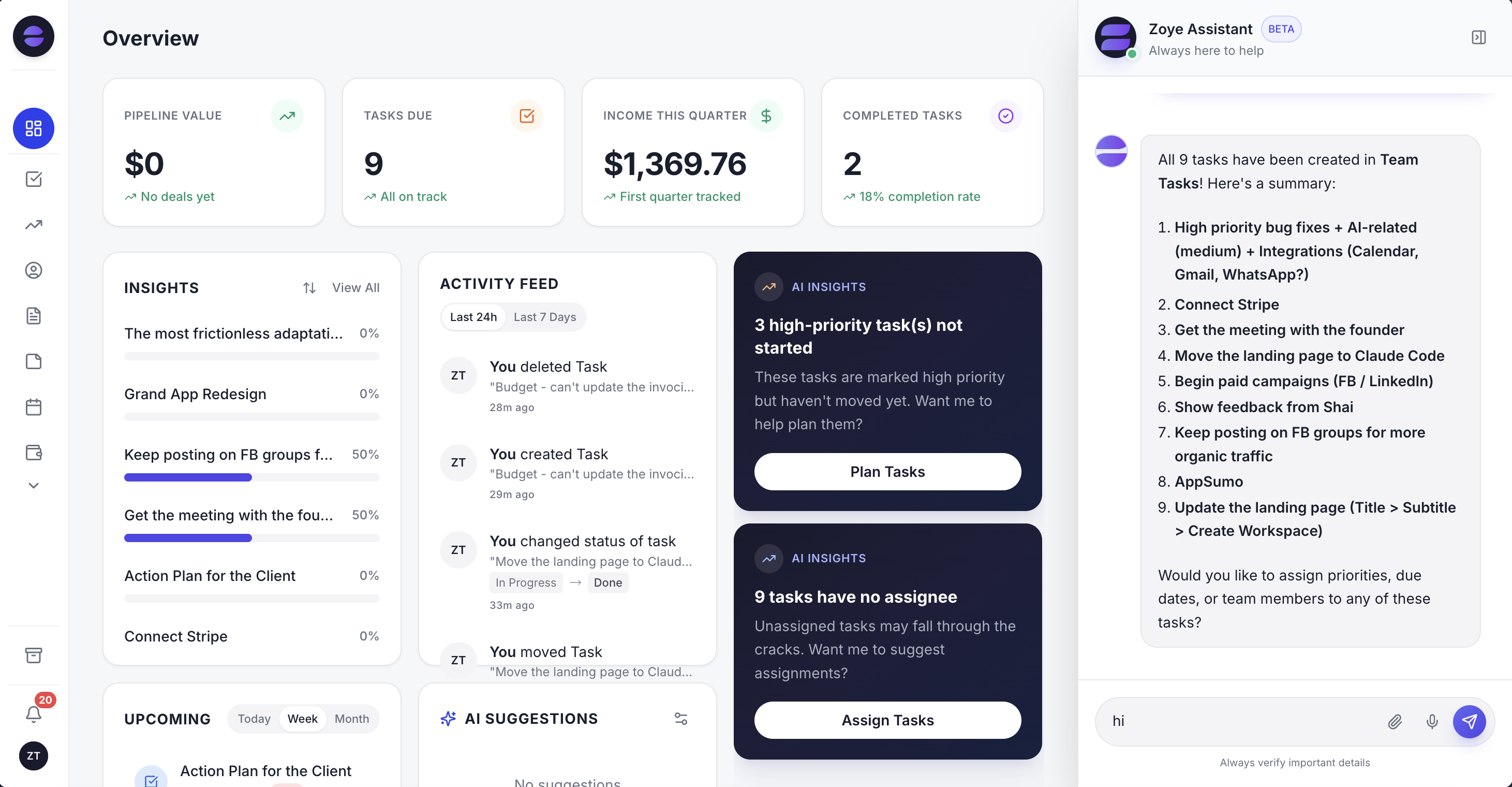 The Zoye dashboard: enquiries, owner leads, tasks and this month's numbers in one place, so the marketing you run actually turns into stays
For a marketing operation that means three things. Every enquiry lands as a lead with its channel attached, whether it came from Instagram, WhatsApp, the website form or a referral, so the attribution table above builds itself instead of being reconstructed from memory. Follow-up happens without anyone remembering it: the assistant chases the guest who never replied and the owner who went quiet, at the interval you set, and reports exactly what it did. And you operate the whole thing by talking to it, including on WhatsApp, which matters when you are standing in a property rather than sitting at a desk. Say "add the owner I met at the marina viewing, two apartments, follow up Thursday" and the record exists with the reminder set. Ask which owner leads have been quiet for more than ten days, get the list, then tell it to message them.
Underneath sits the rest of the back office the spreadsheets were doing: management agreements and owner documents on the owner record, cleaner and turnover tasks assigned and chased, owner invoices and per-property expenses, and reports you can ask for in a sentence. Pricing is flat for the whole team rather than per seat, so adding a cleaner or an assistant to the workspace does not change the bill; current plans are on the pricing page. If most of your enquiries arrive as messages, the wider case for running a business from chat is in our guide to the best WhatsApp CRMs.
A 90 day vacation rental marketing plan
If this is more than you can start at once, do it in this order. Each block assumes a few hours a week, not a marketing hire.
Days 1 to 30, fix capture before you add demand. Pick one destination for every enquiry and route Instagram, WhatsApp, the website form and phone calls into it, each tagged with its source. Set the response rule. Claim and complete the Google Business Profile. Export and clean the past guest list. None of this creates demand, and it will raise your conversion more than anything in month two.
Days 31 to 60, turn on the cheap channels. Send the first past-guest email, aimed at the season they last stayed. Ask last month's guests for reviews and, once, for referrals. Have the conversation with your cleaners about owner leads. Rewrite the first photo and title on every OTA listing. Start the video habit: film five, publish across two weeks.
Days 61 to 90, build the asset and measure. Get one honest page live per property plus one real destination page. Test a small retargeting budget against a specific dated gap. Then sit down with the four numbers per channel and cut whichever one cost the most hours for the fewest stays. On the owner side, put every owner conversation from the quarter into a pipeline with a stage and a next action, and follow up the three that went quiet.
By day 90 you will not have a bigger marketing operation. You will have a smaller one that leaks less, which is the version that grows a portfolio.
Frequently asked questions
There is no single best channel, but for a small portfolio the highest-return order is usually past guests first, then referrals, then your own direct booking site, then local search, then social video, then paid ads. That order is about cost per booking, not glamour: a past guest who already loved the property costs an email to reach, while a paid click costs money every single time. Most operators do it backwards, starting with the channel that takes the most effort and delivers the fewest bookings.
Build a direct channel that you own and feed it deliberately: a fast property site with one honest page per property, a claimed and active Google Business Profile, a guest list you email a few times a year, and a referral habit with cleaners, local businesses and past guests. Keep the OTA listings live while you do it; they are useful for discovery. The goal is not to leave the platforms but to stop depending on them, and that only happens when every enquiry from your own channels gets captured and answered.
It brings enquiries rather than bookings, and that distinction is where most operators lose money. Short video and photography build desire and get you saved and shared, then the interested guest sends a direct message. If that message sits unanswered for hours, the demand you created quietly converts somewhere else. Instagram works when the follow-up behind it is reliable, and it wastes your time when it is not.
Less than the market suggests. You need a property management system for calendars, channel sync and rates, a website that loads fast, a simple habit for batching social posts, and something that catches and follows up every enquiry with its source attached. That last piece is the one most small operators are missing, which is why they can tell you how many followers they have but not which channel produced last month's bookings.
Start with time rather than money. The channels that pay best for a 5 to 40 property portfolio are mostly effort, not budget: guest email, referrals, your own site, local search. Paid social is worth testing only once those are running, because paid traffic amplifies whatever your follow-up already does, including doing nothing. If you do set a budget, keep it small and honest enough that you can trace individual bookings back to it.
Give every enquiry one destination and one owner. Route Instagram messages, website forms, WhatsApp chats and referral calls into a single place where each one becomes a record with its source, and set a follow-up rule you do not have to remember. Zoye does exactly this: enquiries land as leads with the channel attached, and the assistant chases the ones that go quiet, on WhatsApp, so the demand you paid to create actually turns into stays.
The bottom line
Vacation rental marketing is not a content problem for most small operators. The channels above are well understood and the effort is a few hours a week rather than a department. What is missing is the boring half: one destination for every enquiry, a source attached to each one, and a follow-up that happens whether or not anyone remembers.
Fix that first and the rest of the playbook compounds. The video is worth more because the direct message gets answered. The referral is worth more because it gets written down and thanked. The owner you met at a viewing becomes a signed management agreement because somebody, or something, followed up in week three. Zoye exists for that half of the business: it sits alongside your property management system, captures every enquiry with its channel, chases what goes quiet, and keeps the owner pipeline, contracts, staff tasks and invoices in one place you can operate from a WhatsApp message.
For more context, see the vacation rental CRM for property managers, our guide to vacation rental SEO and direct bookings, the best WhatsApp CRMs, the best business management software, and the rest of the Zoye blog.