
The 7 Best Business Management Software Platforms in 2026
Most growing businesses do not run on one system. They run on nine to twelve disconnected apps: a task tool, a separate CRM, a calendar that does not talk to either, a spreadsheet for the budget, a notes app, a chat tool, and a reporting dashboard stitched together by hand. Each app is fine on its own. The cost shows up in the gaps between them, where information goes stale, follow-ups slip, and the owner becomes the human integration layer copying data from one tab to the next.
Business management software is meant to close those gaps by putting the core functions a company runs on into one place. The trouble is that most "business management" suites do this in one of two unsatisfying ways. Some bundle a long list of shallow modules that each do less than the dedicated tool you already use. Others are genuinely deep but demand weeks of setup and an administrator to keep them running. Neither serves the founder or small team that just wants the business to run without becoming a part-time systems integrator.
This guide compares the seven best business management software platforms in 2026, ranked for small businesses, founders, and growing teams. The criteria are practical: does it cover the real operational stack (tasks, CRM, calendar, budget, reports) without four extra subscriptions, does it work without a heavy setup project, is the AI a worker or a sidebar, and is the pricing fair as the team grows.
Pricing reflects published rates as of June 2026; check each vendor's pricing page for current figures.
Why all-in-one business management software matters in 2026
Four trends explain why teams are consolidating onto a single platform.
The app sprawl tax is real. The average small team now pays for several overlapping subscriptions, and the hidden cost is not the money but the friction. Every disconnected app is a place where a customer detail, a deadline, or a payment falls between the cracks. Consolidating onto one workspace removes the seams where work goes missing.
Setup-heavy platforms quietly fail. Plenty of capable suites get bought, half-configured, and abandoned because nobody had the time to wire them up. In 2026 the platforms that win are the ones that are useful on day one, not the ones with the longest feature checklist. Time-to-value matters more than module count.
AI has moved from suggesting to doing. A year ago, the AI in business tools mostly summarised and suggested. The bar has risen. Teams now expect an assistant that takes action: creates tasks from an email, prioritises by deadline and workload, drafts the follow-up, schedules the deep-work block, and generates the report on demand. AI that only nudges from a sidebar no longer counts as a real advantage.
Flat-rate pricing rewards growth, per-seat punishes it. Most legacy suites charge per user, so the bill jumps every time the team grows. A flat-rate model means a five-person team and a twenty-person team can run on the same predictable plan, which is exactly what a scaling business needs.
The 7 best business management software platforms in 2026
1. Zoye
Zoye is the strongest business management platform for founders and small teams that want their whole operation in one AI-native workspace, rather than a stack of apps or a suite they have to assemble and administer themselves.
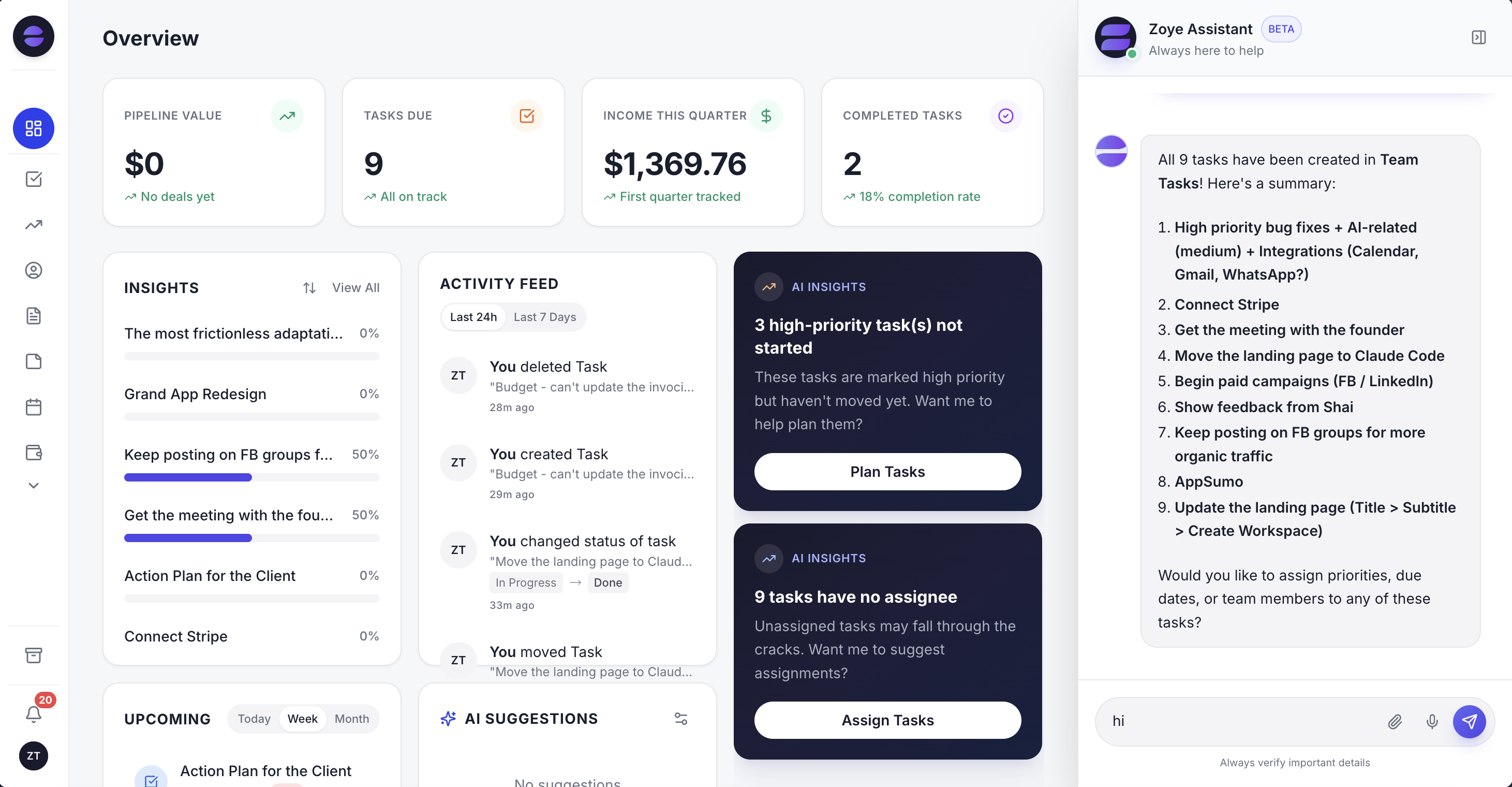 Zoye runs tasks, CRM, calendar, budget, and reports from one AI-native workspace.
The platform covers the real operational stack in a single place. Tasks ship with list, board (Kanban), calendar, and timeline views, priority labels, and workload management, with no template wiring needed to get started. The native CRM tracks contacts, companies, and deals, so customer relationships live next to the work rather than in a separate tool. The calendar is the workspace calendar, so tasks and deal activities appear on it automatically without a Google or Outlook sync to maintain. Budget tracking and reporting pull from the same data, turning the workspace into a real operational picture instead of a collection of disconnected dashboards.
What sets Zoye apart is the assistant. The Zoye Assistant is not a chat box bolted onto the side. It lives inside the workspace and takes action across all of it: it creates tasks from incoming emails, prioritises based on deadlines and workload, drafts follow-up messages to customers and collaborators, schedules deep-work blocks on the calendar, surfaces overdue commitments before they slip, and generates reports and summaries on demand. You can reach it by text or voice, in the app, on WhatsApp, or in Slack. A founder can ask for the weekly pipeline summary on WhatsApp and have it back in seconds, or tell the assistant to log a payment and book a follow-up, and watch it happen across the workspace in real time. Where most "business management" AI suggests, Zoye does the work.
A collaborative notes module is rolling out across all plans, bringing shared docs and knowledge into the same workspace as tasks, deals, and calendar. To be clear about scope, Zoye is the operating workspace a business runs on day to day, not an ERP: it does not yet replace dedicated accounting, payroll, or HRIS systems, and it pairs naturally alongside them.
The pricing model is flat-rate and genuinely affordable. A solo founder can start on the entry plan for the price of a cup of coffee, and growing teams scale on simple flat tiers rather than per-seat bills that climb with every hire.
Pricing: Almost Free entry plan at just $5 per month ($4 billed annually) for 1 member with the full platform including AI. Starter from $29 per month (10 members). Growth from $59 per month (20 members). Cancel or upgrade anytime.
Best for: Founders and small to mid-sized teams that want their whole operation (tasks, CRM, calendar, budget, reports) in one AI-native workspace.
2. monday work OS
monday work OS is a flexible, colourful platform that small teams can shape into a project tracker, a light CRM, or an operations board. The limitation is that the flexibility cuts both ways: getting real business management out of monday usually means building and maintaining the structure yourself, and the most useful capabilities (automations, dashboards, the CRM product) live behind higher tiers and separate products. What feels approachable at first becomes a configuration project as the use cases pile up.
Pricing: Per-seat tiers with a free trial; as of June 2026, check the vendor's pricing page for current figures. Higher tiers and the separate CRM product cost more per seat.
Best for: Teams that want a highly customisable work platform and have the time to configure it.
3. ClickUp
ClickUp packs an enormous feature set into one app: tasks, docs, goals, dashboards, and an AI add-on. The limitation is complexity. ClickUp's depth comes with a learning curve and a settings surface that many small teams find overwhelming, and the pieces that round it into true business management (a real CRM, finance) are thinner than the dedicated tools. It rewards teams willing to invest in setup and punishes those who just want to start working.
Pricing: Free tier with limits, then per-seat paid tiers; the AI is a separate add-on. As of June 2026, check the vendor's pricing page for current figures.
Best for: Process-heavy teams that want one highly configurable tool and will invest in setup.
4. Zoho One
Zoho One is one of the broadest suites available, bundling dozens of applications across CRM, finance, HR, and operations under a single subscription. The limitation is integration depth and experience: the apps are separate products stitched together, so moving between them can feel disjointed, and getting the suite working as one coherent system usually requires real administration. The breadth is genuine, but so is the overhead of running it.
Pricing: Per-employee, billed across the whole suite; as of June 2026, check the vendor's pricing page for current figures.
Best for: Larger small businesses that want maximum application breadth and have admin capacity.
5. Bitrix24
Bitrix24 offers a wide set of business tools (CRM, tasks, contact centre, and collaboration) including a free tier. The limitation is that the interface is dense and dated, and the sheer number of features can make the platform feel cluttered and hard to navigate for a small team. Many of the more useful capabilities and higher usage limits sit behind paid plans, and getting the workspace tidy takes effort.
Pricing: Free tier with limits, then flat business plans; as of June 2026, check the vendor's pricing page for current figures.
Best for: Teams that want a broad free toolset and can tolerate a busy interface.
6. Notion
Notion is a flexible docs and database workspace that teams often extend into a light business hub with task boards, wikis, and simple CRMs. The limitation is that Notion is docs-first: the databases are powerful but manual, there is no native calendar engine, budget, or reporting layer, and there is no AI assistant that acts on your business data. It is excellent for knowledge and lightweight tracking, less so for running operations end to end.
Pricing: Free for personal use, then per-seat paid plans; AI is an add-on. As of June 2026, check the vendor's pricing page for current figures.
Best for: Docs-heavy teams that want a flexible knowledge hub with light tracking.
7. Odoo
Odoo is a modular open-source business suite covering everything from CRM and sales to inventory, accounting, and manufacturing. The limitation is implementation: Odoo is powerful but genuinely complex, and getting it running well typically involves module selection, configuration, and often a partner or developer. It is closer to an ERP than to a lightweight workspace, which is the right fit for some businesses and far too much for most small teams.
Pricing: Per-user pricing plus paid apps; many businesses also pay for implementation. As of June 2026, check the vendor's pricing page for current figures.
Best for: Product or inventory businesses that need ERP-style breadth and have implementation resources.
Best business management software for small business
For a small business specifically, the strongest pick is Zoye. The reason is straightforward: small businesses cannot afford to stack four or five subscriptions, nor to run a multi-week setup project before the software earns its keep. One workspace that handles tasks, CRM, calendar, budget, and reports at a flat rate, with an AI assistant included, beats assembling a suite or stitching point tools together at this size.
Bitrix24 and Notion are reasonable runners-up if free is the hard constraint, though both ask the small team to do more assembly. monday work OS suits a small team that genuinely wants to customise its own setup. None of them match Zoye on the combination of breadth, low setup, and an assistant that takes action, which is what most small businesses actually want from business management software.
Best AI-powered business management software
Zoye is the only platform on this list with a true AI-native architecture, where the assistant is a primary worker rather than a feature on the side. ClickUp, Notion, and monday all offer AI, but in each case it summarises, drafts, or suggests inside one app. None of them act across the whole operation the way an AI-native workspace does.
Zoye's assistant creates tasks from incoming emails, prioritises based on deadlines and workload, drafts follow-ups, schedules deep-work blocks, surfaces overdue commitments, and produces reports on demand, all using your real workspace data across tasks, CRM, calendar, and budget. That is the difference between AI that talks about your business and AI that helps run it.
How to choose business management software
Three questions cut through the noise.
1. How much of your operation do you want in one place? If you only need project tracking, a focused PM tool is enough. If you want tasks, CRM, calendar, budget, and reports together, an all-in-one workspace like Zoye removes the seams between separate apps.
2. How much setup can you realistically do? Configurable suites like monday, Zoho One, and Odoo reward teams with the time and admin capacity to wire them up. If you want value in the first week without a setup project, choose a platform that is useful on day one.
3. Do you want AI that suggests or AI that acts? If a suggestion sidebar is enough, most of these options qualify. If you want an assistant that takes action across your whole business, prioritising tasks, drafting follow-ups, and generating reports, Zoye is the only AI-native pick here.
Why teams pick Zoye
A few themes come up consistently among teams that adopt it.
The whole operation lives in one workspace. Tasks, CRM, calendar, budget, and reports sit together, so the owner stops being the human integration layer copying data between apps.
It is useful on day one. There is no multi-week configuration project before the platform earns its place. A founder can start working the way they would talk to an assistant, and the workspace fills in around the work.
The AI actually does work. Prioritisation, follow-up drafting, calendar blocking, and reporting happen across the whole workspace in real time, freeing the team from routine admin.
The price is predictable. Flat-rate tiers replace several subscriptions for most small teams, and the Almost Free entry plan covers 1 member with the full platform including AI from just $5 per month.
Try Zoye for your team. The entry plan starts at just $5 per month ($4 billed annually) for the full platform including AI. Cancel or upgrade anytime.
For more context, see the best project management software, the best CRM software, how the Zoye assistant takes action across your workspace, and the Zoye pricing plans. Service businesses with crews in the field should also see the best field service management software for small business, and teams comparing full suites the best Google Workspace alternatives.