
The 7 Best Project Management Software Tools in 2026
Most project management software has a quiet blind spot. It manages tasks, boards, and timelines beautifully, but it stops at the edge of the project. The moment a team needs to track a customer relationship, log a budget, schedule across the whole company, or pull a real report, the work spills into a separate CRM, a separate calendar, a separate spreadsheet, and a separate analytics tool. The "project management" tool ends up being one tab among five.
That gap matters more in 2026 than it used to. Small teams run lean, and every extra app is another login, another subscription, another place where data goes stale and out of sync. AI has not closed the gap either: most project management tools now ship an AI feature, but it summarises and suggests rather than doing the work. This guide ranks the seven best project management software tools in 2026, judged not just on how well they handle tasks but on how much of the surrounding work they remove.
Pricing reflects published rates as of June 2026; check each vendor's pricing page for current figures.
Why teams are rethinking project management software in 2026
Four shifts are reshaping how teams pick project management software.
Single-purpose tools leave too much outside the project. Classic project management software handles tasks, dependencies, and milestones, then hands everything else off. Customer history lives in a CRM. Budgets live in a spreadsheet. The calendar lives in Google or Outlook. Reporting lives in a separate dashboard tool. A 12-person agency can easily run five tools to manage what is, conceptually, one set of work. Every handoff is a place for data to drift.
AI that only suggests is no longer enough. Almost every project management tool now markets an AI feature. In practice most of these summarise a project, draft a status update when asked, or propose a due date. They sit in a sidebar and wait. Teams increasingly want an assistant that acts: one that creates tasks from an incoming email, reprioritises by deadline and workload, drafts the follow-up, and surfaces the overdue item before it slips.
Per-seat pricing punishes growth. Most project management software bills per user per month, so the cost climbs with every hire, and AI often sits behind a separate add-on on top. A 20-person team can pay well over a thousand dollars a year for tasks alone, before the CRM, the calendar, and the reporting stack are added. Flat-rate all-in-one pricing changes that math.
Onboarding speed is a feature. The most powerful project management tools are often the slowest to adopt. Deep configuration, custom fields, and view-specific settings mean a team needs a designated admin just to keep the workspace coherent. Small teams without that admin want software that ships with sensible defaults and gets people productive in hours, not weeks.
The 7 best project management software tools in 2026
1. Zoye - the AI-native all-in-one project workspace
Zoye is the strongest project management software for small and mid-size teams that want to manage projects without leaving the rest of the business in separate apps. It handles tasks with the full range of views, then folds in the CRM, calendar, budget, and reporting that other project tools push out to third parties.
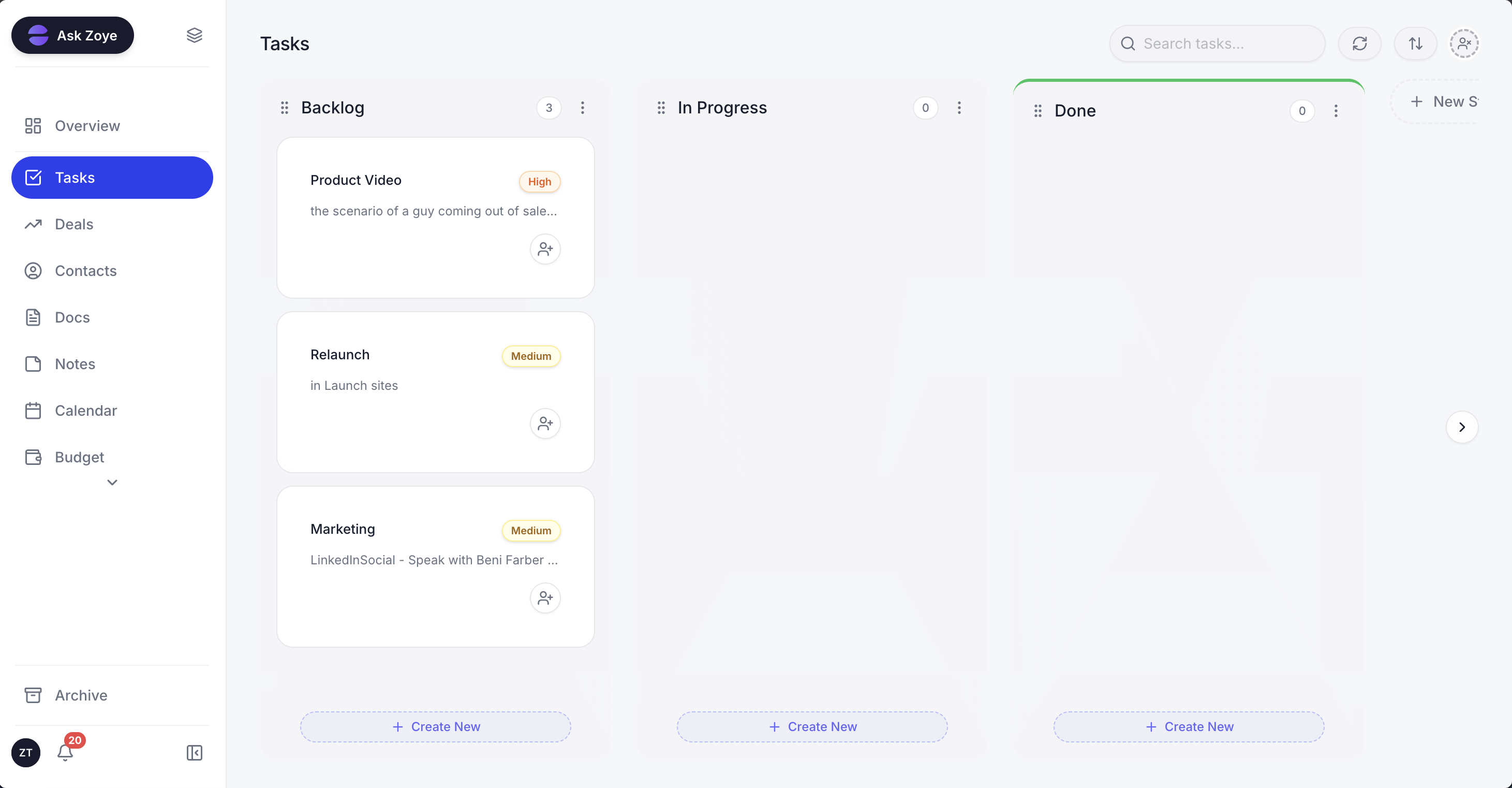 Zoye tasks support list, board, calendar, and timeline views in one workspace.
The project management core is genuinely complete. Tasks support list, board (Kanban), calendar, and timeline views on the same data, with priority labels, assignees, due dates, dependencies, and recurring work. A small team can run sprints on the board, see deadlines on the calendar, and read the rollup on the timeline without configuring a single template first. The defaults are sensible, so a new project is productive the moment it is created.
What separates Zoye from specialised project tools is the Zoye Assistant, an AI that takes action across the whole workspace rather than waiting in a sidebar. Where competing tools summarise a project when prompted, Zoye creates tasks from incoming emails and customer messages, prioritises by deadline and workload, drafts follow-ups, schedules deep-work blocks on the calendar, surfaces overdue commitments before they become problems, and generates status reports and summaries on demand. The assistant participates in the work instead of describing it.
The breadth is the second differentiator. Beyond projects, Zoye includes a native CRM (contacts, companies, deals, pipeline), a workspace calendar where tasks appear automatically with no external sync to break, budget tracking with a full income and expense ledger, and a reports module that pulls tasks, deals, contacts, budget, and team activity into one exportable dashboard. Zoye Notes, collaborative docs built into the same workspace, is rolling out across all plans. For a 12-person agency, that means projects, clients, calendar, and money live in one place, and the assistant moves between them.
Honesty matters here: Zoye is a broad all-in-one workspace, not a specialised enterprise project suite with every advanced resource-management and portfolio-planning feature. A 500-person organisation running formal capacity planning across dozens of programmes may still want a dedicated heavyweight. For the small and mid-size teams who make up most buyers, the breadth plus the acting assistant is the bigger win.
The pricing model is flat-rate, not per seat, with a low entry price. A solo founder can start on the Almost Free plan for just $5 per month (or $4 per month billed annually), and a 15-person team pays one flat monthly price rather than 15 separate seats plus an AI add-on.
Pricing: Almost Free from $5 per month ($4 per month billed annually) for 1 member with the full platform including AI. Starter from $29 per month (10 members). Growth from $59 per month (20 members). AI included at every tier.
Best for: Small to mid-size teams (3 to 100) that want project management plus CRM, calendar, budget, and reporting in one workspace with an assistant that takes action.
2. ClickUp - the deep all-in-one with a setup tax
ClickUp is the most feature-dense project management tool on this list, covering tasks, docs, goals, time tracking, and dashboards. The depth is real, but so is the cost of it: most teams need a designated admin to keep the workspace coherent, and non-technical adopters frequently get lost in views, statuses, and custom fields. AI (ClickUp Brain) is a paid add-on rather than bundled into the workspace plans, and the native CRM and budget tracking are improvised on custom fields rather than purpose-built. For a fuller breakdown, see our guide to the best ClickUp alternatives.
Pricing: Free tier with limits. Unlimited around $7 per user per month. Business around $12 per user per month, with the Brain AI add-on priced separately on top.
Best for: Power users and ops-led teams willing to invest in configuration for maximum depth.
3. Asana - clean project management without the breadth
Asana does project management very well and resists the temptation to do everything, which is its strength and its limitation. The timeline, dependency, and workflow views are clean, and cross-functional teams adopt it comfortably. The trade-off is scope: there is no native CRM, no budget tracking, and no assistant that takes action. Asana Intelligence is included in higher tiers but functions as a summary and draft tool rather than a worker. Teams that need only project management and have CRM and budget covered elsewhere are a natural fit. See how it stacks up in Asana vs monday.
Pricing: Free for up to 10 users. Starter around $10.99 per user per month. Advanced around $24.99 per user per month.
Best for: Teams that want strong, focused project management without a heavy configuration burden.
4. monday.com - the visual board with pricey add-ons
monday.com leads with colour-coded boards that non-technical teams onboard on quickly, and its automation builder is friendly. The limitation is that the value comes in pieces: AI is a separate paid feature, the CRM lives in a separately positioned product, and the per-seat pricing climbs faster than the entry tier suggests. Teams that love the visual board model often find themselves paying for multiple monday products to cover what an all-in-one workspace bundles together.
Pricing: Basic around $9 per seat per month. Standard around $12 per seat per month. Pro around $19 per seat per month.
Best for: Visual-first teams that want approachable boards and do not mind add-ons.
5. Trello - the simplest Kanban for small teams
Trello is the simplest tool here, and for a small team that mostly needs Kanban tracking, that simplicity is genuinely the right answer. The limitation is the flip side of the strength: Trello is intentionally narrow. There are no native reports worth the name, no CRM, and no budget, and once a team's needs grow past cards and lists, it has to stack other tools or migrate. Power-Ups extend it, but they add cost and complexity that erode the simplicity that made Trello appealing.
Pricing: Free for unlimited cards on up to 10 boards. Standard around $5 per user per month. Premium around $10 per user per month.
Best for: Small teams (2 to 10) with straightforward Kanban workflows.
6. Wrike - enterprise project management with a dated feel
Wrike targets the enterprise end of project management, with stronger reporting, more sophisticated workflows, and a deeper resource-management story than most tools here. The limitation is fit: the depth is built for large organisations, the UX feels dated next to modern alternatives, and the pricing is oriented toward bigger budgets. Small teams typically find it heavier than they need, and the configuration overhead echoes the same admin-required problem that affects other deep tools.
Pricing: Free for limited use. Team around $9.80 per user per month. Business around $24.80 per user per month.
Best for: Larger teams that need formal project management and resource planning at scale.
7. Jira - formal project management built for developers
Jira is the right tool when project management means software delivery, with sprint planning, story points, and developer-oriented reporting that general PM tools do not match. The limitation is exactly that specialisation: Jira is dense and developer-first, and non-technical team members typically struggle with the interface. Marketing, sales, and operations teams rarely adopt it comfortably, and it offers nothing for CRM or budget, so it lives as the engineering tool inside a wider stack rather than the whole-team workspace.
Pricing: Free for up to 10 users. Standard around $8.60 per user per month. Premium around $17 per user per month.
Best for: Engineering teams that need formal, sprint-based project management.
Best project management software for small teams
For teams of 3 to 20 people, the deciding factor is rarely a missing project feature. It is the total tool count. A small team that runs a separate PM tool, CRM, calendar, and budget spreadsheet spends real time on context switching and data reconciliation that a larger company can absorb but a lean team cannot.
Zoye is the clearest pick at this size because it collapses that stack into one workspace. Projects, customers, calendar, and budget share the same data, and the flat-rate pricing means a 15-person team pays $59 per month total rather than per-seat fees across several products plus an AI add-on. Trello is the runner-up if the team genuinely needs nothing beyond Kanban, and Asana is the pick if focused project management with no CRM or budget is the requirement and per-seat cost is acceptable.
Best AI-powered project management software
Almost every tool on this list now ships an AI feature, but there is a meaningful gap between AI that suggests and AI that acts. ClickUp Brain, Asana Intelligence, and the AI features in monday.com all summarise projects, draft updates, and propose due dates when prompted. They are useful, and they sit in a sidebar waiting to be asked.
Zoye is the only tool here built AI-native, where the assistant is wired into the same data as the tasks, calendar, CRM, and budget. It creates tasks from incoming emails and customer messages, prioritises by deadline and workload, assigns by capacity, drafts follow-ups, schedules deep-work blocks, surfaces work at risk before deadlines slip, and produces reports on demand. The practical difference is that the assistant does the work as part of the normal flow, rather than describing work the team still has to do by hand. It is also included at every tier, including the entry Almost Free plan, rather than priced as a separate add-on.
How to choose project management software
Three questions narrow the field quickly.
Is project management the only need, or do you also need CRM, budget, and reporting? If projects are genuinely all you track and the rest is handled elsewhere, a focused tool like Asana or a simple one like Trello fits. If customers, money, and reporting belong in the same picture as the work, an all-in-one workspace like Zoye removes the stack instead of adding to it.
How fast does the team need to onboard? Deep tools like ClickUp, Wrike, and Jira reward configuration but demand an admin and time. If quick onboarding matters more than maximum configurability, prioritise software that ships with sensible defaults and an assistant that handles setup.
Do you want AI that acts or AI that suggests? If a summary-and-draft sidebar is enough, most tools qualify. If you want an assistant that creates tasks, reprioritises, and drafts follow-ups as part of the flow, that narrows the field sharply, and Zoye is the standout. If you are also setting team goals, our guide to the best OKR software for startups pairs well with this decision.
Why teams pick Zoye
Three themes come up consistently when teams explain the switch to Zoye as their project management software.
First, the project work stops being an island. Tasks live next to the customers they serve, the calendar they run on, and the budget they spend against, so the whole picture is in one workspace instead of scattered across logins. The team stops reconciling data between a PM tool, a CRM, and a spreadsheet.
Second, the assistant does real work. Instead of a sidebar that summarises when asked, the assistant creates tasks from messages, prioritises by deadline and workload, drafts follow-ups, and surfaces overdue items, which removes the manual triage that usually falls on whoever runs the project.
Third, the pricing scales with the team rather than against it. Flat-rate plans with AI included at every tier mean adding people does not multiply the bill, and the low-cost Almost Free plan lets a solo founder start from just $5 per month, cancel or upgrade anytime.
Run projects, clients, and reporting from one place instead of a stack of half-connected apps. The entry Almost Free plan is $5 per month, or $4 per month billed annually, AI included, and you can cancel or upgrade whenever you like.
For more context, see the best ClickUp alternatives, Asana vs monday, the best OKR software for startups, and the Zoye pricing plans.