
Best OKR Software for Startups 2026: 7 Tools to Track Goals and Hit Targets
OKRs (Objectives and Key Results) are one of the most effective ways a startup can stay focused. An Objective is the ambitious thing you want to achieve this quarter. The Key Results are the two to four measurable outcomes that prove you got there. Done well, OKRs keep a small team pointed at the same handful of targets instead of scattering across a hundred small to-dos.
The problem is rarely the framework. It is the tools. Most dedicated OKR software tracks goals in a silo, completely disconnected from the daily tasks and the CRM, revenue, and budget where progress actually happens. You set a key result like "close 20 new customers," then update the progress number by hand, in a separate app, while the real deal data lives somewhere else entirely. The OKR tool becomes one more thing to maintain rather than a live picture of where the company stands. On top of that, dedicated platforms charge per seat, which gets expensive fast for an early startup counting every dollar.
This guide compares the seven best OKR software options for startups in 2026, ranked for small teams that want goal tracking tied to the work, not stranded in a separate scorecard.
Pricing reflects published rates as of June 2026; check each vendor's pricing page for current figures.
Why startups are rethinking OKR software in 2026
Four trends are reshaping how startups pick an OKR tool.
Goals disconnected from work do not get updated. The single biggest failure mode of dedicated OKR software is the stale scorecard. Key results sit in one app while the tasks, deals, and numbers that move them sit in three others. Updating progress is manual, so it slips, and by mid-quarter the OKR dashboard no longer reflects reality. Startups increasingly want OKRs where the work already lives, so key results pull from real data automatically.
Per-seat OKR pricing is hard to justify early. A standalone OKR platform at $7 to $15 per user per month is a real line item for a startup, on top of project management, CRM, and everything else. For a 10-person team that is a separate annual bill purely for goal tracking. Founders are questioning why goal tracking needs its own per-seat license at all.
AI should surface progress, not just store it. Most OKR tools are passive databases of goals. The shift in 2026 is toward AI that actively tells you which key results are slipping, why, and what to do next, instead of waiting for someone to open the dashboard and notice.
All-in-one beats another point tool. Startups are consolidating their stack. Adding a dedicated OKR app means another integration to wire up, another login, another silo. An all-in-one workspace where objectives are tasks and key results are reports removes the silo entirely.
The 7 best OKR software for startups in 2026
1. Zoye - the all-in-one workspace where OKRs live with the work
Zoye is the strongest OKR software for startups because it solves the core problem with the category: goals stop being a disconnected scorecard and become a live picture tied to the actual work. Objectives are tracked as goals and tasks, key results are measured in Reports that pull real numbers, and the AI assistant surfaces progress automatically.
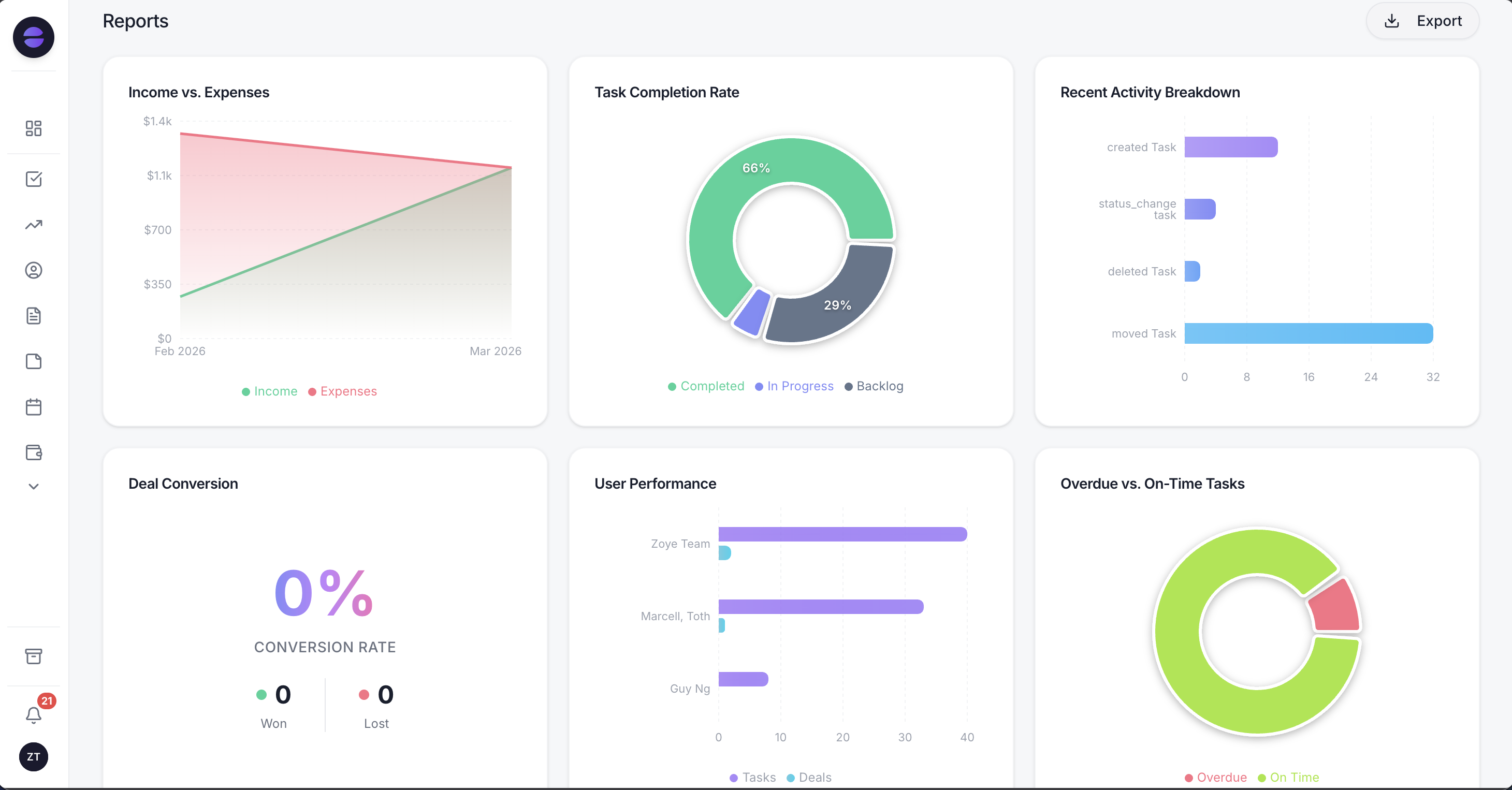 Zoye measures key results in live Reports, tied to the actual work - not a separate OKR silo
Here is how OKRs work in practice. Each Objective lives as a tracked goal in the workspace, broken down into the tasks that move it forward. Each Key Result maps to a measurable outcome that Zoye already tracks: tasks completed, deals closed, revenue booked, budget spent, or team activity. Because the CRM, tasks, calendar, and budget all live in the same workspace, a key result like "reach $40k in new bookings this quarter" reads its progress straight from the deals pipeline. Nobody updates a number by hand. The scorecard is never stale because it is the live data.
The Zoye Assistant surfaces progress, not just stores it
This is where Zoye separates from a passive OKR database. The Zoye Assistant takes action across the workspace: it tells you which key results are on track and which are slipping, explains why (for example, the deals supporting a revenue KR have stalled in one stage), drafts the follow-ups to unstick them, and generates a quarter-to-date OKR progress summary on demand. Where dedicated OKR tools wait for someone to update the dashboard, the assistant proactively flags the goal that is drifting before the quarterly review.
One workspace: tasks, CRM, calendar, budget, and reports
The broader value is that OKRs are not bolted onto an isolated tool. Zoye is an all-in-one business workspace: tasks (with list, board, calendar, and timeline views), a native CRM, a shared calendar, budget tracking, and Reports, all in one place. Objectives connect to the tasks that deliver them. Key results connect to the deals, budget, and activity that prove them. A startup runs its goals, its customer pipeline, its schedule, and its finances in a single workspace instead of paying for an OKR tool, a project manager, a CRM, and a BI dashboard separately.
For most startups that lone fact, OKRs included rather than billed on top, is the decisive one. Goal tracking is not a per-seat add-on; it is part of the workspace you already run the business in.
Pricing: Almost Free at $5 per month for 1 member with the full platform including AI. Starter from $29 per month (10 members). Growth from $59 per month (20 members). All tools and reports included on every plan.
Best for: Startups that want OKRs tied to real work, not a separate scorecard, plus the broader workspace to run the whole business.
2. Lattice - the people platform with OKRs attached
Lattice is primarily a performance and people management platform that includes goal and OKR tracking. For startups that already want performance reviews, engagement surveys, and one-on-ones in one HR suite, having OKRs in the same place is convenient.
The trade-off is that OKRs are a feature of an HR platform, not the core, and the pricing reflects a people-platform license rather than a lightweight goal tracker. For an early startup that just wants OKR tracking, it is more platform (and cost) than the job requires.
Pricing: Per-seat, sold as part of the broader people platform; check the vendor pricing page for current figures.
Best for: Growing companies that want OKRs bundled with performance management and HR.
3. Weekdone - the dedicated OKR and weekly check-in tool
Weekdone is a focused OKR platform built around quarterly objectives and weekly progress check-ins (PPP: plans, progress, problems). For teams that want a clean, purpose-built OKR tool with a structured weekly cadence, it does that one job well.
The trade-off is the silo. Weekdone tracks goals in isolation from your tasks and revenue, so progress updates are manual, and it is yet another subscription alongside your project and CRM tools.
Pricing: Free for very small teams; paid plans scale per user. Check the vendor pricing page for current figures.
Best for: Small teams that want a dedicated OKR tool with a strict weekly check-in rhythm.
4. Profit.co - the deep, configurable OKR platform
Profit.co is one of the most feature-rich dedicated OKR platforms, with extensive scoring, alignment, task linking, and a large template library. For organizations that want formal, ceremony-heavy OKR management, it is comprehensive.
The trade-off is that depth. The configuration and feature surface are more than most early startups need, and like every dedicated tool it tracks goals separately from where the daily work happens.
Pricing: Free tier for small teams; paid per-user plans for the full feature set. Check the vendor pricing page for current figures.
Best for: Larger or process-mature organizations that want deep, formal OKR management.
5. Perdoo - the OKR and strategy execution tool
Perdoo positions itself around strategy execution, linking OKRs to a longer-term strategic vision and KPIs. The visual strategy maps and the distinction between OKRs and ongoing KPIs are genuinely useful for teams thinking about the bigger picture.
The trade-off is the same category limitation: it is a standalone tool that sits beside your actual work rather than being part of it, with per-seat pricing on top of your existing stack.
Pricing: Free tier available; paid per-user plans. Check the vendor pricing page for current figures.
Best for: Teams that want to connect OKRs to a longer-term strategy and KPI layer.
6. ClickUp - the project management tool with goals
ClickUp is a broad project management platform that includes a Goals feature for OKR-style tracking, with targets that can roll up from tasks. For teams already running projects in ClickUp, keeping goals in the same tool avoids a separate app.
The trade-off is ClickUp's well-known complexity. Setting up goals that pull cleanly from the right tasks takes configuration, and there is no native CRM or budget layer, so revenue-based key results still live elsewhere.
Pricing: Free tier with limits. Paid plans per user per month. Check the vendor pricing page for current figures.
Best for: Teams already standardized on ClickUp who want lightweight goal tracking inside it.
7. Notion - the flexible workspace you build OKRs in
Notion is a flexible docs-and-database workspace where you can build an OKR tracker yourself with databases, properties, and rollups. For teams that love customizing their own system, Notion offers total flexibility at a low price.
The trade-off is that you are building and maintaining the OKR system yourself. There is no automatic progress, no native CRM or budget to feed key results, and the rollups only reflect data you manually enter into Notion in the first place.
Pricing: Free for personal use; paid per-user plans for teams. Check the vendor pricing page for current figures.
Best for: Teams that want a fully custom, build-it-yourself OKR setup and are willing to maintain it.
Best free OKR software for startups
For a startup watching every dollar, the cost question matters. Weekdone and Profit.co offer limited free tiers, but they cap members quickly and keep OKRs siloed from your other work. Zoye has no free plan, but it is the most affordable all-in-one option: the entry plan, Almost Free, at $5 per month ($4 per month billed annually) covers 1 member, 1GB of storage, and the whole platform including AI, so a solo founder can run real OKRs (objectives as tasks, key results in Reports, AI progress summaries) for one low monthly fee.
The deeper point about "free" is total cost. A free dedicated OKR tool still leaves you paying separately for project management, CRM, and reporting. An all-in-one free plan that includes OKR tracking alongside those tools is dramatically more useful to a cash-conscious startup.
Best AI-powered OKR software
Most OKR tools store goals; they do not actively manage them. Zoye is the only option on this list with a true AI-native architecture where the assistant works the OKRs for you. It surfaces which key results are slipping and why, drafts the follow-ups to get stalled work moving, and generates a quarter-to-date progress summary on demand, all from the live data in the workspace.
Dedicated platforms are adding AI features, but they remain suggestion panels on top of a manually-updated scorecard. The difference is structural: an AI can only surface honest progress if it can read the real work, and a siloed OKR tool only knows the numbers you typed into it. Because Zoye's key results pull from actual tasks, deals, and budget, the assistant's read on progress reflects reality, not a stale spreadsheet.
How to choose the right OKR software for your startup
Three questions narrow the decision.
1. Are your key results measured by data you already track? If your KRs are things like deals closed, revenue, tasks shipped, or budget spent, choose a tool that reads that data automatically. A workspace like Zoye, where the CRM and tasks live alongside the goals, removes manual updates entirely. A siloed OKR tool means you will be retyping numbers all quarter.
2. Do you need a dedicated OKR platform, or OKRs inside your workspace? Most early startups do better with OKRs inside the tool where work happens. A standalone platform earns its place once a larger org needs formal scoring, alignment trees, and structured check-in ceremonies across many teams.
3. What does it cost across the whole stack? Compare the true total: a per-seat OKR license on top of your existing tools, versus an all-in-one workspace where OKR tracking is included. For a small team, the all-in-one is usually both cheaper and less fragmented.
How startups actually run OKRs without a separate scorecard
The most reliable way to keep OKRs alive through a quarter is to stop treating them as a separate artifact. When the objective is a tracked goal in the same workspace as the tasks, and each key result reads from live data, there is no scorecard to fall out of date. Progress is simply the state of the work.
In practice, a startup running OKRs in Zoye sets the quarter's three or four objectives as goals, breaks each into the tasks that deliver it, and points each key result at a measurable outcome the workspace already tracks. Then the weekly check-in becomes a five-minute review of a live Reports view rather than an hour of collecting updates. The assistant flags the slipping key result before the meeting, so the conversation is about the decision (what do we change?) instead of the status (where are we?).
That shift, from assembling status to making decisions, is the practical payoff of OKR tracking that lives with the work instead of beside it.
Why startups pick Zoye for OKRs
A few themes come up consistently.
OKRs stay honest because they read from real data. Objectives are tracked goals, key results pull from live tasks, deals, and budget, and nobody maintains a separate scorecard.
The AI works the goals, not just stores them. The Zoye Assistant surfaces slipping key results, drafts the follow-ups, and produces progress summaries on demand.
Goal tracking is included, not a per-seat add-on. OKRs come with the all-in-one workspace (tasks, CRM, calendar, budget, reports) instead of being a separate subscription stacked on top.
Try Zoye with your team. The entry plan is Almost Free, with the full platform including AI.
For more context, see the business strategy template for 2026, the best project management apps in 2026, the small business productivity guide, and how to choose a CRM.