
Business Strategy Template 2026: How to Build a Plan That Actually Gets Executed
Most organisations are reasonably good at strategy and consistently bad at execution. They spend significant time in planning sessions, produce documents with clear objectives, and then watch as those priorities slowly disconnect from what teams are actually working on week to week.
The gap between planning and execution happens for predictable reasons: objectives live in a slide deck while tasks live in a project tool; ownership is assumed rather than assigned; progress is measured in quarterly reviews rather than tracked continuously. A well-designed business strategy template fixes this - not by producing a better document, but by building execution into the structure of planning itself.
What a business strategy template actually is - and is not
A business strategy template is a structured framework that guides an organisation through both strategic planning and its execution. The word "template" can be misleading - it suggests a form you fill in. A useful strategy template is not a form. It is a system that creates the connections between where you want to go, what you are going to do to get there, who is responsible for each piece, and how you will know whether it is working.
The distinction between a strategy template and a traditional business plan matters:
- A business plan is primarily a documentation tool - it captures market analysis, financial projections, and strategic rationale for an external audience or as a founding reference point.
- A strategy template is an execution tool - used continuously by the people running the business to make sure day-to-day work stays connected to strategic objectives.
The key difference: A business plan tells the story of your strategy. A strategy template runs it.
Most strategies fail not because the planning was poor but because the execution was never properly connected to it. Teams work hard on the wrong things. Priorities from last quarter quietly get replaced by whatever is most urgent today. Leadership reviews progress at the end of the quarter and discovers that what got done was not what the strategy required.
Why most strategies fail at the execution stage
Understanding where execution breaks down is the prerequisite for designing a template that prevents it. The failure modes are consistent.
The plan lives in the wrong place
If your strategy is a slide deck, it is not operational - it is archival. People reference it when they have to, ignore it when they are busy, and gradually stop connecting it to the decisions they make every day.
Ownership is diffuse
"Shared ownership" of a strategic initiative almost always means no one is actually accountable. Every initiative in a real strategy template has one named owner who is responsible for its success or failure, with the authority to make the decisions that responsibility requires.
The feedback loop is too slow
A quarterly review cycle for tracking strategic execution is too slow for the pace at which conditions change. By the time you discover in a review meeting that an initiative has been off-track for six weeks, the cost of correction is already high.
Resources do not follow priorities
It is common for organisations to define their top strategic priorities and then discover that the allocation of time and money does not match those priorities. If the template does not include a clear model for how resources shift as priorities evolve, the default is for resources to stay where they have always been.
7 components every executable strategy template must include
1. Vision and mission alignment
Every team member should be able to answer two questions: what is this organisation trying to become, and why does it matter? This component creates the anchor that makes everything else coherent - translating the vision into strategic narratives that help people at every level understand how their work contributes to the bigger picture.
2. Market analysis and competitive intelligence
Strategy without a clear-eyed view of the competitive environment is guesswork. This component sets up systems for ongoing market monitoring rather than a once-a-year analysis - tracking competitor moves, customer behaviour shifts, and technology changes that could affect strategic position.
3. Strategic goals with measurable OKRs
Objectives and Key Results (OKRs) convert strategic intent into measurable targets. The objective says where you are going; the key result defines what progress looks like in a way that can be tracked. Good OKRs are specific, time-bound, and slightly uncomfortable - if every team hits every key result every quarter, the targets are too easy.
4. Initiative portfolio and prioritisation
A strategy generates more potential initiatives than any organisation can pursue simultaneously. This component forces explicit prioritisation: which initiatives are in play now, which are deferred, and which are dropped. Without this, organisations accumulate active initiatives until the portfolio is too large to execute any of them well.
5. Resource allocation model
Strategic priorities without resource allocation are wishes. This component defines how budget, headcount, and leadership attention are distributed across initiatives - and how that distribution changes as performance data comes in. The most common failure mode is allocating resources at the start of the planning cycle and never revisiting the allocation.
6. Ownership and accountability matrix
Every initiative, objective, and key result should have one named owner. The accountability matrix makes this explicit, along with the decision rights each owner holds and the escalation path when decisions exceed those rights. Shared ownership usually means no ownership.
7. Real-time performance indicators
The measurement layer: the leading indicators that tell you whether execution is on track before outcomes are determined. Task completion rates, resource utilisation, goal achievement velocity, and deal conversion update continuously and give leaders early-warning signals rather than post-mortems.
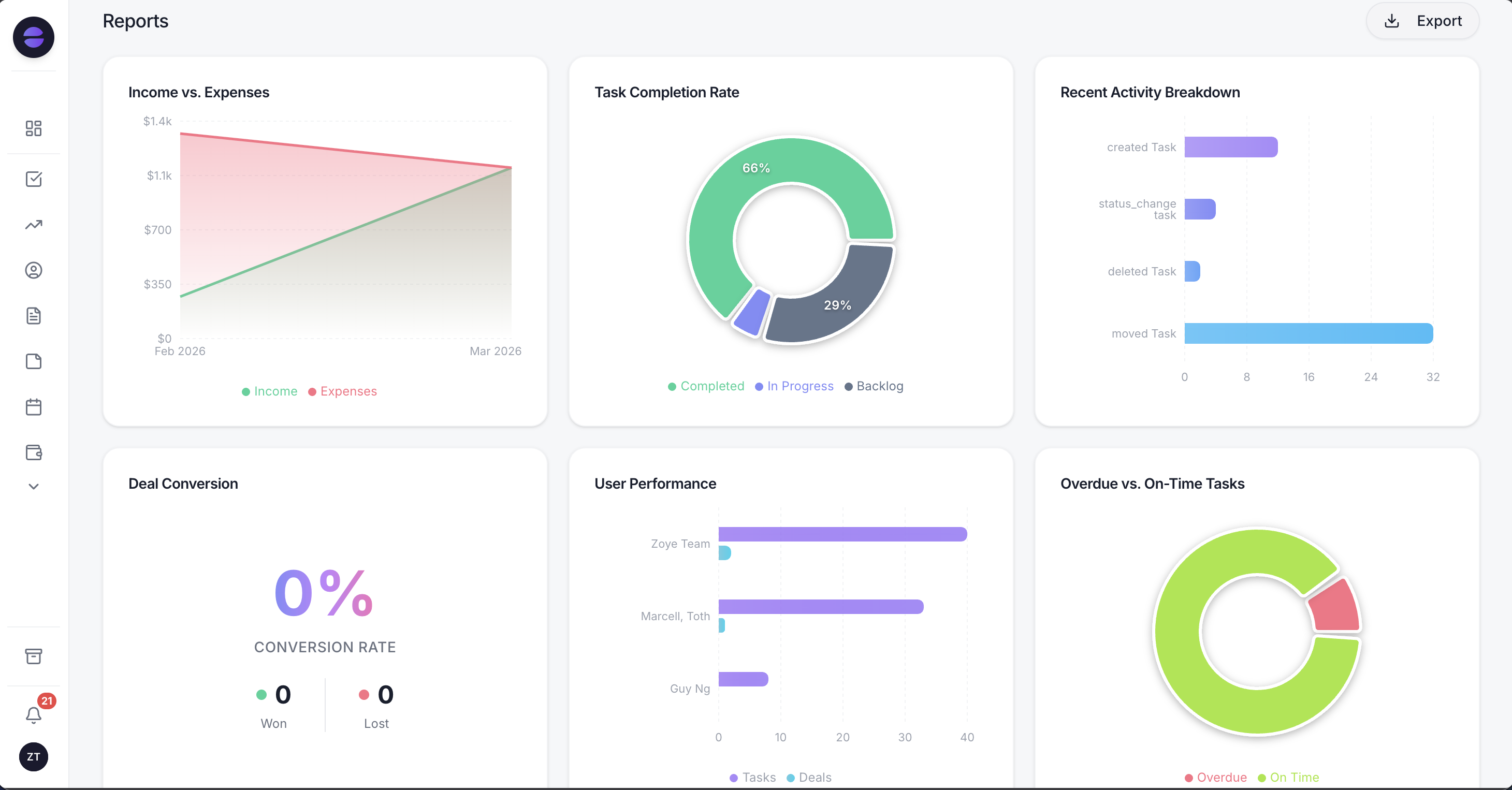 Zoye Reports: the performance indicator layer of your strategy template, updated in real time without manual reporting
See what Zoye can do for you
From CRM and deal tracking to AI-powered task management - explore everything Zoye offers in one workspace.
Explore Features4 types of strategy templates and when to use each
| Template type | Primary users | Time horizon | Key focus | Success metrics |
|---|---|---|---|---|
| Corporate strategy | C-suite, board | 3-5 years | Market position, M&A, portfolio | Revenue growth, market share |
| Business unit strategy | Division leaders | 1-3 years | Competitive advantage, unit growth | Profitability, retention |
| Functional strategy | Department heads | 6-18 months | Process optimisation, capability | KPIs by function |
| Digital transformation | IT, operations | 1-2 years | Tech adoption, change management | Adoption rate, ROI on tech |
Corporate strategy templates
Used by C-suite and boards to define the long-term direction of the whole organisation. The focus is on portfolio-level decisions: which markets to be in, which capabilities to build or acquire, how to allocate capital across business units.
Business unit strategy templates
Used by division leaders to define competitive positioning within a specific market. These templates operate within the boundaries set by corporate strategy but have meaningful autonomy in defining how their unit competes.
Functional strategy templates
Used by department heads to translate business unit objectives into operational plans. A marketing department's strategy template converts a growth objective into specific campaigns, channels, and metrics. These templates operate on shorter timeframes and update more frequently.
Digital transformation templates
Used when an organisation is undertaking a significant technology or operating model change. These templates put as much emphasis on change management and adoption as on technical milestones - because the most common failure mode in digital transformation is adoption failure, not technical failure.
5 steps to build a strategy template that drives execution
Step 1: Define the strategic questions your template must answer
Before you design the template, identify the three to five questions that your strategy actually needs to resolve. These might be: where do we grow next? Which customer segment should we prioritise? What is the one capability we need to build that we do not have? These questions shape what the template needs to contain and prevent it from becoming a generic framework populated with generic answers.
Quick action: Audit your current strategic planning documents and identify the top three questions they leave unanswered. Design your template to answer those questions explicitly.
Step 2: Connect every initiative to a measurable business outcome
For each initiative in your template, write a single sentence that explains which strategic objective it supports and how its success will be measured. If you cannot write that sentence, the initiative should not be in the template. This filter removes the strategic noise and focuses resources on work that actually drives the strategy.
Quick action: Review your top five active projects. Write one sentence for each: "This project supports [objective] and will be measured by [metric]." If you cannot complete the sentence, pause the project.
Step 3: Assign one owner to every element
Go through every objective, key result, and initiative in your template and assign a single named owner. Not a team, not a department - a person. That person is accountable for progress, for raising blockers, and for making the decisions within their scope.
In Zoye, every task and deal has a named assignee visible to the whole team. Zoye Assistant can assign the right owner automatically based on current workload, skills, and availability - removing the friction from an accountability step that often gets skipped.
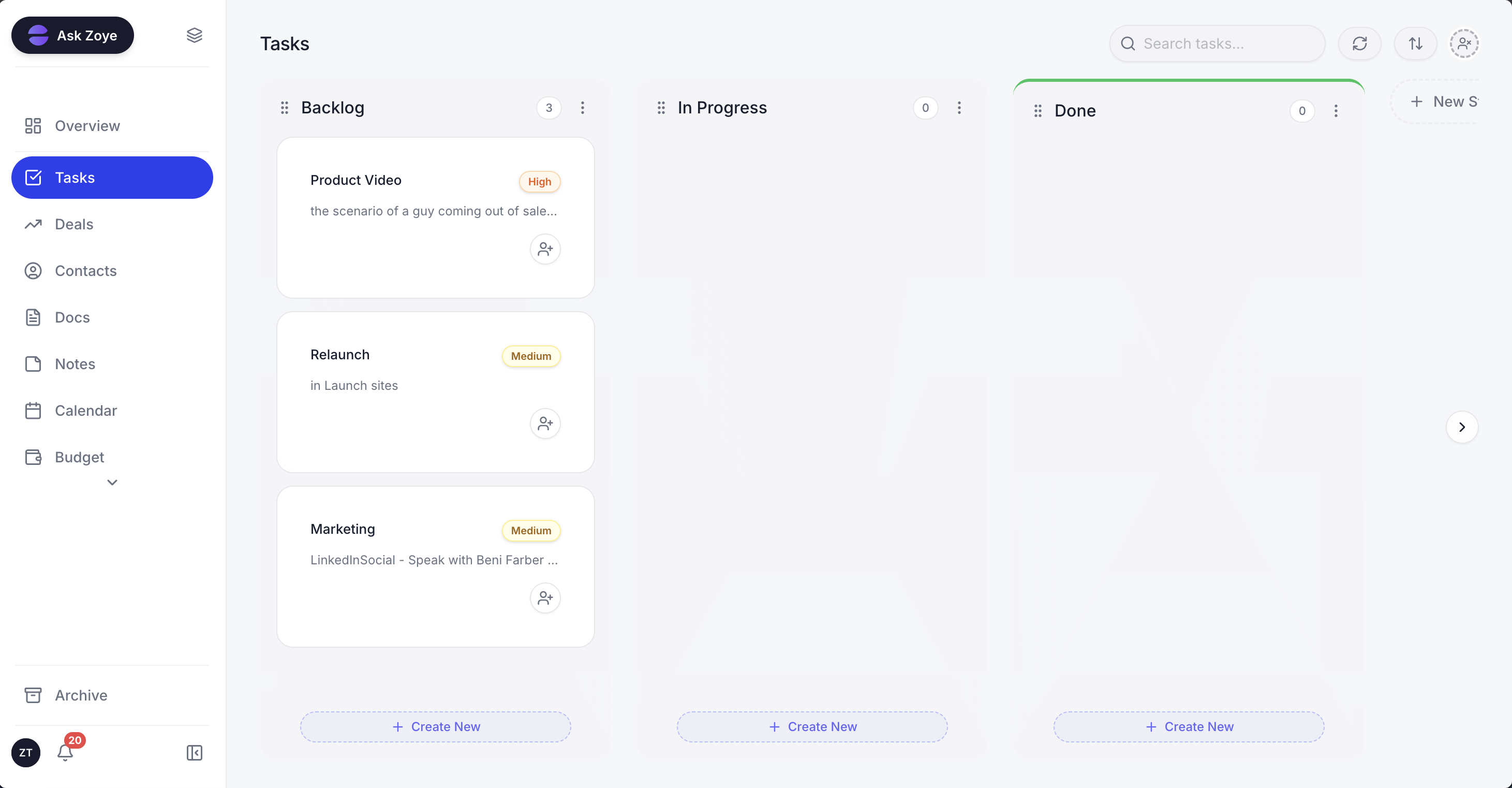 Every task in Zoye has a visible owner - Zoye Assistant can assign the most suitable person automatically based on workload and context
Ready to streamline your business?
Zoye brings AI-powered CRM, task management, and automation into one workspace.
Get StartedStep 4: Build continuous feedback into the design
A strategy review that happens quarterly is a post-mortem, not a management system. Build shorter feedback loops into the template: weekly task completion checks, fortnightly initiative reviews, monthly OKR progress assessments. The goal is to detect drift when it is still correctable.
In Zoye, the AI Insights panel does part of this automatically - it flags stalled priorities, unassigned tasks, and overdue items without waiting for a scheduled review.
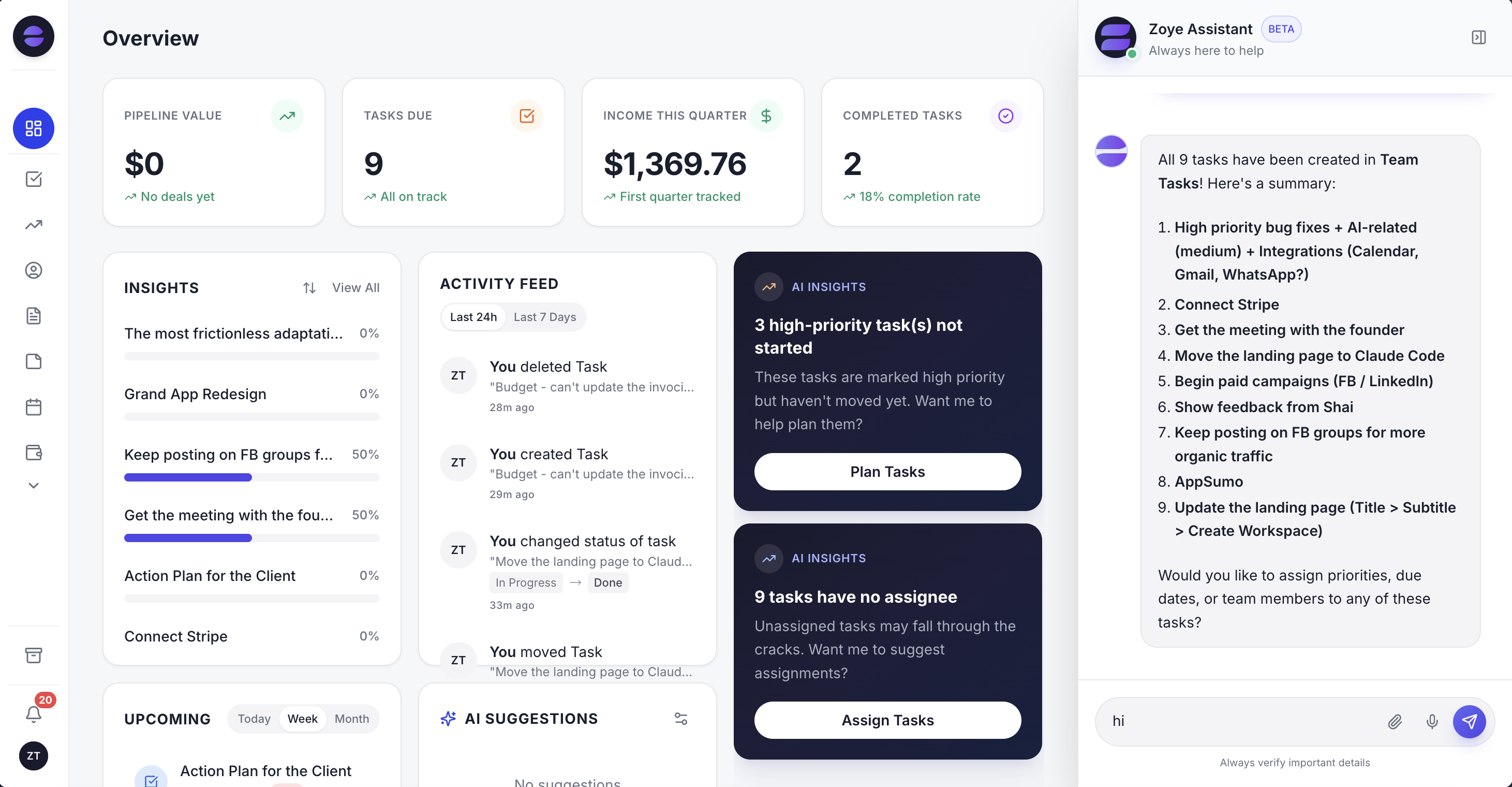 Zoye Insights: continuous feedback built into the dashboard - risks flagged proactively, with one-click actions to resolve them
Step 5: Design for adaptation, not just execution
Define in advance the triggers that would cause you to reassess your current priorities: a competitor launch, a significant shift in customer behaviour, a key team member departure, a technology change. Adaptive planning is not a sign that the strategy was wrong - it is a sign that the organisation is paying attention.
From a planning document to a living strategy system
When your strategic objectives, initiative ownership, task completion, budget tracking, and performance data all live in the same connected workspace, the strategy template is not a separate document - it is the system your team uses every day. That is the condition under which strategy reliably translates into execution.
In Zoye, the connection between strategic intent and daily work is built into the architecture:
- Strategic objectives break down into deals and tasks with named owners and due dates
- Budget and resource allocation are tracked in the Budget module alongside task progress
- Performance data surfaces automatically in the Reports dashboard without manual reporting
- AI Insights flags execution risks in real time before they become strategy-level problems
- Zoye Assistant handles the operational overhead - creating tasks, assigning owners, logging deals - so the team stays focused on execution rather than administration
Want to see it in action?
Watch how Zoye automates your daily workflow - from lead management to team collaboration.
See How It WorksFrequently asked questions
A business strategy template is a structured framework that connects strategic planning to day-to-day execution. Unlike a traditional business plan - which is primarily a documentation tool for external audiences - a strategy template is an operational system used continuously by the people running the business. It defines objectives, measures success, assigns ownership, allocates resources, and provides the feedback loops that keep daily work aligned with strategic priorities.
An effective business strategy template should include seven core components: a vision and mission alignment framework, a market analysis and competitive intelligence structure, strategic goals with measurable OKRs, an initiative portfolio with explicit prioritisation, a dynamic resource allocation model, a clear ownership and accountability matrix, and real-time performance indicators. Templates that lack any of these elements tend to produce good planning and poor execution.
Most business strategies fail at the execution stage for four predictable reasons: the plan exists only in a document that teams rarely consult, ownership is shared rather than assigned to a single named individual, the feedback loop is too slow (quarterly reviews rather than continuous monitoring), and resources are not reallocated as priorities and performance data change. A well-designed strategy template is specifically structured to prevent each of these failure modes.
Connecting strategy to daily work requires three structural changes: breaking strategic objectives down into specific tasks with named owners and deadlines, tracking those tasks in the same system where strategy is defined rather than in a separate tool, and building continuous feedback loops that surface whether execution is on track without waiting for scheduled reviews. AI-native platforms like Zoye support this directly - strategic initiatives become tasks and deals with visible owners, progress updates automatically, and AI Insights flag execution risks in real time.
A corporate strategy template operates at the level of the whole organisation and focuses on long-term market positioning, portfolio decisions, and capital allocation over a three-to-five-year horizon. A functional strategy template operates at the department level and translates business unit objectives into specific operational plans, projects, and metrics over a six-to-eighteen-month horizon. Functional templates tend to update more frequently because they operate closer to where execution actually happens.
Zoye supports strategy execution in three ways. First, the platform connects every module - tasks, deals, contacts, budget, calendar, and reports - in a single workspace, so strategic objectives can be tracked through to execution without data living in separate tools. Second, the AI Insights panel provides continuous monitoring, flagging execution risks before scheduled reviews. Third, Zoye Assistant handles the operational overhead of execution - creating tasks, assigning owners, logging updates - so team members spend their time on the work itself rather than the administration of tracking it.
The bottom line
The gap between strategy and execution is not a planning failure - it is a design failure. Most organisations plan well and execute poorly because their strategy template was designed for documentation rather than operation.
A strategy template that actually works is one where the plan is inseparable from the system teams use to do their work. Objectives break down into owned tasks. Progress updates automatically. Risks surface before they compound. And when conditions change - as they always do - the template adapts without losing the strategic direction that makes the work meaningful.
Zoye is built to be that system. One workspace where strategy, execution, and performance data live together - with an AI assistant that handles the operational layer so the people running the business can focus on the judgment that only humans provide.