
Leadership has never been a fixed skill. The qualities that defined a strong leader a decade ago - presence in a room, authority, a firm plan - are necessary but no longer sufficient. Today's leaders operate across distributed teams, shifting markets, and AI-powered workflows that can execute in seconds what used to take hours.
What hasn't changed is the core challenge: getting people to do their best work together, toward a shared goal, under conditions that are rarely predictable. That challenge is harder now, not easier - and the leaders who handle it well in 2026 share a specific set of skills, mindsets, and tools that this guide breaks down.
What leadership actually means in 2026
Leadership is the ability to move people toward a shared goal while keeping them clear, motivated, and ready to adjust when conditions change. In 2026, a leader might manage a team spread across four time zones, with half their reports working asynchronously, and with AI handling a significant portion of the routine coordination that used to require human attention.
The leadership work that remains is more demanding, not less - it requires sharper judgment, clearer communication, and a greater ability to focus people's energy on what genuinely matters.
The three things every effective leader does
- Influence: shaping what people do and how they think through trust and context, not just authority. A product lead who explains why a feature solves a real customer problem gives the development team something more motivating than a ticket number.
- Direction: translating broad ambitions into clear, actionable priorities with defined ownership. A marketing director who converts a brand vision into a launch calendar with named deliverables creates direction that people can act on.
- Adaptability: adjusting plans and priorities when circumstances change, without losing the team's sense of purpose or momentum.
Leadership vs. management - understanding the real difference
These two words are often used interchangeably, but they describe genuinely different orientations. Leadership is about creating direction and belief. Management is about organising work and making sure execution stays on track.
| Dimension | Leadership focus | Management focus |
|---|---|---|
| Direction | Vision: defining the destination and why it matters | Execution: mapping how to get there and by when |
| Change | Innovation: questioning what exists and imagining what could be | Stability: protecting processes and ensuring consistency |
| People | Culture: shaping values, trust, and shared identity | Operations: organising roles, processes, and resources |
| Timeframe | Long-term strategic outcomes | Short-term operational delivery |
| Approach | Inspiring, influencing, and building belief | Planning, tracking, and controlling progress |
In practice, the best leaders and managers are not opposites - they are the same person in different modes, reading the situation and switching between them deliberately.
7 leadership styles that define how modern organisations operate
1. Transformational leadership
Transformational leaders connect daily work to a larger purpose and push teams to reach outcomes they would not have imagined without them. This style works especially well during periods of change - a new product direction, a market shift, an organisational restructure. The contrarian warning: transformational leadership without operational follow-through curdles into hype. A leader who paints an inspiring vision every quarter but never closes the loop on the last one teaches the team to discount the next one. The style only works when the inspiration is paired with visible delivery.
2. Servant leadership
Servant leaders see their role as removing obstacles and creating conditions for the team to do great work. They prioritise their team's development, wellbeing, and effectiveness over their own visibility. Concretely, a servant leader's calendar looks different: it is full of unblocking conversations and one-to-ones, not status reviews. This style builds deep trust and typically improves retention. The risk is that an unchecked version slides into conflict avoidance, where the leader removes every obstacle except the underperformer everyone is quietly working around.
3. Democratic leadership
Democratic leaders gather input before deciding. This produces better decisions when the problem genuinely benefits from multiple perspectives. The trap is theatre: asking for input on a decision you have already made teaches the team that consultation is a formality, which is worse than not asking at all. Reserve democratic process for decisions you are genuinely willing to change your mind on, and be explicit when you are not.
4. Situational leadership
Situational leaders adapt their approach to each individual based on that person's experience, confidence, and need for support. A new hire needs direct guidance; a senior professional needs space and autonomy. The hard part is reading the signal correctly: a confident-sounding new hire may still need structure, and a quiet senior may be disengaging rather than self-sufficient. Applying the wrong style in either direction produces frustration and underperformance, so the skill is less about the styles and more about accurate diagnosis.
5. Coaching leadership
Coaching leaders invest in the long-term development of the people around them. Rather than providing immediate answers, they ask questions that develop independent thinking. The honest limit: coaching is the wrong mode in a genuine emergency. When the building is on fire, "what do you think we should do?" is not developmental, it is negligent. Great leaders coach in calm periods precisely so they can direct decisively in the crises.
6. Digital-first leadership
Digital-first leaders understand how to create clarity, trust, and alignment through technology. In distributed teams, this means designing communication systems that work asynchronously, using data to replace the visibility that physical co-location used to provide, and making decisions quickly with the information available. In practice it looks like a leader who writes decisions down in a shared workspace so anyone in any time zone can see the reasoning, rather than one who holds the context in their head and a recurring meeting.
7. Autocratic leadership
Autocratic leaders make calls independently, without seeking team input. In genuine crises - a production outage, a security breach, a sudden market collapse - a single decisive voice reduces chaos and enables fast action. The discipline is knowing it is a fire extinguisher, not a thermostat. Used selectively in high-stakes moments it is responsible leadership. Used routinely, it erodes morale and drives away exactly the capable people who have other options.
See what Zoye can do for you
CRM, deals, tasks and your Instagram, Facebook and WhatsApp automations in one workspace. Just ask Zoye and it sets any of it up for you.
Explore Features5 qualities that consistently produce strong leaders
1. Emotional intelligence
Emotional intelligence is the ability to understand and manage your own emotions and to read and respond to the emotions of the people around you. In distributed teams, where most interaction happens through text and video, this requires noticing when someone who is usually vocal goes quiet, or when a team's energy drops week over week - and acting before small problems become performance issues.
2. Adaptability
Adaptability is not the same as being reactive. It is the ability to update your understanding of a situation faster than circumstances change - and to adjust your plans accordingly without losing your team's confidence. The leaders who demonstrate adaptability most effectively treat changes as new information rather than failures.
3. Data literacy
Data literacy means being able to read the dashboards and reports your organisation produces, understand what they are telling you, and ask the right questions when something looks wrong. Leaders who lack this skill are perpetually dependent on others to interpret their business for them.
This is where the right platform makes a significant difference. When every project, task, deal, and budget item lives in one connected workspace - as they do in Zoye - a leader does not need to pull reports manually. The Reports dashboard surfaces income versus expenses, task completion rates, deal conversion, and team performance in real time.
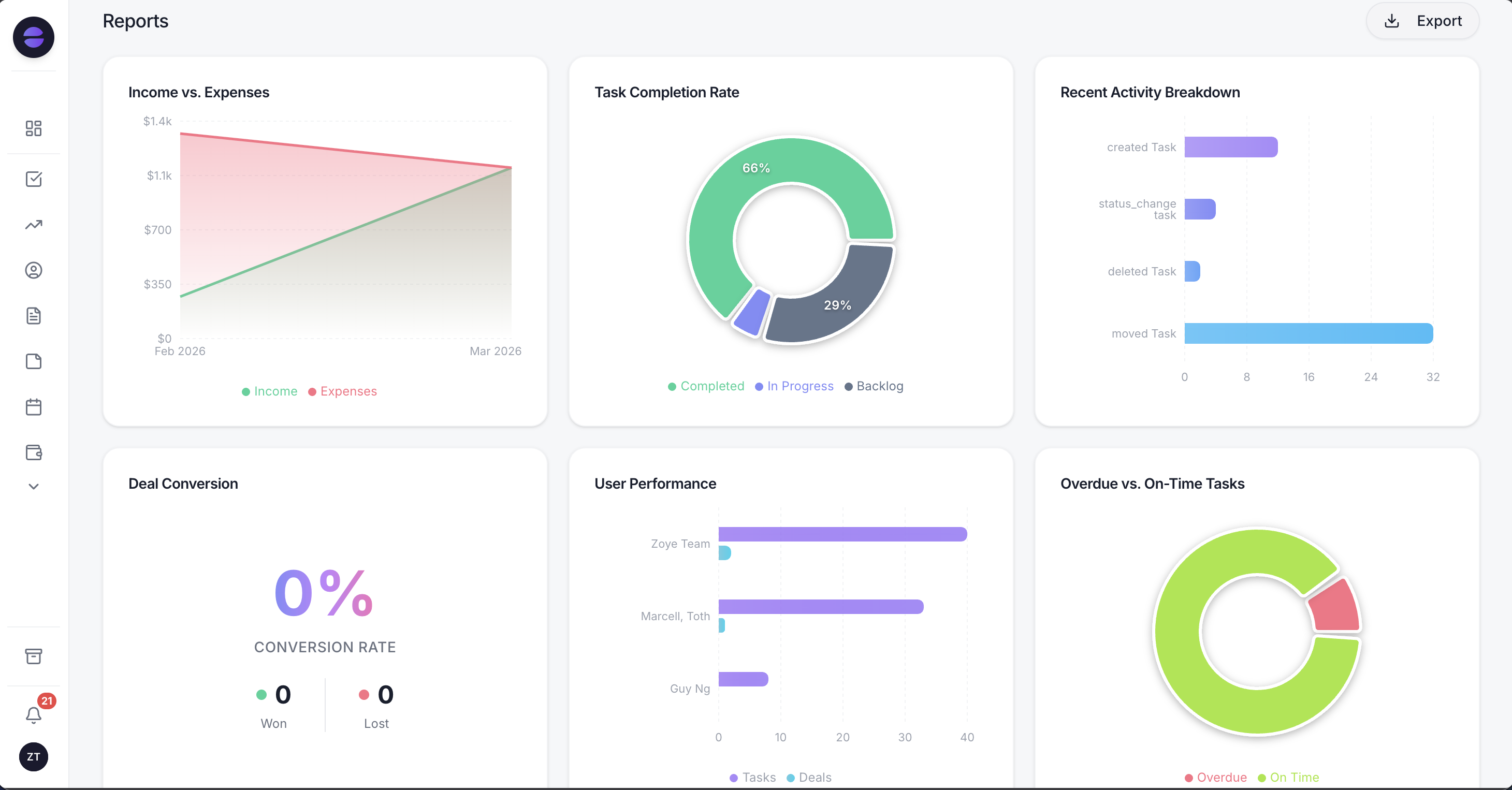 Zoye Reports gives leaders real-time visibility across every dimension of their business - no manual reporting, no stale data
4. Communication
Communication in leadership is not about speaking well in presentations. It is about making sure the right information reaches the right people in the right form, and then confirming it was understood. Effective leaders build in repetition, context, and feedback loops that confirm understanding has actually happened - not just that the message was sent.
5. Systems thinking
Systems thinking is the ability to see how different parts of an organisation connect and affect each other. When a project slips, a systems thinker does not ask only "who is responsible?" They ask what in the workflow created the conditions for this slip - an invisible dependency, an overloaded team member, an approval process with more latency than anyone anticipated.
How AI is changing what leaders spend their time on
The most immediate impact of AI on leadership is practical: a significant portion of a leader's week typically goes to coordination overhead - chasing status updates, preparing reports, scheduling reviews. AI is eliminating most of that. What remains - and becomes more valuable as a result - is the work that requires human judgment: building relationships, making calls in ambiguous situations, developing people, and setting direction.
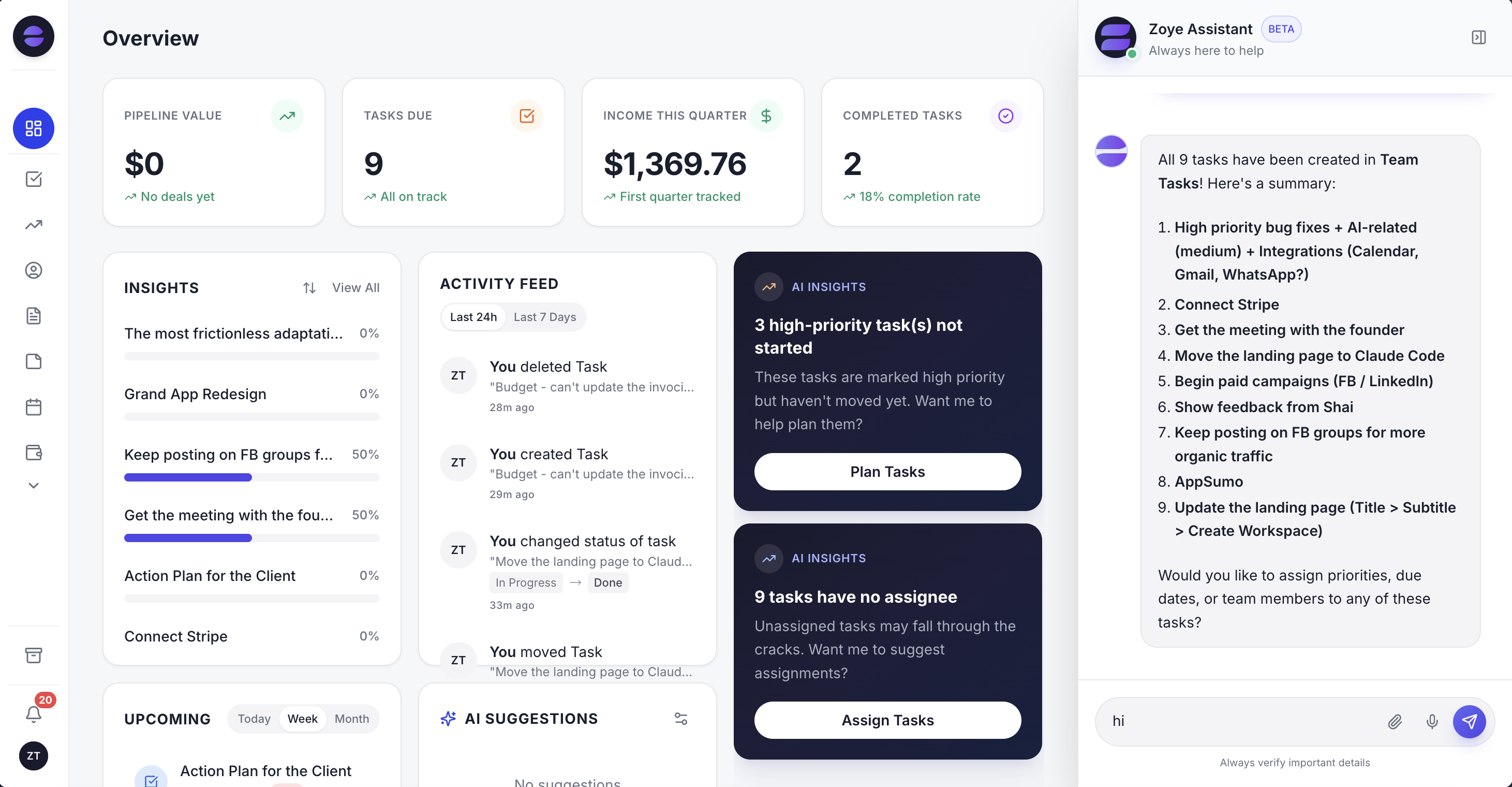 Zoye gives leaders a live overview of their business - with AI Insights proactively flagging what needs attention and Zoye Assistant ready to act on it
AI as a decision-support layer
In Zoye, the AI Insights panel flags high-priority tasks that have not been started, deals with no recent activity, team members who are overloaded, and budget anomalies - proactively, without the leader having to run a report. That shift from reactive to proactive information flow changes the quality of leadership decisions.
AI as an execution partner
A leader who has just wrapped a strong partner call should not need to spend fifteen minutes logging a deal, creating a contact, writing a task, and finding the right assignee. That is coordination work, not leadership work.
What a leader says to Zoye: "Just spoke with Priya at Northwind Logistics - they want to pilot our onboarding service next month. Create the opportunity, add Priya as the contact, and assign whoever has the most bandwidth on the customer success team to scope it."
Zoye creates the deal, the contact, the task, assigns the most suitable team member based on workload and skills, and adds the context note - automatically. The leader stays focused on what happens next, not on the administrative work of recording what just happened.
Ready to hand off the busywork?
Zoye brings AI-powered CRM, task management, and automation into one workspace.
Get StartedVisibility across distributed teams
Zoye's task board, pipeline, and reports update in real time as work moves through stages. A leader can see at a glance how many tasks are in progress, what is in the backlog, and whether high-priority items are stalled - without asking anyone.
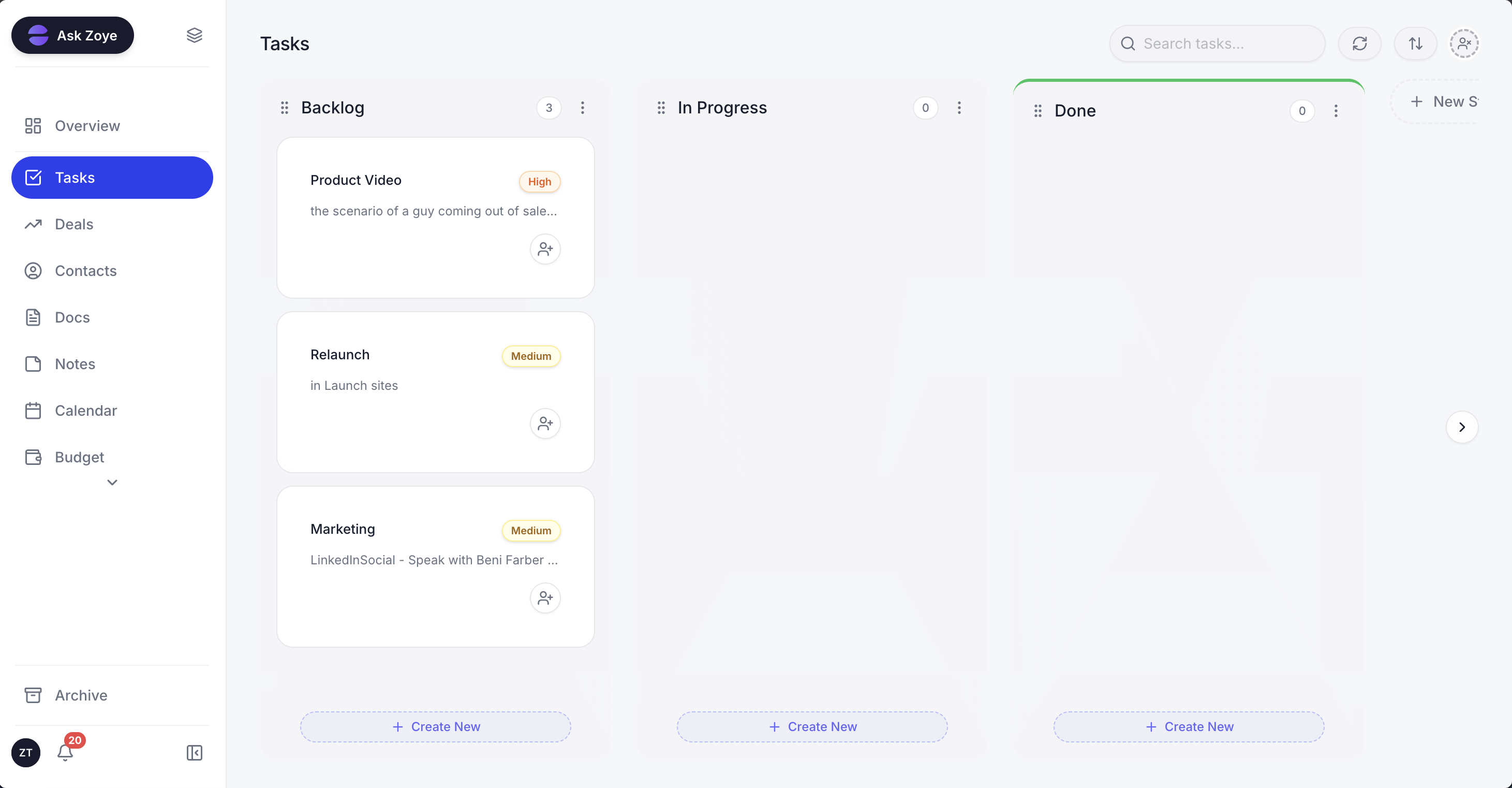 Zoye task board: real-time visibility into what the team is working on without chasing status updates
Building high-performance teams in distributed environments
Clarity is the foundation
In distributed teams, ambiguity costs more than it does in co-located ones. When someone is unsure about a priority or deadline remotely, that ambiguity persists until the next scheduled meeting. Leaders who reduce ambiguity systematically - through clear task ownership, explicit priorities, and a shared workspace where the state of every project is visible - get consistently better performance than those who rely on communication alone.
Accountability without surveillance
Conflating visibility with accountability is one of the most common mistakes leaders make with remote teams. Installing monitoring software or requiring constant check-ins does not create accountability - it creates anxiety and signals a lack of trust. Real accountability comes from clear ownership, meaningful metrics, and a culture where people care about outcomes because they understand what those outcomes mean.
Rhythm creates cohesion
In distributed teams, regular rhythms replace the ambient cohesion of shared physical space. A weekly standup, a monthly retrospective, a quarterly review create the predictable touchpoints that give people a sense of where they stand. Without them, distributed teams drift.
Want to see it in action?
See Zoye catch a new lead, answer on WhatsApp and set up the follow-up, all from one message.
See How It WorksHow to measure whether your leadership is actually working
- Project completion rate: what percentage of projects finish on time? Consistent slippage is almost always a leadership signal, not just an execution one.
- Team retention: voluntary turnover tells you more about the quality of leadership than almost any other metric.
- Response time to blockers: how quickly do leaders remove obstacles when team members flag them? This is a direct measure of servant leadership in practice.
- Goal achievement rate: what proportion of the goals the team commits to do they actually reach?
- Speed of response to early-warning signals: when a deal stalls or a priority slips, how long before someone acts? A short gap between a problem surfacing and a leader responding is one of the clearest signs of proactive, rather than reactive, leadership.
Frequently asked questions
The five leadership skills that consistently produce results in 2026 are emotional intelligence, adaptability, data literacy, communication, and systems thinking. Data literacy and adaptability have grown most in importance as AI tools and fast-moving markets have changed the pace and information density of leadership work. Leaders who can read live data, adjust plans quickly, and communicate clearly across distributed teams have a meaningful advantage over those relying primarily on experience and intuition.
Leadership is about creating direction and helping people believe in it - defining where the organisation is going and why it matters. Management is about organising the work and making sure execution happens effectively. Most senior roles require both, but they operate at different levels: leadership is primarily forward-looking and concerned with people, culture, and strategy; management is primarily operational and concerned with process, resources, and delivery.
AI is changing leadership by eliminating most of the coordination and administrative overhead that used to consume a leader's time - status chasing, report preparation, meeting scheduling, and routine task assignment. What remains is the work that requires genuine human judgment: building relationships, making decisions in ambiguous situations, developing people, and setting strategic direction. Leaders using AI-native platforms like Zoye can see live business data, receive proactive alerts about risks, and delegate operational tasks to an AI assistant - freeing more time for the leadership work that matters most.
Situational and digital-first leadership styles tend to produce the best results in remote and distributed environments. Situational leadership is effective because remote team members have widely varying levels of experience and support needs. Digital-first leadership is essential because it provides the frameworks - asynchronous communication, shared dashboards, real-time visibility - that replace the informal alignment mechanisms of co-located work.
Zoye helps leaders in three specific ways. First, the live dashboard and Reports module give real-time visibility across tasks, deals, budget, and team performance without manual reporting. Second, the AI Insights panel proactively flags risks - unstarted priority tasks, stalled deals, unassigned work - before they become problems. Third, Zoye Assistant handles operational actions from a single text or voice instruction, including via WhatsApp - so leaders spend less time on coordination and more time on judgment-intensive work.
The most common mistake is assuming that good communication and good intentions are sufficient substitutes for clear systems. Distributed teams need explicit structures: visible task ownership, documented priorities, shared calendars, and real-time project status that anyone can check without asking. Leaders who rely on periodic meetings to maintain alignment find that ambiguity accumulates between those touchpoints - driving duplicated work, missed deadlines, and quiet disengagement.
The takeaway
Leadership in 2026 is more demanding than it has ever been - and also more supported. AI tools that handle operational overhead, platforms that provide real-time business visibility, and a growing body of research on what drives team performance mean that leaders who invest in the right skills and systems have resources available that previous generations simply did not.
The skills that matter - emotional intelligence, adaptability, data literacy, clear communication, and systems thinking - are all learnable. The technology that extends a leader's reach is already here. What makes the difference is the commitment to use it deliberately, and to keep learning from what the data, the team, and the outcomes are telling you.