
Notion vs monday.com 2026: Which Runs a Small Business Better?
Notion and monday.com show up on nearly every small-business shortlist in 2026, and they solve the problem from opposite ends. Notion hands you a blank, flexible canvas: docs, wikis, and databases you assemble into whatever system you can imagine. monday.com hands you a colourful work operating system: prebuilt boards, dashboards, and automations you configure to track the work. Both are genuinely good at what they set out to do, and both ask the same thing of you in return: your time to build it and keep it updated.
That is the quiet cost that rarely makes the comparison tables. Notion is only as useful as the structure you architect and maintain. monday.com is only as useful as the boards you set up and the fields you keep current. Neither actually does the work. For a small business owner who is already the head of sales, delivery, and admin at once, "another surface to maintain" is exactly the thing that gets abandoned three months in.
This comparison is fair to both. It covers where each one genuinely shines, where each one starts to drag, and a third option that removes the maintenance problem entirely instead of adding to it. If Notion and monday.com feel like a close call, that closeness is usually the signal that the real answer is a different kind of tool.
Pricing reflects published rates as of July 2026; check each vendor's pricing page for current figures.
Notion vs monday.com vs Zoye at a glance
| Dimension | Zoye | Notion | monday.com |
|---|---|---|---|
| What it does | Runs the work: captures, updates, follows up | You build the system | You configure the boards |
| Ease of use | Talk to it in plain language | Flexible but you architect it | Friendly boards, ongoing setup |
| Views / boards | List, board, calendar, timeline | Database views, docs, wikis | Boards, timeline, dashboards |
| Automation | Describe it in a sentence, it builds it | Basic rules, database buttons | Recipe builder, credit-based |
| CRM / clients | Built in, kept current by the AI | Build your own from databases | Separate CRM product |
| AI | Operator included, takes action | Notion AI - paid add-on | AI credits scale by plan |
| Native, captures and replies | Not available | Not available | |
| Pricing model | Flat tier-based, not per seat | Per seat | Per seat, 3-seat minimum |
| Entry plan | Almost Free, $5/mo, 1 member, full platform incl AI | Generous for personal use | Free for up to 2 seats |
| Setup time | Same day | Days to weeks to design | Days, more for complex boards |
Ease of use and setup
Notion feels effortless when you start typing and deceptively demanding when you try to run a business on it. A blank page is welcoming; a well-run company workspace is a designed system of linked databases, relations, filtered views, and templates that someone has to plan. That flexibility is Notion's superpower for people who enjoy building, and its tax for people who just want to start working. Expect days, sometimes weeks, of shaping before the workspace feels like it runs your operation rather than the other way around.
monday.com is friendlier out of the box. Its colourful boards are intuitive, and most people grasp a status column and a timeline within an hour. The catch arrives later: turning those boards into a system that reflects how your business actually works means configuring columns, automations, and dashboards, and then keeping every item current. It is easier to begin than Notion and still very much a tool you operate rather than one that operates for you.
Verdict: monday.com is faster to pick up; Notion is more malleable once you invest the design time. Both reward the effort you put in, and both require that effort continuously.
Views, boards, and structure
Notion is strongest as a knowledge and documentation layer. Its databases can be shown as tables, boards, calendars, timelines, and galleries, and its real magic is mixing structured data with rich docs on the same page. For wikis, SOPs, project briefs, and lightweight trackers, few tools are as elegant. The trade-off is that heavy databases can feel sluggish, and complex relational setups become fragile as they grow.
monday.com is built board-first. Its Kanban, timeline, Gantt, workload, and dashboard views are polished and visual, and rolling status up into a manager dashboard is a core strength. If your work is naturally board-shaped, monday.com presents it cleanly. Where it strains is depth: documents and freeform knowledge are not its home turf the way they are Notion's.
Verdict: Notion for docs-plus-data flexibility; monday.com for visual, board-driven project tracking. Choose by whether your work lives mostly in documents or mostly in boards.
Want to see it in action?
Watch how Zoye automates your daily workflow - from lead management to team collaboration.
See How It WorksAutomation
Notion has grown its automation over the years with database buttons and rule-based automations that trigger on property changes. It is useful for nudging a status forward or creating linked items, but it is comparatively basic, and anything cross-tool usually still leans on a separate connector.
monday.com treats automation as a headline feature. Its recipe builder ("when status changes to done, notify the owner") is approachable and covers a wide range of no-code workflows. The friction is twofold: automation runs are metered by plan, so heavy use pushes you up tiers, and every recipe is still something you design, wire up, and maintain by hand.
Verdict: monday.com has the richer no-code automation; Notion's is lighter. But in both cases you are the automation architect, building and babysitting each rule.
Breadth: CRM and client work
This is where small businesses feel the gap most, because running a business is not only internal task tracking. It is capturing leads, replying fast, chasing follow-ups, booking clients, and keeping customer records straight.
Notion has no purpose-built CRM. You can build one from its databases, and plenty of teams do, but it remains a manual system you design and then feed by hand. It will not capture a lead from an ad or a WhatsApp message, and it will not send a follow-up on its own.
monday.com sells a dedicated CRM product alongside its work OS, which is more structured than a Notion build and handles pipelines, contacts, and deal stages. It is a real CRM, but like the boards around it, it depends on people entering data and sending every message. The pipeline is only as current as the last person who updated it.
Verdict: monday.com offers a more complete CRM out of the box; Notion asks you to build one. Both still need a human to operate the customer-facing work.
See what Zoye can do for you
From CRM and deal tracking to AI-powered task management - explore everything Zoye offers in one workspace.
Explore FeaturesAI
Notion AI is a paid add-on layered on top of your plan. It drafts text, summarises pages, answers questions about your workspace, and helps fill databases. It is a genuinely helpful writing and retrieval assistant, and it stays firmly in the assist lane: it suggests and drafts, it does not run your operation.
monday.com AI includes an assistant and AI blocks with usage credits that scale by plan, so heavier AI use nudges you toward higher tiers. It can categorise, summarise, and draft within boards. Like Notion AI, it is fundamentally an assistant: it helps you work faster, it does not do the work end to end.
Verdict: Both AIs are capable assistants that draft, summarise, and answer. Neither captures a lead, updates the CRM itself, or chases a follow-up without you. For an AI that takes those actions, see the third option below.
Pricing
Notion pricing:
- Free: generous for personal use and small, light teams
- Plus: per user, monthly, for small teams
- Business: per user, monthly, for growing companies
- Enterprise: custom
- Notion AI: a paid add-on on top of your plan
monday.com pricing:
- Free: up to 2 seats, limited
- Basic, Standard, Pro: per seat, with a three-seat minimum on paid plans
- Enterprise: custom
- AI: included with usage credits that scale by plan
Both bill per seat, so the total grows every time you hire, and both put their strongest capabilities (Notion AI as an add-on, monday.com's automation and AI credits at higher tiers) behind more spend. For a single user Notion tends to be cheaper; for a small team that wants boards plus a CRM, monday.com's per-seat total climbs quickly.
For contrast, Zoye is flat tier-based rather than per seat: Almost Free at $5/month for 1 member with the full platform including AI, Starter from $29/month for 10 members, and Growth from $59/month for 20 members. A 15-person team pays one flat $59/month on Growth with the AI operator, CRM, and WhatsApp all included, rather than a per-seat bill that rises with headcount plus AI on top.
Verdict: Notion is cheapest for individuals; monday.com's per-seat model gets expensive for a team that also needs a CRM. Flat tier-based pricing wins once the team and the toolset grow.
Ready to streamline your business?
Zoye brings AI-powered CRM, task management, and automation into one workspace.
Get StartedThe third option: Zoye
Notion and monday.com share one root limitation: both are surfaces you maintain. The value only appears if you keep building and updating them. Zoye is a different kind of tool. It is the AI operator that runs the business for you: it captures leads, updates the CRM itself, chases follow-ups, books clients, and builds automations from a plain-language sentence, including over WhatsApp. Instead of another board to keep current, you get a workspace that keeps itself current.
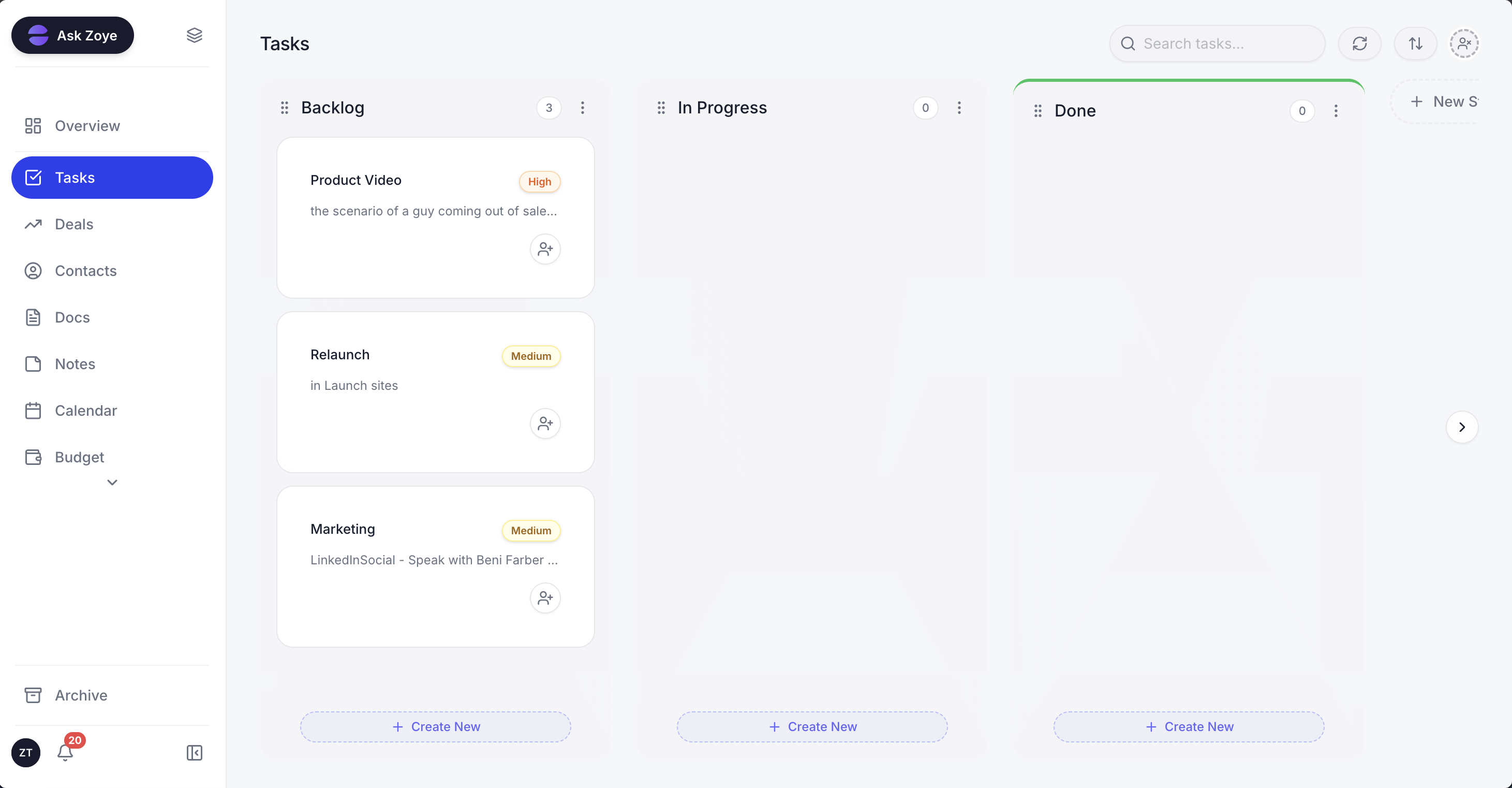 Zoye: a board view where the AI operator captures, updates, and follows up on the work itself
In practice that means tasks, deals, contacts, calendar, and reports live in one place, and the assistant takes real action across all of them from a single instruction. You can ask it in plain words to "follow up with everyone who enquired this week and did not reply," and it does it, rather than handing you a rule to configure. You build new automations by describing them, for example "when a new lead comes in from WhatsApp, save the contact, reply with our intro, and remind me to call tomorrow."
Real example: A 12-person marketing agency runs its whole intake from WhatsApp. A prospect messages on a Friday evening. Zoye captures the lead, files the contact, replies with the agency's intro and a booking link, and drafts a follow-up task for Monday, all before anyone opens a laptop. In Notion or monday.com that same sequence would be several manual steps across boards someone has to remember to update, and neither would have caught the message in the first place.
Want to see it in action?
Watch how Zoye automates your daily workflow - from lead management to team collaboration.
See How It WorksWhen to choose each
Choose Notion if:
- You want a flexible canvas for docs, wikis, and lightweight databases in one place
- You enjoy designing your own system and will maintain it
- Your work lives mostly in documents and knowledge, not customer pipelines
- You are a solo user or small team where its cheaper pricing shines
Choose monday.com if:
- You want colourful, visual boards your team can pick up quickly
- Board-driven project tracking with manager dashboards is your core need
- You want a more structured, ready-made CRM product and will keep it updated
- You can absorb per-seat pricing and rising AI or automation credits as you grow
Choose Zoye if:
- You want a tool that runs the work, not another surface to maintain
- You need leads captured, the CRM kept current, and follow-ups chased automatically
- You want to build automations by describing them in plain language
- You run a lot of your business from WhatsApp and want the AI to handle conversations
- You prefer flat tier-based pricing with AI included on every plan
Frequently asked questions
For a single user or a tiny team, Notion is usually cheaper, and its free plan is generous for personal use. monday.com bills per seat with a three-seat minimum on paid plans, so costs climb faster as you add people. But both charge per seat and both put their strongest AI behind extra cost, so the real number depends on team size and how much AI you use. (Pricing as of July 2026 - check each vendor's pricing page.)
monday.com includes AI features such as its AI assistant and AI blocks, with usage credits that scale by plan and heavier use pushing you toward higher tiers. Notion AI is a paid add-on layered on top of your plan. Neither includes an AI that actually runs your work end to end at entry-level prices - both mainly draft, summarise, and answer questions. (Pricing as of July 2026 - check each vendor's pricing page.)
It depends on how you work. Notion suits teams that want a flexible canvas for docs, wikis, and lightweight databases and do not mind building their own structure. monday.com suits teams that want ready-made colourful boards to track projects and are willing to configure and maintain them. Neither runs the customer-facing work for you - capturing leads, chasing follow-ups, booking clients - which is where a small business actually loses time.
Notion does not ship a purpose-built CRM. You can build one from its databases, and many teams do, but it stays a manual system you have to design and keep updated. monday.com sells a dedicated CRM product on top of its work OS. Both still depend on someone entering the data and sending every follow-up. Zoye keeps its own customer records and does the follow-through itself.
Not really. Both give you automation recipes you configure with triggers and actions, but you still design every rule and operate the tool day to day. Zoye is different: it is an AI operator that captures leads, updates the CRM itself, chases follow-ups, and books clients, and you build new automations by describing them in a plain sentence, including over WhatsApp.
The bottom line
Notion and monday.com are both strong tools built for different tastes. Notion is the flexible canvas for teams that want to design their own system and live in docs and databases. monday.com is the visual work OS for teams that want ready-made boards and dashboards and will keep them configured. Pick Notion if you love building and maintaining your own structure; pick monday.com if you want colourful boards your team adopts fast.
But if the honest question is which one will run your small business rather than sit there waiting for you to feed it, neither is built for that. Both are surfaces you maintain, and maintenance is exactly what a busy owner runs out of. Zoye is the third option: an AI operator that captures the leads, keeps the records current, and chases the follow-ups itself, with a real CRM, WhatsApp, and AI included on every plan, and flat pricing that does not rise every time you hire.
For more context, see the best CRM software, business automation for small business, the best marketing project management software, and the rest of the Zoye blog.