
The 7 Best CRM Software Platforms in 2026
CRM software is genuinely powerful in 2026. The leading platforms track every contact, score every lead, forecast every quarter, and automate large parts of the sales process. For a dedicated sales team that lives inside a pipeline all day, that depth is exactly the point.
The problem is that a CRM rarely lives alone. A deal that closes turns into onboarding tasks, a customer call turns into a calendar event, a signed contract turns into an invoice and a budget line, and the founder still wants a single report that ties all of it together. Standalone CRM software handles the contacts and the pipeline, then leaves you to stitch the rest together with a separate task app, a separate calendar, a separate docs tool, and a separate reporting layer. Each one is another subscription, another login, and another silo where information goes to hide.
This guide compares the seven best CRM software platforms in 2026. It is written for the teams who feel that gap most: small businesses, founders, agencies, and lean sales teams who want a CRM that connects to the rest of how they actually run the business, not one that adds another island to the map.
Pricing reflects published rates as of June 2026; check each vendor's pricing page for current figures.
Why teams are rethinking their CRM in 2026
Four shifts are pushing teams to re-evaluate the CRM they have.
Tool sprawl has become the real cost. The headline price of a CRM is rarely the full bill. Around it sits a task tool, a calendar app, a documents tool, a budget tracker, and a reporting layer, each charged per seat. For a growing team, that stack quietly becomes the largest line in the software budget, and every tool in it is a separate place data can fall out of sync.
AI is now table stakes, but most of it only suggests. Every major CRM has bolted on an AI feature: lead scoring, email drafting, a chat sidebar. The useful question in 2026 is no longer whether a CRM has AI, but whether that AI takes action. Most assistants summarise a record or propose a draft and then wait for you to do the actual work. A smaller group can create the deal, link the contact, and assign the follow-up themselves.
Per-seat pricing punishes growth. The per-user model made sense when a CRM was used only by closers. Now operations, finance, and support all need visibility, so every new hire who simply needs to see the pipeline adds another seat fee. Flat-rate platforms remove that tax and let the whole company work from the same data.
Customers moved to messaging. A growing share of customer conversations happen on WhatsApp and other messaging channels, not email. CRM software built around an email inbox treats those threads as an afterthought, which means the most important conversations often never reach the system of record at all.
The 7 best CRM software platforms in 2026
1. Zoye - the all-in-one workspace with a CRM that takes action
Zoye is the strongest CRM software pick for teams who want the contacts-and-deals core of a CRM without spinning up four other tools around it. It is an AI-native all-in-one workspace: the CRM sits alongside tasks, calendar, budget, and reports, and a single assistant works across all of it.
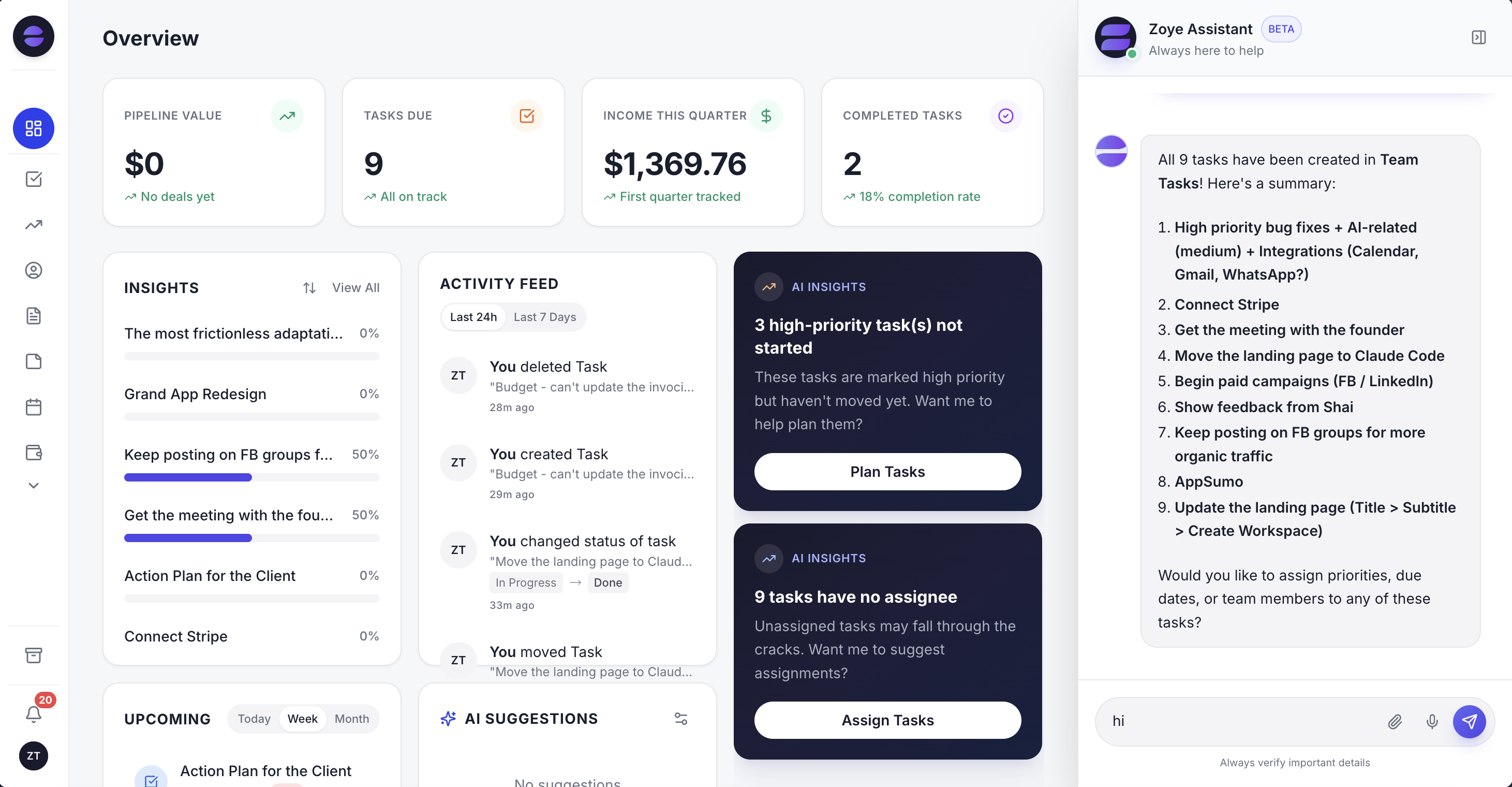 Zoye keeps contacts, deals, tasks, and calendar in one AI-native workspace.
The CRM itself covers what you expect: a contacts database that separates people from companies, a visual deals pipeline with custom stages, customer conversations centralised in one place, and full activity history on every record. Because contacts and deals live in the same workspace as tasks and the calendar, a deal links directly to the follow-ups it generates and the meetings on the schedule, with no integration to wire up and nothing to keep in sync by hand.
The differentiator is the Zoye Assistant, which takes action rather than just offering advice. Tell it about a call you just finished and it opens the deal, creates the contact, links them together, drafts the follow-up message, and assigns a task with a due date, all from one plain-language instruction typed or spoken. It prioritises your pipeline by deadline and deal value, surfaces deals that have gone quiet and tasks that are overdue before you go looking, and builds a report on demand instead of making you assemble one. Because Zoye centralises customer conversations and connects to WhatsApp, the assistant can read an incoming message and draft a reply or open a deal straight from the thread.
Around the CRM sits the rest of the workspace: tasks with list, board, calendar, and timeline views, a calendar where deadlines and meetings live together, budget and expense tracking, and reports that pull from contacts, deals, tasks, and finance into one exportable dashboard. Collaborative notes are rolling out to bring docs into the same workspace. To be straight about it, Zoye is a unified workspace with a strong, modern CRM, not a twenty-year enterprise sales platform with every advanced sales-ops feature Salesforce has accumulated. For most small businesses and lean teams, that breadth in one place is worth far more than enterprise depth they will never use.
Pricing: Almost Free at $5 per month for 1 member with the full platform including AI. Starter from $29 per month (10 members). Growth from $59 per month (20 members). Scale from $119 per month (100 members). Every tool and integration is included on every plan.
Best for: Small businesses, founders, and lean teams who want a real CRM plus tasks, calendar, and reports in one AI-native workspace.
2. HubSpot - the marketing-led CRM that gets expensive fast
HubSpot built its CRM around inbound marketing, and that origin shapes everything. The free tier is genuinely useful for a very small team, and the platform is polished. The limitation is the climb: the moment you need real marketing automation, reporting depth, or higher contact limits, the jump from Starter to Professional is steep, and most of the AI features sit behind paid tiers. Teams that primarily need a sales pipeline can find themselves paying for a marketing suite they barely touch.
Pricing: Free plan with limits. Starter around $15 per user per month, Professional around $90 per user per month, scaling up from there (as of June 2026, check HubSpot's pricing page).
Best for: Marketing-led teams that want acquisition and CRM in one place and can absorb the tier jumps.
3. Salesforce - the enterprise standard, with enterprise overhead
Salesforce is the most feature-complete CRM in the market, with the deepest customisation, the broadest app ecosystem, and the most mature AI through Einstein. That power is also its drawback. This is not a tool you configure in an afternoon: most organisations need a dedicated admin or an outside consultant to get real value from it, and the total cost of ownership climbs quickly once you add seats and implementation. For teams under fifty people, the depth is usually more than the workflow needs.
Pricing: Around $25 per user per month at the entry tier, rising to roughly $175 (Enterprise) and $350 (Unlimited) per user per month at the top (as of June 2026, check Salesforce's pricing page).
Best for: Large enterprises with complex, multi-team sales processes and the resources to administer them.
4. Zoho CRM - affordable, strongest inside the Zoho suite
Zoho CRM competes on price and on integration depth within the wider Zoho product family. Its Zia assistant brings lead scoring and anomaly detection at a fraction of the cost of Salesforce or HubSpot, and for teams already running Zoho Books or Zoho Desk the cross-suite story is a genuine advantage. The limitation appears outside that ecosystem: the integration narrative weakens, the interface can feel dated, and the breadth of modules can overwhelm a team that just wants a clean pipeline.
Pricing: Standard around $14 per user per month, scaling to Enterprise and Ultimate tiers (as of June 2026, check Zoho's pricing page).
Best for: Budget-conscious teams already invested in the Zoho ecosystem.
5. Pipedrive - the cleanest pure sales pipeline
Pipedrive was designed by salespeople for salespeople, and the focus shows. The visual pipeline is clean and intuitive, a team can be productive on day one, and the AI additions sit on top of an experience that was already strong. The trade-off is deliberate narrowness: Pipedrive is a CRM and only a CRM. It does not handle task management beyond deal activities, has no document management, no budget tracking, and no native calendar of its own, so teams that need more than pipeline oversight end up buying tools alongside it.
Pricing: Essential around $14 per seat per month, rising through Advanced, Professional, and Enterprise tiers (as of June 2026, check Pipedrive's pricing page).
Best for: Deal-focused sales teams that want a clean pipeline and nothing extra.
6. Freshsales - sales engagement with AI at every touchpoint
Freshsales, part of the Freshworks suite, uses its Freddy AI to read customer engagement signals: which leads are showing intent, which deals are going stale, and what message a prospect is most likely to answer. It covers the sales layer well at an accessible entry price. The limitation is scope: like the other pure CRMs here, Freshsales stops at contacts, deals, and communication, and does not extend into documents, budget, or cross-functional task management the way an all-in-one workspace does.
Pricing: Growth tier around $9 per user per month, scaling to Pro and Enterprise (billed annually, as of June 2026, check the Freshworks pricing page).
Best for: Sales teams that want AI-driven engagement insights on a modest budget.
7. monday CRM - a flexible CRM built on a work platform
monday CRM applies the colourful, building-block approach of monday.com's work platform to sales. It is highly customisable, visually friendly, and appealing to teams that like to shape their own workflows and boards. The trade-off is the flip side of that flexibility: the CRM is a newer layer on a general work-management platform rather than a sales-first tool, so deeper CRM capabilities can feel less mature, and the customisation that makes it powerful also means more setup before it fits the way you sell.
Pricing: Per-seat tiers with a minimum seat count, typically billed annually (as of June 2026, check monday.com's pricing page).
Best for: Teams already on monday.com that want a customisable CRM on the same platform.
Best CRM software for small business
For most small businesses, the right CRM is the one that does not force a second stack around it. A ten-person company does not want a CRM plus a separate task tool plus a separate calendar plus a separate budget tracker, each billed per seat and each holding a slice of the truth. That is why Zoye is the clearest small-business pick: the CRM, tasks, calendar, budget, and reports live in one workspace, the entry plan covers one member for $5 per month, and flat-rate pricing means adding the rest of the team does not multiply the bill.
Pipedrive is the runner-up if the business is purely a sales operation and genuinely needs nothing beyond a pipeline. HubSpot suits a small business whose growth is marketing-led and who can grow into its tiers. The deciding question is simple: do you need only a pipeline, or do you need a CRM that connects to everything else you run?
Best AI-powered CRM
Every CRM on this list now markets AI, so the useful distinction is between AI that suggests and AI that acts. Salesforce Einstein, HubSpot Breeze, Zoho Zia, and Freshsales Freddy are all capable, and they lead with scoring, summaries, and drafting. In each case, though, the AI hands the result back to you to execute.
Zoye is the pick when you want the assistant to do the work. Ask it to log the call you just had, and it creates the deal, links the contact, drafts the follow-up, and assigns the task in one step. It prioritises the pipeline by deadline and value, flags the deals that have gone quiet without being asked, and produces the weekly report on demand. The difference between a CRM that drafts an email and one that opens the deal, links the contact, and books the follow-up is the difference between a helpful sidebar and a teammate who clears the busywork.
How to choose a CRM
Three questions narrow the field quickly.
1. Do you need only a pipeline, or a connected workspace? If your team lives entirely inside deals and wants nothing else, a focused CRM like Pipedrive does the job well. If a closed deal turns into tasks, meetings, invoices, and reports, an all-in-one workspace like Zoye removes the integration overhead and the duplicate data entry.
2. What does it actually cost at your team size? Multiply the per-seat price by everyone who needs access, not just the closers, and add any AI tier billed separately. Compare that total against a flat-rate plan. For a growing team, the gap is often large.
3. Does the AI take action or only advise? During a trial, ask the assistant to create a deal, link a contact, and assign a follow-up in one instruction. If it returns a draft instead of changing the records, the AI is a writing layer, not an operations layer.
Why teams pick Zoye
A few reasons come up again and again.
The stack consolidates. CRM, tasks, calendar, budget, and reports live in one workspace, so the team stops paying for and switching between five disconnected tools.
The pricing scales sanely. Flat-rate plans mean a solo founder today and a twenty-person team next year work from the same workspace without per-seat fees eating the budget as they hire.
The AI does the work. The assistant opens deals, links contacts, drafts follow-ups, prioritises the pipeline, surfaces what is slipping, and builds reports on demand, instead of waiting to be asked.
The customers reach you where they are. Because Zoye centralises customer conversations and connects to WhatsApp, the messages that matter most land in the system of record, and the assistant can draft the reply.
Try Zoye with your team. The entry plan is Almost Free at $5 per month for 1 member, with the full platform including AI.
For more context, see the best AI CRMs in 2026, our breakdown of HubSpot vs Salesforce, the best Zoho CRM alternatives, and the Zoye pricing page.