
Best CRM for Lawyers in 2026: 7 Options for Mexico and Spain
A law firm in Mexico City or Madrid rarely loses a client on the strength of the argument. It loses them on a Friday afternoon, when someone writes on WhatsApp asking how much a divorce costs, nobody answers until Monday, and by Monday that person has already paid a retainer to the office that replied in four minutes.
The daily reality of a small practice is that the enquiry does not arrive through a tidy web form. It arrives as a voice note at eleven at night, as a message from a cousin of a former client, as a call while you are in a hearing. Then comes the part nobody enjoys: asking the client for their ID six times, reminding them that the hearing is on Tuesday, and sending the fee reminder that has been sitting in your drafts for three weeks. That is the operating cost of running a firm, and it is exactly the work that stops happening in a busy week.
This guide compares the seven best options for managing clients in a law firm in 2026, with the Mexican and Spanish markets in mind. It is not a ranking of who has the longest feature list. It is a ranking of how much of that operating work each tool actually takes off your desk. And one clarification up front: none of these is case-management software for running the matter itself. What is discussed here is the front door of the practice, which is where the fees leak.
Pricing reflects published rates as of August 2026; check each vendor's pricing page for current figures.
Why law firms are changing tools in 2026
Four things have shifted in the last two years.
The first consultation is negotiated on WhatsApp. In Mexico and Spain, a person looking for a lawyer writes rather than calls. They ask what it costs, how long it takes, and whether you handle that kind of case, and they ask three offices at once. A tool that does not live where that conversation happens is a tool that will be filled in after the fact, which in practice means never.
Whoever answers first is usually retained. It is not about being the best lawyer, it is about being present at the moment of anxiety. A system that only sends you a notification does not help when the phone is on silent inside a courtroom. What changes the outcome is having something that replies with substance while you cannot.
Nobody wants a second job maintaining software. Plenty of firms bought a program, spent a weekend configuring pipelines, and abandoned it within two months because keeping it up to date competed with billable hours. The tool that survives in a small practice is the one that does not need feeding.
Per-seat pricing punishes exactly the wrong moment. Most CRMs charge per user per month. The moment you hire a junior and a paralegal, the bill jumps, right when cash is tightest. Flat-rate options protect the margin of a growing firm.
The 7 best CRM options for lawyers in 2026
1. Zoye - the AI operator that answers, books, and chases
Zoye is the strongest option for a firm that does not want one more system to maintain, but something that works while the lawyer is in court. It is not a database you keep up to date: it is an AI operator that picks up the enquiry the moment it arrives, replies, qualifies what the person needs, books the consultation on the calendar, and chases the documents and the fees on its own.
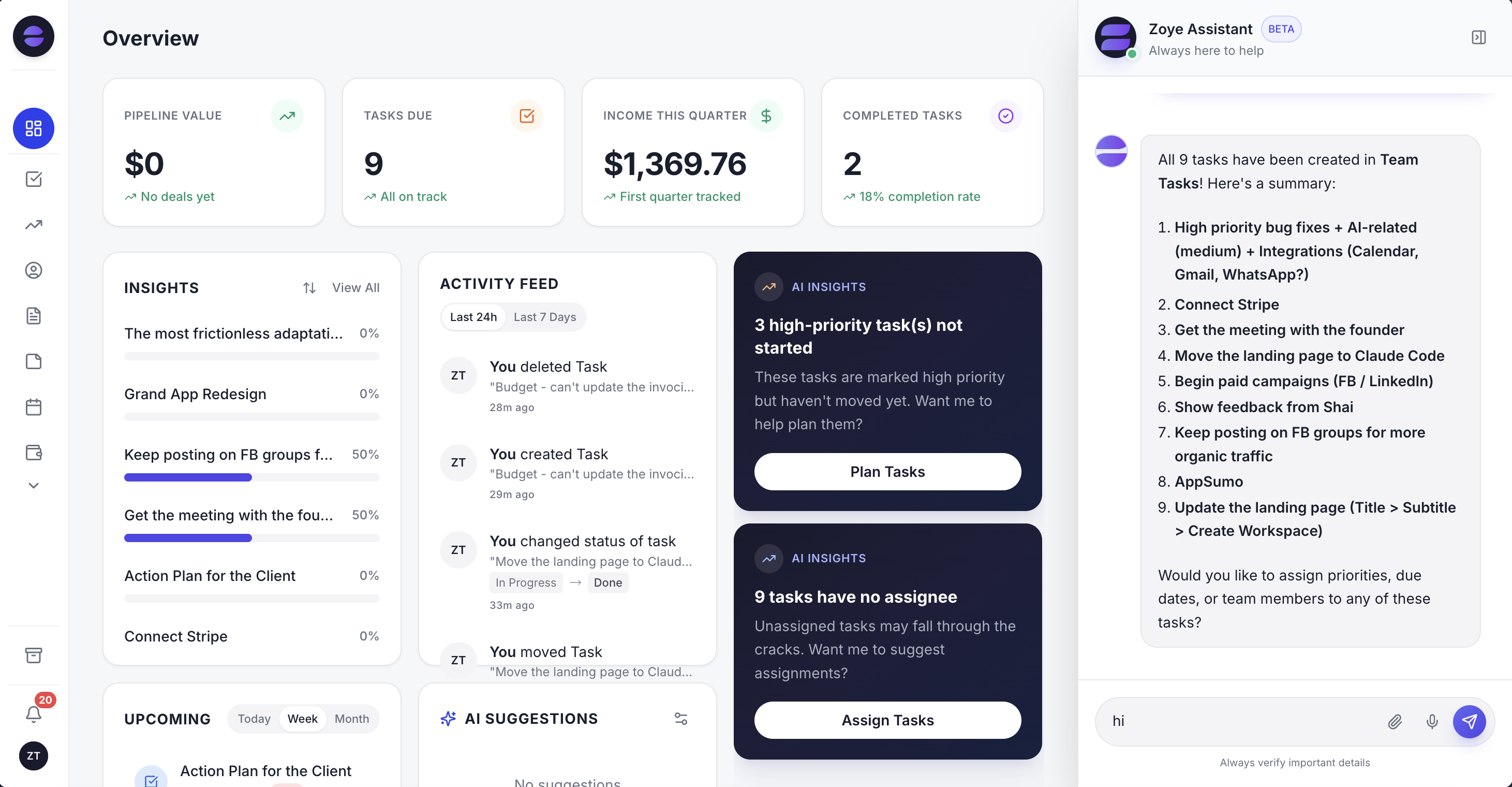 The Zoye dashboard brings enquiries, consultations, and pending follow-ups into a single view, with the assistant ready to act.
The difference is what the assistant does rather than suggests. When someone writes at eleven at night asking about a labour dispute, the assistant answers within seconds with useful information, records the enquiry as a lead with the type of matter attached, offers two slots for the initial consultation, and puts the confirmed one on the calendar. If the person goes quiet, it comes back two days later. If they book, it sends the reminder the day before so the meeting actually happens.
The same applies to the part of the practice that eats the most hours and produces the least joy. Asking a client for their identity document, the deed, or the payslips turns into a follow-up sequence the assistant runs by itself over WhatsApp or email until the file is complete. Hearing dates and internal deadlines become reminders that go out without you creating them one by one. The unpaid fee that has been outstanding for a month gets a polite nudge that is easier for software to send than for the lawyer who has to see that client again next week.
Around the assistant, Zoye holds everything a small firm needs in a single workspace: client and enquiry records, a calendar for consultations, hearings, and internal deadlines, budget and fee tracking, and reports that show how many enquiries came in, how many turned into signed matters, and where they were lost. Everything can be seen as a list, a Kanban board, a calendar, or a timeline, with no configuration.
And instead of building automations on a complicated canvas, you write in plain Spanish what you want to happen, for example "when someone writes asking about a divorce, reply with the initial consultation fee and offer me a slot on Thursday", and the assistant builds and runs it.
One honest note: Zoye is not a legal practice-management suite. It does not run the matter file, procedural deadlines, or specialist billing. Its job is the front door and the ongoing relationship, which is precisely where clients are lost.
Pricing: Almost Free from 5 USD per month for 1 member and 1GB of storage, with the full platform including AI. Starter from 29 USD per month (10 members, 5GB). Growth from 59 USD per month (20 members, 10GB, 24/7 support). Scale from 119 USD per month (100 members, 25GB), plus a Customize tier with tailored limits and dedicated support.
Best for: solo lawyers and small firms in Mexico and Spain who want the first reply and the chasing to stop depending on their memory.
2. Kommo - the pipeline with a WhatsApp inbox
Kommo, formerly amoCRM, is widely used across Latin America for a simple reason: it puts WhatsApp conversations inside a visual sales pipeline, and for a firm that wants to see every enquiry as a card moving toward a signed engagement, that view is genuinely useful. Its integration catalogue is broad and the mobile app is decent.
The cost is that you assemble it. The stages, the triggers, and the bots have to be designed, connected, and tuned, and that configuration becomes a project of its own that competes with billable work. It organizes the conversation well, but the operation still runs on you.
Pricing: paid tiers per user per month; check the Kommo site for current figures.
Best for: firms that want a visual pipeline with WhatsApp attached and do not mind configuring it.
3. HubSpot - the generic CRM with a free tier
HubSpot is a very capable general-purpose CRM with a well-known free plan, a clean interface, and an enormous ecosystem. A firm can adapt it to intake with custom properties, a pipeline of enquiries, and email sequences, and the reporting is better than most.
The catch is in the word generic. It knows nothing about matter types, hearings, or document collection until someone sets that up, and the features that matter for a small practice, such as serious automation, climb the price ladder quickly. It is a strong tool if you have someone to configure and maintain it.
Pricing: free plan with limits; paid tiers rise quickly per user per month.
Best for: firms with someone to own the configuration who already use HubSpot for marketing.
4. Zoho CRM - the low-cost configurable option
Zoho CRM is one of the most affordable serious CRMs on the market, it has a solid Spanish interface, and it can be shaped into almost anything with custom modules and fields. For a price-sensitive firm that enjoys building its own system, it goes a long way for the money.
The trade-off is the same as with any construction kit: the tool arrives empty and the result depends entirely on how much time you invest in it. And the Zoho suite is so broad that finding where a given setting lives becomes its own skill. It organizes and automates, but only after you have told it exactly how.
Pricing: accessible paid tiers per user per month; check the Zoho site.
Best for: firms with a tight budget and the patience to configure their own system.
Want to see it in action?
Watch how Zoye automates your daily workflow - from lead management to team collaboration.
See How It Works5. Clientify - the CRM with marketing for the Spanish-speaking market
Clientify is popular in Spain and gaining ground in Latin America because it combines CRM with marketing tools, landing pages, and email campaigns in Spanish, with support in the same language and time zone. For a firm that also wants to run its own client acquisition, that combination is convenient.
Its limit is that it is designed for commercial sales teams. Adapting it to a legal practice means renaming stages and inventing fields, and the follow-up work, the actual chasing, remains manual. It brings you the enquiry, but it does not handle the enquiry.
Pricing: paid tiers per user per month; check the Clientify site.
Best for: firms in Spain that want CRM and marketing in Spanish in one place.
6. Legal practice-management suites - built for the matter, not the enquiry
The specialist software category, with the international suites and the local products for the Mexican and Spanish markets, exists to run what happens after the client signs: the matter file, the documents, procedural deadlines, hours, and fee notes. If the firm handles volume litigation, this kind of tool is not optional.
The blind spot is consistent across the category: they assume a client already exists. Capturing the person who wrote on WhatsApp before deciding, replying in minutes, and chasing them until they book is not what they were built for. Many firms end up pairing a suite for matters with something else for the front door.
Pricing: varies widely by product and firm size; ask for a demo and current pricing.
Best for: firms that need matter, document, and deadline management for the legal work itself.
7. Spreadsheets and WhatsApp Business - the honest starting point
It deserves a place on the list because it is what most solo practices actually use: a spreadsheet of enquiries, WhatsApp Business with labels, and the phone calendar. It costs nothing, everyone knows how to use it, and for the first months it works.
It breaks in a predictable way. The spreadsheet is updated when there is time, which is never, the labels stop matching reality, and the follow-up depends entirely on remembering. It is not a bad system, it is a system with a single point of failure: you.
Pricing: free.
Best for: a practice just starting out that has not yet reached a steady flow of enquiries.
CRM for lawyers in Mexico
In Mexico the first contact happens on WhatsApp almost without exception, and it usually starts with the same two questions: how much does it cost and how long does it take. The firm that answers those two questions clearly and quickly is the one that gets the consultation, regardless of how the website looks.
That is why Kommo has done so well in the market: it brings the chats into a pipeline. The half it does not solve is the reply itself. An operator like Zoye covers precisely that gap: it answers with substance while you are in a hearing, records the enquiry with the type of matter attached, and offers a slot in your calendar without you touching the phone. For a two-lawyer practice competing with larger firms, being the office that always replies is a real advantage, and it is one of the few that can be automated.
Referrals matter just as much. A former client who recommends you sends someone who writes with no context, and if that person waits two days they simply write to somebody else. Automatic first contact protects the source of business that most Mexican firms depend on the most.
CRM for lawyers in Spain
In Spain the picture is a little different. Firms tend to have a more established digital presence, the web form and email still carry weight alongside WhatsApp, and specialist legal software is more entrenched, especially in offices that handle litigation volume.
What repeats is the gap. The specialist suite runs the matter file well and knows nothing about the person who wrote on Saturday asking about an eviction. The generic CRM, or Clientify, brings the enquiry in but leaves the chasing to the team. For a Spanish firm the practical value of an operator like Zoye is in the middle of that sandwich: automatic first reply, consultation booked on the calendar, document collection chased until the file is complete, and hearing reminders that go out on their own, while the matter itself stays in whatever tool already runs it.
See what Zoye can do for you
From CRM and deal tracking to AI-powered task management - explore everything Zoye offers in one workspace.
Explore FeaturesThe work a law firm actually wants to hand over
Beyond features, it helps to name the tasks that eat the week in a small practice, because that is the real yardstick for any tool.
The reply outside office hours. Enquiries do not respect a schedule, and the ones that arrive at night or at the weekend are the most likely to be lost. Anything that answers on your behalf, with correct information, recovers clients you never knew you had.
Document collection. The ID, the payslip, the contract, the deed. Chasing it is repetitive, mildly uncomfortable, and completely delegable to a sequence that reminds the client until the file is complete.
Hearing and deadline reminders. Not for you alone, for the client too. A client who forgets a hearing or misses a signing costs far more than the reminder would have.
The fee follow-up. The awkward conversation nobody wants. A polite automated reminder recovers money that would otherwise sit unpaid for months, without straining the relationship.
Reactivating the old client. Someone you handled a matter for two years ago has other needs, and a firm that stays in touch gets called first. This never happens manually because it is nobody's urgent task.
How to choose the right CRM for your firm
Three questions narrow the list quickly.
1. Where does your first contact arrive? If it is WhatsApp, and in Mexico and Spain it almost always is, you need conversation and follow-up in the same place, not a CRM you copy chats into by hand.
2. Do you want to organize information, or have someone do the work? If a tidy record of enquiries is enough, almost any option here works. If you want the first reply, the booking, and the chasing to happen on their own, you need an operator, not a database.
3. What happens when the firm grows? Check how the price scales before you commit. Per-seat models spike the moment you hire, and migrating a firm's data twice in three years is a cost nobody budgets for.
Why law firms choose Zoye
Three things come up again and again in the practices that stay.
The first reply stops depending on being available. The assistant answers, qualifies, and books over WhatsApp at any hour, so an enquiry that arrives during a hearing does not become a lost client.
There is no tool to maintain. Instead of filling in records and creating reminders one by one, you say what you want in plain language and the operator updates the record, books, and chases by itself.
Everything lives in one place. Enquiries, clients, the consultation and hearing calendar, fees, and reports in a single workspace, with no jumping between five apps or paying per seat every time the firm grows.
Try Zoye in your firm. The Almost Free plan starts at 5 USD per month for 1 member, with the full platform including AI, and you can upgrade or cancel whenever you want.
Ready to streamline your business?
Zoye brings AI-powered CRM, task management, and automation into one workspace.
Get StartedFor more context, see the CRM for lawyers guide, the Kommo alternatives, and the CRM for salons.