The Best CRM for Interior Designers in 2026
Interior design is a business where the work is visual and the failure is administrative. Nobody loses a project because a scheme was ugly. They lose it because an enquiry sat for four days, because the client was never told the sofa had a fourteen-week lead time, or because a variation agreed in a WhatsApp message in March was invisible by June when the invoice arrived.
That is an uncomfortable thing to accept when your training is in space, light and materials. But the studios that grow are rarely the ones with the best eye. They are the ones where the enquiry gets answered the same day, the proposal goes out when promised, the approval is chased, and the scope is written down.
This guide covers what a design studio actually needs on the client side, where the line sits between interior design software and a CRM, how to stop unqualified enquiries eating your week, and how an AI operator changes the arithmetic for a small studio.
What an interior designer actually needs
Strip away the feature lists and the commercial job comes down to six things.
| Need | What it looks like on a normal week |
|---|---|
| Fast, filtered enquiry handling | Every enquiry gets a same-day reply and a budget question before a site visit |
| Consultations that convert | The proposal follows the meeting within days, not whenever there is a gap |
| Approvals that move | The client who has not signed off the scheme is chased before the trade is booked |
| Written scope | Anything outside the agreement becomes a variation before work starts |
| One client thread | Messages, decisions, dates and documents live on the project, not on a phone |
| Money that arrives | Deposits and stage payments are followed up without an awkward conversation |
None of these require a product library. Your design software, if you use one, handles specification properly and should keep doing so. The gap is everything that happens around it, and that is where small studios lose both time and margin.
Where the line sits: design software versus CRM
This distinction saves a lot of wasted subscription money, and it runs in both directions.
Interior design software is built around the product. Specification sheets, sourcing, purchase orders, tracking what has shipped and what is delayed, reconciling supplier invoices against what the client was billed, and handling margin on trade pricing. Studio Designer, Design Manager, Houzz Pro, Mydoma and their peers exist because this is genuinely specialist work, and general tools do it badly.
A CRM is built around the relationship. Which enquiry deserves your time, who has not replied to the proposal, who has not approved the scheme, which invoice is overdue, and which client message is still sitting unanswered at nine at night.
The common mistake is buying the first and assuming it covers the second. It rarely does. Design platforms are strong from the moment a project exists and weak before that, which means the part of the business that determines whether you have projects at all is usually still being run from an email inbox and a phone.
The opposite mistake is rarer but worth naming: a general CRM is not going to manage your purchase orders, and a studio that tries to force it will end up with a spreadsheet anyway.
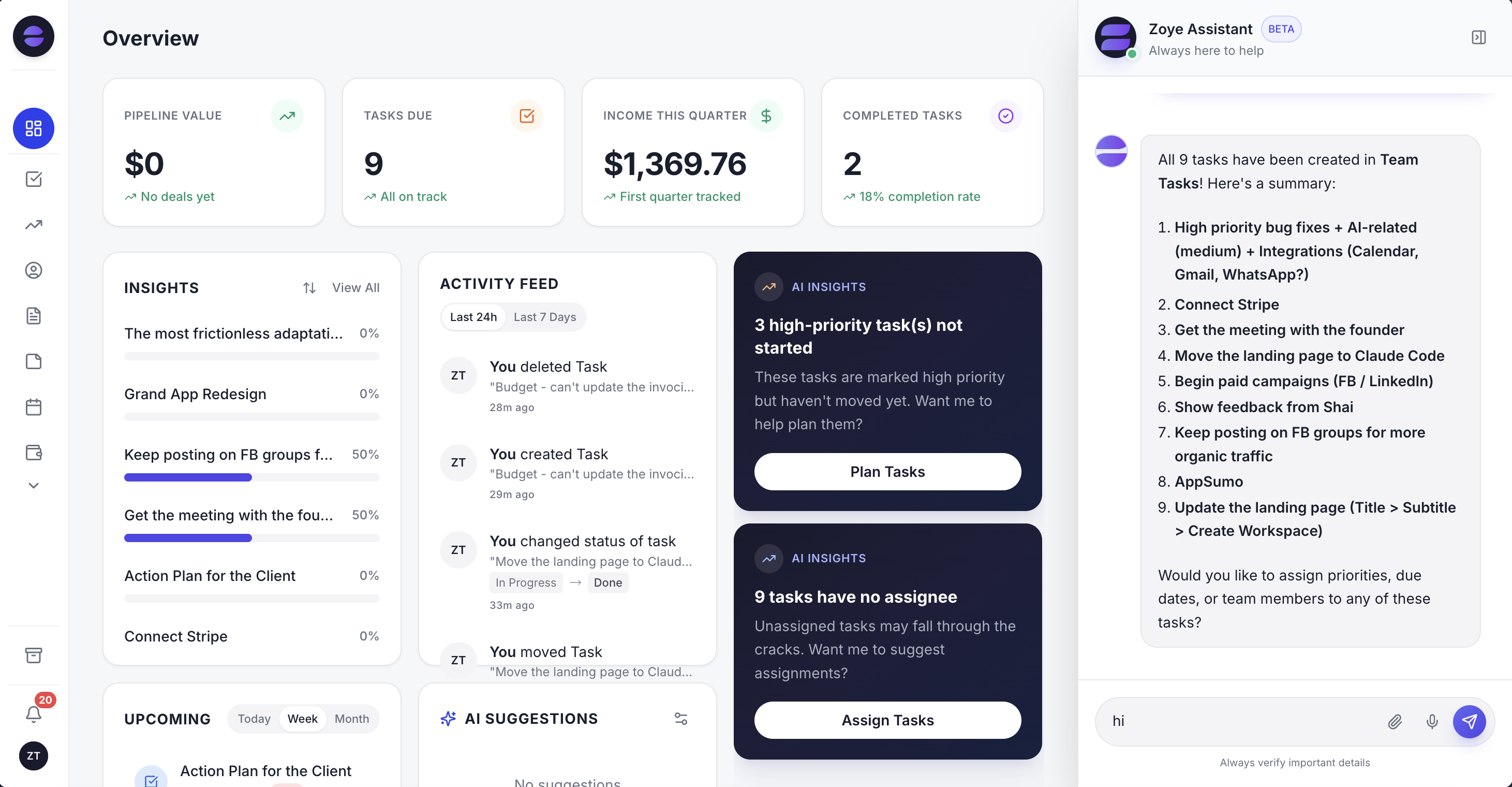 The Zoye dashboard: your whole business at a glance, with proactive AI Insights and Zoye Assistant always available on the right
The enquiry that quietly costs you three weeks
Every studio knows the pattern. An enquiry arrives, it sounds promising, a site visit is arranged, two hours go on travel and conversation, a proposal is written, and then nothing. Not a rejection, just silence. Repeat that three times in a month and you have spent the better part of a week on work that was never going to happen.
The cause is almost always the same: qualification was skipped because it felt rude to ask about money early. So the budget conversation happened at the proposal stage, which is the most expensive possible moment to discover that the client was thinking of a figure a fraction of yours.
The remedy is not a hard sales script. It is three questions asked consistently and early, in a tone that is helpful rather than gatekeeping.
What is the realistic budget range for the whole project, including furniture. When does the property need to be finished, and is it available now or still in build. And who else is involved in the decision, because a spouse or a partner who has not been in the conversation is the single most common reason a signed-off scheme unravels.
Asked early, these save weeks. Asked late, they end projects. In Zoye the assistant can put them into the first exchange naturally, record the answers against the lead, and flag the enquiries that are worth your Saturday.
Scope creep is a documentation problem
Most designers describe scope creep as a client-behaviour problem. In practice it is nearly always a record-keeping problem wearing that disguise.
Here is the mechanism. A client asks for something small in a message. It genuinely is small, so you say yes. It is never written down as a variation because writing it down felt disproportionate. Six weeks later there have been eleven of those, the project is a month behind, and when you finally raise it the client is genuinely surprised, because from their side each request was tiny and none was ever refused.
Nobody behaved badly. The system failed. And the fix is not firmness, it is friction in the right place: a written variation, issued quickly, before the work starts.
| What arrives | What usually happens | What should happen |
|---|---|---|
| A small request in a message | Agreed verbally, never recorded | Logged on the project, answered in writing |
| A change after approval | Absorbed to keep the peace | Priced as a variation before work begins |
| A delay caused by the client | Quietly swallowed into the schedule | Recorded, with the revised date confirmed |
| A supplier lead-time change | Communicated late, if at all | Passed on the day you learn it |
| An approval given verbally on site | Remembered, not documented | Confirmed in a message that lands on the record |
The reason a CRM helps here is unglamorous but decisive: when the conversation and the project record are the same place, documenting a variation stops being a separate administrative task you do later. Later is what never happens.
The photograph problem
Design is the rare profession where most client decisions arrive as images. A photograph of a wall in afternoon light, a screenshot from a magazine, a snap of a sample against a floor. These are not chat, they are the project record, and in most studios they live on a phone.
The consequences show up months later. The client says they approved the darker stain, you remember the lighter one, and the only evidence is somewhere in four thousand messages. Or a freelancer who worked on the project for six weeks leaves, and with them goes the only copy of what the client agreed about the joinery.
There is also a subtler cost. When images are trapped in a thread, nobody can see the project as a whole. You end up rebuilding context before every client call, scrolling back to remember where things stood, which is ten unbillable minutes repeated across every live job.
The fix is not a stricter filing habit, because filing is exactly what gets skipped in a busy week. It is that the conversation and the project record should be the same thing, so an image lands where it belongs without anyone deciding to move it. In Zoye the exchange attaches itself to the client and the project automatically, which means the approval, the rejection and the photograph that prompted both are together when you need them.
Getting paid without the awkward conversation
Design fees have an uncomfortable shape. The deposit funds the work, the stage payments keep it moving, and the final invoice arrives at exactly the moment the client is emotionally finished with the project and least inclined to engage with paperwork.
Most studios handle this badly, not through disorganisation but through reluctance. Chasing money feels like it damages a relationship you have spent months building, so the reminder gets postponed, then postponed again, and by the time it goes out it has acquired an apologetic tone that invites negotiation.
The studios that do this well have removed the emotion by removing the decision. The reminder is scheduled when the invoice is issued, it goes out on time whether or not anyone feels like sending it, and because it is routine it reads as routine. Clients respond to that. What they push back on is the message that arrives six weeks late and sounds like a complaint.
This is precisely the kind of task worth handing to a system. Zoye can follow up an unpaid deposit on the schedule you set, in a tone you have approved, without you having to spend twenty minutes composing something that does not sound resentful.
Where generic tools fall short for studios
Three patterns come up repeatedly.
The inbox and the phone. This is how most studios start, and it works up to roughly the point where you are running three projects at once. It breaks in predictable ways: an enquiry buried under supplier emails, a client decision made in a message nobody transcribed, and a proposal that went out late because the week filled up with site visits.
Project management tools. Asana, Trello, Notion and their relatives are genuinely good at tasks and genuinely poor at clients. They will hold your schedule beautifully and do nothing about the enquiry that arrived on Friday night. Studios that adopt them usually end up with an organised project list and an unchanged pipeline.
General CRMs and client platforms. HoneyBook, Dubsado, Pipedrive and similar give you a pipeline, forms and contracts. The limitation is the same one every service business hits: they record what should happen and leave the doing to you. The reminder fires while you are on a site with a client and a joiner, it gets dismissed, and the chase never goes out. A tool that displays an overdue approval is not the same as a tool that follows it up.
How Zoye runs the client side for you
Zoye is not a tidier inbox. It is an AI Business Operator: you brief it the way you would brief a competent studio manager, in a sentence, and it carries the work out.
On a normal studio week that looks like this. An enquiry arrives on Saturday evening and gets a warm, useful reply within minutes, including the budget and timeline questions, so by Monday you know whether it deserves a visit. The proposal you promised on Tuesday gets chased on Friday if the client has gone quiet. The scheme awaiting sign-off gets a polite nudge before you commit the trades. The deposit that was due last week gets followed up without you having to compose an uncomfortable message. And the client who sent three photographs at eleven at night has them attached to the right project, not lost in a thread.
You set those routines up by describing them. Telling the assistant to chase any proposal that has gone unanswered for five days, and to remind you when a scheme has been awaiting approval for a week, is enough for it to build and run that automation. There is no workflow canvas to maintain, which matters in a studio where the person who would maintain it is the person billing hours.
Behind the assistant sits a full workspace: CRM with client and enquiry records, tasks in list, board, calendar and timeline views, a shared calendar, budget tracking, and reports drawn from all of it.
See what Zoye can do for you
From CRM and deal tracking to AI-powered task management - explore everything Zoye offers in one workspace.
Explore FeaturesMapping the needs to the features
| What a studio needs | How Zoye handles it |
|---|---|
| Fast, filtered enquiry handling | The assistant replies immediately and asks the qualifying questions in the conversation |
| Consultations that convert | Proposals get chased on a schedule instead of when you remember |
| Approvals that move | Schemes awaiting sign-off are nudged before trades are committed |
| Written scope | Requests land on the project record, so a variation is one step, not a separate job |
| One client thread | Messages, photographs, decisions and dates sit on the same project |
| Money that arrives | Deposits and stage payments are followed up automatically |
| Reporting | Enquiry-to-consultation and consultation-to-project rates come from real activity |
The referral you never asked for
Interior design is a referral business more than almost any other trade, and most studios treat referrals as weather: pleasant when they arrive, impossible to influence. That is not quite true.
Referrals come disproportionately from two moments. The first is the handover, when the client is standing in a finished room and feeling something. The second is roughly six months later, when they have lived in it, hosted in it, and had three people ask who did the work. Almost nobody in the profession contacts a client at that second moment, which is precisely when the recommendation is easiest to make and most likely to convert.
The reason is not indifference. It is that six months is far beyond the horizon of any studio's working memory. The project closed, the file went quiet, and the calendar moved on. Without a system that surfaces it, that moment arrives and passes unobserved every single time.
This is the kind of thing worth automating precisely because it is low-effort and high-value. A short, warm message at the right distance from completion, asking how the space is working and whether they would be happy to be mentioned as a reference, costs nothing and lands well. Zoye can schedule it at project close so it goes out months later without anyone remembering, which is the only way it ever actually happens.
What to measure after thirty days
Studios tend to judge software on whether it feels organised. That is the wrong test, and it is why so many subscriptions survive without earning anything. Four numbers answer the question honestly.
| What to check | What good looks like | What it tells you |
|---|---|---|
| Median first reply time | Hours, including evenings and weekends | Whether enquiries are being answered while they are still warm |
| Enquiries reaching consultation | Lower than before, deliberately | Whether qualification is filtering out the time-wasters |
| Consultation to signed project | Higher than before | Whether you are meeting better-matched clients |
| Variations issued in writing | A real number, not zero | Whether scope is being controlled or absorbed |
That second row surprises people. A good qualification process should reduce the number of site visits you give, not increase it. If consultations are flat but conversions have not moved, you are still meeting everybody who asks.
Solo designer, small studio, or established practice?
The right answer differs sharply by stage, and it is worth being honest about which one you are.
Solo designers and new studios have one bottleneck: everything depends on one person, and that person is on site. Enquiries go cold not because they were unwanted but because nobody was free. For this group the highest-value software is whatever answers and chases without waiting for a gap in the day, and procurement software is usually premature.
Small studios of two to six people hit a different wall. There is now more than one person in the client conversation, which means context lives in several heads and several phones. The cost is duplicated questions, contradictory answers, and the unpleasant discovery that the only record of an approval left with a freelancer. This is the stage where a shared client record stops being nice and starts being necessary.
Established practices with procurement in-house genuinely need dedicated design software, and should buy it. The question for them is not whether to replace it but whether the pipeline and client communication that sit in front of it are being run with the same rigour, which in most practices they are not.
What it costs
Pricing splits sharply by what the product was built to do.
| Option | Typical monthly cost for a 4-person studio |
|---|---|
| Zoye | $29 flat (up to 10 members, AI included) |
| Inbox, phone and a spreadsheet | $0, plus the enquiries that went cold and the scope never billed |
| General CRM or client platform | ~$56 to $100, per user, before add-ons |
| Dedicated interior design platform | ~$200 to $400, per user tiers, procurement modules extra |
Pricing reflects published rates as of September 2026 and varies by tier and region. Check each vendor's pricing page for current figures.
The entry tier, Almost Free, is $5 per month, or $4 per month on annual billing, and gives one designer the whole platform with the AI assistant included. A studio of up to 10 people sits on Starter at $29 per month, and up to 20 on Growth at $59 per month, whatever the project count.
The honest framing is this: if you already run design software, Zoye is an addition, and the comparison is what the client layer costs on top. Against a single unbilled variation, or one enquiry converted that would otherwise have gone cold, that arithmetic resolves quickly.
Four mistakes that cost studios the most
Giving consultations before asking about budget. The most expensive habit in the profession, and the easiest to fix. The question is not rude when it is framed as making sure you propose something realistic.
Letting client decisions live in messages. A fabric approved in a chat that nobody transferred to the project is a dispute waiting to happen, and you will lose it, because the client remembers differently and you have no record.
Treating scope conversations as relationship risk. Designers avoid them to protect goodwill, then resent the project. Clients almost never object to a variation raised promptly and politely. They object to one raised at the end.
Buying procurement software to solve a sales problem. If your issue is that enquiries go cold and proposals go unchased, a product library will not touch it, and you will have spent four figures discovering that.
Ready to streamline your business?
Zoye brings AI-powered CRM, task management, and automation into one workspace.
Get StartedThe takeaway
Interior design studios do not usually lose money on design. They lose it in the space around the work: the enquiry answered on Tuesday, the proposal that went unchased, the variation nobody wrote down, and the deposit nobody asked for twice.
The software that fixes that is not the one with the biggest product catalogue. It is the one that answers while you are on site, asks the awkward question early so you do not waste a Saturday, and chases the approval without you having to remember. Zoye's entry Almost Free plan is $5 per month, or $4 per month billed annually, with the full platform and AI included, so you can cancel or upgrade at any point.
And judge it after a month on the number most studios never look at: how many variations you issued in writing. If that figure moved off zero, the software has already paid for itself several times over.
For more context, see the CRM for photographers, the CRM for contractors, the best HoneyBook alternatives, the guide to how to stop losing leads, and the rest of the Zoye blog.