
The Best CRM for Immigration Consultants in 2026
Immigration consultancy has an unusual operational shape. The advice itself is a small fraction of the hours. The overwhelming majority of the work is collecting documents from people, tracking dates that cannot slip, and reassuring anxious clients who are waiting on decisions neither of you controls.
That is why most practices feel busier than their case volume suggests. A consultant with thirty live files is not doing thirty files of advisory work. They are sending the same document reminder for the eleventh time, checking a spreadsheet to make sure nothing expires this month, and answering the same status question from a client who asked four days ago and is genuinely frightened.
This guide covers what an immigration practice actually needs operationally, where the line sits between regulated case management software and a CRM, how to stop document chasing eating your week, and how an AI operator changes the arithmetic for a small practice.
What an immigration consultant actually needs
Strip away the feature lists and the operational job comes down to six things.
| Need | What it looks like on a normal week |
|---|---|
| Enquiries screened before consultation | Eligibility, visa route and timeline established before a paid hour is booked |
| Documents that arrive | Missing items chased by name, repeatedly, without a person doing it |
| Deadlines that cannot slip | Filing windows and expiries carry owners and warn long before they bite |
| Clients who feel informed | Status updates go out during long waits, so nobody has to ask twice |
| One case thread | Messages, documents, dates and decisions live on the case, not in an inbox |
| Fees collected on time | Staged payments followed up without an uncomfortable conversation |
None of these are advisory. Your case management system, if you use one, holds the forms and the filings properly and should keep doing so. The gap is the operational layer wrapped around it, and that is where a small practice loses most of its capacity.
Where the line sits: case management versus CRM
This boundary is more important in immigration than in most sectors, because one side of it is regulated and the other is not.
Immigration case management software holds the regulated substance. Government forms, electronic filing where available, case records structured the way your regulator expects, and the audit trail that proves what was submitted and when. Docketwise, INSZoom, Officio and their peers exist for this, and no general tool should be improvised into the role.
A CRM is the operational and commercial layer. Which enquiry deserves a consultation, which client still owes a birth certificate, which deadline is four weeks out, which applicant has not heard from you since submission, and which invoice is unpaid.
The mistake that costs the most is assuming the case management platform's client-facing features cover the second job. Most include a document request portal, and a portal is a place where documents can be uploaded. It is not a system that notices they have not been, works out which specific items are missing, and asks again next Tuesday.
The opposite mistake matters more here than elsewhere. Do not use a general CRM to store regulated case data or to substitute for compliance records. Keep the regulated material where it belongs.
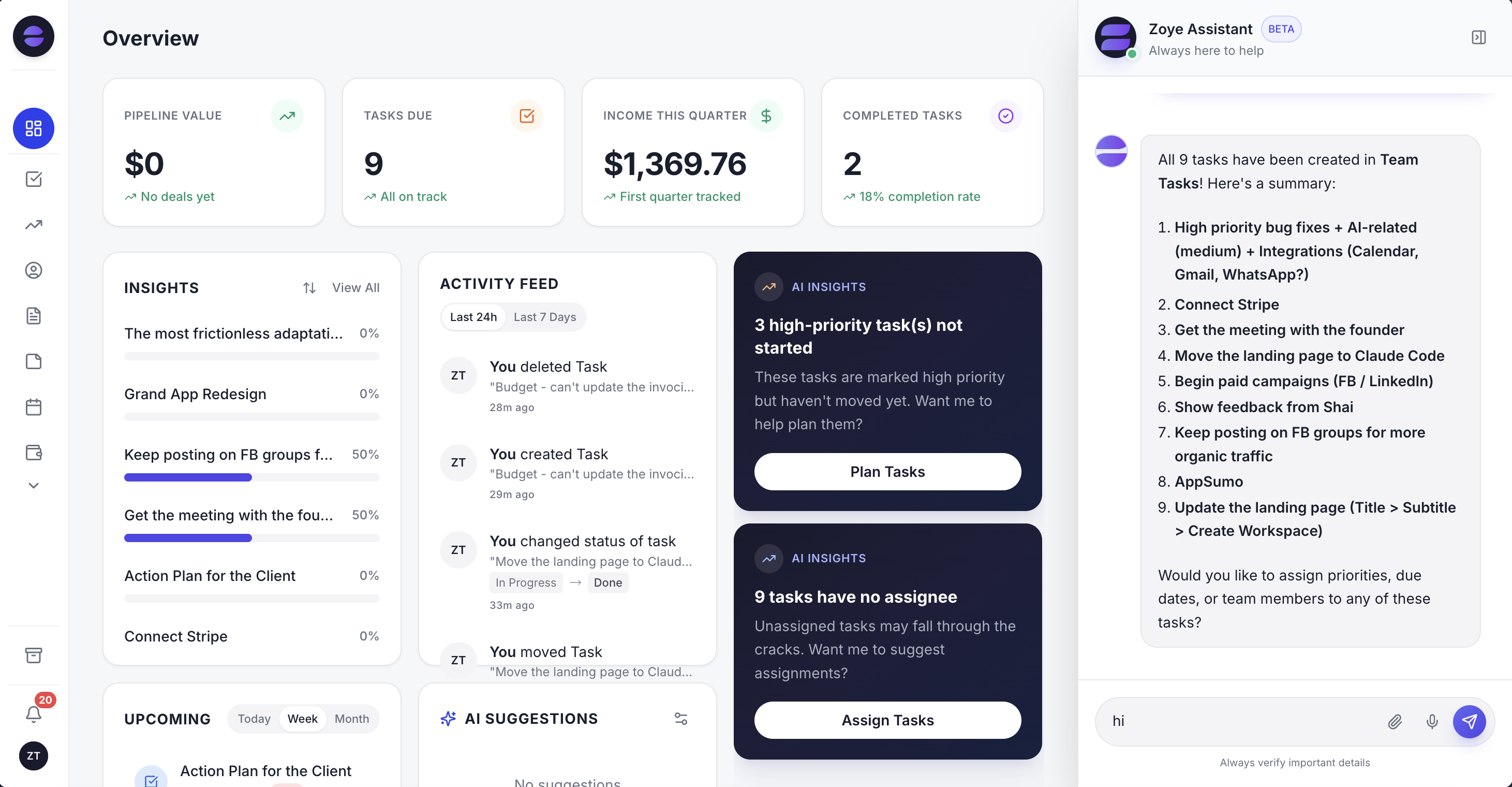 The Zoye dashboard: your whole business at a glance, with proactive AI Insights and Zoye Assistant always available on the right
Document chasing is the real job
Ask any immigration consultant where their week goes and the answer is documents. Not advice, not strategy, not the interesting parts of the law. Chasing a client for a marriage certificate, a bank statement covering the right six months, a translated qualification, a passport page they photographed badly.
The pattern is remarkably consistent. You send a list of nine items. The client sends four, usually the easy four. The remaining five sit there. You chase the whole list again, which is mildly insulting to a client who already sent four things. They send one more. Three remain. Weeks pass. Eventually the deadline forces a phone call that should never have been necessary.
Two structural fixes matter more than any amount of diligence.
The first is that reminders must name the specific outstanding items, not resend the original list. A client who receives "we still need your 2024 tax assessment and your spouse's birth certificate" acts. A client who receives the same nine-item list for the third time feels nagged and does nothing.
The second is that the reminder must repeat on its own schedule. Every practice intends to follow up weekly. No practice does, because following up on twenty cases means twenty decisions, and those decisions lose to whatever is urgent today.
| The chase | What most practices do | What actually works |
|---|---|---|
| First request | A full list of required documents | The same, plus a clear deadline |
| One week later | Nothing, or a resend of the full list | Name only the items still missing |
| Two weeks later | An apologetic nudge if someone remembers | Automatic reminder, same specificity |
| Deadline approaching | Panic phone call | Escalation to a human, with the gap already known |
| Nothing received | Case drifts | Flagged for a decision about the file |
With Zoye you describe that rather than build it: tell the assistant to chase outstanding documents weekly, naming only what is missing, and to alert you when a case has items outstanding within thirty days of a deadline.
Deadlines that end people's lives if you miss them
Every profession has deadlines. Immigration has a category that is genuinely different, because the consequence of missing a filing window is not a late fee. It can be loss of status, separation from family, or removal.
That changes what an acceptable system looks like. A single calendar alert on the day is not adequate, and neither is a spreadsheet that only one person maintains. The practices that never miss a date share three characteristics.
Every deadline sits in the same system as the client and the documents, so the question "are we ready for this one" can be answered without opening three tools. Every deadline has an owner, named, not implied. And every deadline has a chain of warnings rather than a single one: far enough out to gather documents, close enough to escalate, and a final one that cannot be silently dismissed.
There is a fourth characteristic worth adding. The warning should be tied to readiness, not only to the date. A filing window in six weeks with all documents collected is a calendar entry. The same window with three documents outstanding is a problem that needs attention now, and a system that cannot tell the difference is not helping you.
The anxious client is a workload, not a personality
Immigration clients are frightened in a way that clients of most professional services are not. Their case is about where they live, whether their family is together, and whether the life they have built continues. Anxiety on that scale produces behaviour that looks like impatience and is actually fear.
Practically, it produces a specific and large workload: the repeated status question. A client asks on Monday, is told the application is with the authorities, and asks again on Thursday because four days of silence felt like something had gone wrong.
Most practices treat this as an irritation to be absorbed. It is more useful to treat it as a signal that the communication cadence is wrong. When clients are told proactively, at a predictable rhythm, that nothing has changed and the case remains in the queue, the volume of inbound status questions drops sharply. The client is not asking because they want information. They are asking because silence is unbearable when the stakes are this high.
A short, regular update during the waiting period is therefore not a nicety. It is the cheapest workload reduction available to an immigration practice, and it also happens to be the thing clients remember when they recommend you.
The consultation you should never have given
Immigration enquiries arrive in enormous volume and convert at a low rate, which makes screening more valuable here than in almost any comparable profession. A consultant who gives paid or unpaid consultations to everyone who asks will spend a large share of their week on cases that were never viable.
The screening that prevents this is a short set of factual questions, and none of them require giving advice. What nationality and current status does the applicant hold, because that determines which routes exist at all. Where are they physically located now, since in-country and out-of-country applications differ fundamentally. What is the actual timeline, because someone whose permission expires in nine days is a different conversation from someone planning next year. And has this case been refused before, since a previous refusal changes both the strategy and the honest probability.
That last question matters more than consultants often expect. Applicants frequently do not volunteer a prior refusal, sometimes from embarrassment and sometimes because they were advised not to. Discovering it after you have quoted and begun work is a genuinely difficult conversation, and asking plainly at enquiry stage avoids it entirely.
None of this is advice, and none of it requires a regulated adviser to gather. It is factual intake, and it is exactly the kind of structured questioning an assistant can carry out in the first conversation so that your consultation hours go to the cases that can actually proceed.
Where generic tools fall short for practices
Three patterns come up repeatedly.
Spreadsheets and an inbox. Most small practices run this way and it holds until roughly twenty live files. It breaks in three places: the document nobody noticed was still missing, the deadline visible only to the person who maintains the sheet, and the enquiry that arrived while everyone was in consultations.
The case management system's client portal. Genuinely useful for secure document upload, and worth having. The limit is that a portal is passive. It waits. It does not work out that a client uploaded four of nine items eleven days ago and has gone quiet.
General CRMs. Pipedrive, HubSpot and Zoho give you a clean pipeline and per-user pricing. They hit the same wall every service business hits: they record what should happen and leave the doing to you. The task fires while you are mid-consultation, it gets dismissed, and the document is never chased. A tool that lists outstanding items is not a tool that asks for them.
How Zoye runs the operational side for you
Zoye is not a tidier case list. It is an AI Business Operator: you brief it the way you would brief a capable practice manager, in a sentence, and it carries the work out.
On a normal practice week that looks like this. An enquiry arrives at eleven at night from a different time zone and gets a fast, useful reply that establishes route, timeline and circumstances before you spend a consultation hour on it. The six clients with outstanding documents each get a reminder naming only what is still missing. The case with a filing window in five weeks and two documents outstanding is escalated to you, while the one that is fully prepared simply sits in the calendar. Every client in a long waiting period gets a scheduled update. And the client who has now asked the same status question three times gets an answer immediately rather than after your next gap.
You build those routines by describing them. Telling the assistant to chase missing documents weekly by name, to warn you at ninety, thirty and seven days before any filing date, and to update waiting clients fortnightly is enough for it to build and run those automations.
Behind the assistant sits a complete workspace: CRM with client and case records, tasks in list, board, calendar and timeline views, a shared calendar, budget tracking, and reports drawn from all of it.
See what Zoye can do for you
From CRM and deal tracking to AI-powered task management - explore everything Zoye offers in one workspace.
Explore FeaturesMapping the needs to the features
| What a practice needs | How Zoye handles it |
|---|---|
| Enquiries screened before consultation | The assistant establishes route and circumstances in the conversation |
| Documents that arrive | Weekly chases naming only the outstanding items, running on their own |
| Deadlines that cannot slip | Warning chains tied to readiness, not just to the date |
| Clients who feel informed | Scheduled updates through long waits, so inbound questions fall |
| One case thread | Messages, documents, dates and decisions on the same case record |
| Fees collected on time | Staged payments followed up automatically |
| Reporting | Enquiry to consultation and consultation to instruction rates from real activity |
What to measure after thirty days
Practices tend to judge software on whether the case list looks organised. Four numbers tell you whether anything changed.
| What to check | What good looks like | What it tells you |
|---|---|---|
| Median document turnaround | Days shorter than before | Whether specific, repeating chases beat resending the list |
| Cases with items outstanding inside 30 days of a deadline | Close to zero | Whether readiness is being tracked, not just dates |
| Inbound status questions per case | Noticeably lower | Whether proactive updates replaced anxious chasing |
| Enquiries converted to instruction | Higher than before | Whether screening improved who you spend consultation hours on |
That third row is the one most practices have never measured, and it is the clearest evidence of whether communication changed. Inbound status questions are a direct tax on your week, and they fall when clients stop feeling forgotten.
Solo consultant, small practice, or multi-adviser firm?
The right answer differs by size, and the failure modes differ too.
Solo consultants have one constraint: every hour spent chasing documents is an hour not spent on billable advisory work or new enquiries. Automating the chase is not a convenience here, it is the difference between a practice that can grow and one permanently capped by admin.
Small practices of two to six develop a different problem. Cases are shared, and shared cases lose context. A client explains their circumstances to one adviser and is asked the same question by another a week later, which in immigration does real damage to confidence. This is the stage at which a single shared case thread stops being tidy and becomes a client-retention issue.
Multi-adviser firms genuinely need proper regulated case management, and should buy it. Their question is whether the operational layer around it, particularly document collection and deadline readiness, is run with the same rigour as the filings, which in most firms it is not.
What it costs
Pricing splits by whether regulated case handling is included.
| Option | Typical monthly cost for a 4-person practice |
|---|---|
| Zoye | $29 flat (up to 10 members, AI included) |
| Spreadsheet and inbox | $0, plus the missed deadline you cannot undo |
| General CRM | ~$56 to $100, per user, before add-ons |
| Immigration case management platform | ~$200 to $600, per user tiers, e-filing at the top |
Pricing reflects published rates as of September 2026 and varies by tier and region. Check each vendor's pricing page for current figures.
Pricing starts at $5 per month on the Almost Free plan, or $4 per month if you pay for the year, which covers a single consultant and includes the AI assistant rather than charging for it separately. A practice with staff moves to Starter at $29 per month for up to 10 people, or Growth at $59 per month for up to 20.
The honest framing: if you already pay for case management, Zoye sits alongside it and the comparison is what the operational layer costs on top. Against the hours a single consultant loses to manual document chasing in a month, that arithmetic is not close.
Four mistakes that cost practices the most
Resending the full document list. It reads as though you have not noticed what the client already sent, which reduces the chance they respond at all. Name only what is missing.
Tracking deadlines by date alone. A filing window with documents outstanding is a completely different situation from one that is ready. A system that shows only dates will let you walk calmly toward a problem.
Treating status questions as an interruption. They are a measurable workload created by silence, and they fall when you communicate proactively. Absorbing them is the expensive option.
Putting regulated case data in a general CRM. Keep forms, filings and compliance records in purpose-built software. The operational layer around them is a different question and a different tool.
Ready to streamline your business?
Zoye brings AI-powered CRM, task management, and automation into one workspace.
Get StartedThe takeaway
Immigration practices do not usually lose money on the advice. They lose it in the operations: the document chased by hand eleven times, the deadline tracked in one person's spreadsheet, the frightened client who asked three times because nobody told them anything, and the enquiry that went cold while everyone was in consultations.
The software that fixes that is not the one with the biggest forms library. It is the one that chases the specific missing document without you, warns you about a deadline while there is still time to act, and keeps a worried client informed through a wait neither of you controls. Zoye's entry Almost Free plan is $5 per month, or $4 per month billed annually, with the full platform and AI included, so you can cancel or upgrade at any point.
And judge it after a month on the figure most practices have never tracked: how many inbound status questions you received. When that number falls, it means your clients finally feel informed, and the hours it frees are yours.
For more context, see the CRM for lawyers, the CRM for consultants, the guide to automated follow-up emails, how to stop losing leads, and the rest of the Zoye blog.