The Best CRM for Solar Installers in 2026
Solar has an unusual shape as a business. The enquiry is cheap to generate and expensive to serve, the sales cycle runs for weeks or months, and between the signature and the switch-on sits a queue of other people's paperwork that you do not control. Most of the money that leaks out of a solar company leaks in the waiting.
It shows up in specific places. A lead that came in on Saturday and was called on Wednesday, by which point two competitors had already surveyed. A quote sent in good faith that went quiet, and was never chased because the pipeline had forty of them. A survey slot given to a rented north-facing roof. A customer four weeks into a grid connection wait who has heard nothing and is starting to wonder whether you have forgotten them.
This guide covers what a solar installer actually needs on the commercial side, where the line sits between solar design software and a CRM, how to stop unqualified enquiries burning survey days, and how an AI operator changes the arithmetic for a small installer.
What a solar installer actually needs
Strip away the feature lists and the commercial job comes down to six things.
| Need | What it looks like on a normal week |
|---|---|
| Fast, filtered lead handling | Every enquiry is answered within the hour and screened before a survey is offered |
| Surveys that happen | Appointments confirmed, reminded, and rebooked when someone does not turn up |
| Quotes that get chased | A proposal sent three weeks ago is followed up on a schedule, not on memory |
| Paperwork that moves | Grid applications, permits and incentive claims have owners and deadlines |
| Customers kept informed | The gap between deposit and install is filled with updates nobody has to write |
| Aftercare that earns referrals | The customer is contacted once the system has been running long enough to talk about |
None of these are engineering. Your design software, if you use one, sizes the system properly and should keep doing so. The gap is the process wrapped around it, which is where installers lose both margin and reputation.
Where the line sits: solar design software versus CRM
Getting this boundary right saves a lot of money, and installers get it wrong in both directions.
Solar design software turns a roof into a system. Satellite or LIDAR roof modelling, shading analysis across the year, panel layout, string and inverter sizing, yield and payback modelling, and a customer-facing proposal. Aurora Solar, OpenSolar, Solargraf, Enact and their peers exist because this is real engineering, and it is validated work you should not improvise.
A CRM is the operational and commercial layer. Which enquiry deserves a survey, who has not replied to the quote, which job is blocked on a grid application, which customer has not heard from you in a fortnight, and which invoice is unpaid.
The mistake that costs most is assuming the design platform's built-in CRM covers the second job. Some include a pipeline, and it is usually a list of deals with stages, which is not the same as something that follows up. The other mistake is trying to force a general CRM to produce proposals. It will produce something, and it will not be a document you want to put your MCS or equivalent accreditation behind.
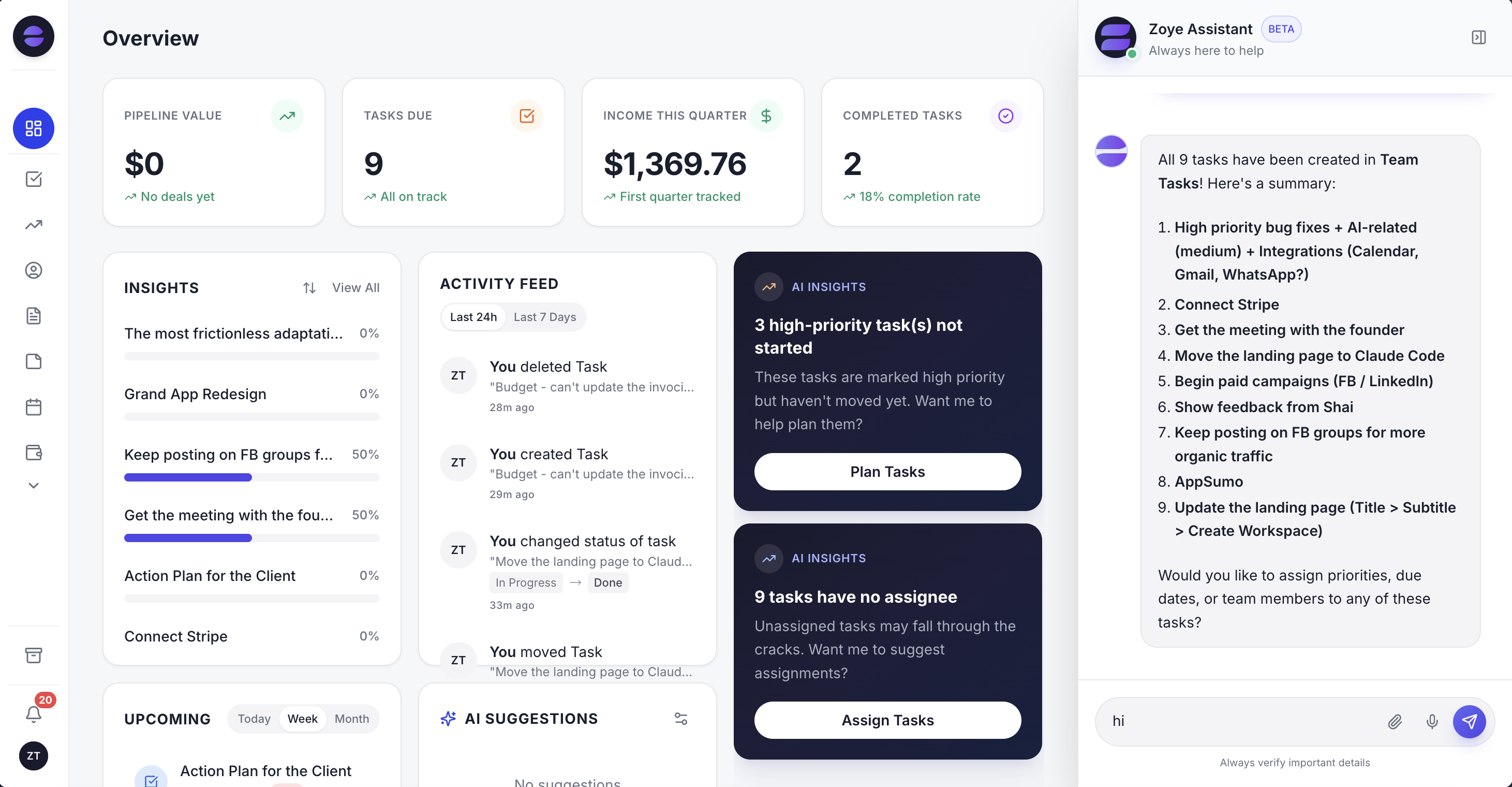 The Zoye dashboard: your whole business at a glance, with proactive AI Insights and Zoye Assistant always available on the right
The survey day you should never have given
A survey is the most expensive thing a solar company gives away for free. Travel, a skilled person for two hours, and often a follow-up design session. Run four a week and give away one that was never viable, and you have lost a quarter of your survey capacity to a job that could not proceed.
The screening that prevents this is short and almost never done consistently. Does the person own the property, because a tenant cannot authorise a roof installation. Which way does the main roof face and is there significant shading from trees or neighbouring buildings. How old is the roof covering, because nobody wants to install onto tiles that need replacing in three years. And is this a cash purchase or does it depend on finance approval, because a finance-dependent deal has an entirely different probability and timeline.
None of these questions are awkward when framed as making sure the survey is worth the customer's time too. They are only awkward when saved until after you have driven there.
| What you learn early | What it saves |
|---|---|
| The enquirer is a tenant, not the owner | A wasted survey and an uncomfortable conversation on the doorstep |
| The main roof faces north with heavy shading | A design that was never going to produce an acceptable payback |
| The roof covering is at end of life | A job that stalls or becomes a roofing argument after install |
| The deal depends on finance | A realistic timeline instead of a quote you think is imminent |
| Only one of two owners is engaged | The most common cause of a signed deal unravelling later |
That last row deserves particular attention in domestic solar. Where a property is jointly owned, a decision made with one partner and not the other is the single most reliable predictor of a deal that dies at the last moment. Finding out at the enquiry stage costs one question.
The long middle where deals go quiet
Solar sales cycles are long, and the middle is where they die. A customer who was enthusiastic in week one is comparing three quotes in week three and has gone quiet by week six, not because they decided against you but because life intervened and nobody prompted them.
Most installers know their follow-up is weak and assume the fix is discipline. It is not, because the failure is structural. When you have forty live quotes, following up properly means forty individual decisions about who to contact and what to say, and that work always loses to today's install problem.
The pattern that works is boringly mechanical. A quote gets a follow-up at day three, another at day ten, and a final one at day twenty-one, each adding something rather than simply asking again. The additions matter: a note about incentive deadlines, a reference to a similar install nearby, a straightforward offer to answer questions the other quotes have raised. And critically, the sequence runs whether or not anyone in the office is free that day.
With Zoye you set that up by describing it rather than building it. Telling the assistant to chase every quote at three days, ten days and three weeks, and to flag anything that has gone silent past that, is enough for it to build and run the sequence.
The waiting period that costs you referrals
Between the deposit and the switch-on, a domestic solar job frequently sits for weeks. Grid connection applications, scaffolding availability, panel lead times, inspection scheduling, and in many markets an incentive or export tariff registration.
From your side this is normal and you know roughly what is happening. From the customer's side they have paid a significant deposit and heard nothing, which produces exactly one thought: has this company forgotten about me. That thought does not usually generate a complaint. It generates a customer who will never recommend you, which is far more expensive in a business where referral is the cheapest lead source you have.
The fix costs almost nothing. A short update every fortnight during the wait, even when the update is that nothing has changed and the application is still with the network operator, completely removes the anxiety. Customers do not expect you to control the grid operator. They expect you to tell them what is happening.
This is a textbook case for automation, because the message is low-value to write and high-value to receive, and it is the first thing dropped in a busy week. Zoye can send it on a schedule for every job in the waiting state, with the specifics filled in, so the customer hears from you on a rhythm without anyone composing anything.
Seasonality makes follow-up worth more, not less
Solar demand is seasonal in most markets, and installers respond to that in a predictable and slightly self-defeating way. In the busy months nobody has time to chase quotes because the crews are full. In the quiet months everybody chases, but the leads being chased are now months old and cold.
The result is a business that converts worst precisely when it most needs the work. The quotes that would have closed were sent in June and abandoned in June, because June was busy, and by November they are a list of people who bought from somebody else.
The structural fix is to decouple follow-up from capacity. A quote sent in the busiest week of the year should be chased on exactly the same schedule as one sent in the quietest, because the customer's decision timeline has nothing to do with your workload. That is only achievable if the chasing does not consume a person's attention, which is the entire argument for automating it rather than resolving to try harder.
There is a second seasonal effect worth planning for. Incentive schemes, export tariffs and grant windows frequently have deadlines, and a deadline is the single most effective thing you can put in a follow-up message. An installer who knows which of their live quotes are affected by a closing window, and contacts exactly those customers with that specific fact, will convert a meaningful share of a pipeline that otherwise would have drifted into the next year.
Where generic tools fall short for installers
Three patterns come up repeatedly.
Spreadsheets and a shared inbox. Most installers start here and it holds until roughly the point where you are running two crews. It breaks in three places: the enquiry nobody claimed because everyone assumed someone else had, the quote that was never chased, and the job whose grid application deadline nobody was watching.
The design platform's built-in pipeline. Better than a spreadsheet and genuinely useful for tracking deal stages. The limitation is that it records position rather than driving action. It will tell you that eleven quotes are outstanding. It will not contact any of them.
General CRMs. Pipedrive, HubSpot and Zoho give you a clean pipeline and per-user pricing. They hit the same wall every field business hits: the reminder fires while your coordinator is on the phone to a scaffolder, it gets dismissed, and the chase never happens. A tool that lists overdue follow-ups is not the same as a tool that sends them.
How Zoye runs the commercial side for you
Zoye is not a neater pipeline. It is an AI Business Operator: you brief it the way you would brief a good operations coordinator, in a sentence, and it carries the work out.
On a normal installer week that looks like this. An enquiry arrives on Sunday evening and gets a fast, useful reply that screens for ownership, roof aspect and finance before Monday morning, so your surveyor's week fills with viable jobs. Survey appointments are confirmed and reminded, and the no-show from Tuesday gets offered a new slot without anyone deciding to send it. Quotes sent three weeks ago get chased on schedule. The four jobs sitting in grid connection limbo each get a fortnightly update. And the customer whose system has been running six weeks gets asked how it is performing, which is when referrals actually come from.
You build those routines by describing them. Telling the assistant to screen every new enquiry for ownership and roof aspect, to chase quotes at three and ten days, and to update waiting customers every fortnight is enough. It builds and runs those automations from the sentence, with no workflow canvas to maintain.
Behind the assistant sits a complete workspace: CRM with customer and job records, tasks in list, board, calendar and timeline views, a shared calendar, budget tracking, and reports drawn from all of it.
See what Zoye can do for you
From CRM and deal tracking to AI-powered task management - explore everything Zoye offers in one workspace.
Explore FeaturesMapping the needs to the features
| What an installer needs | How Zoye handles it |
|---|---|
| Fast, filtered lead handling | The assistant replies immediately and screens in the conversation itself |
| Surveys that happen | Confirmation at booking, reminder the day before, automatic rebooking after a no-show |
| Quotes that get chased | A follow-up sequence that runs regardless of who is free |
| Paperwork that moves | Grid applications and permits carry owners and deadlines that surface before they bite |
| Customers kept informed | Scheduled updates through the waiting period, written for you |
| Aftercare that earns referrals | A check-in once the system has real generation data to discuss |
| Reporting | Enquiry to survey, survey to quote and quote to install rates from real activity |
What to measure after thirty days
Installers tend to judge software on whether the pipeline looks tidy. That is the wrong test. Four numbers tell you whether anything actually changed.
| What to check | What good looks like | What it tells you |
|---|---|---|
| Median first response time | Under an hour, including evenings and weekends | Whether you are reaching leads before your competitors |
| Surveys per signed job | Lower than before | Whether screening is keeping unviable roofs off the calendar |
| Quotes chased three or more times | Close to all of them | Whether follow-up survives a busy week |
| Customers updated during the wait | Every job, every fortnight | Whether the silence that kills referrals has been closed |
That third row is usually the revelation. Most installers discover their real follow-up average is closer to one attempt than three, and that the deals they thought went cold were simply never asked a second time.
Sole trader, small installer, or regional company?
The right answer differs sharply by size, and buying for the wrong stage is common.
Sole traders and two-person outfits have one bottleneck: the person who quotes is the person on the roof. Enquiries go cold during install days, which are most days. For this group the highest-value software is whatever answers and screens without needing anyone to be free, and a full design-and-CRM platform is usually more than the business can absorb.
Small installers of three to ten people hit a different problem. There is now a coordinator, and that coordinator becomes the single point through which every quote chase, every grid application and every customer update must pass. They will drop things, not through carelessness but through volume. This is the stage where automating the routine communication stops being optional.
Regional companies with multiple crews genuinely need proper design software, scheduling depth and often integration with procurement. The question for them is not whether to buy a platform but whether the follow-up discipline in front of it is as strong as the engineering behind it, which it usually is not.
What it costs
Pricing splits sharply by whether design is bundled.
| Option | Typical monthly cost for a 6-person installer |
|---|---|
| Zoye | $29 flat (up to 10 members, AI included) |
| Spreadsheet and shared inbox | $0, plus the quotes never chased and surveys wasted |
| General CRM | ~$84 to $150, per user, before add-ons |
| Solar platform with design and CRM bundled | ~$600 to $1,800, per user tiers, design modules at the top end |
Pricing reflects published rates as of September 2026 and varies by tier and region. Check each vendor's pricing page for current figures.
An installer working alone pays $5 per month on Almost Free, or $4 per month billed annually, and the AI assistant comes with it rather than as a paid extra. A crew of up to 10 is covered by Starter at $29 per month, and up to 20 by Growth at $59 per month.
The honest framing: if you already pay for design software, Zoye sits alongside it and the comparison is what the commercial layer costs on top. Against one additional install won from a quote that would otherwise have gone quiet, that arithmetic resolves in the first month.
Four mistakes that cost installers the most
Surveying before screening. The most expensive habit in the trade. Four questions asked at enquiry save roughly one wasted survey day a week for most installers.
Treating the quote as the end of the sale. In solar the quote is the middle. The deals are won in the follow-up, and most installers stop after one attempt.
Going silent during the grid connection wait. The customer cannot tell the difference between waiting on a network operator and being forgotten. Silence costs referrals you will never know you lost.
Buying a bundled platform to fix a follow-up problem. If your issue is that quotes go unchased, better roof modelling will not touch it, and you will have committed to a significant per-seat cost to discover that.
Ready to streamline your business?
Zoye brings AI-powered CRM, task management, and automation into one workspace.
Get StartedThe takeaway
Solar installers do not usually lose money on the engineering. They lose it in the waiting: the lead called on Wednesday, the survey given to a roof that was never viable, the quote nobody chased past the first attempt, and the customer who sat in silence for a month and quietly decided not to recommend you.
The software that fixes that is not the one with the best shading model. It is the one that answers while you are on a roof, screens the enquiry before it costs you a day, chases the quote three times without being reminded, and keeps the customer informed through the part of the job you do not control. Zoye's entry Almost Free plan is $5 per month, or $4 per month billed annually, with the full platform and AI included, so you can cancel or upgrade at any point.
And judge it after a month on the figure most installers have never measured: how many of your live quotes were followed up more than once. That number is where your close rate actually lives.
For more context, see the field service management software for small business, the CRM for contractors, the guide to AI lead management, how to stop losing leads, and the rest of the Zoye blog.