
Tool Sprawl: What Nine Disconnected Apps Really Cost a Small Business
Nobody decides to run a business across nine applications. It happens the way weight does, one reasonable choice at a time. The spreadsheet was fine until two people needed it at once, so a project tool arrived. The project tool had no place for customers, so a CRM arrived. The CRM did not send invoices, so an invoicing app arrived. Then a scheduling link, a shared inbox, a form builder, a document signer, a chat tool, and something to store files in. Every one of those purchases was defensible on the day it was made. None of them was made with the others in view.
Tool sprawl is the state you end up in. Not a stack of bad software, but a stack of good software that does not know about itself. The symptom people notice first is trivial and constant: the same customer's name, typed again. The symptoms they notice later are expensive.
This guide is an honest accounting. What sprawl actually costs, where the widely repeated "consolidate everything" advice is wrong, where consolidation genuinely pays, and a concrete audit you can run this week without buying anything.
Sprawl is not a purchasing failure, it is a compounding one
It helps to be clear about what the problem is not. The problem is not that small businesses buy too much software. Modern tools are cheap, easy to trial and often genuinely excellent. Okta's annual Businesses at Work report has for years tracked the average number of applications per customer sitting in the dozens, and climbing, with the largest organisations well into the hundreds. That trend is not a story about bad judgement. It is a story about how good and how available the software became.
The problem is that each tool is evaluated alone and lives in a group. A tool's cost is its subscription. A tool's true cost is its subscription plus every connection it needs to the rest of the stack, plus every time a human becomes that connection. The second number is invisible at purchase and grows every time a new tool joins. Nine tools do not have nine relationships to maintain, they have as many as thirty-six potential pairs, and in practice a handful of those pairs carry almost all of the pain because that is where the customer record travels.
That is the whole thesis of this article, so it is worth stating plainly before the detail: sprawl hurts exactly where records move, and almost nowhere else.
The four bills, only one of which arrives
1. The re-typing tax
This is the cost everybody feels and nobody measures. A new enquiry arrives by email. The name and number go into the CRM. A task to call them goes into the project tool. A meeting goes into the calendar with the details pasted into the description because the calendar cannot see the CRM. After the call, notes go somewhere, a quote goes into the invoicing app where the customer must be created again, and the file goes into cloud storage under a folder name someone invented on the spot.
That is one customer, six tools, and at least four separate acts of typing information that already existed. Ten new enquiries a week turns it into a part-time job that nobody is assigned and nobody counts. The work is not hard, which is precisely why it never gets escalated. It just eats the day in ten-second increments.
2. The record that exists three times and disagrees with itself
Re-typing has a second-order effect that is worse than the time it takes. Once the same customer exists in the CRM, the invoicing app and the shared inbox, those three copies begin to drift. The phone number gets corrected in one of them. The company name gets a Ltd in another. Somebody marks the deal won in the CRM but the invoicing app still lists the old contact who left the company in March.
Now the business has no single answer to simple questions. Which number do we call? Which address goes on the invoice? Did we already follow up? A stack that cannot answer those questions without a human cross-checking is a stack that quietly pushes every decision back onto memory. The failure mode is not dramatic. It is a quote sent to a person who left, a duplicate follow-up that makes the business look disorganised, and a pipeline number that nobody quite trusts at the end of the month.
Want to see it in action?
Watch how Zoye automates your daily workflow - from lead management to team collaboration.
See How It Works3. Integrations that break without telling you
The standard answer to sprawl is to connect the tools. Automation platforms make this genuinely easy, and for many businesses a handful of connections is the right call. The problem is what happens afterwards.
An integration is a small piece of software that nobody owns. It was set up in twenty minutes by whoever was frustrated that day, it has no documentation, and it fails silently. A vendor changes an API version, a field gets renamed, an authorisation token expires, a plan downgrade removes webhook access. The connection stops firing. Nothing turns red, because nothing was watching. Three weeks later somebody notices that new leads stopped appearing, and there is no way to know how many were lost.
This is the sharpest difference between tools that are connected and tools that are unified. A connection between two products is a thing you maintain. A link inside one product is a thing that cannot come undone, because there is nothing between the two records to fail.
4. Per-seat bills that compound in two directions
Subscription cost is the only bill that actually arrives, and it is still routinely underestimated because per-seat pricing multiplies along two axes at once. Take an illustrative six-person business, the sort of shape a small agency or a consultancy has, running nine tools that average twelve US dollars per user per month. That is roughly 648 US dollars a month, or close to 7,800 a year, before anyone upgrades a tier to unlock the one feature they actually needed.
Then the business hires two people. The tool count did not change, but the bill went up by a third, because every new person has to be licensed everywhere. Sprawl is one of the few costs in a small business that scales with headcount and with the number of things you once decided to try. Meanwhile the usage is rarely uniform: it is common to find seats provisioned for people who log in twice a year, and entire products that survived only because nobody cancelled them.
The honest counter-argument: best-of-breed is often genuinely better
Most articles about tool sprawl end here, with a recommendation to collapse everything into one platform. That advice is half right, and the half that is wrong does real damage, so it is worth saying clearly.
Specialist tools are frequently better than the bundled equivalent, and sometimes dramatically so. A design team should use design software. A development team should use a real code host. A business with genuine accounting complexity should keep a genuine accounting ledger, with its audit trail, its tax handling and its accountant who already knows it. Hotels and short-let operators need a property management system and a channel manager, and no general workspace substitutes for those. Regulated industries frequently need systems certified for their sector.
The reason is structural rather than a matter of vendor quality. Depth wins wherever the tool is the craft itself. When the software is where the actual work is performed, the twentieth feature matters, the keyboard shortcuts matter, the file format matters, and a bundled approximation is a downgrade dressed up as convenience.
Consolidation wins somewhere else entirely: wherever the tool is mostly a place a record sits between one action and the next. A contact, a deal, a task, a meeting, an invoice and a document are not crafts. They are records, and their value comes almost entirely from being connected to each other. Splitting them across products creates work with no compensating benefit, which is why that is the part of the stack worth collapsing and the specialist part is not.
So the useful question is never "how do I get down to one tool?" It is "which of my tools exist to hold records that need to travel?"
The audit you can run this week
This takes about ninety minutes and needs nothing but a document. Do it before you evaluate any product, because it changes what you are shopping for.
Step one: list every tool. Everything anyone pays for or logs into, including the free ones, the ones on somebody's personal card, and the ones only one person uses. Expect to be surprised by the length. Note the monthly cost, the number of seats, and who the actual owner is. Any tool with no owner is already a finding.
Step two: mark the record holders. Go down the list and tick every tool that stores a customer, a lead, a deal, a task, a meeting, an invoice or a signed document. These are your record holders. The unticked tools, the design app, the ledger, the code host, the video calls, are mostly fine as they are. Sprawl lives in the ticked rows.
Step three: trace one real customer and count the hops. Pick a customer you won recently and walk their entire path, from the first enquiry to the paid invoice. At every point where a human copied, re-typed or exported information from one tool into another, write down a hop: which tool it left, which tool it entered, what information moved, and roughly how long it took.
Step four: read the hop list. This is where the answer is. Most stacks produce between four and ten hops per customer, and typically two or three of them account for most of the friction. Multiply each hop by the number of customers you handle in a month and you have a defensible number for what sprawl costs you in hours, sitting next to the number your subscriptions cost you in cash.
Step five: decide per hop, not per tool. For each hop there are only three verdicts. Automate it, if the two tools connect reliably and someone will own the connection. Eliminate it, if the two records genuinely belong in one place. Or accept it, if the hop is rare or the specialist tool on one end is worth keeping. Writing the verdict down is the point. A hop with no verdict is one you will still be paying for next year.
See what Zoye can do for you
From CRM and deal tracking to AI-powered task management - explore everything Zoye offers in one workspace.
Explore FeaturesWhere a single workspace changes the arithmetic
The reason consolidation works on record holders is not that one login is nicer than nine. It is that a link inside a single system is not maintained by anyone. It simply is.
This is the problem Zoye is built around. It is an AI Business Operator: one workspace holding thirteen tools that already reference each other, with an assistant that operates them on your behalf. CRM and contacts, tasks, deals, calendar, documents, team, budget and invoices, reports, workflow automations, WhatsApp automations, Facebook and Instagram, email tracking, and the AI Notetaker all live in the same place, and every record knows the records around it. A deal knows its contact, its tasks, its files and its invoices, because they are the same objects rather than copies that have to be reconciled.
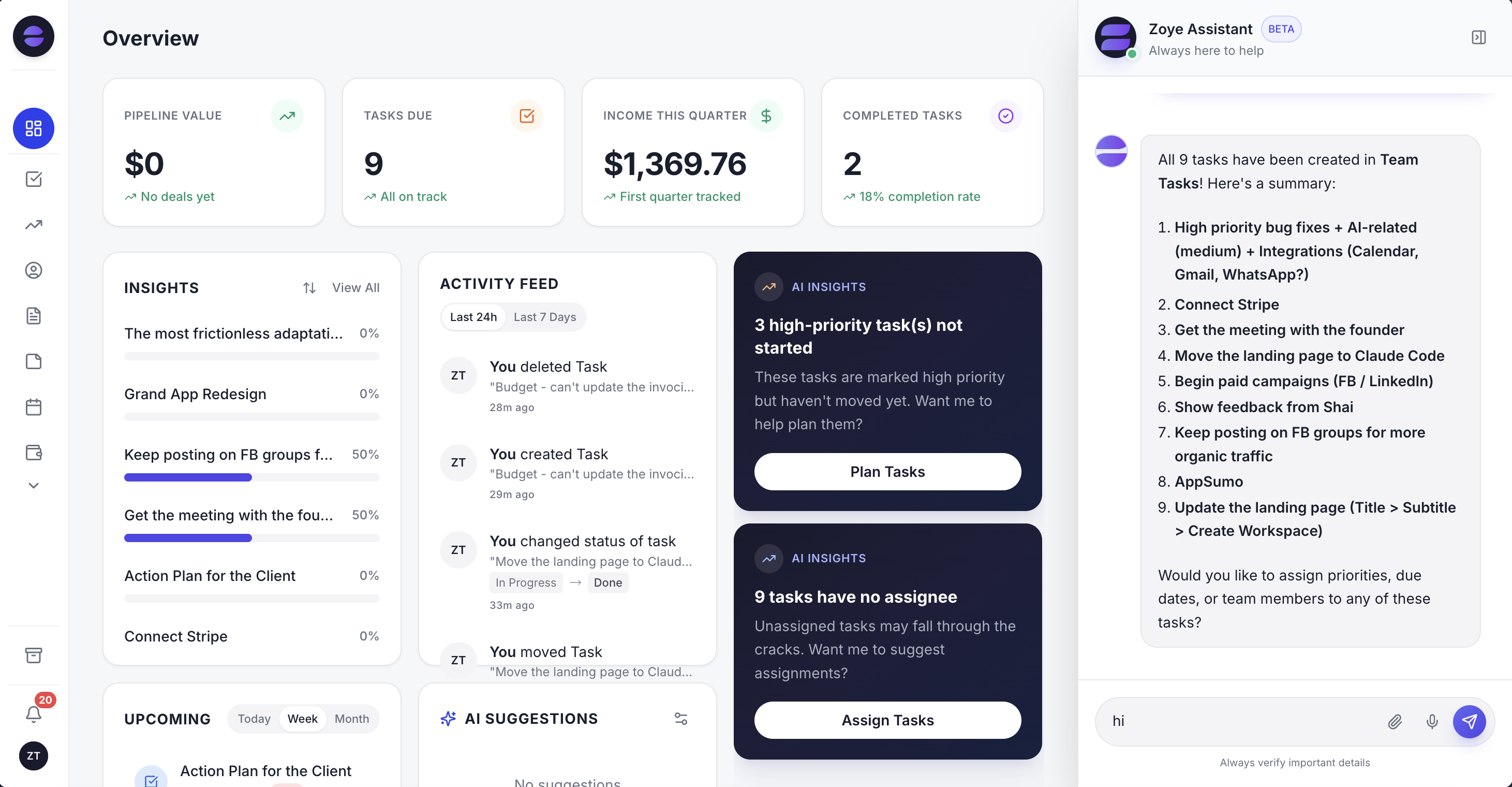
One workspace where the customer record is already linked to its deal, its tasks, its meetings and its invoices, so there is no hop to automate in the first place.
Three consequences follow from that, and they map directly onto the four bills above.
The re-typing tax mostly disappears, because the second act of typing was only ever needed to keep two systems in agreement. Ask the assistant to log a call, create the follow-up task and move the deal stage, in the app, on WhatsApp, by voice note, in Slack or through the Claude connector, and one instruction updates the record everywhere it appears. It is the same assistant with the same tools and the same permissions on every channel.
The disagreeing-record problem stops being possible in the consolidated part of the stack, because there is one record rather than three copies. Zoye also has an import path for the tools you are leaving, including Trello, Monday.com and plain spreadsheets, and the assistant will pull records out of a CSV, a PDF or a screenshot you send it, which matters because the migration itself is usually the reason people postpone fixing sprawl. Jira, Notion and ClickUp imports are coming soon.
The integration-maintenance problem shrinks to the connections you genuinely still need, since the links between contacts, deals, tasks, calendar, documents and invoices are internal. Where you do want a rule to run, you describe it in a sentence and Zoye builds the trigger, conditions and actions, shows you the finished rule in plain English, and runs nothing until you approve it. Every run is logged with what fired, what changed and what it sent, and is reversible, which is the opposite of an integration that fails in silence.
Zoye is also deliberately not everything. It is not a property management system, not a channel manager, not an accounting ledger and not a helpdesk ticketing suite, and the Notes module is collaborative docs that is still rolling out. Those are exactly the specialist categories from the counter-argument above, and keeping them separate is the right call. Any of the thirteen tools can be hidden per workspace or per person and turned back on later, so the workspace matches the shape of your business rather than the vendor's feature list. Pricing is published on the pricing page.
Ready to streamline your business?
Zoye brings AI-powered CRM, task management, and automation into one workspace.
Get StartedWhat to do with the audit once you have it
A stack does not need to be rebuilt in a weekend, and attempting it is how consolidation projects fail. The order that works is boring and effective.
Start with the single hop that costs the most hours per month, not the tool that costs the most money. Fixing one expensive hop produces a visible result within a week, which is what buys you the patience to fix the next one.
Cancel nothing until its replacement has held real work for a full billing cycle. Run the two in parallel, deliberately and briefly, and set the date you will decide. Sprawl often grows because a tool that was meant to be temporary never got switched off, and a botched migration is the fastest way to add another one.
Give every remaining tool an owner by name. Not a department, a person. The owner's only job is to know why the tool is still there, and to answer that question once a year. Tools without an owner are the ones you will find on the audit in three years, still charging, still holding a stale copy of a customer.
Finally, apply one rule to the next purchase. Before adding tool number ten, ask whether it will hold a record that already exists somewhere else. If it will, the real question is not whether the tool is good. It is who is going to keep the two copies in agreement, and what happens when they stop.
The number that actually matters
Tool count is a vanity metric. Some of the healthiest small businesses run fifteen products and feel no friction at all, because those products sit in separate lanes and no customer record ever crosses between them. Some of the most painful stacks are five tools deep, with the same contact living in every one of them and a person spending an hour a day acting as the integration.
Count the hops instead. Then decide, hop by hop, whether to automate it, eliminate it, or accept it on purpose. That is the whole discipline, and it survives every change in the software market, because it is a question about your business rather than about anyone's product.
If the answer turns out to be that most of your hops exist purely because your records live in different buildings, one connected workspace is worth a serious look.
For more on the same problem from different angles, see the guide to business management software, how to choose a CRM, and whether you need both a CRM and project management software.