
HubSpot vs Marketo 2026: Which Fits Your Team - Plus a Third Option
HubSpot and Marketo both promise to turn marketing into a machine that captures leads and nurtures them until they buy. They arrive at that promise from opposite ends of the market. HubSpot is the approachable all-rounder that a small team can switch on without a specialist. Marketo, now Adobe Marketo Engage, is enterprise marketing automation built for large databases and dedicated operations teams. Choosing between them is really a question about how big and how complex your marketing motion actually is.
There is a catch that sits underneath both, though. HubSpot and Marketo are engines you have to build and then keep running. Somebody has to design the nurture flows, write the lead-scoring rules, maintain the segments, and watch the reports. That works when you have a marketing-operations person whose whole job is to feed the machine. For a small business owner who is also doing sales, delivery, and admin, the machine often ends up half-built and quietly abandoned.
This comparison covers where each platform genuinely shines, where each gets heavy, and a third option that takes a different shape entirely: instead of a bigger engine for you to operate, an AI operator that captures and chases the leads itself. If the honest answer to "who is going to run this every week" is "nobody has time," that third option deserves a look.
Pricing reflects published rates as of July 2026; check each vendor's pricing page for current figures.
HubSpot vs Marketo at a glance
| Dimension | Zoye | HubSpot | Marketo |
|---|---|---|---|
| Core role | AI operator that runs lead capture + follow-up | All-in-one CRM + marketing platform | Enterprise marketing automation |
| Who it fits | Small and service businesses | SMB to mid-market | Mid-market to enterprise |
| Ease of use | Same-day, no specialist | Approachable, moderate setup | Steep, needs a specialist |
| Lead management | Captures + chases leads itself | Strong CRM + forms + pipelines | Deep scoring + segmentation |
| Automation | Built from a plain-language sentence | Visual workflows, tiered | Powerful, complex flows |
| Breadth | Leads, CRM, tasks, calendar, budget, reports | CRM, marketing, sales, service hubs | Marketing automation focused |
| Built-in AI | Included on every plan, takes action | AI add-ons across hubs | AI features, higher tiers |
| Native, agent can reply | Via integrations | Via integrations | |
| Entry price | Almost Free, $5/mo for 1 member, higher plans from $29/mo | Free CRM, paid tiers scale up | Enterprise quotes, no free tier |
| Best for | Getting leads chased without hiring | Growing teams wanting one suite | Large teams with ops staff |
Ease of use and setup
The first real difference shows up before anyone sends a single email.
HubSpot is built to be adopted without a marketing-operations specialist. The interface is clean, the onboarding is guided, and a small team can have a CRM, a few forms, and a basic email sequence running within a few days. The depth is there when you grow into it, but you are not forced to confront it on day one.
Marketo is built for scale and control, and the setup reflects that. Smart Lists, program templates, engagement streams, and the scoring model are powerful, but they assume someone who knows the platform. Most companies running Marketo well have either a dedicated marketing-operations hire or an agency partner. For a team without that, the ramp is measured in weeks or months, not days.
Verdict: HubSpot for teams that want to be productive quickly without a specialist. Marketo when you have the operations muscle to justify a heavier, more configurable platform.
Lead management
Both platforms are, at heart, about not letting leads slip. They approach it differently.
HubSpot gives you a genuine CRM under the marketing layer: contact records, deal pipelines, forms, landing pages, and lists all connected, so a lead captured on a form lands in the same place your sales follow-up happens. For a small-to-mid team that wants marketing and sales looking at one system, this tight coupling is HubSpot's strongest card.
Marketo goes deeper on the marketing-qualification side. Behavioural lead scoring, fine-grained segmentation, and multi-touch engagement programs let a large team route thousands of leads by fit and intent before sales ever sees them. It typically sits alongside a separate CRM such as Salesforce rather than replacing it, which is normal at enterprise scale but is extra plumbing for a small team.
Verdict: HubSpot for one connected CRM-and-marketing view. Marketo when high-volume scoring and segmentation are the point and you already run a separate CRM.
Want to see it in action?
Watch how Zoye automates your daily workflow - from lead management to team collaboration.
See How It WorksAutomation
This is where the "engine you have to build" reality bites hardest.
HubSpot workflows are visual and approachable. You can trigger emails, update properties, rotate leads, and branch on conditions, and the builder is friendly enough that a non-specialist can assemble a useful sequence. Higher tiers unlock more triggers and more complex logic.
Marketo automation is genuinely powerful. Trigger and batch campaigns, engagement programs, and Smart Campaigns can express nurture logic that few tools match. The cost of that power is complexity: building and maintaining these flows is a skilled job, and a misconfigured program can quietly send the wrong thing to the wrong segment.
Both are excellent at running automation you have designed. Neither designs it for you, and neither notices on its own that a warm lead has gone three days without a reply and decides to chase it. That gap is exactly what the third option below is built to fill.
Verdict: HubSpot for approachable automation a small team can maintain. Marketo for deep, high-control flows when you have people to build them.
Breadth: how much of the business it covers
HubSpot has grown into a suite: Marketing, Sales, Service, Content, and Operations hubs around a shared CRM. You can run a lot of the customer lifecycle inside it. The trade-off is that the value shows up when you buy into several hubs, and the price climbs with each one and with contact tiers.
Marketo is focused. It is marketing automation, and it is deep at it, but it does not try to be your CRM, your service desk, or your finance system. In an enterprise stack that is a feature, because each system does one job. For a small business it means Marketo is only ever one piece of a larger, more expensive puzzle.
Verdict: HubSpot for teams that want one suite covering more of the lifecycle. Marketo when you want a specialised marketing engine inside a larger enterprise stack.
See what Zoye can do for you
From CRM and deal tracking to AI-powered task management - explore everything Zoye offers in one workspace.
Explore FeaturesAI
Both platforms have added AI, and both use it mostly to assist rather than to act.
HubSpot has layered AI across its hubs: content assistance, email and copy drafting, predictive lead scoring, and chat-style helpers, with the richer capabilities on higher tiers. It is helpful, and it speeds up the human who is still doing the work.
Marketo brings predictive content, audience insights, and engagement optimisation, aimed at large-scale programs. Again, it makes a skilled operator faster; it does not remove the operator.
The common thread is that these AIs suggest, draft, and score. They hand work back to a person to execute. An AI that actually captures the lead, updates the record, and sends the follow-up itself is a different category, and it is where the third option comes in.
Verdict: HubSpot and Marketo both use AI to assist the person running the platform. Neither runs the follow-up for you.
Pricing and fit for small teams
HubSpot pricing:
- Free CRM: $0, with basic marketing, sales, and service tools
- Marketing Hub Starter: a modest monthly price that scales with contacts
- Professional and Enterprise: significant step-ups, priced by tier and contact volume
Marketo pricing:
- No free tier and no public self-serve price
- Quoted by sales, based largely on database size and modules
- Typically starts in the low thousands of dollars per month and rises from there
Zoye pricing:
- Almost Free: $5/month ($4 billed annually), 1 member, full platform including AI
- Starter: from $29/month, 10 members
- Growth: from $59/month, 20 members
- Every plan includes all tools and connectors, flat-rate, not per contact
Verdict: HubSpot can start free and stay affordable for a small team. Marketo is an enterprise investment that rarely fits a small budget. For a small business whose real need is leads captured and chased, both can be more platform than the job requires.
The third option: Zoye
HubSpot and Marketo are both engines you operate. They are very good engines, and if you have the people to run them they earn their keep. The problem they share is the one small businesses feel most: the software only works as hard as the person feeding it, and small teams do not have a spare person. Zoye takes a different shape. It is not a marketing-automation platform for you to build and Zoye does not pretend to be one. It is an AI operator that captures your leads, keeps the CRM current itself, and chases the follow-ups for you, over email and over WhatsApp.
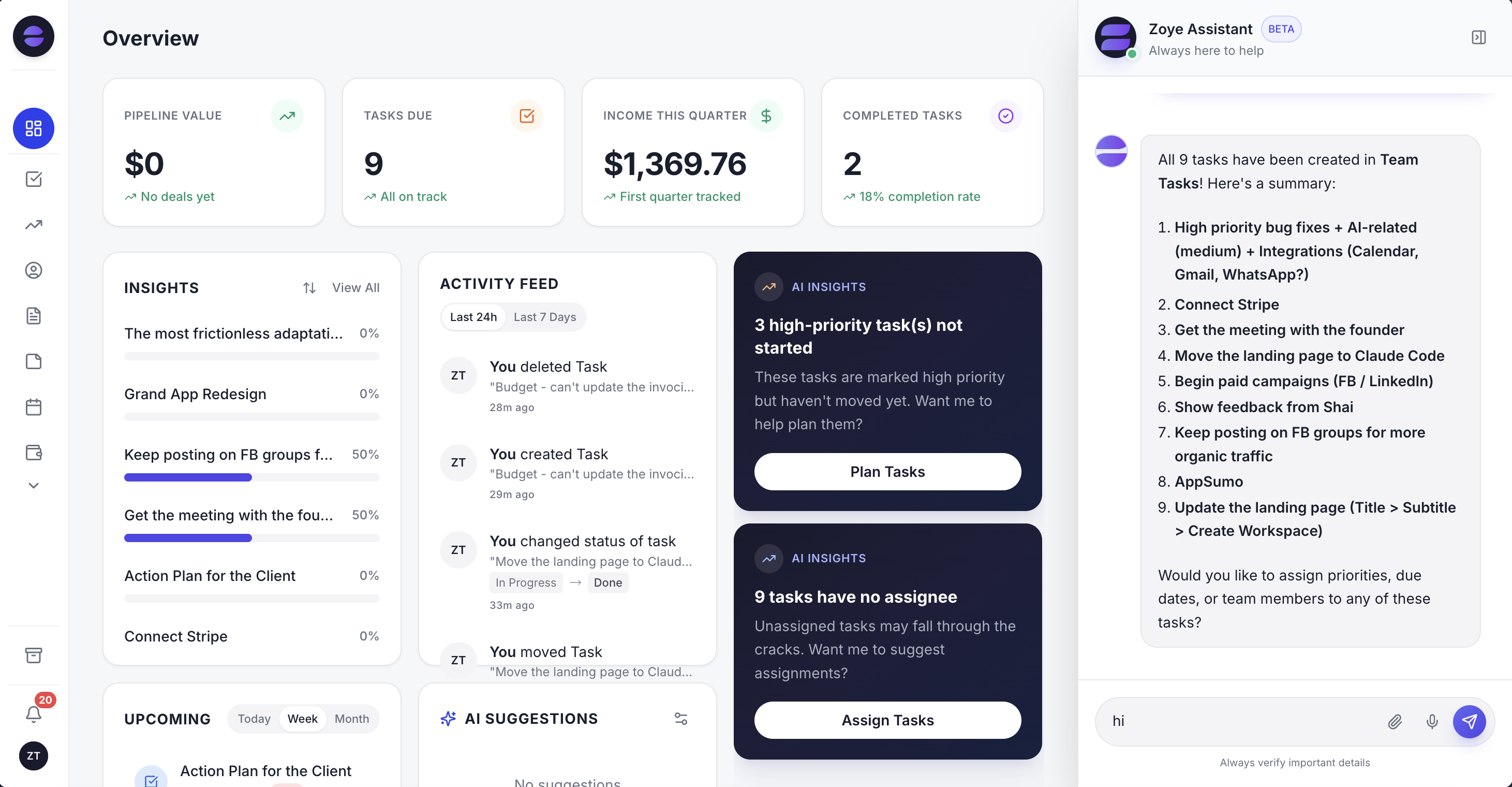 Zoye: leads, pipeline, follow-ups, and live AI Insights in one workspace the assistant keeps up to date itself
The distinction matters. In HubSpot or Marketo, a new lead from an ad is only handled if you have already built a workflow to handle it, and the follow-up only happens on the schedule you designed. In Zoye, you can say in plain language what should happen, for example "when someone messages us on WhatsApp asking about pricing, reply with the starter details and book a call," and Zoye builds and runs that automation. When a lead goes quiet, Zoye notices and chases it without being told again. The CRM stays current because the operator, not you, is the one updating it.
Zoye is deliberately not trying to be enterprise marketing automation. It will not out-segment Marketo on a million-record database, and it is honest about that. What it does instead is remove the manual chasing that causes small businesses to lose leads in the first place, on a plan that starts at $5 per month for 1 member and includes AI on every tier.
Real example: A 6-person home-services company runs its enquiries through WhatsApp and a web form. Instead of building a nurture program, the owner tells Zoye once: "capture every enquiry, reply within a few minutes with our availability, and follow up twice if they go quiet." Zoye captures each lead into the CRM, drafts and sends the first reply, and chases the ones that stall - work that in HubSpot would be a workflow to build and in Marketo a program to configure and staff.
Ready to streamline your business?
Zoye brings AI-powered CRM, task management, and automation into one workspace.
Get StartedWhen to choose each
Choose HubSpot if:
- You want CRM and marketing in one connected, approachable suite
- Your team can adopt a platform without a dedicated specialist
- You expect to grow into more hubs over time
- Starting free and scaling by tier fits your budget
Choose Marketo if:
- You run high-volume, complex nurture programs at enterprise scale
- You have a marketing-operations hire or agency to build and maintain it
- Deep lead scoring and fine-grained segmentation are core to your motion
- You already run a separate CRM such as Salesforce alongside it
Choose Zoye if:
- Your real problem is leads slipping because nobody has time to chase them
- You want an operator that captures leads and follows up itself, not another engine to build
- You want automations you can describe in a sentence, including over WhatsApp
- You want AI included on every plan and flat pricing that does not climb with contacts
- You are a small or service business that needs results the same day, without a specialist
The bottom line
HubSpot and Marketo are both strong at what they are built for. HubSpot is the approachable all-rounder that a growing team can adopt without a specialist and expand over time. Marketo is enterprise marketing automation with the depth to run sophisticated, high-volume programs when you have the people to operate it. If you have the team to feed the engine, either can be a fine choice, and the decision comes down to scale, budget, and how much operations muscle you already have.
The question worth asking first, though, is who is actually going to run the follow-up every week. For a lot of small businesses the honest answer is that nobody has the time, which is why the leads slip. Zoye is built for exactly that team: not a bigger engine to build, but an AI operator that captures the leads and chases them itself, included on every plan and working the same day you sign up.
For more context, see AI lead management, how to stop losing leads, the best CRM for a one-person business, and the rest of the Zoye blog.