
Best CRM for a One-Person Business 2026: 7 Picks for Solo Founders
Most CRM advice is written for sales teams. It assumes a rep whose whole job is the pipeline, a manager who reviews the dashboard, and an ops person who keeps the data clean. A one-person business has none of those roles, because one person is all of them at once. You are the salesperson, the person delivering the work, and the admin who is supposed to keep everything up to date. Something always gives, and it is almost always the CRM.
That is the real bottleneck for a solo founder. The problem is not choosing software; it is that every traditional CRM assumes someone will operate it. It waits for you to enter the contact, log the call, set the reminder, and write the follow-up. When you are heads-down delivering a project for a week, none of that happens, the database goes stale, and within a month you have another tool you bought and stopped using. The tool did not fail. It just needed an operator you do not have.
So the question for 2026 is not "which CRM has the most fields" but "which one runs itself so a team of one does not have to." This guide compares the seven best CRMs for a one-person business, ranked for solo founders who need the follow-through to happen whether or not they have a spare hour to do data entry.
Pricing reflects published rates as of July 2026; check each vendor's pricing page for current figures.
Why solo owners abandon most CRMs in 2026
Four things break a CRM for a one-person business, and they are the same four every time.
A CRM you have to feed goes empty. The classic failure is an empty database nobody fills in. For a team, at least one person is nominally responsible for data hygiene. For a solo owner there is no one, so the first busy week ends the discipline. An empty CRM is worse than no CRM, because you trust it and it is wrong.
Follow-ups nobody sends are lost deals. The money in a small business is in the second, third, and fourth touch, the quiet quote that just needs a nudge. A traditional CRM reminds you to send that nudge, then leaves the writing and sending to you. On a busy week the reminder gets dismissed and the deal quietly dies. Reminders are not follow-through.
Leads arrive while you are delivering. A solo owner cannot answer a new enquiry at 2pm when they are mid-session with a client. By the time you surface, the prospect has messaged two competitors. The lead needed capturing and a first reply in the moment, not an entry in a to-do list for later.
Complexity you will never configure. Enterprise-grade CRMs ship with pipelines, automation builders, and custom objects that assume an admin will set them up. A one-person business does not have a spare weekend to build funnels. Anything that needs configuring before it delivers value tends to never get configured at all.
The shift in 2026 is from software you operate to an operator that runs the software for you. Instead of a database you feed and reminders you action, the new model is an AI Business Operator that captures the lead, keeps its own records, and does the chasing itself. That is the lens this list is ranked through.
The 7 best CRMs for a one-person business in 2026
1. Zoye - the operator that runs the business for a team of one
Zoye is the strongest pick for a one-person business because it is not a CRM you have to operate. It is the AI Business Operator that runs the work: it captures leads, keeps its own records up to date, and chases the follow-ups itself, so the single most common reason solo owners abandon a CRM, that nobody has time to feed it, simply does not apply.
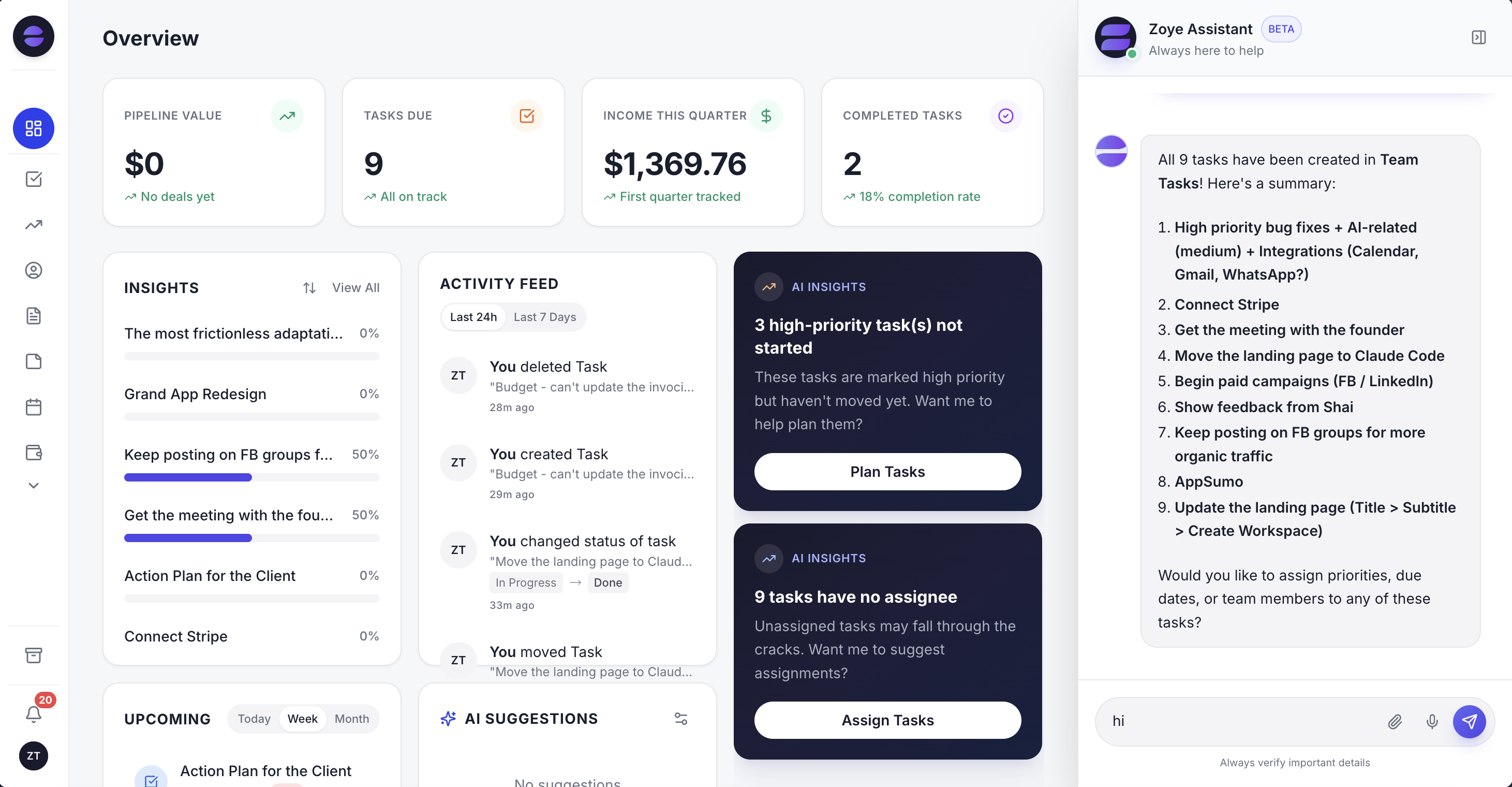 The Zoye dashboard gives a solo founder the whole business at a glance, with the assistant ready to capture leads and run follow-ups on demand.
Here is the difference in practice. A new enquiry lands, by web form, email, or WhatsApp message, while you are with a client. Zoye captures it, replies in your voice, qualifies it, and books the call, then logs the whole thing on the contact record without you touching a keyboard. A quote you sent last week has gone quiet; Zoye chases it with a follow-up it drafts and sends, and updates the deal stage when the reply comes in. At the end of the day the records are current not because you found an hour to update them, but because the operator kept them current as it worked.
The part that matters most for a team of one is that you build the automations by describing them. You do not open a workflow builder and wire nodes together. You tell Zoye, in a plain sentence, "when someone messages me on WhatsApp about a booking, ask for the date and add them to my pipeline," and it sets that up. The same works for chasing unpaid invoices, sending a reminder before a session, or reactivating a client who went quiet three months ago. The villain here is the software you bought and stopped using; Zoye is built so there is nothing to stop using, because it does the operating.
Underneath the operator is the full workspace a solo owner needs in one place: contacts and pipeline, tasks with list, board, calendar, and timeline views, a calendar, budget tracking, and reports, so you are not stitching a CRM to a task app to a calendar to a spreadsheet. And because the assistant works over WhatsApp, most of the business can run from your phone.
Pricing: Almost Free at $5 per month for 1 member with the full platform including AI. Starter from $29 per month (10 members). Growth from $59 per month (20 members). Scale from $119 per month (100 members).
Best for: Solo founders and one-person service businesses that need the follow-up to happen without hiring, and want the CRM to keep itself up to date.
2. HubSpot Free - the generous free database
HubSpot Free is the most generous traditional free CRM, and for a solo founder who wants a clean contact database with unlimited records, it is a reasonable starting point. The interface is polished and the ecosystem is huge.
The limitation for a one-person business is that HubSpot is still a tool you operate. It stores contacts and shows a pipeline, but you enter every deal, log every note, and send every follow-up yourself. The useful automation lives in paid tiers that jump in price quickly, and the platform's depth is aimed at sales teams, not a team of one.
Pricing: Free tier with generous limits. Paid Starter tiers scale up per seat; check HubSpot's pricing page for current figures.
Best for: Solo owners who want a free, polished contact database and are happy to do the operating themselves.
3. Pipedrive - the visual pipeline for a hands-on seller
Pipedrive is a well-designed, sales-focused CRM built around a visual pipeline. For a solo founder who genuinely enjoys managing their deals by hand and wants a clean drag-and-drop board, it is one of the more pleasant tools to use.
The trade-off is that Pipedrive is exactly what its name says: a pipeline you drive. It is excellent at showing you where deals are, but moving them forward, the calls, the follow-ups, the data entry, is all on you. For a one-person business with no spare time, a pipeline you must push manually is the same maintenance burden in a nicer wrapper.
Pricing: No free plan; paid tiers start at a low per-user monthly rate. Check Pipedrive's pricing page for current figures.
Best for: Solo sellers who like hands-on pipeline management and have time to work it daily.
4. Zoho CRM (and Bigin) - the affordable, configurable option
Zoho CRM, and its lighter sibling Bigin, is a capable, budget-friendly CRM with a deep feature set and a large surrounding suite. For a cost-conscious solo owner who wants room to grow, the price-to-feature ratio is strong.
The limitation is the flip side of that depth: Zoho rewards configuration. To get value you set up modules, workflows, and rules, which is time a one-person business rarely has. Bigin trims this down and is genuinely simpler, but even then the records and the follow-ups depend on you keeping them current.
Pricing: Bigin has a free tier for solo use; Zoho CRM paid plans start low per user. Check Zoho's pricing page for current figures.
Best for: Budget-focused solo owners willing to invest setup time for a configurable, low-cost CRM.
Want to see it in action?
Watch how Zoye automates your daily workflow - from lead management to team collaboration.
See How It Works5. HoneyBook - the client-workflow tool for service solopreneurs
HoneyBook is popular with solo service providers, coaches, photographers, and freelancers, because it bundles proposals, contracts, invoices, and a light CRM into one client-workflow tool. For a solo owner whose business is project-based client work, that bundle is genuinely useful.
The limitation is that HoneyBook still runs on your input. It gives you the templates and the pipeline, but you send the proposal, chase the signature, and follow up on the quiet lead. It organises the client workflow well; it does not operate it for you. It is also priced as a subscription with no permanent free plan.
Pricing: No permanent free plan; paid plans billed monthly or annually. Check HoneyBook's pricing page for current figures.
Best for: Solo service providers who want proposals, contracts, and invoicing in one place and will run the workflow themselves.
6. Streak - the CRM that lives inside Gmail
Streak turns Gmail into a lightweight CRM, which appeals to solo founders who live in their inbox and do not want another app to check. Tracking deals as email threads is a low-friction way to start, and setup is minimal.
The trade-off is that Streak is only as active as your inbox habits. It shows pipeline stages next to your email, but it does not capture leads from anywhere else, does not follow up on its own, and ties your whole customer history to one Gmail account. For a solo owner it is a tidy starting point, not an operator.
Pricing: Free tier for personal use; paid plans per user per month. Check Streak's pricing page for current figures.
Best for: Gmail-centric solo owners who want a minimal, inbox-based way to track deals.
7. A spreadsheet - the zero-cost starting point
A spreadsheet is where most one-person businesses actually begin, and there is no shame in it. For the first handful of contacts it is free, flexible, and completely under your control. Many solo owners run on Google Sheets far longer than they admit.
The limitation is that a spreadsheet is pure storage. It never reminds you, never captures a lead while you are busy, never follows up, and quietly rots the moment you stop updating it, which is exactly when a busy week hits. It is a fine place to start and a poor place to stay, because the whole job of a CRM for a solo owner is the follow-through, and a spreadsheet does none of it.
Pricing: Free with Google Sheets or Excel.
Best for: Brand-new solo owners with a handful of contacts who are not ready for any tool yet.
Best free CRM for a solo business
If free is the deciding factor, there are two honest answers. HubSpot Free is the best traditional free CRM: a clean, generous contact database you operate yourself. If what you want is a place to store contacts and you are happy to do the follow-ups by hand, it is hard to beat at zero cost.
But a free database and an operator that works for you are different things. Zoye's entry plan, Almost Free, covers 1 member at $5 per month with the full platform including AI, which means a solo owner gets not just storage but the operator that captures leads and runs the follow-ups. For a one-person business, where the scarce resource is time rather than seats, a five-dollar plan that does the work is worth far more than a free plan that only holds the data.
See what Zoye can do for you
From CRM and deal tracking to AI-powered task management - explore everything Zoye offers in one workspace.
Explore FeaturesBest AI CRM for a one-person business
Almost every CRM now advertises AI, so the useful question is what the AI actually does. On most of the tools above, AI means suggestions: it drafts a line if you ask, scores a lead, or summarises a thread. You are still the one who acts on every suggestion, which for a solo owner is just a faster version of the same manual work.
Zoye is the only pick on this list where the AI is the operator rather than a suggestion panel. It captures the lead, writes and sends the follow-up, books the call, chases the quiet quote, updates the record, and reactivates a dormant client, and it does all of it across channels including WhatsApp. The test for a one-person business is simple: does the AI reduce the number of things you personally have to do, or just speed up the things you already do? On this list, only Zoye removes the tasks entirely.
How to choose the right CRM for your one-person business
Three questions settle it for most solo owners.
1. Where does your business actually happen? If most enquiries and conversations run through WhatsApp and your phone, you need a CRM that captures and replies there, not one that assumes you are at a desk in an inbox. That points to Zoye. If you live in Gmail, Streak fits; if you want a polished web database, HubSpot Free does.
2. Do you have time to operate a CRM, honestly? If yes, and you enjoy it, Pipedrive or Zoho give you a lot of control. If you know you will not keep it fed, do not buy a tool that needs feeding. Choose the operator that keeps itself current, which is Zoye.
3. Is the value in storing or in doing? A spreadsheet, HubSpot Free, and Streak store. HoneyBook organises. Only an AI operator does the chasing for you. For a team of one, the doing is where the leverage is.
Why solo founders pick Zoye
A few things come up again and again from one-person businesses.
The records stay current without you. Because the operator updates them as it works, the CRM never goes stale during a busy week, which removes the single most common reason solo owners abandon their tools.
The follow-ups actually happen. Quiet quotes get chased, new leads get a fast first reply, and dormant clients get reactivated, whether or not you had a spare hour that day.
You build automations by talking. No workflow builder, no configuration weekend. You describe what you want in a sentence and the operator sets it up, over WhatsApp too.
It is one workspace, not a stack. Contacts, pipeline, tasks, calendar, budget, and reports live together, so a solo owner is not paying for and switching between four tools.
Try Zoye with your one-person business. The entry plan is Almost Free at $5 per month for 1 member, with the full platform including AI, so the operator starts running your follow-ups from day one.
For more context, see the best CRM for small business, the easiest CRM for small business, and AI for solopreneurs.