
Most small business owners looking for a CRM have already bought one before. It is still there, somewhere, half set up, with three stale leads and a lot of empty fields, quietly billing a card. The problem was never that it was not good enough. The problem was that for it to work, someone had to keep it filled in, and when you run a small business, that someone is you, and you already ran out of time.
That is the quiet failure of almost every CRM sold to small businesses: it only helps if you feed it, and data entry is exactly what slips first when the day gets busy. A quote goes out, the call ends, the customer never comes back, and nobody chased them, because the thing that was supposed to remind you was the same thing you forgot to update. A small business does not lose customers because it has no CRM. It loses them because the CRM it has requires work nobody has time to do.
This guide looks at customer management for small business honestly: what a small business actually needs, why classic CRMs disappoint non-technical owners, and which 2026 option is built to do the work itself instead of adding one more chore to your list.
Pricing reflects published rates as of July 2026; check each vendor's pricing page for current figures.
What a small business actually needs from a CRM
Before comparing systems, it helps to be clear about what genuinely matters for a small business, because most of what is sold as "CRM features" was built for large sales teams, not for you.
One place for every customer and every lead. The foundation is simple: every enquiry, from every source, lands in a single central place so nothing falls through the cracks. If some leads are in WhatsApp, some in email, and some in your head, you do not have a system, you have a mess.
Follow-up that actually happens. The money in a small business is in the follow-up. Studies of response speed show again and again that replying within minutes multiplies your odds of closing, yet most leads never receive more than one touch. A small business needs a system that makes sure every quote gets chased and every quiet lead gets a reminder, even when the owner is busy.
Real simplicity, not just a nice interface. "Easy to use" is measured not by the first screen but by how much work is required after setup. A system that looks simple but requires you to enter every lead, every meeting, and every follow-up by hand is not simple. It has just pushed the complexity onto you.
No maintenance that becomes a second job. If the system needs flow-building, API connections, or a weekly tune-up, it has recreated the exact problem it was meant to solve. For a small business owner, the only interface that lasts is a conversation, ideally in a channel you already use all day.
Why small business owners abandon their CRMs
Software fatigue reached a breaking point. Surveys repeatedly find that a large majority of small businesses never fully use the customer-management software they pay for; the setup, data entry, and upkeep quietly get abandoned. Owners are not looking for another dashboard to neglect. They are looking for the work to get done.
The follow-up math became impossible. One owner cannot chase every quote, every no-show, and every quiet lead while also running the business itself. A classic CRM only shows you the gap; it does not close it. What is missing is not another list of things to do, but something that does them.
Customers moved to WhatsApp, the CRMs did not. Clients of service businesses respond on WhatsApp, not in a CRM portal. A system that does not live in that channel forces the owner to copy every conversation in by hand, and that is exactly the step that gets dropped under load.
The technology crossed from demo to dependable. Two years ago, AI that takes action was an impressive demo and not a reliable tool. In 2026, mature permission systems, confirmation flows, and safe execution mean an agent can hold write-access to a real business responsibly. The category quietly moved from "interesting" to "usable by people who do not care how it works."
Want to see it in action?
See Zoye catch a new lead, answer on WhatsApp and set up the follow-up, all from one message.
See How It WorksThe best CRMs for small business in 2026
The honest way to map this market is not a list of five interchangeable systems; it is one AI Business Operator that does the work, alongside good classic CRMs that still require you to operate them.
1. Zoye - the AI Business Operator that runs things, not just stores them
Zoye is the first AI Business Operator: an agent with real write-access across an entire business workspace, built specifically for owner-operated small businesses rather than developers or enterprise IT. Instead of you filling in the system, the Zoye Assistant executes: it captures leads, chases follow-ups, books clients, updates customer records itself, and sets up automations when you describe what should happen.
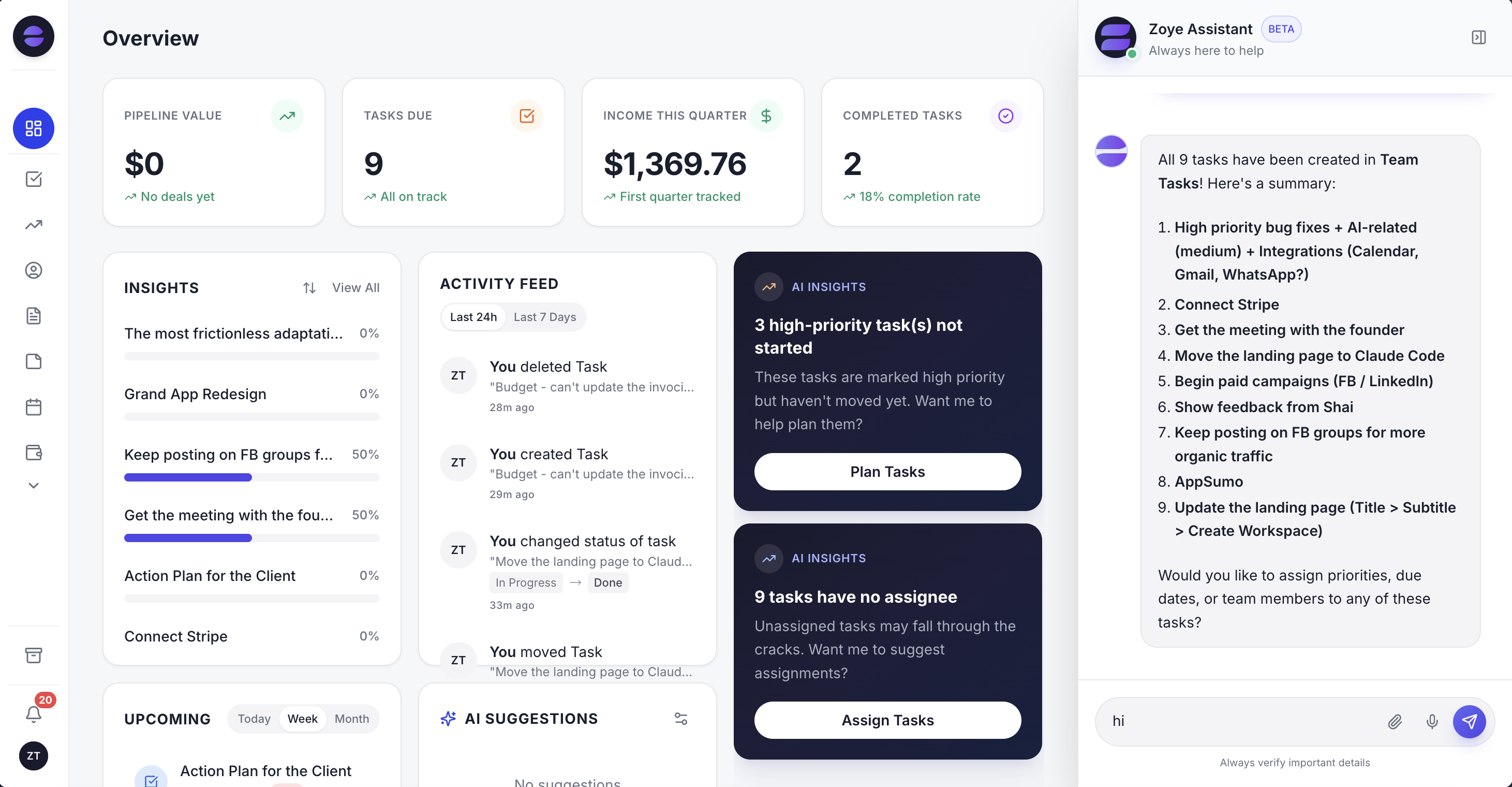 Zoye's dashboard: the operator keeps customers, leads, and follow-ups current, so nothing depends on the owner remembering to update it
The interface is a conversation. Say "new lead, Dana, wants a quote for Friday" and the lead exists, with a follow-up scheduled. Say "chase everyone who hasn't answered a quote this week" and the follow-ups go out. Say "when a new lead comes in, reply within a minute and book a call if they're interested" and the assistant builds and runs that automation itself; there is no workflow canvas to learn, because describing the outcome is the whole setup. It works the same on WhatsApp, so the owner runs the day from the same app their customers message them on.
Underneath the agent sits a complete workspace: customer and lead management, tasks with list, board (Kanban), calendar, and timeline views, a shared calendar, budget tracking, and reports, so the agent's write-access covers the whole operation rather than one silo. The safety layer is what makes that trustworthy: destructive actions require confirmation, the assistant respects each user's permissions, and it never fabricates a record or claims an action succeeded when it did not. Non-technical owners never have to "maintain" any of it; you talk, it runs.
Pricing: Almost Free at $5 per month for 1 member with the full platform including AI. Starter from $29 per month (10 members). Growth from $59 per month (20 members). All tools included on every plan.
Best for: Owner-operated small businesses (1-20 people) that want one agent to actually run leads, follow-ups, bookings, and records, instead of another tool to operate.
2. HubSpot - the CRM that grows with you (if you maintain it)
HubSpot offers a strong free CRM and a marketing and sales platform that scales as the business grows. For a small business planning to expand, that breadth is appealing, and the free tier is genuinely useful to start.
The real cost shows up in two ways: paid tiers climb quickly as you turn on features and add contacts, and like any classic CRM, the value depends entirely on how much data you enter by hand. The breadth does not remove the maintenance; it enlarges it.
Pricing: Free plan available. Paid tiers climb significantly by feature set and contact count.
Best for: Growing small businesses ready to invest in setup and upkeep to scale into one platform.
3. Pipedrive - the simple CRM for sales teams
Pipedrive is one of the more sales-friendly CRMs, with a clean visual pipeline that is easy to grasp. For a small business whose core activity is closing deals, the simplicity is a genuine advantage.
The limitation is that it remains a system you operate. Every lead, every stage, and every follow-up still requires manual entry, and beyond sales (service, tasks, budget) you will need additional tools. It streamlines the pipeline; it does not close the maintenance gap.
Pricing: Per-user, per-month tiers; check the pricing page for current figures.
Best for: Sales-focused small businesses that want a simple visual pipeline and are happy to feed it themselves.
4. Zoho CRM - the value pick with feature depth
Zoho CRM offers impressive feature depth at a competitive price, and integrates with the wide Zoho product family. For a small business that wants a lot of capability on a limited budget, it is a strong value option.
The flip side of depth is complexity. Zoho is configuration-rich, and getting value out of it takes setup and tuning time that a small business owner cannot always spare. And like the others, the system stores data; it does not act on it for you.
Pricing: Per-user, per-month tiers including a low-cost entry level; check the pricing page for current figures.
Best for: Small businesses that want a lot of capability at a low price and are ready to invest in setup.
5. Freshsales - the clean CRM with built-in AI
Freshsales (from Freshworks) offers a clean sales CRM with lead scoring and AI-assisted features. The interface is friendly and the free tier is useful for small teams.
The AI here, as in most CRMs, mostly suggests and scores; the execution still belongs to you. The system is also sales-focused, so managing service, tasks, and budget will need additional tools. It is a good sales tool, not an operator that runs the whole business.
Pricing: Free tier available; paid plans per user, per month.
Best for: Small sales teams that want a clean CRM with basic AI-driven lead scoring.
See what Zoye can do for you
CRM, deals, tasks and your Instagram, Facebook and WhatsApp automations in one workspace. Just ask Zoye and it sets any of it up for you.
Explore FeaturesHow to choose a CRM for your small business
Three questions cut through nearly all of the marketing.
1. How much work is required after setup? Do not just ask whether the interface is nice. Ask who enters the data. If the answer is "you, every lead, by hand," you are buying another system to maintain. If the system captures, follows up, and updates itself, you are buying time back.
2. Does it just store data, or act on it? A classic CRM shows you what needs doing. An operator does it: sends the follow-up, books the appointment, updates the stage. Decide whether you want a system that reminds you, or one that executes.
3. Who maintains it in six months? The graveyard of small business software is full of tools that needed an operator the business did not have. If the system requires flows, integrations, or a technical onboarding call, be honest about whether that maintenance will actually happen.
What the first week with a business operator looks like
The adoption path is smaller and faster than a software migration, because there is nothing to migrate into place first. Day one, you connect your channels and tell Zoye about your business the way you would brief a new hire; it starts capturing enquiries immediately. By midweek, you have delegated the reflex tasks: "follow up every quote that goes quiet for two days," "book consultations only on Tuesday and Thursday afternoons," "remind me each morning what needs my attention." By the end of the week, the pattern inverts: instead of opening software to check on the business, the business reports to you, in chat, and you answer with decisions instead of data entry.
That inversion is the entire point. The measure of a real CRM for a small business is not how many features it has, but how much of your week it quietly gives back.
Why small businesses pick Zoye
A few themes come up consistently.
The difference is that it acts. A new lead gets logged and answered, a quiet deal gets a nudge, a booking lands on the calendar, and the record updates itself, none of it waiting on the owner to remember. For a small business with no operations hire, that is the whole point.
You never have to keep it running. There is no automation canvas to wire together and no prompt library to curate. You tell Zoye what you want, on WhatsApp if that is easiest, and it stands up the routine and keeps it going for you.
It replaces the operating burden, not just a tool. Customers, leads, tasks, calendar, budget, and reports live in one workspace the agent can act across, so the owner stops being the integration layer between five apps.
And it is built to be handed real responsibility: it checks with you before anything irreversible, respects each teammate's permissions, and never reports a result it did not actually produce. That guardrail is what lets a small team genuinely let go of the busywork.
Try Zoye with your team. The entry plan is Almost Free, with the full platform including AI.
Ready to hand off the busywork?
Zoye brings AI-powered CRM, task management, and automation into one workspace.
Get StartedFor more context, see what a CRM system is, the easiest CRM for small business, the best CRM software, and the rest of the Zoye blog.
Prefer the quick overview? Visit the dedicated AI workspace for small business page.