If you run a small business and someone told you that you "need a CRM," you are not alone in feeling a little lost. The term gets thrown around by software companies, consultants, and everyone with something to sell, usually without anyone stopping to explain what it actually means or whether you need it. This guide fixes that. No jargon, no sales pitch dressed up as advice, just a clear answer to a simple question.
CRM stands for Customer Relationship Management. That is the whole acronym. Stripped of the buzzwords, a CRM is one organised place that remembers everything about your customers and leads: who they are, what you have discussed, what you sold them, and what you still owe them. If you have ever forgotten to call someone back, lost a lead because a message slipped through, or rebuilt a customer's history from scratch every time they reached out, a CRM is meant to solve exactly that.
Here is the honest part, though, and it is the part most articles skip. The classic answer to "what is CRM" is "software you buy and fill in yourself," and for busy owners that answer quietly fails. This guide explains what CRM really is, why the traditional version stops working for most small businesses within a few months, and what a better model looks like in 2026.
What CRM actually means, in plain English
Think about how you already manage customers today. You probably have contacts in your phone, conversations in WhatsApp and email, a few notes in a notebook or a spreadsheet, and a running list in your head of who you need to chase. That mental list is your CRM. It just happens to be scattered, fragile, and completely dependent on your memory.
A CRM system moves all of that into one place. Each customer gets a record. Under that record sits their contact details, the history of every conversation, the deals or jobs in progress, and the tasks you still need to do. When that customer messages you six weeks later, you do not have to remember who they are or where you left off. You open their record and the whole story is there.
That is the promise. A CRM turns a pile of scattered information into a single, organised memory of every relationship your business has. Sales teams use it to track deals. Service businesses use it to manage clients and bookings. Solo founders use it so that no lead ever falls through the cracks. The core idea is the same at every size: one trusted place that never forgets a customer.
What people actually mean when they say "CRM"
The word gets used three slightly different ways, which is part of why it confuses people.
The practice. Sometimes CRM means the discipline of managing customer relationships well: responding quickly, following up, remembering context, and treating every lead like it matters. This is the goal, regardless of what tools you use.
The software. Most of the time, when someone says "we need a CRM," they mean the software: a system like the ones sold by HubSpot, Zoho, Pipedrive, or Salesforce that stores contacts, tracks deals, and organises follow-ups. This is what you are usually shopping for.
The database. At its most basic, a CRM is just a smart customer database: a structured list of people, linked to their history and their next steps. Everything else a CRM does is built on top of that database.
For a small business owner, the useful takeaway is this. You do not need to care about the theory. You need one place that remembers your customers and makes sure you never drop a follow-up. Whether that place is called a CRM, a customer database, or something else entirely matters far less than whether it actually works for you day to day.
Want to see it in action?
See Zoye catch a new lead, answer on WhatsApp and set up the follow-up, all from one message.
See How It WorksWhat a CRM is supposed to do for you
A good customer system, whatever you call it, should handle a handful of jobs. If you understand these jobs, you understand what CRM is for.
Remember every contact and their history. Every lead and customer in one list, each linked to the full record of your conversations, so you never start from zero.
Track deals and jobs in progress. A clear view of who is a new enquiry, who is deciding, who has bought, and who needs a nudge, so nothing stalls silently.
Never let a follow-up slip. The single biggest reason small businesses lose sales is not price or product, it is silence. A lead asks a question, the owner gets busy, and nobody follows up. A CRM is supposed to make sure that stops happening.
Centralise customer conversations. WhatsApp, email, calls, and messages all attached to the right person, so the history is complete no matter which channel a customer uses.
Show you what is actually going on. How many leads came in, how many turned into customers, what is overdue, and where the business stands, without you building a report by hand.
Those five jobs are the real point of a CRM. Keep them in mind, because they are the standard against which every tool, and every alternative, should be judged.
Why the classic "just buy a CRM" answer fails small business owners
Here is where most guides stop, having told you CRM is wonderful and you should go get one. But if buying a CRM solved the problem, the majority of them would not sit abandoned within a few months. They do. The reason is structural, and it is worth understanding before you spend money.
A classic CRM only remembers what you type into it. This is the core flaw. A traditional CRM is an empty filing cabinet. It knows nothing until you enter it. Every call has to be logged. Every deal stage has to be dragged. Every follow-up has to be scheduled by hand. When you are busy actually running the business, that data entry is the first thing to go. Within weeks the CRM is out of date, and a CRM you do not trust is worse than no CRM at all.
It assumes you have time you do not have. Enterprise sales teams have people whose job is to keep the CRM current. A small business owner does not. You are selling, delivering, invoicing, and answering the phone. Nobody is maintaining the software, so it decays.
Setup punishes non-technical owners. Pipelines, custom fields, automation rules, integrations. The classic CRM asks you to be a part-time systems administrator before it does anything useful. Most owners never get past the setup, and the ones who do rarely have time to maintain what they built.
You bought it, then stopped using it. This is the pattern almost every small business owner recognises. The CRM was going to change everything. Three months later it is a graveyard of half-entered contacts, and you are back to your phone, your inbox, and your memory. The software was not the answer, because the software waited for you to do the work.
The problem was never that you picked the wrong CRM. It is that the entire model, a tool that only remembers what you feed it, was built for teams with admins, not for owners with no spare hours.
See what Zoye can do for you
CRM, deals, tasks and your Instagram, Facebook and WhatsApp automations in one workspace. Just ask Zoye and it sets any of it up for you.
Explore FeaturesThe better model in 2026: a CRM that does the work itself
The reason classic CRM fails is that it is passive. It sits and waits. The shift happening in 2026 is toward something active: instead of software you maintain, an operator that runs the customer side of your business for you.
This is the model behind Zoye. Rather than being one more empty system for you to fill in, Zoye is an AI Business Operator: it captures the lead, logs the conversation, chases the follow-up, books the client, and updates the customer record itself, so the thing a classic CRM asks you to do by hand simply happens on its own.
The difference is not a feature. It is who does the work. A traditional CRM is a place you go to enter information. Zoye is something you talk to, that then acts. You can run it by typing what you need in the app, or by messaging it on WhatsApp or Slack, the way you already talk to a capable assistant. There is no dashboard to babysit, no fields to keep current, no maintenance to fall behind on.
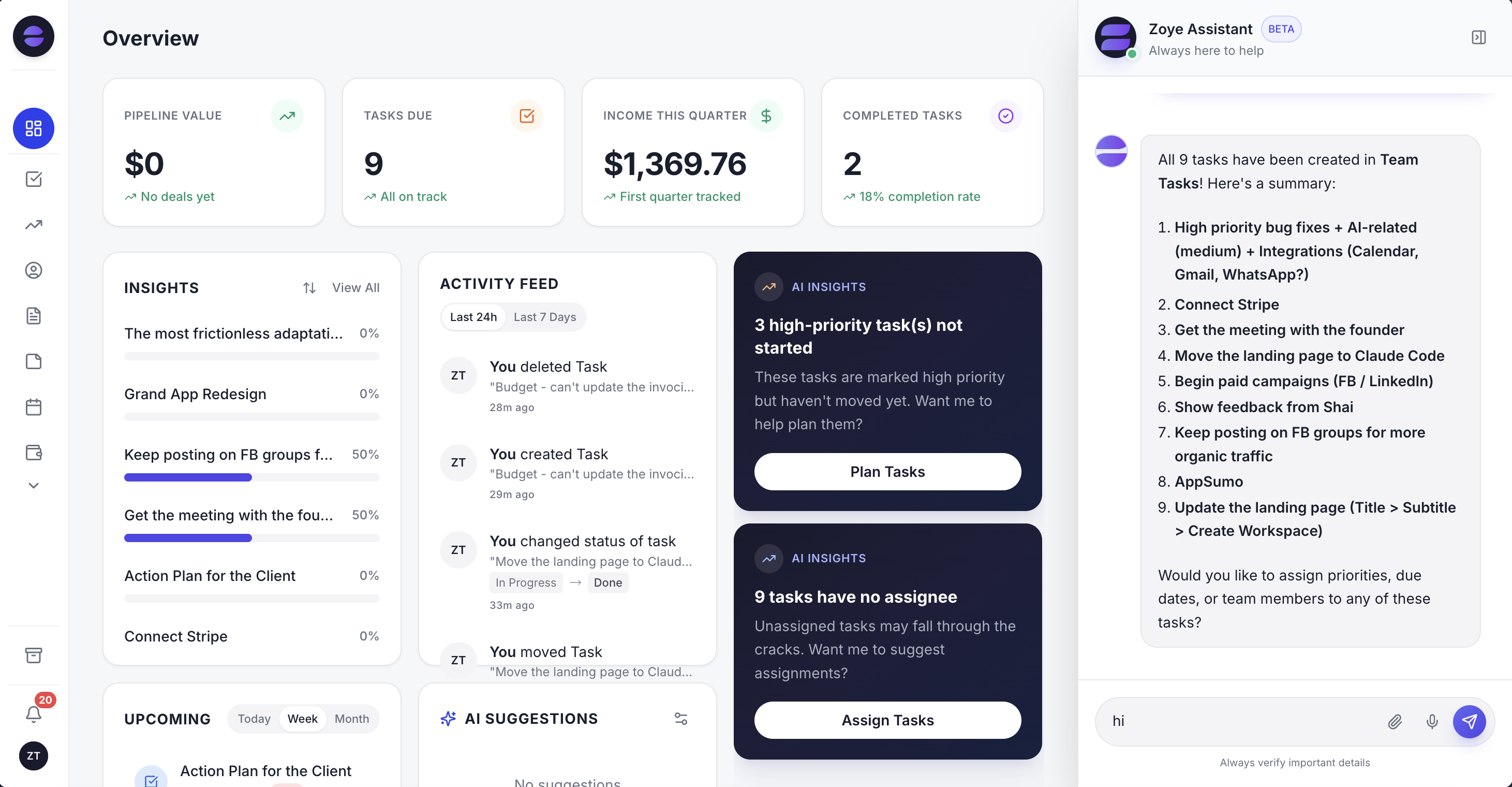 The Zoye dashboard: your whole business at a glance, with proactive AI Insights and Zoye Assistant always available on the right
Concretely, here is what that looks like against the five jobs of a CRM we listed earlier.
It remembers every contact on its own. When a new lead messages, Zoye creates the contact and logs the conversation. You do not add anyone by hand. The record builds itself from real activity.
It moves deals forward without being dragged. Zoye tracks where each lead sits and, crucially, it chases the ones going quiet. The follow-up that a classic CRM would just remind you to do, Zoye drafts and sends.
It closes the follow-up gap automatically. This is the single biggest win. The lost-because-nobody-replied problem disappears when the operator is the one making sure every lead gets a timely reply.
It centralises conversations, including WhatsApp. Messages across channels land next to the right contact, and Zoye can draft the reply and set the next step so the history stays complete.
It shows you the picture without a report-building exercise. Ask Zoye how many leads came in this month or what is overdue, and you get the answer. The reports assemble themselves from the work Zoye already tracked.
And because you never maintain it, it does not decay. That is the whole point. A tool that updates itself cannot fall out of date the way a manual CRM inevitably does. Beyond the customer side, the same workspace also covers tasks, calendar, budget, and reports, so the operator is running the business, not just the contact list. If you want to go a level deeper on the system view, our guide on what a CRM system is covers it, and how to choose a CRM walks through the buying decision.
Pricing: Almost Free at $5 per month for 1 member with the full platform including AI. Starter from $29 per month (10 members). Growth from $59 per month (20 members). Pricing reflects published rates as of July 2026; check the pricing page for current figures.
Best for: Small business owners and small teams who want the result a CRM promises without becoming the person who has to maintain it.
So, do you actually need a CRM?
Come back to the honest version of the question. You do not need "a CRM" as an item to own. You need the outcome: no lead lost, no follow-up missed, every customer's history in one place, and a clear picture of where the business stands.
If you are still managing all of that in your head and your inbox and it is working, you may not need anything yet. But the moment you notice leads going cold because you forgot to reply, or you find yourself asking "who was that person again?", you have outgrown memory and paper. At that point the question is not whether to get a customer system, but which kind.
The old kind, an empty CRM you fill in yourself, will help for a few weeks and then quietly become another abandoned tab. The new kind, an operator that does the capturing and chasing for you, actually holds up, because staying current is its job, not yours.
Why owners pick Zoye
A few themes come up again and again from owners who tried the classic route first.
It does the work, so it does not decay. Because Zoye updates the customer record itself, there is no data-entry chore to fall behind on, and no abandoned CRM three months later.
It closes the follow-up gap. The leads that used to go cold because nobody replied now get a timely, drafted response, which is where most of the recovered revenue comes from.
You run it by talking to it. Type what you need in the app, or message it on WhatsApp or Slack, and it acts. No admin skills, no setup marathon, no maintenance.
It is one workspace, not a stack. Customers, tasks, calendar, budget, and reports live together, so you are not stitching five tools into a system you then have to keep in sync.
Try Zoye with your team. The entry plan is Almost Free, with the full platform including AI.
Ready to hand off the busywork?
Zoye brings AI-powered CRM, task management, and automation into one workspace.
Get StartedFor more context, see our guide on what a CRM system is, the best CRM software in 2026, and how to run a CRM without data entry.