
Most guides to selling on WhatsApp stop at "reply fast and be friendly." That advice is not wrong, but it hides the real problem. WhatsApp is where your buyers already are, which means the channel converts far better than email or a contact form. The trouble starts the moment you get more messages than one person can watch. Replies slow down, quotes go out and never get chased, and a buyer who was ready to pay drifts to a competitor who answered first.
Selling on WhatsApp is not hard because the channel is complicated. It is hard because it demands a level of speed and consistency that a busy owner cannot sustain by hand. Every unanswered message after business hours, every follow-up you meant to send on Tuesday and forgot, every buyer who asked "still available?" and got silence is money leaving the building.
This playbook covers the full cycle: setting up your catalog, winning the first reply, qualifying without interrogating, sending price and product clearly, following up until the buyer decides, and closing inside the chat. Then it covers the part almost no other guide does: how an AI operator runs that whole process for you, so the playbook actually happens on the days you are too busy to run it yourself.
Pricing reflects published rates as of July 2026; check each vendor's pricing page for current figures.
Why WhatsApp is the highest-converting sales channel in 2026
Three things make WhatsApp different from every other channel a small business uses.
Buyers open and reply. An email sits unread; a WhatsApp message gets seen within minutes and answered in the same conversation. For most small businesses, WhatsApp reply rates dwarf email and outperform every form on the website. When the buyer is already talking to you, the sale is halfway done.
The whole sale fits in one thread. Question, catalog, price, objection, payment link, confirmation: it all happens in a single chat the buyer already trusts. There is no bouncing between a website, an email, and a phone call. That continuity is why WhatsApp closes faster than almost anything else.
It works without a website. A WhatsApp Business profile with a catalog and a payment link is a complete storefront. Plenty of businesses run every sale through WhatsApp and never send a buyer to a site. That makes it the cheapest, fastest sales channel a new business can start with.
The one weakness is human. WhatsApp rewards instant replies and relentless follow-up, and those are exactly the two things a busy owner cannot guarantee. Solve that and WhatsApp becomes the best-performing sales channel you have.
Step 1: Set up your WhatsApp Business profile and catalog
Start with the free WhatsApp Business app (or the WhatsApp Business API if you are running higher volume or a team). Fill in the business name, category, description, hours, and a link to your site or Instagram. This is your storefront window, so make it complete.
Then build the catalog. Add each product or service with a clear photo, a short benefit-led description, and the price. A buyer who can see the item and the price inside the chat decides faster than one you make wait for a quote. Group items sensibly and keep the catalog current: nothing kills trust like asking about a listed product and hearing "actually that is sold out."
Set a greeting message and an away message so a buyer who arrives at 11pm gets an instant, human-sounding acknowledgement instead of silence. These are small, but they are the difference between a lead who waits and a lead who leaves.
Step 2: Get buyers to message you in the first place
A perfect setup is worthless if nobody messages. The job here is to put a reason to chat everywhere your buyers already look, with one tap to start the conversation.
Use click-to-chat links. A wa.me/yournumber link opens a chat with one tap. Put it in your Instagram and TikTok bios, on your website as a floating button, in your Google Business Profile, in your email signature, and in the description of every ad. Pair the link with a clear promise: "Message us for a quote in 5 minutes," "Chat to see today's stock," "Ask for the catalog."
Give a reason to start. People do not message to "learn more." They message for a quote, a catalog, availability, or a discount. Lead your ads and posts with that specific offer and make WhatsApp the obvious next step.
Capture the first message context. When someone taps your ad and lands in the chat, you want to know which ad or product brought them. This is where a proper system earns its keep: it tags the source automatically so you know what is working and can reply with context.
Want to see it in action?
See Zoye catch a new lead, answer on WhatsApp and set up the follow-up, all from one message.
See How It WorksStep 3: Win the first reply (speed is everything)
The single biggest predictor of whether a WhatsApp chat becomes a sale is how fast you answer the first message. A reply in under five minutes feels like a live conversation; a reply two hours later feels like a missed connection, and by then the buyer has often messaged three competitors.
The problem is obvious: you cannot watch WhatsApp every waking minute, and buyers message at night, on weekends, and while you are with another customer. Hiring someone to sit on the app is expensive and still leaves gaps.
This is the first place automation pays for itself. An instant acknowledgement ("Thanks for your message, one of us is on it and will send your quote shortly") holds the buyer while you get to it. Better still, an AI operator can handle the whole opening: greet the buyer, answer the common questions, send the catalog, and only hand you the conversation once it is qualified and warm. The buyer feels answered instantly; you only step in when there is a real sale to close.
Step 4: Qualify without interrogating
Once a buyer is talking, you need to understand what they want before you can sell it. The mistake most people make is firing off a list of questions that reads like a form. WhatsApp is a conversation, so qualify like one: ask two or three natural questions that move toward the sale.
For a product business: what are you looking for, for when, and roughly what budget. For a service business: what do you need, when do you need it, and have you used a service like this before. The goal is enough information to recommend the right thing and quote accurately, not a full intake interview.
Keep it human. One question at a time, respond to their answers, and mirror their tone. A buyer who feels heard buys; a buyer who feels processed leaves.
Step 5: Send product and price clearly, then handle objections
When you know what the buyer needs, send the recommendation with the product, the price, and a clear next step, all in the chat. Do not make the buyer chase you for the price; hiding it feels evasive and slows the sale. A short message with the item photo, the price, and "want me to send the payment link?" converts far better than a wall of text.
Objections on WhatsApp are usually one of three things: price, timing, or trust. Answer price with value, not a discount by default ("it includes X and Y, and here is why that matters for you"). Answer timing by making it easy to buy now and receive later. Answer trust with proof: a photo, a quick reference, a clear return or guarantee policy. Keep answers short and confident.
See what Zoye can do for you
CRM, deals, tasks and your Instagram, Facebook and WhatsApp automations in one workspace. Just ask Zoye and it sets any of it up for you.
Explore FeaturesStep 6: Follow up until the buyer decides (this is where most sales are lost)
Here is the uncomfortable truth: most WhatsApp sales are lost not to a competitor and not to a "no," but to silence. The buyer asked a question, got a good answer, said "let me think," and then both sides went quiet. A single well-timed follow-up recovers a huge share of those.
The follow-up rhythm that works: a gentle nudge the next day ("did you have any questions on the quote?"), a value-add a few days later (a photo, a relevant tip, a limited offer), and a final check a week out ("closing this off my list, still interested?"). Most buyers who go quiet are not gone; they are busy, and the follow-up is permission to come back.
The reason follow-up gets skipped is not laziness. It is that tracking who to chase, and when, across dozens of open chats is genuinely hard to do by hand. You would need a spreadsheet of every conversation, its stage, and the next touch date, updated constantly. Nobody does that reliably. So the follow-ups that would win the most sales are exactly the ones that fall through.
Step 7: Close and collect payment inside the chat
Closing on WhatsApp should feel like a natural next step, not a hard pitch. When the buyer signals intent, make paying frictionless: send a payment link, share your details, or confirm the order and delivery in one clean message. Every extra step between "yes" and "paid" is a chance to lose the sale, so remove them.
After the sale, do not disappear. A confirmation, a delivery update, and a check-in after the buyer receives the product turn a one-time sale into a repeat customer and a referral. The same follow-up discipline that wins the first sale is what builds the second and third.
The problem with running this playbook by hand
Read back over those seven steps and notice how much of the work is not selling. It is admin: acknowledging every message instantly, tagging the source, tracking each conversation's stage, remembering who to follow up with and when, updating your records after every reply. A skilled salesperson could run five or ten conversations this way. At twenty or fifty, it collapses, and the sales you lose are invisible, so you never even know the cost.
This is the gap the "reply fast and follow up" advice ignores. The playbook is correct. It is just not humanly runnable at volume by a busy owner. You do not need more willpower. You need the process to run itself.
How Zoye runs your WhatsApp sales for you
Zoye is the AI Business Operator that actually runs the playbook above, instead of just giving you a place to type replies. Most tools in this space are a CRM you have to feed or a bot that answers a canned question and stops. Zoye is different: it does the work.
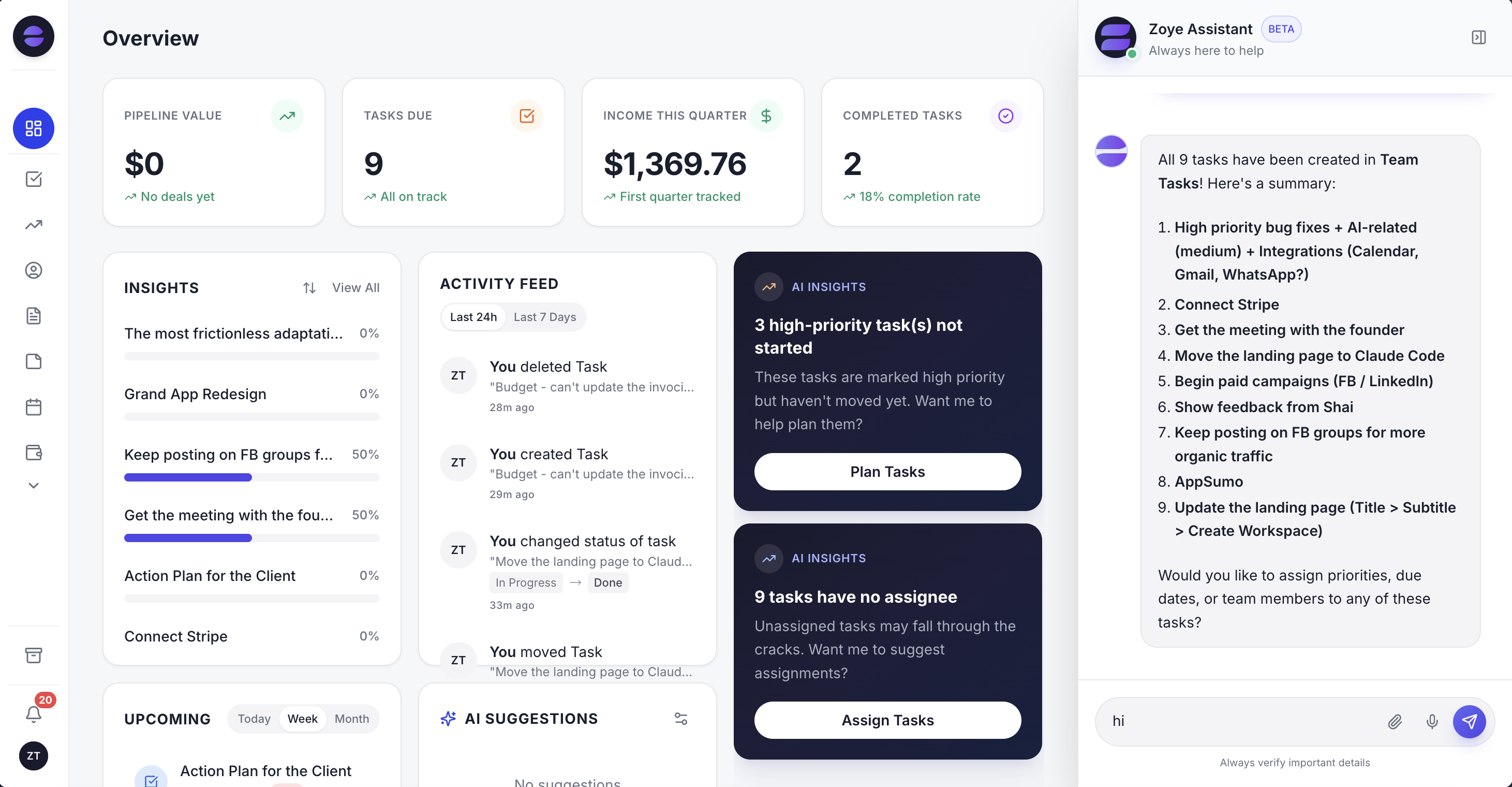 The Zoye dashboard brings every WhatsApp lead, follow-up, and deal into one view, with the assistant ready to act.
Connect WhatsApp and Zoye becomes the operator behind every conversation. When a buyer messages, Zoye captures the lead into your CRM automatically, tags where it came from, and can send an instant, on-brand first reply so nobody waits. It qualifies with natural questions, sends the catalog and price, and surfaces the conversation to you the moment it is worth your time. You are never staring at a full inbox wondering which chat is hot.
The follow-up gap, the one that loses the most sales, is where Zoye earns its place. It knows every open conversation, its stage, and the next touch date, and it chases the follow-ups on schedule without you writing a reminder. A buyer who said "let me think" on Monday gets a well-timed nudge on Tuesday because Zoye scheduled it, not because you remembered. It books the client into your calendar, confirms the appointment, and updates the deal itself.
The Lead Bot is the part buyers see. It answers, asks your qualifying questions, offers open slots and books the one they pick, and follows up when the chat goes quiet. In free-text mode Zoye, as an AI agent, holds the whole conversation in plain language. When the buyer is ready, it sends a payment link right in the chat, paid into your own Stripe account (or Grow in Israel), and the deal moves to the stage you chose as soon as they pay. A click-to-chat link and a QR code for your shop window, flyers or packaging bring new buyers straight into it.
Because Zoye is an all-in-one workspace, the whole sale lives in one place: the WhatsApp conversation, the contact record, the deal stage, the calendar booking, the payment follow-up, and the reports that tell you which ads and products actually drive sales. You are not stitching a chat app to a CRM to a calendar to a spreadsheet. It is one operator running all of it.
And you run Zoye by talking to it, including from WhatsApp and Slack. Tell it "follow up with everyone who asked about the summer catalog and did not reply" and it does it. Say "build me an automation that pings me when a quote goes unanswered for two days" and it wires that up for you, no setup screens, no technical skills. A non-technical owner never has to maintain it. This is the opposite of the software you bought, configured once, and stopped using.
Pricing: Almost Free at $5 per month for 1 member with the full platform including AI. Starter from $29 per month (10 members). Growth from $59 per month (20 members).
Best for: Owners and small teams who sell on WhatsApp and want the follow-ups, bookings, and CRM updates to happen without them running it by hand.
Ready to hand off the busywork?
Zoye brings AI-powered CRM, task management, and automation into one workspace.
Get StartedA simple WhatsApp sales stack for 2026
You do not need ten tools. For most small businesses selling on WhatsApp, the stack is short.
WhatsApp Business (app or API) for the storefront, catalog, and the conversation itself. Start with the free app; move to the API when volume or a team demands it.
A payment link so buyers can pay inside the chat without friction. Your local payment provider almost certainly offers one.
An AI operator that runs the process. This is the piece that turns WhatsApp from a channel you have to babysit into a channel that sells while you work. It captures leads, replies instantly, follows up on schedule, books clients, and keeps your records current. Zoye is built for exactly this.
Everything else (broadcast lists, labels, quick replies) is a nice-to-have that the operator handles for you anyway.
Common WhatsApp selling mistakes to avoid
A few patterns quietly kill WhatsApp sales, and they are easy to fix.
Slow first replies. The number one killer. If you cannot answer in minutes, automate the instant acknowledgement and the opening so the buyer never sits in silence.
No follow-up system. Relying on memory means most follow-ups never happen. Let a system own the schedule.
Hiding the price. Making buyers ask for the price adds friction and reads as evasive. Show it clearly.
Treating WhatsApp like a broadcast megaphone. Spamming a broadcast list with offers gets you muted and blocked. WhatsApp is a conversation channel; earn the right to message with value.
Losing the record. If the conversation lives only in the chat, you lose the buyer's history, the source, and the follow-up thread. Capture every lead into a real record so nothing is forgotten.
Why teams pick Zoye to run WhatsApp sales
A few themes come up again and again.
Speed without staffing. Buyers get an instant, on-brand reply at any hour, and the owner only steps in when there is a real sale to close.
Follow-ups that actually happen. Zoye owns the schedule, so the nudges that win the most sales go out on time, every time, without anyone remembering.
One place for the whole sale. The conversation, the contact, the deal, the booking, and the reports all live together, updated by the operator itself.
Runnable by talking to it. Tell Zoye what you want the way you would tell a colleague, even from WhatsApp, and it does it and builds the automations, so a non-technical owner never has to maintain a thing.
Try Zoye with your team. The entry plan is Almost Free, with the full platform including AI.
For more context, see the best WhatsApp CRM in 2026, our guide to AI agents that run a business, and the Zoye blog for more on selling and automating with WhatsApp.
See the automations Zoye ships for this, and how each one stays inside WhatsApp's rules, on the WhatsApp Automations page.