
20 Workflow Automation Examples Small Businesses Can Switch On This Week
Most articles about workflow automation stay at the altitude of "automate your repetitive tasks", which is true and completely useless. What a business under 25 people actually needs is a list of specific rules, written as trigger, condition and action, that can be switched on in an afternoon and evaluated a fortnight later.
So that is what this is. Twenty rules, grouped by where the money leaks rather than by which department owns them, because leaks do not respect org charts. Each one states what starts it, what has to be true for it to run, what it does, and roughly what it is worth. Six of them ship as ready-made recipes inside Zoye's workflow automations; the rest you would write yourself in a sentence, and all twenty are within reach of a team with no technical staff.
Read them as a menu, not a checklist. Nobody should switch on twenty rules at once, and the last section explains which two to build first and which one almost everybody builds far too early.
How to read each example
Every rule below has the same four parts, and it is worth being pedantic about them because most failed automations fail in the second one.
The trigger is the event that wakes the rule up. A record is created, a field changes, a date passes, a stage moves.
The condition is what has to be true for the rule to actually do anything. This is where automations go wrong. A trigger with no condition fires on everything, including the test record you created on Tuesday and the duplicate lead your ad platform sent twice. A condition that is too narrow never fires at all, which is worse, because the rule looks alive on screen while doing nothing.
The actions are what happens. Usually more than one: send something, create a task, update a field, notify a person.
What it is worth is the honest part. Some of these save fifteen minutes a week. Two of them are worth more than everything else on the list combined.
Group 1: Lead response, where the most expensive leak lives
You paid to generate these enquiries. Every hour of silence discounts them.
1. Instant first reply to a new lead
Trigger: a lead record is created from any source. Condition: the lead has a contactable channel and has not already been messaged in the last 24 hours. Actions: send the first-touch message, assign an owner, create a follow-up task for the owner dated the next working day. Worth: the single highest-return rule on this list. Enquiries that never convert overwhelmingly did not refuse; they simply never got a second message while they still remembered sending the first one.
The dedupe clause in the condition is not optional. Without it, a person who fills in your form and then messages you on WhatsApp gets two identical welcomes, which reads as carelessness rather than responsiveness.
2. Route by source, then by owner
Trigger: a lead record is created. Condition: the source field matches a defined channel, for example paid ads, website form, referral or manual entry. Actions: set the owner according to the routing rule, tag the record with the campaign, add the source to the follow-up task title. Worth: it prevents the single most demoralising failure in a small sales team, which is two people cheerfully calling the same lead an hour apart while a third enquiry sits untouched.
3. Qualification answers land on fields, not in a chat log
Trigger: a lead replies to the qualifying questions. Condition: at least the budget and timeline answers are present. Actions: write each answer onto its own CRM field, set the lead stage, and only then notify a human. Worth: this is the difference between a qualification flow and a transcript. Answers in fields are filterable, reportable and visible on the record. Answers in a chat log are archaeology.
Want to see it in action?
Watch how Zoye automates your daily workflow - from lead management to team collaboration.
See How It WorksGroup 2: Pipeline hygiene, or how deals die of neglect
A pipeline is only useful if it reflects reality. Most small-business pipelines are a museum of optimistic close dates.
4. Deal stale for seven days
Trigger: a scheduled daily check. Condition: the deal is open, is not in a stage where waiting is expected, and has had no activity for seven days. Actions: notify the owner with the deal name and last activity date, create a re-engagement task, and flag the deal on the board. Worth: second only to lead response. Deals rarely die of rejection. They die of nobody being sure whose turn it is to speak.
The "stage where waiting is expected" clause matters. If a deal is legitimately parked pending a client's board meeting, nagging about it every week teaches the team to ignore the notification, and a notification everybody ignores is worse than none.
5. Stage entry creates its own checklist
Trigger: a deal moves into a given stage, for example Proposal Sent. Condition: the deal does not already have the checklist attached. Actions: create the standard tasks for that stage with owners and relative due dates, attach the relevant document, set the next-step date. Worth: it turns a stage name into an actual process. Small teams usually know what should happen at each stage. The gap is doing it every single time, on the busy days as well as the quiet ones, and that is the gap this closes without a meeting about it.
6. No next step on an active deal
Trigger: a daily check. Condition: the deal is in an active stage and has no future-dated task or meeting attached. Actions: create a task asking the owner to set a next step, due today. Worth: deceptively strong. "What is the next step" is the question that most reliably separates a real deal from a hope, and this rule asks it automatically instead of waiting for a pipeline review.
Group 3: Handover after a win, the least automated part of most businesses
Everybody automates the chase. Almost nobody automates the moment the chase succeeds, which is exactly when a customer forms their opinion of you.
7. Won-deal onboarding kicks off
Trigger: a deal moves to Won. Condition: the deal has a linked contact and company. Actions: create the onboarding task set with owners, send the welcome message, schedule the kickoff meeting, generate the first invoice draft, and notify the delivery side. Worth: high, and mostly invisible. The gap between "we won it" and "somebody started work on it" is where new customers quietly downgrade their opinion of you from impressive to ordinary.
8. Kickoff pack assembles itself
Trigger: the kickoff meeting is booked. Condition: the meeting is linked to a won deal. Actions: create the project document from your template, pre-fill it with the deal details, attach it to the contact and the company, and share it with the assigned team. Worth: it removes the twenty minutes of copying that nobody schedules and everybody resents, and it means the kickoff runs off the same facts the sale was made on.
9. Loss reason gets captured while it is still true
Trigger: a deal moves to Lost. Condition: the loss reason field is empty. Actions: create a task for the owner due the same day, and hold the deal in a review state until the reason is filled. Worth: small per instance, compounding over a year. Loss reasons recorded a month later are fiction. Recorded the same day, they are the cheapest product research you will ever run.
10. First check-in after delivery starts
Trigger: a set number of days after the won-deal date. Condition: the customer is still active and no check-in has happened. Actions: create a check-in task for the account owner and draft the message. Worth: the cheapest next sale you have is the customer you already won. A scheduled check-in is how that stops depending on somebody remembering.
See what Zoye can do for you
From CRM and deal tracking to AI-powered task management - explore everything Zoye offers in one workspace.
Explore FeaturesGroup 4: Invoice chasing, the leak with a number attached
This is the one group where the value is trivially measurable, because it is denominated in days of cash.
11. Friendly pre-due reminder
Trigger: three working days before an invoice due date. Condition: the invoice is unpaid. Actions: send a short reminder with the amount and the due date, and log the send on the invoice record. Worth: a meaningful share of late payments are not deliberate. They are an invoice that landed in a busy week. A pre-due nudge converts a good share of those without any awkwardness.
12. Overdue invoice chase
Trigger: a daily check. Condition: the invoice is past its due date and unpaid. Actions: send the escalating reminder appropriate to how overdue it is, create a task for the account owner at defined thresholds, and record every step on the invoice. Worth: the highest measurable-in-currency rule on this list. Consistency is the whole mechanism. Chasing that happens reliably and unemotionally gets paid faster than chasing that happens when someone is annoyed enough to remember.
13. Serious escalation and a stop-work decision
Trigger: an invoice passes a defined age, commonly 30 or 45 days overdue. Condition: unpaid, and previous reminders were delivered. Actions: notify the owner and whoever runs finance, create a decision task about pausing work, and put a visible flag on the customer record. Worth: this rule exists so that the decision gets made by a person, on time, with the facts in front of them. Automating the escalation is right. Automating the decision is not.
14. Payment received closes the loop
Trigger: an invoice is marked paid. Condition: open chase tasks exist for that invoice. Actions: close the chase tasks, stop the reminder sequence, and update the customer record. Worth: it prevents the failure that destroys trust in automation faster than anything else, which is a reminder sent to a customer who paid last week.
Group 5: Task unblocking, where internal work stalls
15. Blocked task surfaces to a human
Trigger: a task is marked blocked, or sits untouched past its due date. Condition: the task is still open and assigned. Actions: notify the assignee and their manager, add it to the blocked list on the board, and escalate if it is still blocked after a set period. Worth: blocked work is not visible by default. Somebody knows they are stuck and everybody else assumes progress. This rule replaces the stand-up question that only gets asked when there is a stand-up.
16. Parent task closes when its subtasks are done
Trigger: the last open subtask is completed. Condition: every subtask is complete and the parent is still open. Actions: close the parent, notify its owner, and trigger whatever depended on the parent. Worth: small individually, large in aggregate. It is the administrative residue of structured work, and it is the sort of thing people forget until the board is full of parents that finished weeks ago.
17. Unassigned task gets an owner
Trigger: a task has been unassigned for 24 hours. Condition: the task is open and has a due date. Actions: assign it according to the routing rule, or notify a nominated person to assign it. Worth: an unassigned task is a task nobody is doing. In teams under 25 people this happens constantly, because everybody assumes the person who created it will handle it.
Group 6: Reporting, or getting your Monday back
18. Monday pipeline digest
Trigger: a weekly schedule. Condition: none needed beyond the workspace being active. Actions: assemble new leads, deals that moved, deals that went quiet, deals closing this week, and unpaid invoices into one message, and deliver it where the team already reads things. Worth: it replaces the meeting that exists purely to establish facts, so the meeting that remains can be about decisions.
19. Monthly summary that writes itself
Trigger: the first working day of the month. Condition: none. Actions: produce revenue, won and lost counts, average cycle time, activity by person and outstanding receivables, then file it in the workspace. Worth: the reporting rule with the largest gap between effort saved and difficulty of building. It is usually an hour a month of somebody's life, recovered permanently.
20. Contacts nobody has spoken to
Trigger: a weekly schedule. Condition: the contact is a customer or qualified lead with no activity for a defined period. Actions: assemble the list, assign a light re-engagement task, and drop the summary to the owner. Worth: it converts the vague worry that you are neglecting people into a specific list of eight names, which is actionable in a way the worry never was.
Where Zoye fits
The reason most of these rules never get built is not that anybody disagrees with them. It is that building them traditionally means picking a trigger from a dropdown, adding filter conditions, mapping fields between apps, testing with a fake record, and then owning that plumbing forever as the connected apps change beneath it.
Zoye removes the build step rather than making it prettier. You describe the rule in a sentence, in the app, on WhatsApp or in Slack. Zoye turns it into a real trigger, conditions and actions, shows you the finished rule written back in plain English, and nothing runs until you approve it. A visual builder exists if you want to see the shape of a rule or adjust one, and you are never obliged to open it.
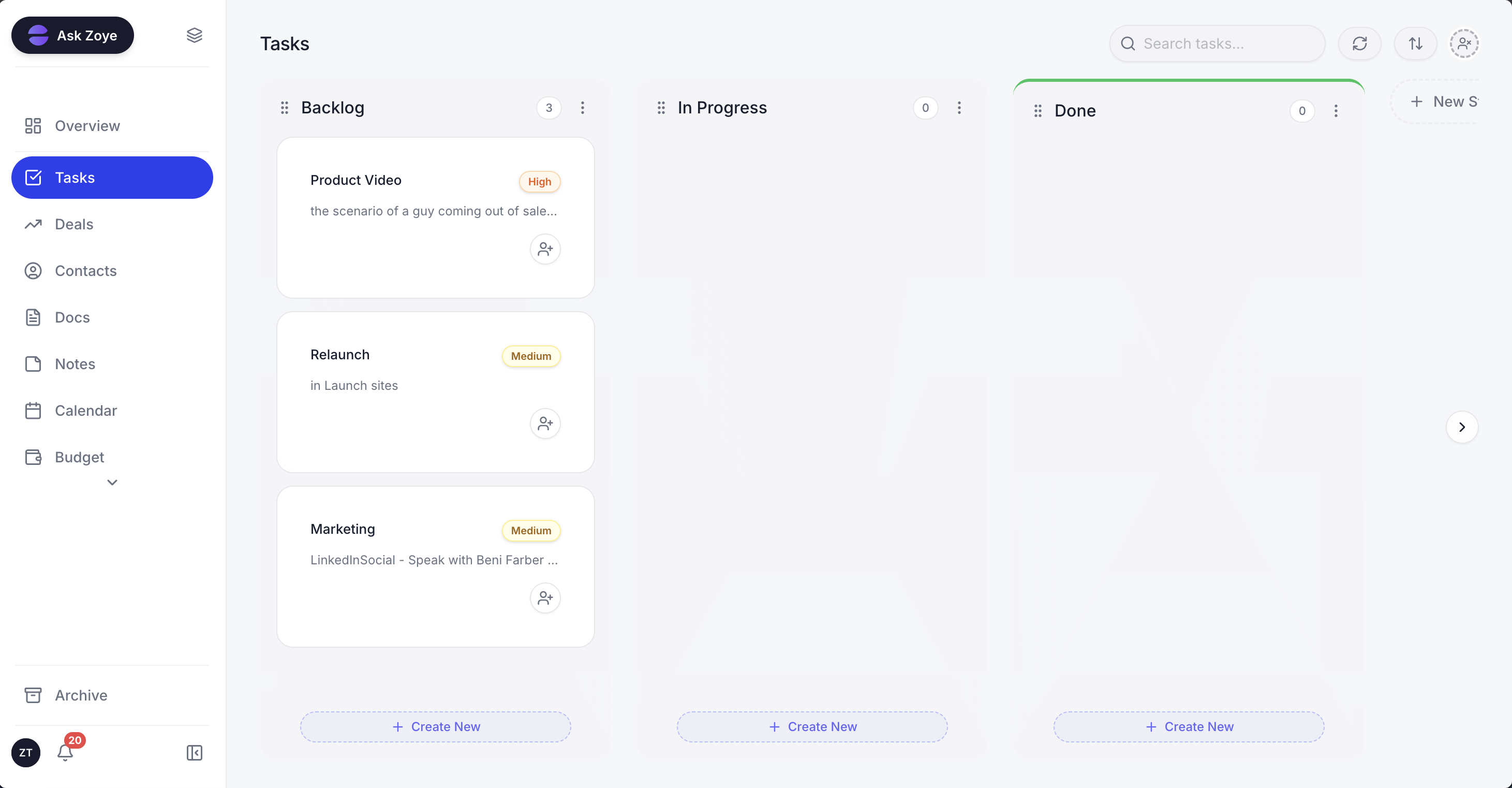 Zoye's task board: automation output lands as ordinary tasks with priority labels, so the team works the same board it always did
Two structural details matter more than the sentence-to-rule step. The first is that triggers and actions reach across eight of the workspace tools, and every record already links to every other one, so a deal knows its contact, its tasks, its files and its invoices without an integration in between. That is why rule 7 above can create tasks, book a meeting, draft an invoice and message a customer as one action set rather than four connected chains, each with its own way of failing quietly.
The second is the run log. Every run records what fired, what changed and what it sent, and it is reversible. This is unglamorous and it is the thing that separates automations you trust from automations you eventually switch off. When a rule fires on a bad record, you want to see it, understand it and undo it, not discover it three weeks later in a customer complaint.
Six of the rules above ship as recipes you can switch on directly: instant lead follow-up, the seven-day stale deal, won-deal onboarding, the overdue-invoice chase, blocked-task surfacing, and the parent task that closes when its subtasks are done. They map to rules 1, 4, 7, 12, 15 and 16 on this list, which is not a coincidence; they are the six that a small business benefits from most.
Worth being straight about the limits. Zoye is not an accounting ledger, so the invoice rules chase and record rather than reconcile your books. It is not a helpdesk ticketing suite. And it does not run your ads; it captures and works the leads your ads produce.
Ready to streamline your business?
Zoye brings AI-powered CRM, task management, and automation into one workspace.
Get StartedThe two to build first
Build instant lead response and the stale-deal nudge, in that order, and build nothing else for a fortnight.
They are first for the same reason. Both sit directly on revenue you have already paid for, both are measurable inside two weeks, and neither asks anybody to change how they work. Lead response protects the money you spent generating enquiries. The stale-deal nudge protects the money already sitting in your pipeline, which is the cheapest revenue in the business because the expensive part is done.
There is a second reason to start here. These two rules produce visible results fast, which matters enormously for the political reality of automation in a small team. The person who is quietly certain that automation makes the business feel robotic needs to see a recovered deal, not a diagram. For a deeper treatment of the follow-up mechanics specifically, see the guide to how to automate follow-ups, and for the sales-side sequencing, the piece on sales automation for small business.
The one everybody builds too early
Lead scoring.
It is irresistible. It sounds like the sophisticated version of routing, it produces a satisfying number on every record, and it makes a small operation feel like a serious one. It is also, in a business doing a few dozen deals a quarter, almost entirely arbitrary.
Scoring works by learning which attributes correlate with closing. That requires enough closed deals for the correlation to mean anything. With a small sample, the weights end up reflecting whatever the person building the model believed on the day they built it, and the score then hardens that belief into a number everyone treats as evidence. Worse, people start acting on it. A lead scored 34 gets less attention than a lead scored 71 despite the difference being noise, and the scoring model becomes self-fulfilling because the low-scored leads genuinely do convert worse once you stop calling them.
Route by source and owner instead. That is a fact, not an inference. Revisit scoring when you have several hundred closed deals to learn from, and when you do, check it against outcomes for a quarter before letting it change anybody's behaviour.
The same discipline applies to elaborate branching. A rule with nine conditions and four paths is not more powerful than three simple rules; it is harder to debug, harder to hand over and much more likely to silently stop matching anything.
A sane cadence for switching them on
One rule a fortnight is a good pace for a small team, and it is faster than it sounds: that is twelve automations in six months, which is more than most businesses this size ever get running.
For each one, do three things. Watch the run log for the first two weeks and confirm it fired the number of times you expected, because a rule that fires zero times looks identical to a rule that works. Give it an owner by name, since a rule nobody owns is a rule nobody will fix. And write down, in one sentence, what you expect it to change, so that in a month you can tell whether it did.
Then review the whole set quarterly. Retire the rules that no longer match how you work, because a stale automation firing on an obsolete process is a more expensive problem than a missing one. If you want the underlying theory behind choosing which processes qualify in the first place, read what is business process automation.
A note on templates and merge fields
Several of these rules send a message, which means placeholders. Two rules keep this from embarrassing you.
Always have a fallback for an empty value. A message that opens with "Hi {first_name}," is fine until the record came from a form where somebody typed only a company name, at which point you have sent a greeting to a blank. Set a default, usually "there", and test the rule against a deliberately incomplete record before it goes live.
And treat every outbound rule as if a real customer will read it out loud to a colleague, because eventually one will. The tone that reads as efficient at scale often reads as impersonal to the individual receiving it. Automation should make the timing reliable, not make the message sound like it came from a machine.
Start with the leak, not the tool
The instinct with automation is to open a builder and see what it can do. The better instinct is to spend twenty minutes listing the last five things that went wrong in your business, then find the rule on this list that would have caught each one.
That list is almost always shorter than people expect, and it almost always points at the same handful of leaks: an enquiry that went unanswered, a deal nobody followed up, a handover that started late, an invoice nobody chased. Four or five rules is enough to close most of it.
Try Zoye and describe your first rule in a sentence.
For more context, see the workflow automations overview, the guide to what is business process automation, and the practical walkthrough of how to automate follow-ups.