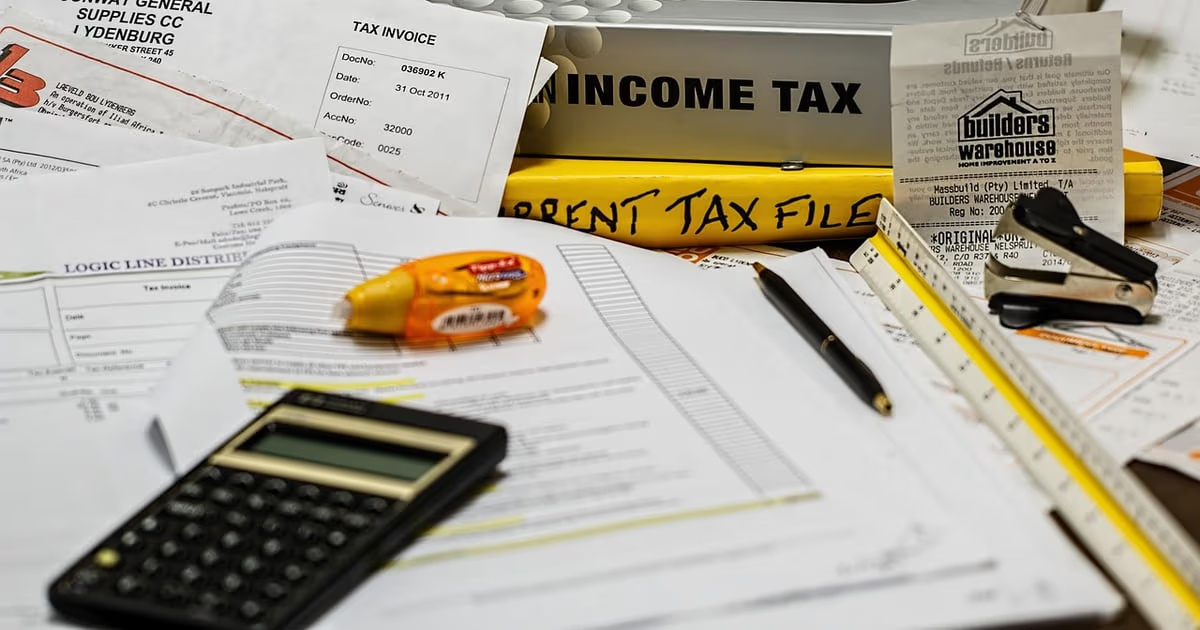
Most sales and most paid invoices are not lost to a competitor. They are lost to silence. Someone asks for a quote, you send it, and then life happens: you get busy, you assume they will come back to you, and three weeks later the deal is cold and you cannot even remember whose turn it was to reply. The follow-up that would have closed it never got sent, not because you did not care, but because remembering to chase every lead, quote, invoice, and past client is a full-time job on top of the actual work.
This is the quiet leak in almost every small business. The first message is easy. It is the second, third, and fourth touches that win the deal, and those are exactly the ones a busy owner forgets. Studies of sales outcomes consistently find that the majority of conversions happen after several follow-ups, yet most people stop after one. The gap between one message and five is, quite literally, the gap between the revenue you booked and the revenue you left on the table.
The good news is that follow-ups are the single most automatable part of running a business, because they are predictable. The same handful of moments repeat forever: a new lead, a sent quote, an unpaid invoice, a finished job, a customer who went quiet. This guide walks through why follow-ups die, the anatomy of a follow-up sequence you can reuse, the timing and cadence that actually work, templates for email and WhatsApp, and finally how to move from setting manual reminders to handing the whole thing to an AI that chases for you.
Pricing reflects published rates as of July 2026; check each vendor's pricing page for current figures.
Why follow-ups die (and it is not laziness)
The reason follow-ups fail is structural, not personal. Understanding the failure mode is what lets you design around it.
The owner is the bottleneck. In a small business, the same person who should be following up is also delivering the work, answering the phone, sending invoices, and putting out fires. Following up is important but never urgent, so it always loses to whatever is on fire today. By the time the fire is out, the lead has gone cold.
There is no system of record. Follow-ups live in your head, in a notebook, or scattered across your inbox and phone. Without one place that says "these five people are waiting to hear back from you," you are relying on memory, and memory is the least reliable tool in the business.
One message feels like enough. It is uncomfortable to chase, so people send a single message, hear nothing, and quietly decide the person is not interested. In reality, one unanswered message is almost never a no. It is a missed notification, a busy week, or a "I will get to that later" that never resurfaced. The deal was still alive, it just needed a nudge.
The timing is guesswork. Even when people do follow up, they do it whenever they happen to remember, which is usually too late or in an awkward clump. Effective follow-up depends on cadence, and cadence depends on tracking dates, which brings us right back to needing a system.
The through-line is that follow-ups are a memory-and-timing problem, and humans are bad at both. That is precisely why they are the ideal thing to automate.
The anatomy of a follow-up sequence
A follow-up sequence is just a planned series of messages sent after a trigger event. Instead of one message and silence, you keep light, useful contact until the person acts. Almost every small business needs the same five sequences. Build these once and you have covered the vast majority of the revenue that leaks out of a typical business.
1. The new-lead sequence. Triggered when a lead comes in from your website, WhatsApp, a social DM, or a phone enquiry. Speed matters more here than anywhere: a lead contacted within minutes is far more likely to convert than one contacted the next day. The sequence: an instant acknowledgement, a value-adding message within a few hours, and a check-in the next day if they have gone quiet.
2. The quote or proposal sequence. Triggered when you send a price or proposal. This is the highest-value sequence to automate because these are people who have already told you they want to buy. The sequence: a same-day "did you get this and any questions?", a nudge after two to three days, and a final "should I hold this price or shall we close the file?" after a week.
3. The invoice sequence. Triggered when an invoice is sent and, especially, when it becomes overdue. Chasing money is the follow-up people hate most, so it is the one that slips most, which is how businesses end up carrying thousands in unpaid invoices. The sequence: a friendly reminder a few days before the due date, a polite nudge on the due date, and firmer reminders at set intervals after.
4. The review or referral sequence. Triggered when a job is completed or a purchase is delivered. A happy customer is most likely to leave a review or refer a friend right after a good experience, and that window closes fast. The sequence: a thank-you when the work is done, a review request a day or two later while the goodwill is fresh, and an optional referral ask a couple of weeks on.
5. The win-back sequence. Triggered when a past customer has gone quiet for a set period. It is far cheaper to win back someone who already bought from you than to find a new lead. The sequence: a "we miss you" check-in, a reason to return, and a final light touch before you let them rest.
Want to see it in action?
See Zoye catch a new lead, answer on WhatsApp and set up the follow-up, all from one message.
See How It WorksTiming and cadence: how often, and when
The single biggest mistake in follow-up is inconsistency: a flurry of messages, then months of silence. The fix is a simple, deliberate cadence. Here is a reliable default you can adapt.
Follow up fast the first time. For a fresh lead or a sent quote, the first follow-up should go out same-day. Responsiveness is a signal of how you will treat the customer, and the earlier touches capture far more replies.
Space the next touches out. After the first, a rhythm of roughly day 1, day 3, day 7, then day 14 works well for most service businesses. It keeps you present without crowding the person. Each message should add a little value or lower a little friction, not just repeat "just checking in."
Know when to stop. Three to five touches over one to two weeks captures the large majority of replies you will get. After that, move the contact into a slower long-term nurture rather than hammering them. Persistence works; harassment does not.
Mind the clock and the calendar. Messages sent mid-morning or early evening on weekdays tend to land better than late nights or weekends, and a follow-up that lands when someone is at their desk gets actioned, not buried. The exact window depends on your customers, which is another argument for a system that can send at a chosen time rather than whenever you remember.
The reason cadence is so hard to run by hand is obvious once you see it laid out: every one of these numbers is a date you have to track, per contact, across dozens of open threads. That is a spreadsheet nobody keeps up. It is, however, trivial for software.
Doing it over email and WhatsApp
Follow-ups are not only an email game any more. For a lot of small businesses, especially service and local ones, customers now prefer to message. WhatsApp follow-ups are often read within minutes and answered far more often than email, because they land in the same place people talk to friends and family.
The right approach is to meet each customer on the channel they chose. If a lead came in by WhatsApp, follow up on WhatsApp. If a proposal went out by email, the first nudge can be email with a WhatsApp fallback if they go quiet. The templates below work on both; keep WhatsApp versions shorter and more conversational.
New-lead template (email or WhatsApp):
Hi {first_name}, thanks for reaching out about {topic}. I would love to help. Are you free for a quick call this week, or is there anything I can answer right now to make this easy?
Quote follow-up template:
Hi {first_name}, just making sure the proposal I sent on {date} reached you. Happy to walk through any part of it or adjust the scope. Shall I pencil you in to get started?
Invoice reminder template:
Hi {first_name}, a quick reminder that invoice {number} for {amount} is due on {due_date}. You can pay here: {link}. Any questions, just reply to this message.
Review request template:
Hi {first_name}, it was a pleasure working with you on {project}. If you have a spare minute, a short review here would mean a lot and helps other people find us: {link}. Thank you.
A note on WhatsApp specifically: business messaging on WhatsApp operates within Meta's rules, including message templates and windows for the first outbound contact. A proper WhatsApp platform handles that compliance for you so your follow-ups stay within policy. The point is not to blast people, it is to reliably send the right message at the right time on the channel they already use.
From reminders to an operator that chases for you
There is a ladder of maturity in how businesses handle follow-ups, and most owners are stuck on the bottom two rungs.
Rung one: memory. You try to remember. This fails constantly, as we have covered.
Rung two: reminders. You set a task or a calendar alert to follow up. This is better, but it still makes you do all the work: the reminder pings, and then you have to open the app, find the contact, remember the context, write the message, and send it. Every one of those steps is a place to stall, and a reminder you snooze five times is just a slower version of forgetting.
Rung three: templated automation. A tool sends pre-written emails on a schedule. This removes the sending effort, but classic automation is rigid. It fires the same generic message regardless of what the customer actually said, it usually only covers email, and setting up the sequences means learning a builder full of triggers and branches that most owners never finish configuring.
Rung four: an AI Business Operator that chases for you. This is the shift in 2026. Instead of building sequences in a tool, you say what should happen and an AI does the chasing, drafting each message in context, sending across email and WhatsApp, reading the replies, and updating the records itself. You are not maintaining a machine; you are delegating to one.
That last rung is what changes the economics of follow-up, because it removes the two things that made follow-up fail in the first place: the memory problem and the effort problem. You never forget, because the operator is tracking every open thread. And you never have to muster the energy to chase, because the operator does it.
See what Zoye can do for you
CRM, deals, tasks and your Instagram, Facebook and WhatsApp automations in one workspace. Just ask Zoye and it sets any of it up for you.
Explore FeaturesHow Zoye automates your follow-ups
Zoye is not a follow-up tool you configure, it is an AI Business Operator that runs the chasing for you. You say what follow-up you want, and Zoye handles the rest: the timing, the drafting, the sending across email and WhatsApp, and the record-keeping. It is the difference between owning a machine you have to operate and hiring someone who just gets it done.
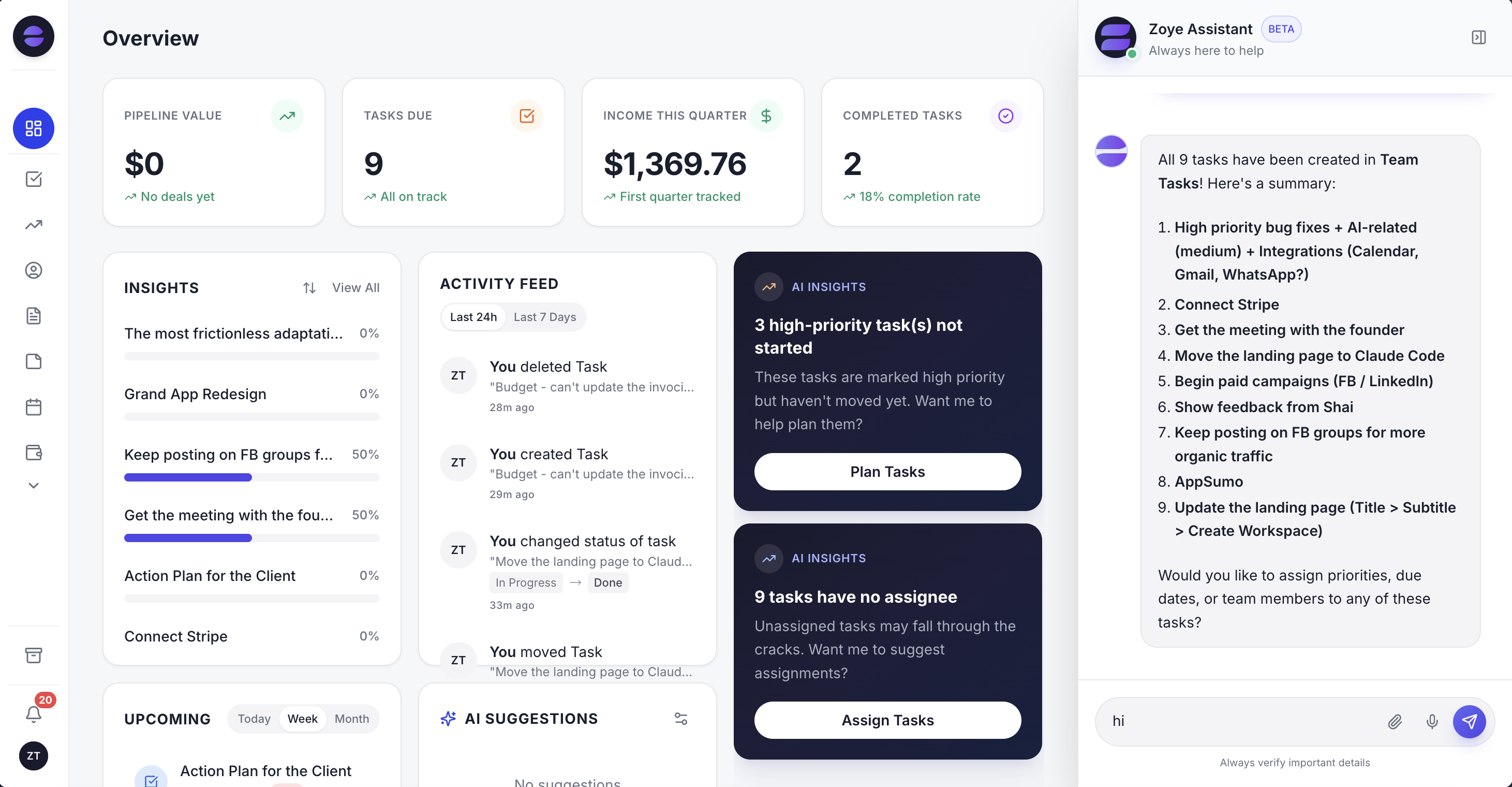 Zoye tracks every open lead, quote, and invoice and chases the follow-ups for you, on schedule, over email and WhatsApp.
Here is what that looks like day to day. Tell Zoye, "chase everyone who got a quote this week and has not replied," and it finds those contacts, drafts a personalised nudge for each one based on what they asked for, and queues the messages for you to approve or send automatically. Say, "remind clients three days before their invoice is due and again on the due date," and it sets that automation up, no trigger-and-branch builder to learn. When a lead arrives from WhatsApp, Zoye captures it as a contact, sends the acknowledgement, and schedules the next touch, without you opening the app.
Because Zoye centralises your customer conversations and connects to WhatsApp and Slack, the follow-up happens on the channel the customer actually uses, and the reply comes back into the same place. When someone answers, Zoye logs it against the record, moves the deal forward, and stops chasing, so nobody gets a follow-up they already responded to. And because Zoye is a full workspace, those follow-ups sit alongside your contacts, deal pipeline, tasks, calendar, and reports, so the chase is connected to the rest of the business rather than stranded in a separate email tool.
The result is that the five sequences from earlier in this guide run themselves. New leads get answered fast, quotes get chased until they close or clearly die, invoices get gently but reliably pursued, happy customers get asked for reviews at the right moment, and quiet ones get won back, all without you keeping a mental list. Follow-up stops being the thing you feel guilty about and becomes the thing that quietly runs in the background.
Pricing: Almost Free at $5 per month for 1 member with the core tools. Starter from $29 per month (10 members). Growth from $59 per month (20 members).
Best for: Small businesses, founders, and lean teams that lose revenue to forgotten follow-ups and want the chasing handled for them.
A simple plan to start this week
You do not need to automate everything at once. Start with the sequence that is costing you the most money, which for most businesses is either the quote follow-up or the overdue invoice.
1. Pick one sequence. Choose quotes or invoices first, since those are people who have already shown intent or already owe you money.
2. Write your three messages. Use the templates above as a starting point and rewrite them in your own voice. Keep them short and specific.
3. Set the cadence. Decide the days, for example same-day, day 3, day 7. Write it down so it is a rule, not a mood.
4. Hand it to Zoye. Describe the sequence once and let it run the chasing over email and WhatsApp, so you are approving messages instead of remembering to write them.
5. Add the next sequence. Once the first is running itself, add new-lead, then reviews, then win-back. Within a couple of weeks the whole follow-up engine is running without you.
Ready to hand off the busywork?
Zoye brings AI-powered CRM, task management, and automation into one workspace.
Get StartedWhy teams pick Zoye
A few themes come up consistently when small businesses move their follow-ups to Zoye.
Nothing gets forgotten. Zoye tracks every open lead, quote, and invoice, so the follow-up that would have slipped through the cracks gets sent on time, every time.
The chasing actually happens. Reminders still leave the work to you; Zoye does the work. It drafts each message in context and sends it across email and WhatsApp, so the follow-up is done, not just remembered.
You describe it, you do not build it. There is no automation builder to learn. You tell Zoye what you want, even from WhatsApp on your phone, and it wires up the sequence and runs it.
It is connected to the whole business. Because the CRM, tasks, calendar, and reports live in the same workspace, your follow-ups are tied to real contacts and deals, and the operator updates the record the moment someone replies.
Try Zoye with your team. The entry plan is Almost Free, with the core tools.
For more context, see business automation for small business, how to stop losing leads, and AI lead management.