WhatsApp Message Templates in 2026: Categories, Approval and Examples
WhatsApp message templates are the part of the WhatsApp Business Platform that everyone underestimates. They look like a formality: write your message, submit it, wait a day, start sending. Then the first one comes back rejected with no explanation a normal person can act on, the second gets approved but silently recategorized as marketing and starts costing money, and the third gets paused at nine in the morning on the day of a launch.
None of that is bad luck. Meta's template system is a set of specific, published rules about what a business may say to someone on a channel that people treat as private. Once you can see the rules, templates stop being a lottery. You will know before you submit whether a message is utility or marketing, whether a variable is going to trip the reviewer, and what happens to an approved template when you change one word in it.
This guide covers the whole surface: what a template is and when one becomes mandatory, the three categories and how Meta decides which one you are in, variables and the sample-value requirement, the concrete reasons templates get rejected, copy-ready examples by use case, quality rating and messaging limits, and how to change an approved template without breaking it.
Every policy claim below was checked against Meta's own WhatsApp Business Platform documentation as of August 2026. Meta revises these rules frequently, so verify anything you are about to build a process on.
What a WhatsApp message template actually is
A template is a message asset you register with your WhatsApp Business Account and submit to Meta for review. Once approved, you can send it to a phone number by referencing it and filling in whatever variable slots you defined. Meta's documentation is blunt about why it exists: a template is the only kind of message that can be sent to a WhatsApp user outside a customer service window.
Every template is assembled from four components, and each has hard limits worth knowing before you start writing:
- Header (optional). Either a line of text capped at 60 characters, or a media header carrying an image, video, GIF or PDF, or a location. A text header supports one variable.
- Body (required). Up to 1,024 characters, text only, and this is where most of your variables live.
- Footer (optional). Up to 60 characters, plain text, no variables allowed.
- Buttons (optional). Up to 10 in total. One phone-number button, up to two URL buttons, one copy-code button, and up to 10 quick-reply buttons, with type-specific character caps. Anything past the third button collapses behind a "See all options" control, and templates with four or more buttons do not render on WhatsApp desktop.
Template names are lowercase alphanumeric with underscores, up to 512 characters, and they do not have to be unique across languages, which is how one message ends up existing in eight locales under one name.
Two operational limits catch growing businesses off guard. You can create at most 100 templates per WhatsApp Business Account per hour, and a submission that duplicates an existing template gets rejected outright, with authentication templates the only exception.
The 24-hour window, and the exact moment a template becomes mandatory
This is the single rule that explains most of the confusion around WhatsApp for business, and it is simpler than the internet makes it sound.
A customer service window opens the moment a WhatsApp user messages or calls your business. It lasts 24 hours. If they message you again before it expires, the timer resets to a fresh 24 hours from that new message.
Inside an open window you can send free-form messages: text, images, audio, documents, interactive messages, anything. No template, no review, no approval. This is a normal conversation and it behaves like one.
When the window closes, that stops. From then on the only thing your business can send to that person is a pre-approved template. So the practical test is:
- Your business starts the conversation? Template, always, regardless of how well you know the person.
- You are replying inside 24 hours of their last message? No template needed.
- You are replying more than 24 hours later? Template, even though they wrote to you first.
That third case is the one that costs small businesses money and goodwill. A customer asks a question on Friday evening, nobody sees it until Monday, and the friendly free-form reply the owner wants to send is no longer allowed. It has to be a template, which means it had to have been written and approved days earlier. Response speed is not just a service virtue on WhatsApp; it is the difference between a free message and a queue.
One more piece of the window worth knowing: opt-in is a separate requirement that does not go away. Meta's Business Messaging Policy requires that the person gave you their phone number and gave permission to receive messages from you before you message them at all. An open window is not consent, and consent is not an open window. You need both.
If you want the automation side of this rather than the policy side, our WhatsApp automations page shows what actually fires on a lead, and the WhatsApp broadcast guide covers the audience and frequency questions this article deliberately leaves alone.
Want to see it in action?
Watch how Zoye automates your daily workflow - from lead management to team collaboration.
See How It WorksThe three categories, and how Meta decides which one you are in
Every template must be assigned one of three categories at creation. You propose the category; Meta's automated review confirms or overrides it. The category is not cosmetic. It governs what content is permitted, how the message is priced, and in some markets whether it gets delivered at all.
Utility
Meta's categorization documentation defines a utility template by two conditions that must both hold: the message is non-promotional, and it was either requested by the user or is essential to a transaction or to safety. Order confirmations, shipping and delivery updates, appointment reminders, payment receipts, account alerts and post-purchase feedback surveys are the canonical examples. These are typically triggered by something the user did.
Utility is the category most small businesses should be living in, and the one most of them accidentally leave. Under the per-message pricing model Meta introduced on 1 July 2025, utility templates sent inside an open customer service window are free, and utility templates outside a window are billed at rates that vary by volume tier and by the recipient's country calling code.
Marketing
Marketing is the catch-all for anything that promotes: offers, launches, event invitations, product recommendations, re-engagement, cross-sell. Crucially, Meta places mixed-content templates in marketing too. If an order confirmation ends with "and here is 10% off your next order", the whole template is marketing. One promotional sentence recategorizes the entire message.
Marketing templates are always billed on delivery, whether or not a window is open. They also sit under two constraints that did not exist a couple of years ago. Meta applies per-user marketing limits: an adaptive cap based on how many marketing messages a given person has recently read and how crowded their inbox already is. Hit the cap and the message is not delivered. Meta's guidance is to wait at least 24 hours before retrying that recipient, because repeated retries inside 24 hours raise error 131049 and can suspend delivery attempts to that user for up to a day. Those per-user limits do not currently apply for businesses in or messaging users in the European Economic Area, the United Kingdom, Japan or South Korea. Separately, and this is the one that surprises people, Meta's documentation states that marketing template messages are not currently delivered to users with United States phone numbers.
Authentication
Authentication is the narrowest category and the least forgiving. It exists for one job: verifying identity with a one-time passcode. The content rules are correspondingly strict. Authentication templates cannot contain URLs, media or emojis, and they must use a copy-code or one-tap button.
Do not use authentication as a shortcut for cheap delivery of a non-authentication message. Meta re-reviews for this: templates approved as marketing or utility that should have been authentication have their status changed to rejected on the first day of the following month.
Recategorization is routine, not exceptional
Meta reviews approved templates monthly to confirm they are still in the right category. If a template you registered as utility is really marketing, you get one day of advance notice before the category changes, unless you are a repeat offender, in which case the notice is skipped. If you believe a categorization is wrong, you can request a review through Business Support within 60 days of creation or of the category change.
The budget consequence is worth stating plainly: a template you costed as utility can become a marketing template, and marketing is billed on every delivery. If WhatsApp is a real line item for you, our breakdown of WhatsApp Business API pricing explains how the per-message model works underneath these categories.
Variables and the sample-value rule
Variables are what make one approved template serve ten thousand different messages. Meta supports two syntaxes and you pick one per template.
Named parameters look like {{first_name}} or {{order_id}}. They must be unique single strings of lowercase characters and underscores, and because they are named, they can appear in your send payload in any order.
Positional parameters look like {{1}}, {{2}}, {{3}}. They must be sequential and in order, both when you create the template and when you send it. This is the default if you do not specify a format.
Both syntaxes carry the same non-negotiable requirement, and it is the one people skip: every variable needs an example value at creation time. The reviewer is a system reading your template as a finished message, and a body that reads "Hi {{1}}, your {{2}} is ready for {{3}}" with no samples supplied is unreviewable. Give it "Sarah", "framed print" and "collection on Thursday" and it becomes a sentence a reviewer can judge. Missing or nonsensical samples are one of the most common rejection causes, and Meta's appeal process explicitly requires the appeal to include a sample.
A few habits that keep variables out of trouble:
- Do not start or end the body with a variable. A dangling parameter is a documented rejection reason.
- Keep special characters like
#,$and%out of the parameter itself. - Do not overuse them. A body that is 60% placeholders reads as a mail-merge shell and gets treated like one.
- Make the sample realistic. "asdf" is not a sample value.
- Remember the footer takes no variables at all, and a text header takes exactly one.
See what Zoye can do for you
From CRM and deal tracking to AI-powered task management - explore everything Zoye offers in one workspace.
Explore FeaturesWhy templates get rejected
Meta's template review is automated, usually returns a decision within 24 hours, and gives you a rejection reason that is often too terse to act on. Here is what the documentation actually lists, translated into things you can check before you submit.
Parameter problems. Missing braces, special characters inside the parameter, non-sequential numbering on positional parameters, too many parameters for the length of the body, or a parameter dangling at the very start or end of the body.
Policy violations. Content that breaks Meta's Commerce Policy or the WhatsApp Business Messaging Policy. The prohibited list is specific and includes illegal products and services, firearms, drugs and hazardous materials, live animals and endangered species, fraudulent or deceptive schemes, adult products and dating services, multi-level marketing, payday loans and debt collection. Offensive content, including sexually explicit material and nudity, is prohibited outright.
Requesting sensitive identifiers. A template that asks the recipient to reply with a government ID number, full card details or similar will not pass.
Abusive or threatening content. This one catches legitimate businesses in one specific place: overdue-invoice chasing. Firm is fine, threatening is not.
Character limits. Exceeding the body limit, the header limit or the footer limit.
Duplication. Submitting a template that matches one you already have, in every category except authentication.
And two failure patterns that are not technically rejection reasons but produce them constantly. First, category mismatch: a promotional sentence inside an otherwise transactional message. Second, vagueness. A body that says "Hi {{1}}, we have news for you, click here" gives the reviewer nothing to evaluate and looks like every spam template ever written. Specific messages pass more often than clever ones.
Copy-ready template examples by use case
Adapt these to your own voice and check them against the category definitions above before submitting. Each one is written to sit cleanly inside its category, with variables that let the message change without a resubmission.
Order confirmation (utility). Hi {{first_name}}, thanks for your order. Order {{order_id}} is confirmed for {{order_total}} and we will let you know the moment it ships. You can reply to this message if anything looks wrong.
Delivery update (utility). Hi {{first_name}}, your order {{order_id}} is out for delivery today and should arrive by {{delivery_window}}. Reply here if you need to change the drop-off instructions.
Appointment reminder (utility). Hi {{first_name}}, this is a reminder of your appointment with {{staff_name}} on {{appointment_date}} at {{appointment_time}}. Reply CHANGE if you need a different slot.
Invoice reminder (utility, and mind the tone). Hi {{first_name}}, invoice {{invoice_number}} for {{invoice_amount}} was due on {{due_date}}. The payment link is below if it is easier than a transfer, and reply here if it has already been paid.
Quote follow-up (utility when it references the existing transaction). Hi {{first_name}}, the quote we sent for {{project_name}} is valid until {{expiry_date}}. Reply here with any questions and we will adjust it.
New-lead reply (utility, because it answers a request they made). Hi {{first_name}}, thanks for getting in touch about {{enquiry_topic}}. {{owner_name}} is picking this up and will come back to you today. If anything is urgent, just reply here.
Seasonal offer (marketing). Hi {{first_name}}, our {{offer_name}} runs until {{offer_end_date}}: {{offer_detail}}. Reply STOP if you would rather not hear about offers.
Re-engagement (marketing). Hi {{first_name}}, it has been a while since your last {{service_name}} with us. If you would like to book again, reply here and we will find you a slot this month.
Event invitation (marketing). Hi {{first_name}}, we are running {{event_name}} on {{event_date}} at {{event_location}}. Reply YES and we will save you a place.
One-time passcode (authentication). Authentication templates are built from Meta's own authentication template format rather than free-written body copy, and they carry a copy-code or one-tap button with no URLs, media or emojis. Build these through the authentication template flow rather than by writing your own body text and hoping it is classified correctly.
Two notes that apply to all of the above. Include a way to stop hearing from you on anything promotional, because opt-out handling is both a policy expectation and the cheapest protection your quality rating has. And write the message you would actually send one person, not the message you would put on a billboard.
Ready to streamline your business?
Zoye brings AI-powered CRM, task management, and automation into one workspace.
Get StartedQuality rating, pausing and messaging limits
Approval is where most guides stop. In practice, approval is the beginning, because Meta keeps scoring the template after it goes live.
Template quality rating is calculated automatically from usage, engagement and customer feedback, which in practice means blocks, reports and read rates. Every template carries one of four ratings: green for high quality with little or no negative feedback, yellow for medium, red for low, and unknown for a template that has not gathered enough data yet. A red template can still be sent, right up until it cannot.
Pausing escalates on a published schedule. The first time a template drops to the lowest quality rating it is paused for three hours. The second time, six hours. The third time, it is disabled. Paused templates unpause automatically when the timer expires and the rating is recalculated from recent feedback, so recovery is real. Templates paused under Meta's template pacing program are different and require a manual unpause, either from the "manually unpause it" link in WhatsApp Manager or through the API's unpause endpoint. While a template is paused the API rejects sends outright, so a paused template in the middle of a campaign is not a delay, it is a hole.
Messaging limits are a separate ladder that sits at the phone-number level rather than the template level. The tiers are 250, 2,000, 10,000, 100,000 and unlimited unique customers you can start conversations with in a rolling 24 hours. New portfolios begin at 250. You reach 2,000 by verifying your business, having a partner verify you, or delivering 2,000 messages outside customer service windows to unique numbers within a rolling 30-day period using templates with a high quality rating. Beyond 2,000, Meta scales you automatically, within about six hours, when you are both sending consistently high-quality messages and using at least half your current limit over the previous seven days.
Read those two systems together and the incentive is clear: volume on WhatsApp is earned by sending messages people are happy to receive. A business that chases reach by messaging everyone gets throttled by the same mechanism it was trying to outrun.
How to edit a template without losing approval
The honest answer first: there is no way to change the content of an approved template and keep the approval untouched. Editing either the content or the category sends the template back through category validation and template review, which can take up to 24 hours, and re-approval is not guaranteed. Approved templates that have become disabled can also be edited and resubmitted, which is the normal recovery path after a third pause.
So the skill is not editing well. It is designing templates that rarely need editing.
Put everything volatile in a variable. Prices, dates, names, offer titles, order references, staff names, locations. A template whose fixed text says "our {{offer_name}} runs until {{offer_end_date}}" never needs resubmitting when the offer changes. A template that hardcodes "our Summer Sale runs until 31 August" needs resubmitting every season, and every resubmission is another roll of the review dice.
Keep the fixed text about the relationship, not the campaign. Greeting, context, the reason you are messaging and the way to reply are stable. The specifics are not.
Time your edits away from your sends. A review can take a day. Editing a template the morning of a campaign is how a campaign does not go out.
Be careful with the clone-instead-of-edit trick. Creating a second near-identical template and retiring the first sounds smart, and sometimes it is the right call, but duplicate templates are a documented rejection reason in every category except authentication. If you clone, the new one has to be genuinely different, not the old one with a comma moved.
Keep a record of what each template is for. Once you have thirty templates across eight languages, the thing that stops you from editing the wrong one is documentation, not memory.
Where Zoye fits
Everything above is the part of WhatsApp that a business has to get right and gets no credit for. Zoye's role is to make it not be a project.
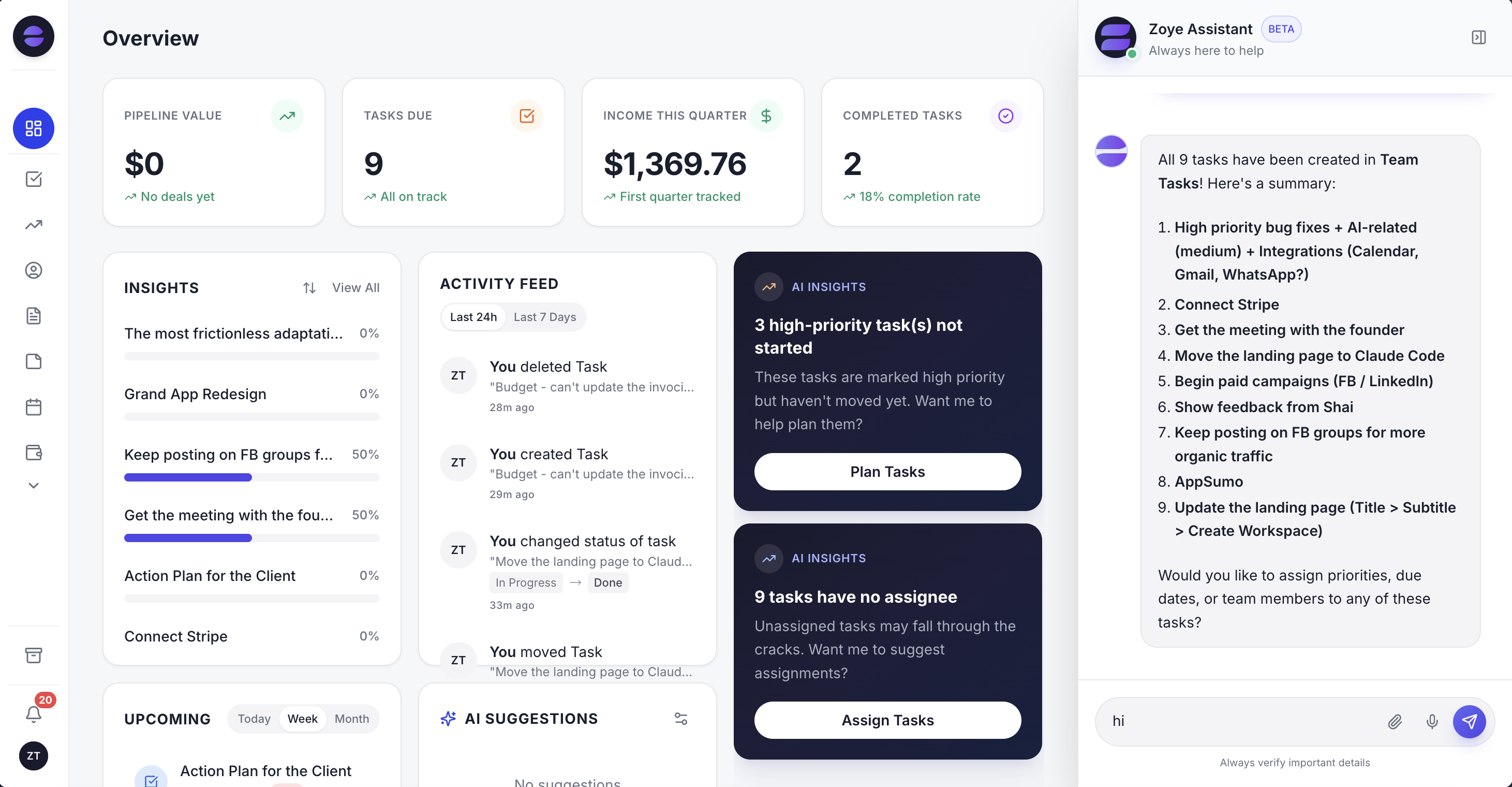 The Zoye dashboard, where a WhatsApp conversation and the contact record it belongs to are the same thing.
Zoye handles template approval as a workflow rather than a chore: it categorizes the template, submits it to Meta, tracks the approval status, and resubmits edits when they are needed, so the thing you actually do is write the message. Everything runs on the official Meta WhatsApp Business Platform, so the rules in this article are the rules you are operating under, not a workaround layered on top of them.
Around that sit the six WhatsApp automations, all off by default and all confirming before they send: a new-lead auto-message with per-source switches and one-message-per-person dedupe, a qualification bot that writes answers straight into CRM fields, smart audiences that stay live as records change, scheduled broadcasts with per-recipient merge fields and pacing, template approval handled for you, and click-to-chat capture.
The part that matters for template quality is less obvious. Because the conversation and the customer record are the same object in Zoye, an audience is built from what is true about a contact right now rather than from a static export, and a scheduled broadcast is paced rather than dumped. Both of those are quality-rating protection, and quality rating is what your messaging limits are made of.
Zoye is not a WhatsApp inbox product and does not pretend to be a marketing suite. It is one workspace with thirteen tools that already link to each other, plus an assistant that operates them, on WhatsApp and in the web app with the same tools and the same permissions.
A checklist before you submit
Run this list before every template goes to review, and your approval rate stops being a source of drama.
- Is the message genuinely non-promotional and either user-requested or transactional? If yes, submit as utility. If there is any promotional sentence anywhere in it, submit it as marketing and budget accordingly.
- Does the body stay under 1,024 characters, the header under 60, the footer under 60?
- Does every variable have a realistic sample value?
- Are positional parameters sequential, or named parameters lowercase with underscores?
- Does the body start and end with fixed text rather than a variable?
- Is there a way to stop receiving messages, on anything promotional?
- Does the message read like something you would send to one person?
- Is it different enough from your existing templates not to be flagged as a duplicate?
- If it is authentication, does it use the authentication template format, with no URLs, media or emojis?
- Are you submitting at least a day before you need to send it?
Templates are not the interesting part of running a business on WhatsApp. They are the part that decides whether the interesting part is allowed to happen. Get the categories right, keep the volatile text in variables, respond fast enough that the 24-hour window works for you instead of against you, and the approval queue becomes background noise.
To go further, see the WhatsApp broadcast guide for audience and frequency, WhatsApp Business API pricing for what the categories cost, and the WhatsApp automations page for what runs on top of an approved template.