
Sales Automation for Small Business: What to Automate and What Never to
Most advice about sales automation for small business is written as though the reader has a sales team. It does not. In a two-person consultancy or a six-person agency, the person selling is also the person delivering, invoicing, and answering the phone, and selling happens in the gaps between everything else. That changes the entire calculation. The question is not how to make a sales floor more efficient. It is which parts of a sale can run without a human in the room at all, so that the few hours the owner actually has go to the parts that need them.
The honest answer is that a sale splits cleanly into two kinds of work, and most small businesses have them backwards. There is mechanical work: replying, remembering, tracking, updating, handing over. It is repetitive, it follows rules, and it is exactly what gets dropped when the week gets busy. Then there is judgement work: the pitch, the objection, the price. It is not repetitive, it does not follow rules, and it is what people are actually buying when they buy from a small business rather than a large one.
Automation is supposed to move the mechanical work off the owner's plate so the judgement work gets their full attention. What often happens instead is the reverse. The owner keeps hand-typing pipeline updates at 11pm and lets a template argue the price. This guide is about drawing that line properly: the four things that should never be manual, the five-touch cadence and what each touch is for, the three things that should never be automated, and how to tell a lead that has died from one that is merely slow.
The four parts of a sale that should never be manual
These four are pure mechanics. Nothing is lost by handing them to software, and a great deal is lost by not.
1. The first response. A prospect is never more interested than in the minutes right after they contact you, and there is no version of a small business where a human reliably catches that window. Leads arrive at 9pm, on a Saturday, while you are on site with another client. The fix is not to try harder, it is to separate the acknowledgement from the conversation. An instant, honest, short reply that confirms you have the enquiry and says when a real answer is coming does two things: it stops the person shopping around, and it buys you the hours you need to reply properly. The classic study behind the urgency, Oldroyd, McElheran and Elkington's lead-response research published in Harvard Business Review in 2011, found response times of an hour or less mattered enormously to whether a contact was ever qualified. That work is now well over a decade old and its exact figures should be treated as directional rather than as a benchmark you owe anyone, but the direction has not reversed: waiting is expensive, and instant acknowledgement is close to free.
2. The follow-up cadence. Nobody loses deals because they lack a follow-up strategy. They lose them because holding thirty open threads, each with its own next date, in a human head is impossible. The cadence itself is trivial to define. Running it by hand across a busy fortnight is not. Once the sequence lives in software, persistence stops being a personality trait and becomes a default setting. There is a fuller treatment of the messages themselves in our guide to automated follow-up emails; what matters here is that the schedule should not depend on your memory.
3. Stage hygiene. Every pipeline drifts. Deals sit in "proposal sent" three weeks after the proposal went out, "negotiating" contains two records that quietly closed and one that quietly died, and the forecast is fiction. Stage hygiene is the work of keeping the board honest: moving a deal when the thing that defines the stage actually happens, flagging anything that has not moved in a set number of days, and closing out what is finished. It is mechanical work with an obvious rule set, and it is the first thing to rot because nobody enjoys it. A rule that surfaces every deal untouched for seven days is worth more to a small business than most reporting features.
4. The handover after a win. The moment a deal is won is the moment the business is most likely to drop something. There is a kickoff to book, a folder to make, an invoice to raise, an onboarding note to send, an owner to assign. Doing that by hand five times is fine. Doing it by hand fifty times means the fourteenth client gets a worse start than the first, and nobody ever knows why. A won deal should fan out into its tasks and its first invoice without anyone remembering the checklist. That is what the workflow rules on our workflow automations page are built for: describe the sequence once and let the win trigger it.
What unites these four is that a machine does them better than a person, not merely cheaper. Software does not get tired at 9pm, does not skip the boring one, and does not decide today is the day to stop updating the pipeline.
Want to see it in action?
Watch how Zoye automates your daily workflow - from lead management to team collaboration.
See How It WorksThe five-touch cadence, and what each touch is actually for
Most cadences fail because every touch says the same thing in slightly different words. "Just checking in" four times is not persistence, it is nagging with a calendar attached. A cadence works when each touch has a distinct job, so that a person who ignored touch two has a genuinely different reason to answer touch four.
Touch one, same day: acknowledge and set expectations. Confirm what they asked for, in their words, and say when they will hear something substantive. This is the touch that should be automatic and instant. Its only job is to convert an anonymous enquiry into an active conversation.
Touch two, day one or two: add something useful. Not a nudge. A relevant example, a rough range, a question that shows you understood the problem. The point is to earn the right to the later touches by being worth reading once. If touch two is empty, touches three through five will be ignored on sight.
Touch three, around day four: remove a specific blocker. By now you usually know, or can guess, what is in the way: budget approval, a colleague who has not seen it, uncertainty about timelines. Address the likely one directly and offer to make it easier. This is the touch that most often produces the real objection, which is why it is the most valuable one in the sequence.
Touch four, around day seven: offer a decision, not a conversation. Two concrete options with a date attached. People stall indefinitely on open questions and respond quickly to closed ones. Something as plain as asking whether to start this month or hold the file until next quarter converts far better than another request for a call.
Touch five, around day twelve to fourteen: close the loop honestly. Say you are going to stop chasing, leave the door open, and mean it. This message reliably produces replies, partly because it is a relief and partly because it is the first time the prospect faces losing the option. Do not fake it. If you send a closing message and then reappear three days later, you have taught the person that nothing you say has a deadline.
Five touches over two weeks is a default, not a law. A high-value, long-cycle deal deserves a slower, longer version. A twenty-euro impulse purchase does not deserve five messages at all. What matters is that the shape is deliberate and that touches two through four each carry something new.
The three things you should never automate
This is the part of the argument that most sales automation content skips, and it is the part that decides whether automation makes your business better or quietly hollows it out.
Never automate the pitch. The reason a prospect chooses a small business over a larger competitor is almost never price and almost never feature count. It is that someone understood their specific situation and said something about it that a bigger, busier vendor did not bother to say. That understanding is the product. The moment the pitch comes out of a template library, you have thrown away the only structural advantage you had, and you are now competing with larger companies on the ground they are best at: volume and polish. You will lose. A drafted first pass is fine, and genuinely saves time. But someone who has spoken to the customer has to rewrite it, because the sentence that wins the deal is the one only you could have written.
Never automate the objection. An objection is not an obstacle, it is the most valuable information the prospect will ever give you, and it is almost always a proxy for something else. "Too expensive" usually means the value is unclear, or the buyer cannot defend the spend internally, or they have been burned before. "We need to think about it" usually means a person who is not in the conversation has to be convinced. A scripted rebuttal answers the surface sentence and destroys the chance of finding out what was underneath it. Worse, a canned objection handler is instantly recognisable, and being handled is the fastest way to end a relationship that had not started yet. Automate the reminder that an objection is outstanding. Do not automate the reply.
Never automate the price conversation. Pricing is where scope, risk, terms and judgement all meet, and it is the single place where a wrong automated message costs real money. An automated discount teaches the market that your list price is theatre. An automated quote sent before you understood the scope becomes a number you have to walk back, which is a far worse conversation than a slow quote would have been. A payment-terms concession made by a rule rather than a person can put a small business into a cash-flow hole that no amount of pipeline efficiency repairs. Send the reminder to price it. Track whether the quote was opened. Chase the unanswered proposal. But have a human decide the number, every time.
There is a shared logic under all three. Automate anything whose correct output is knowable in advance. Never automate anything whose correct output depends on what the other person just said. The first category is admin. The second is the actual job.
There is a fourth candidate worth naming, even though it sits slightly outside the sale: the apology. When something has gone wrong, an automated message is not neutral, it is actively damaging, because it tells the customer that their bad experience was not worth a person's time.
See what Zoye can do for you
From CRM and deal tracking to AI-powered task management - explore everything Zoye offers in one workspace.
Explore FeaturesHow to tell a dead lead from a slow one
The most expensive mistake in small business sales is not chasing too long. It is quitting on the slow ones and refusing to quit on the dead ones, which is exactly backwards and happens constantly, because silence looks identical in both cases.
Silence is not evidence. Plenty of people who intend to buy go quiet for a month because a project slipped, a colleague left, or the busy season started. Plenty of people who will never buy reply politely and promptly to everything. Read signals instead.
A slow lead usually has a date attached to it. A contract that ends in March, a hire starting in September, a busy season that finishes in six weeks. If the prospect ever named a time-bound circumstance, they are not dead, they are scheduled. The correct move is not another chase message, it is a note on the record with a real date on it, so the conversation restarts when the circumstance changes rather than when you happen to think of them.
A slow lead still produces traces. They open the proposal again. They reply after nine days with two words. They forward it to someone internally. Any of that is a live lead moving at its own speed.
A dead lead usually failed a qualifying fact early on. Wrong size, no budget, no authority to sign, no problem urgent enough to fund. Look back at the first conversation and you will normally find the tell, sitting there ignored, because the enquiry was flattering. If a qualifying fact failed and no signal has appeared across a full cadence, that is a dead lead and continuing to chase it is a form of procrastination.
The practical rule: complete the cadence, then sort every non-responder into "scheduled" or "closed", never into "still chasing". Scheduled leads get a date and a reason. Closed leads get closed, with the reason written down so your reporting eventually tells you which lead sources produce them. What you must not keep is a pipeline full of records nobody has decided about, because that is the thing that makes the whole board untrustworthy. Our guide to stopping lead leakage covers the earlier stages of the same problem.
How Zoye runs the mechanical half
Zoye is an AI Business Operator: one workspace with thirteen connected tools, plus an assistant that operates them. For sales specifically, that means the cadence runs itself and the record updates itself, while the pitch, the objection and the price stay entirely yours.
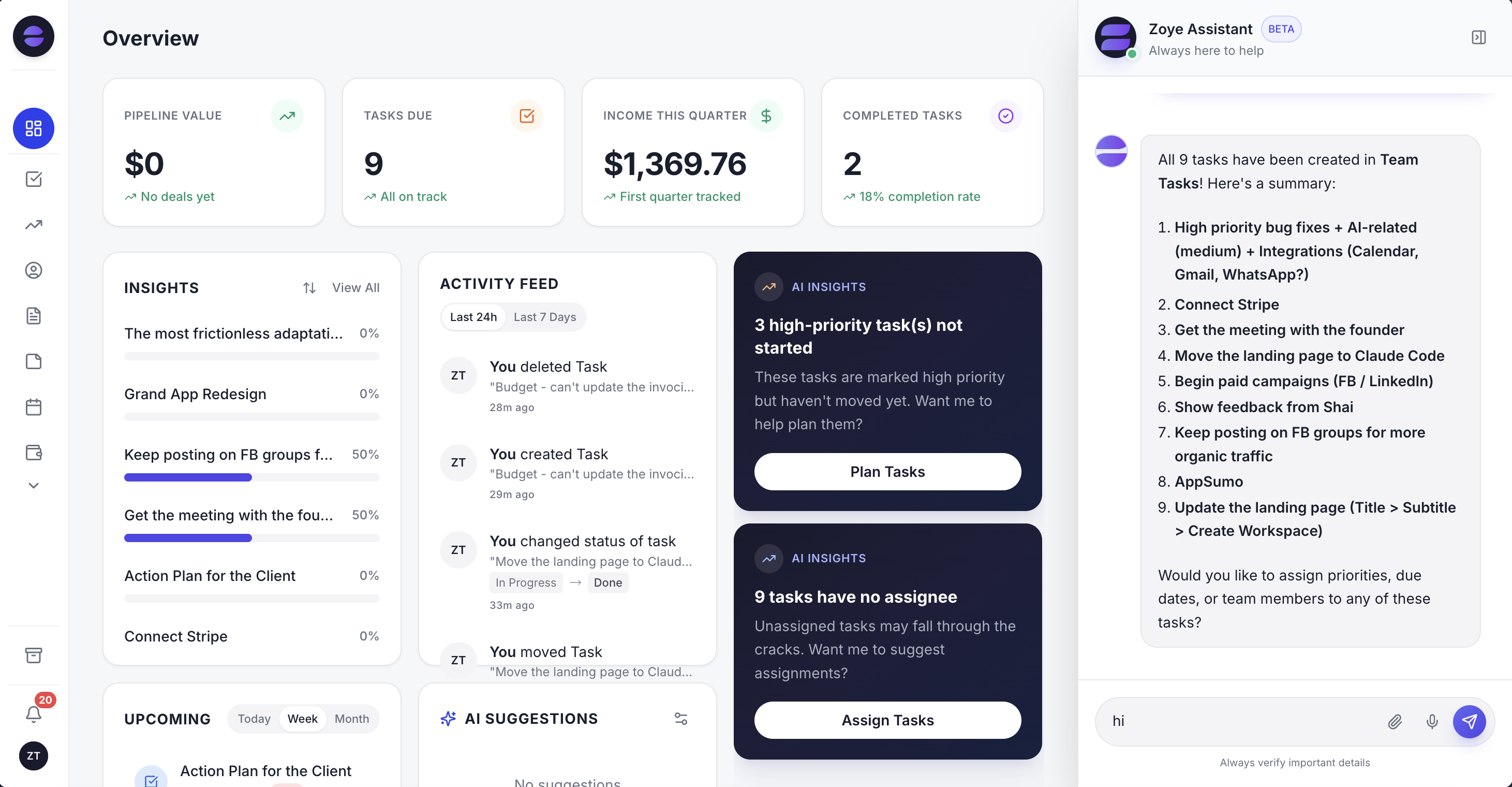 One view of the pipeline, the tasks it created, and the follow-ups still owed.
You describe a rule in a sentence, in the app, on WhatsApp or in Slack, and Zoye turns it into a real trigger with conditions and actions, shows you the finished rule in plain English, and runs nothing until you approve it. A visual builder exists if you want it; you are never made to open one. So "acknowledge every new lead within a minute and assign it to me", "flag any deal that has not moved in seven days", and "when a deal is won, create the kickoff task, the client folder and the first invoice" are three sentences rather than three afternoons in a workflow tool. Every run is logged with what fired, what changed and what was sent, and it is reversible, which is what makes it safe to let rules touch real records.
Because every record links to every other one, stage hygiene stops being data entry. A deal already knows its contact, its tasks, its files and its invoices, so moving it forward does not mean retyping anything into four places. Ask for real figures from live data, such as which deals are stalled or which invoices are overdue, and you get the answer from the records rather than from a guess.
The same assistant, with the same tools and the same permissions, is available in the web app, on WhatsApp, by voice note, in Slack, and in Claude through the connector. That matters more than it sounds for the four mechanical jobs above, because the moments when a pipeline goes stale are precisely the moments you are not at a desk. Updating a deal from the car after a site visit is the difference between a board that reflects reality and one that reflects last Tuesday.
To be clear about scope: Zoye is not an enterprise sales suite with territory management and quota planning, and it does not write your pitch for you. It handles the response, the cadence, the hygiene and the handover, which is the half of the sale that was being dropped.
Pricing: Almost Free at $5 per month for 1 member, Starter at $29 per month for 10, Growth at $59 per month for 20, and Scale at $119 per month for 100. Annual billing lowers the monthly equivalent; see pricing for the current figures.
Best for: owners and lean teams who sell in the gaps between delivering the work.
Where to start, in order
Do not build ten rules. Build two, and let them run for a fortnight before adding a third.
Start with the first response. It is the highest-value automation in any small business and the least controversial, because nobody has ever objected to being answered quickly. Write an acknowledgement you would be happy to receive, make it honest about timing, and let it fire on every channel.
Then do stage hygiene. A rule that surfaces stalled deals and a rule that closes out finished ones will do more for your forecast than any dashboard. This is also the automation that makes everything downstream possible, because rules built on a rotten pipeline fire on bad data.
Add the cadence third, once you know what your touches should say. Automating an empty sequence just delivers your worst messages more reliably.
Add the win handover fourth, at the point where you have enough clients that the checklist has started slipping.
Leave the pitch, the objection and the price alone permanently. Not for now. Permanently. Those are the reason someone chose a small business, and protecting the hours to do them well is the entire point of automating everything else.
Ready to streamline your business?
Zoye brings AI-powered CRM, task management, and automation into one workspace.
Get StartedThe measure that tells you it worked
One number is worth watching: how many hours a week you spend on sales admin versus sales conversations. Most owners start somewhere near an even split and are horrified when they actually count. Automation is working when that ratio moves and the pipeline gets more accurate at the same time. If admin hours fall but the board gets less trustworthy, you have not automated the work, you have merely stopped doing it.
Sales automation for a small business is not about sending more messages. It is about making sure that the messages you do send are sent by a person who had the time to think, arriving on a schedule that no longer depends on anyone remembering.
See also our guides to CRM automation and how to stop losing leads, or explore what Zoye's workflow automations can run for you.