
Every CRM is sold on the same promise: put your customers in one place and nothing will slip through the cracks. The promise is real, but it hides a condition written in the smallest print of all. The CRM only works if someone keeps feeding it. Every call logged by hand, every deal stage dragged across, every new lead typed into a form, every follow-up set as a reminder. That upkeep is the actual product you bought, and it is the reason most small businesses end up with a half-empty database nobody trusts.
This is the quiet failure at the heart of the whole category. A traditional CRM is a filing cabinet with a login. It stores whatever you put in and shows it back to you neatly, but it does not lift a finger on its own. For a busy, non-technical owner who is also selling, delivering, invoicing, and answering messages, the data entry is the first thing to slip. Within a few months the records are stale, you stop trusting what you see, and the CRM becomes the most expensive thing in the stack that nobody opens: software you bought and stopped using.
"CRM without data entry" is the answer that has finally arrived in 2026. Not a tidier form or a faster import, but a system that keeps its own records. This guide explains what that phrase actually means, why traditional CRMs fail without constant feeding, what the four hidden kinds of data entry really are, and how to move from a CRM you stopped updating to one that updates itself.
Pricing reflects published rates as of July 2026; check each vendor's pricing page for current figures.
What "CRM without data entry" actually means
The phrase gets used loosely, so it is worth being precise. "No data entry" does not mean a CRM with fewer fields or a slicker import wizard. Those still leave you doing the work, just a little faster. A true CRM without data entry means the records maintain themselves: the software does the logging, the creating, the updating, and the chasing on its own, and you never open a blank form to keep it current.
Concretely, that breaks down into four behaviours the system has to do for you rather than ask of you.
It logs conversations by itself. Calls, WhatsApp threads, and emails get recorded against the right contact automatically, instead of waiting for you to remember and type a summary after the fact.
It creates and updates records on its own. A new enquiry becomes a contact and a deal at the correct stage without you filling anything in, and when the deal moves, the record moves with it.
It captures leads before you touch them. A message, a form, or a missed call turns into a tracked lead in the system, so nothing lives only in your phone or your inbox.
It runs the follow-ups. The next step is drafted, scheduled, and chased, rather than sitting as a reminder you will eventually snooze.
When all four happen without you, the CRM stays current as a side effect of your business running, not as a separate admin job you have to protect time for. That is the whole idea, and it is a genuine shift from the model every classic CRM is built on.
Why traditional CRMs become software you bought and stopped using
To understand why "no data entry" matters so much, you have to see clearly why the old model breaks. It is not that the tools are badly built. HubSpot, Zoho, Pipedrive, and Salesforce are capable pieces of software. The failure is structural, and it comes down to one assumption baked into every classic CRM: a human will keep it fed.
The maintenance never ends. A CRM is only as good as the data in it, and keeping that data current is a permanent chore with no finish line. Every call logged, every stage updated, every new lead entered, forever. For a non-technical owner juggling ten other jobs, this is the task that always loses. And an out-of-date CRM is worse than none, because the moment you catch it showing you something wrong, you stop trusting all of it.
It was sold as a sales tool, but you are the whole company. Classic CRM systems assume a dedicated sales rep who lives in the pipeline all day and treats data entry as part of the job. Most small businesses do not have that person. The owner sells, delivers, invoices, and supports, all at once, so the tool that only handles the sales slice, and only if fed, sits mostly empty.
The work compounds faster than the value. Every contact you do not log, every stage you do not move, every note you skip is a tiny gap, and the gaps accumulate. After a busy quarter the database is so far behind reality that catching it up feels impossible, so you stop trying. The CRM quietly slides from "central to the business" to "that thing we set up and abandoned."
The common thread is effort. The classic CRM answers a busy owner's problem by asking them to do more admin, and "do more admin" is never the answer a busy owner can actually sustain. This is why CRM abandonment is so common that it has become a running joke among small-business owners. The fix cannot be more discipline. It has to be removing the work.
Want to see it in action?
See Zoye catch a new lead, answer on WhatsApp and set up the follow-up, all from one message.
See How It WorksThe four kinds of data entry a CRM secretly demands
When people say a CRM is "too much work," they usually cannot name exactly what the work is. It helps to break it into the four distinct kinds of data entry a classic CRM quietly demands, because a CRM without data entry has to remove each one, not just one of them.
1. Capture. Getting the lead into the system in the first place. A message arrives on WhatsApp, someone fills in a web form, a call comes in. In a classic CRM, none of that reaches the database until you copy it in by hand. Every lead that stays in your inbox or your phone is invisible to the system that is supposed to track it.
2. Logging. Recording what happened. After a call or a message exchange, someone has to write down the gist, attach it to the contact, and note the outcome. This is the entry that slips most, because it happens after the real work is done and there is always something more urgent next.
3. Updating. Keeping the state accurate. Deals move stages, contacts change details, tasks get completed. In a classic CRM every one of those changes is a manual edit, and skipped edits are how the pipeline drifts away from reality.
4. Following up. Turning "I should chase that" into a scheduled, executed action. In most CRMs the best you get is a reminder, which still relies on you to actually send the message when it fires. The reminder is not the follow-up. You are.
A tool that automates one of these and leaves the other three is not a CRM without data entry, it is a CRM with slightly less. The shift that matters in 2026 is a system that handles all four, so the record stays true without a human standing over it.
How an AI Business Operator keeps its own records
The model that removes all four kinds of data entry is not a better CRM. It is a different category: an AI Business Operator. Instead of a database waiting for input, it is an assistant that takes action, with a real CRM underneath it that the assistant keeps current as it works.
The difference is what happens when something occurs in your business. In a classic CRM, an event (a call, a message, a new enquiry) creates a to-do list for you: open the tool, find the contact, update the stage, type the notes, set a reminder. In an operator model, the same event is something you just mention, or that the system reads directly, and the operator does the recording, the linking, and the scheduling itself.
You finish a call and say what happened. The operator creates the contact if it is new, opens the deal at the right stage, logs the conversation, drafts the follow-up message, and schedules the next task with a due date. A WhatsApp message lands, and it becomes a tracked lead with a drafted reply before you have opened the app. You ask it to chase everyone who went quiet this week, and it drafts and queues the messages. Nothing about this requires you to open a blank form, because keeping the record accurate is the operator's job, not a chore it hands back to you.
That is why the operator model fixes CRM abandonment at the root. Nobody abandons a CRM they never have to feed. The records stay current because staying current is baked into how the system works, not into how disciplined you manage to be on a busy week.
Zoye: the CRM that keeps itself up to date
Zoye is built on exactly this model. It is not a CRM you maintain, it is an AI Business Operator that runs the work and keeps the CRM current itself. It captures leads, logs conversations, updates the records, chases follow-ups, books clients, and even builds the automations you ask for, so a non-technical owner never has to do the data entry that kills a classic CRM.
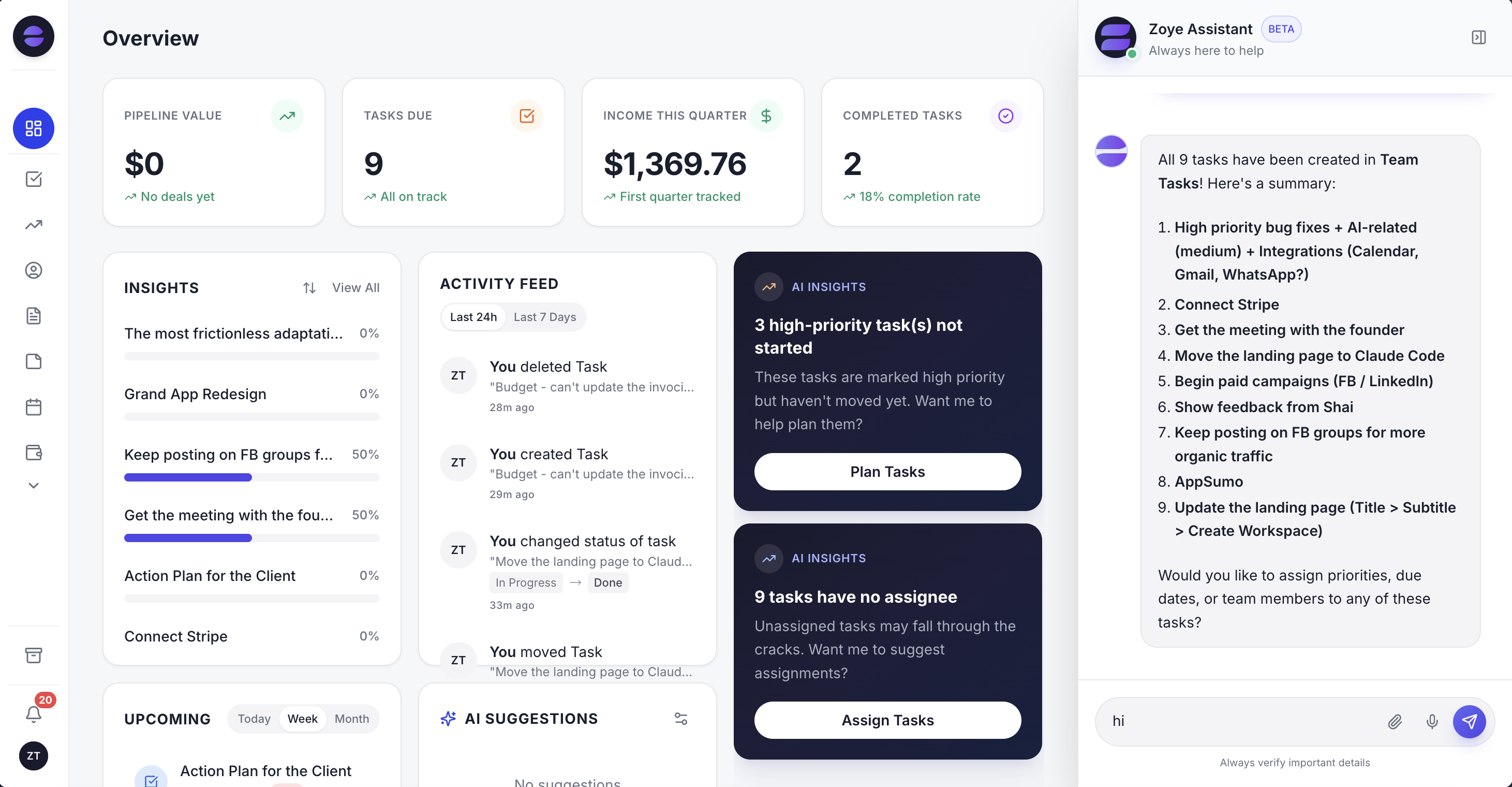 Zoye keeps contacts, deals, tasks, and calendar in one AI-native workspace and updates the records for you.
Underneath, Zoye has a genuine, modern CRM: a contact database that separates people from companies, a visual deal pipeline with custom stages, centralised customer conversations, and a full activity history on every record. But the point is what happens without you touching it. Tell Zoye about a conversation you just had, out loud or by typing, and it opens the deal, creates the contact, links them, logs the notes, drafts the follow-up, and assigns a task with a due date. Ask it to build an automation ("when a lead comes in from WhatsApp, tag it and remind me in two hours") and it wires that up, with no builder to learn.
Because you run it by talking to it, you can operate the whole business from wherever you already are, including WhatsApp and Slack. An incoming WhatsApp message becomes a contact, a deal, and a follow-up without you opening the app, which is exactly the "capture" step that a classic CRM leaves entirely to you. And because Zoye is a full workspace, the self-updating CRM sits alongside tasks with list, board, calendar, and timeline views, a shared calendar, budget tracking, and reports that pull from contacts, deals, tasks, and finances into one exportable dashboard. Collaborative notes bring documents into the same place. To be honest about scope: Zoye is a unified operator with a strong modern CRM, not a twenty-year-old enterprise sales suite with every advanced sales-ops feature Salesforce has accumulated. For most small businesses and lean teams, a CRM that keeps itself current beats enterprise depth they will never touch.
Pricing: Almost Free at $5 per month for 1 member with the full platform including AI. Starter from $29 per month (10 members). Growth from $59 per month (20 members).
Best for: Small businesses, founders, freelancers, and lean teams that want their CRM kept current for them instead of maintained by them.
See what Zoye can do for you
CRM, deals, tasks and your Instagram, Facebook and WhatsApp automations in one workspace. Just ask Zoye and it sets any of it up for you.
Explore FeaturesWhat still needs you
A CRM without data entry does not mean a business that runs with nobody watching, and it is worth being clear about the line. The operator handles the mechanical work: the logging, the record-keeping, the drafting, the scheduling, the chasing on a cadence. What stays with you is judgement.
You still decide the offer, set the price, and choose which relationships are worth your personal time. You review and approve the follow-ups the operator drafts when the message is sensitive or high-value, rather than letting everything send blind. You handle the conversations that genuinely need a human: the tricky negotiation, the unhappy customer, the referral partner who wants to hear your voice. The operator gives you those moments back by taking the admin off your plate, but it does not replace your relationships or your decisions.
The right way to think about it: the operator removes the reasons your CRM went stale, so the parts that actually need a human are the only parts left for you to do. That is the trade worth making. Less data entry, more of the work only you can do.
Ready to hand off the busywork?
Zoye brings AI-powered CRM, task management, and automation into one workspace.
Get StartedHow to switch from a CRM you stopped updating
If you already have a CRM gathering dust, moving to one that keeps itself current is simpler than the migration you are dreading. The stale data is the problem you are leaving behind, so you do not need to painstakingly clean it first.
Start with what is live, not the archive. Bring across your active contacts and open deals: the relationships that are actually in play. The long tail of dead records is what made the old system feel like a chore, and there is no reason to carry it forward.
Let the operator backfill as it works. Instead of a giant one-time data-entry project, connect your messaging and let the system capture and log new activity from day one. The database fills itself in through use, which is the whole point.
Tell Zoye about your routines. The follow-up cadences, the reminders, the "always chase a quote after three days" habits you kept in your head or in a classic CRM's clunky automation builder can be set up just by telling Zoye what you want.
Judge it on the six-month test. The real question is never how a CRM looks in a demo, it is whether you are still using it half a year later. A system that maintains itself passes that test precisely because there is no upkeep to abandon.
Why teams pick Zoye
A few themes come up consistently.
Nobody has to maintain it. The records stay current because Zoye logs, creates, and updates them from what you tell it or straight from an incoming message, which removes the single biggest reason small businesses abandon a CRM.
It removes all four kinds of data entry, not just one. Zoye captures the lead, logs the conversation, updates the record, and runs the follow-up, so the database reflects reality without you protecting time to keep it that way.
It runs the whole business, not just the sales slice. Contacts and deals sit alongside tasks, calendar, budget, and reports, so the owner is not stitching separate tools together or feeding several of them by hand.
Try Zoye with your team. The entry plan is Almost Free, with the full platform including AI.
For more context, see CRM for small business, what is a CRM, and AI lead management.