A car sale is decided in the first hour and then in the three weeks that follow. Someone messages about the silver estate on your forecourt at nine at night. If nobody answers until Tuesday, they have already booked a viewing somewhere else. And if they do come in, drive it, and leave saying they will think about it, the sale now depends entirely on whether anyone remembers to follow up on Thursday, and again the week after.
That is the whole business, and almost none of it is about inventory software. Most independent dealers already know which cars they have. What they lose money on is the enquiry that sat unanswered, the test drive nobody confirmed, and the buyer who went quiet and was never chased.
This guide covers what a car dealer actually needs from a CRM in 2026, why WhatsApp has become the channel that decides the sale, and how an AI operator changes the arithmetic for a small dealership.
What a car dealer actually needs
Strip away the feature lists and the job comes down to six things.
| Need | What it looks like on a normal week |
|---|---|
| Instant lead capture | An enquiry arrives at 9pm from WhatsApp, a marketplace, or the website, and becomes a tracked lead rather than an unread message |
| Fast first reply | Someone answers within minutes, because the first dealer to reply usually gets the test drive |
| Test drive scheduling | The appointment is booked against a real calendar, confirmed, and reminded, so no-shows drop |
| Relentless follow-up | The buyer who said "I'll think about it" gets chased on day two, day seven, and day fourteen |
| Part-exchange tracking | The trade-in valuation and the customer's expectation live on the deal, not in someone's head |
| One customer record | Enquiry, test drive, finance conversation, and part-exchange are all attached to the same buyer |
Notice what is not on that list: stock management, manufacturer reporting, and finance house integrations. Those matter enormously to a franchise group and barely at all to an independent selling thirty cars a month. Buying a platform built for the first group is the most common way small dealers waste money on software.
Why WhatsApp is the centre of gravity
Car buying moved to messaging faster than most industries, and for a specific reason: buyers want photos, they want them now, and they want to ask three quick questions without committing to a phone call.
A typical enquiry is now a message asking whether the car is still available, followed by a request for a picture of the interior, followed by a question about service history. That exchange happens on WhatsApp, on the salesperson's phone, often outside working hours. It never touches a CRM unless somebody types it in later, which they mostly do not.
This creates the exact failure that costs dealers the most. The conversation is the sales process, and it is invisible to whatever system you are paying for. When the salesperson is off on Saturday, the thread is on their phone. When they leave, the customer relationship leaves with them.
Any CRM you choose in 2026 has to answer one question honestly: does it work where the conversation actually happens, or does it require a person to transcribe the conversation into it afterwards?
The five moments a used car sale is won or lost
It helps to stop thinking of a dealership CRM as a database and start thinking of it as coverage for five specific moments. Every one of them is a point where a sale either survives or quietly dies, and every one of them fails for the same reason: the person who should have acted was busy doing something else.
| Moment | What usually happens | What should happen |
|---|---|---|
| The out-of-hours enquiry | Seen at 9pm, answered Monday, buyer already booked elsewhere | Acknowledged within minutes with the answer to the question actually asked |
| The availability question | Answered inconsistently by whoever picks up, sometimes wrongly | Answered from one shared record, so nobody promises a car that is reserved |
| The test drive booking | Agreed verbally, never confirmed, and a share simply do not arrive | Booked against a real calendar, confirmed, and reminded the day before |
| The day-two follow-up | Nobody sends it, because Saturday was busy and Monday was busier | Sent automatically, referencing the specific car they drove |
| The part-exchange promise | "I will get you a figure" and then silence | Tracked as an open item and chased until the figure is actually sent |
Read that table as a diagnostic rather than a feature list. Whichever row makes you wince is the one costing you the most, and it is almost never the row about inventory.
Where generic tools fall short for dealerships
Three patterns come up repeatedly.
Spreadsheets and a phone. This is how most independents start and it genuinely works up to a point. It breaks in exactly three places: two salespeople promise the same car, an enquiry gets missed on a busy Saturday, and follow-ups quietly stop happening after the second attempt. Each of those is a lost sale, and lost sales in this business are worth thousands.
Dedicated automotive platforms. These are strong products for the group they are built for. They handle inventory feeds, manufacturer compliance, finance integrations, and multi-site reporting properly. They are also quote-based, priced for dealer groups, and require someone to administer them. An independent dealer typically uses a fraction of the platform and pays for all of it, both in money and in daily complexity.
General CRMs. Pipedrive, HubSpot, and Zoho all give you a clean pipeline and per-user pricing. The problem is the same one every dealer hits: they store the deal beautifully and do none of the work. The reminder fires, the salesperson is on the forecourt with a customer, the reminder gets dismissed, and the follow-up never happens. A tool that displays what you should have done is not the same as a tool that does it.
The part-exchange conversation nobody tracks
Part-exchange deserves its own section because it is where the most expensive silence in the business happens.
The pattern is familiar. A buyer mentions they have a car to trade. Somebody says they will look into it and come back with a number. That promise lives nowhere: not in a system, not on a card, usually not even in a note. A day passes, then three. By the time the figure is ready the buyer has taken their car to a walk-in valuation elsewhere and anchored their expectation to a number you cannot match.
What makes this worse than an ordinary missed follow-up is that the trade-in is often the reason the deal is affordable at all. Losing the part-exchange does not lose you a valuation, it loses you the sale attached to it.
The fix is unglamorous. The valuation promise has to become a tracked item attached to the buyer, with a deadline, that somebody or something chases. The expectation the customer voiced has to be written down next to it, because the gap between what they hope the car is worth and what it is actually worth is the negotiation, and walking into it blind wastes the appointment.
That is the argument for keeping the trade-in on the deal record rather than in a valuation tool that does not know the deal exists. The number matters far less than the fact that somebody is accountable for sending it.
How Zoye runs a dealership for you
Zoye approaches this from the opposite direction. It is not a prettier place to store your deals. It is an AI Business Operator: you message it the way you would message a good sales manager, and it executes.
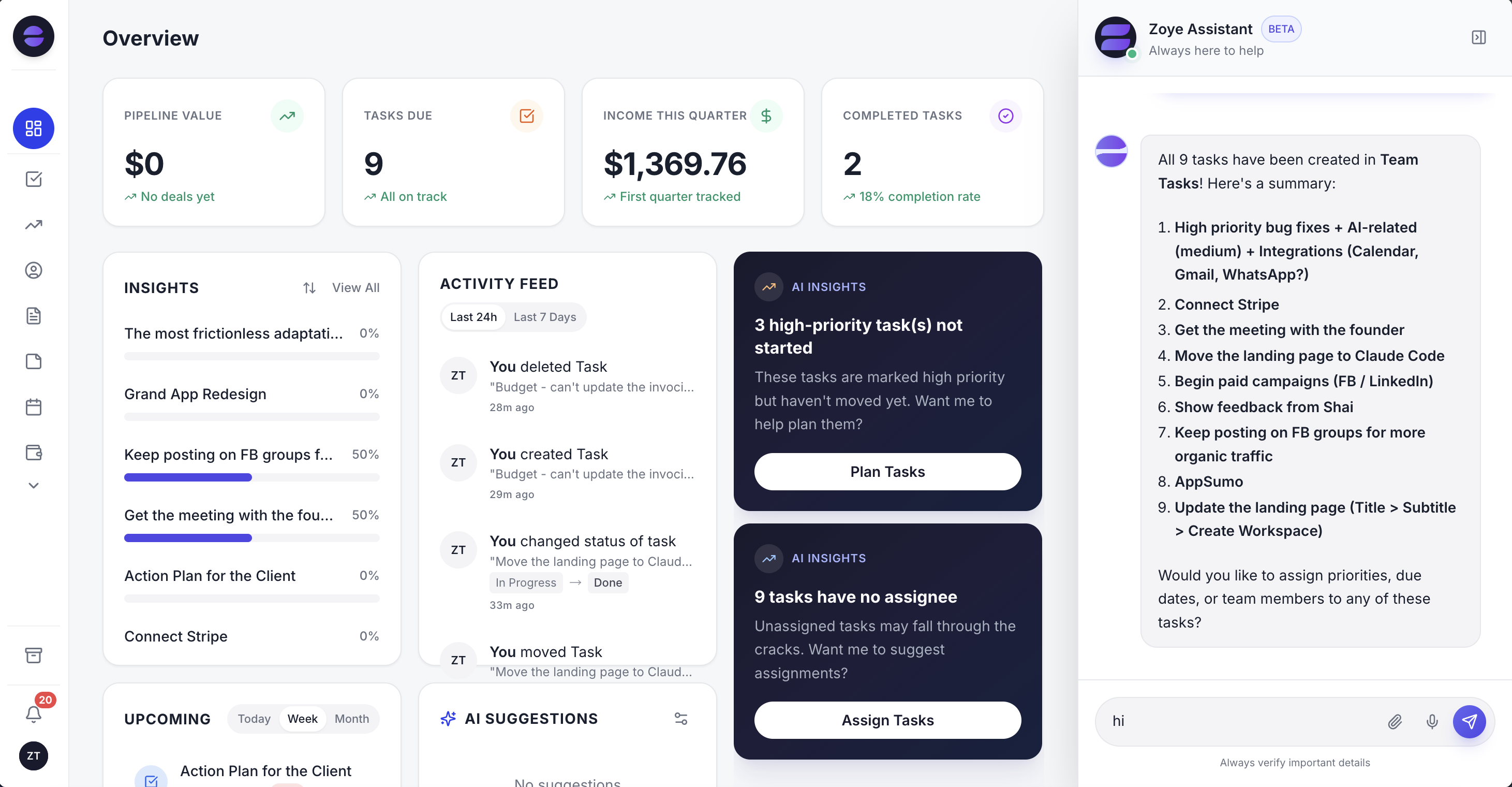 The Zoye dashboard: your whole business at a glance, with proactive AI Insights and Zoye Assistant always available on the right
In practice, on a dealership week, that looks like this. An enquiry arrives about a specific car and the assistant captures it as a lead with the vehicle, the source, and the buyer's questions already attached. A test drive gets booked against your real calendar, confirmed, and reminded the day before. The buyer who drove it on Saturday and said they would think about it gets a follow-up on Monday without anyone deciding to send one, and another the following week if they stay quiet. The part-exchange valuation you promised to send gets chased until it is sent.
You build those routines by describing them. Telling Zoye to follow up two days after every test drive, and again after a week if the buyer has not replied, is enough. It builds that automation and then runs it. There is no workflow canvas to maintain and no administrator role to fill, which matters because the most common fate of dealership software is not being replaced. It is being abandoned three months in.
Behind the assistant sits a complete workspace: CRM with deals and stages, tasks in list, board, calendar, and timeline views, a shared calendar, budget tracking, and reports that pull from all of it.
See what Zoye can do for you
CRM, deals, tasks and your Instagram, Facebook and WhatsApp automations in one workspace. Just ask Zoye and it sets any of it up for you.
Explore FeaturesThe Saturday problem: coverage without more staff
Every independent dealer runs into the same arithmetic. The busiest selling hours are exactly the hours when the fewest people are free to answer a message, and hiring to cover them is rarely justified by the volume.
Saturday afternoon is the clearest version. Two customers are on the forecourt, one is on a test drive, the phone is ringing, and four WhatsApp enquiries arrive in the space of an hour. Each of those four is worth a few thousand pounds in gross profit if it converts. All four get read on a phone screen between conversations and none of them gets a proper reply until the evening, by which time two have gone elsewhere.
The instinct is to solve this with discipline: a rule that enquiries get answered within fifteen minutes, a rota, a shared phone. It works for about three weeks. Discipline does not survive contact with a busy showroom, and blaming the salesperson standing in front of a paying customer for not answering a message is blaming the wrong thing.
The realistic fix is to remove the human from the first step entirely. The first reply to an enquiry is almost always mechanical: confirm the car is available, answer the obvious question, offer two viewing slots. None of that requires the person who is currently mid-negotiation on the forecourt. When the first reply happens on its own and lands as a booked appointment in the calendar, Saturday stops being the day you lose leads and becomes the day you collect them.
This is also the honest answer to the question of whether a small dealership needs a CRM at all. It does not need somewhere to look at its leads. It needs something that acts while everyone is occupied.
Mapping the needs to the features
| What a dealer needs | How Zoye handles it |
|---|---|
| Instant lead capture | Enquiries become tracked leads automatically, with context attached |
| Fast first reply | The assistant drafts and sends the first response without waiting for a free salesperson |
| Test drive scheduling | Booked against your real calendar, confirmed, reminded, and rebooked after a no-show |
| Relentless follow-up | The assistant chases quiet buyers on its own schedule, not on someone's memory |
| Part-exchange tracking | Valuation and expectation live on the deal record alongside everything else |
| One customer record | Conversation, appointment, deal stage, and notes sit on the same buyer |
| Reporting | Pipeline value, conversion, and activity pull from the work that already happened |
What it costs
Pricing in this category splits sharply by who the product was built for.
| Option | Typical monthly cost for a 5-person dealership |
|---|---|
| Zoye | $29 flat (up to 10 members, AI included) |
| Spreadsheet and phone | $0, plus the sales you lose to missed follow-ups |
| General CRM (Pipedrive, Zoho, HubSpot) | ~$70 to $125, per user, before add-ons |
| Dedicated automotive platform | Quote-based, commonly $300 and up, aimed at dealer groups |
Pricing reflects published rates as of September 2026; automotive platforms are typically quoted rather than listed. Check each vendor's pricing page for current figures.
Zoye's entry Almost Free plan is $5 per month, or $4 per month billed annually, and covers one member with the full platform including the AI assistant. Starter is $29 per month for up to 10 members and Growth is $59 per month for up to 20, which is less than most general CRMs charge for two seats.
Independent dealer or franchise group?
The honest split is worth stating plainly, because it decides your shortlist.
Franchise and multi-site groups should look at dedicated automotive platforms. Manufacturer reporting, inventory feeds, in-house finance, and multi-site permissions are genuine requirements, and a general workspace will not cover them. Expect to pay accordingly and to appoint someone to administer it.
Independent dealers, used car specialists, and small showrooms almost never need that. The bottleneck is not inventory management, it is that the owner is also the salesperson, the buyer, and the person who was supposed to call the customer back on Thursday. For this group, the highest-value software is whatever makes the follow-up happen without a human remembering.
Car sourcing and brokerage businesses sit closer to the second group again: high-touch conversations, long follow-up cycles, and almost no inventory to manage.
| Dealer profile | Best fit | Why |
|---|---|---|
| Franchise or multi-site group | Dedicated automotive platform | Manufacturer reporting, inventory feeds and finance integrations are genuine requirements |
| Independent used car dealer, 1 to 10 staff | AI workspace such as Zoye | The bottleneck is response speed and follow-up, not stock administration |
| Car sourcing agent or broker | AI workspace such as Zoye | High-touch conversations and long follow-up cycles with almost no inventory to manage |
| Prestige or specialist dealer, low volume | AI workspace such as Zoye | Few cars, long sales cycles, and relationships that must not go cold between enquiries |
| Dealer group with an in-house admin team | Dedicated automotive platform | There is someone to configure and maintain it, which is the hidden requirement |
How to choose: four questions before you commit
1. Does it work where the conversation happens? If your enquiries arrive on WhatsApp and the CRM requires someone to retype them, adoption will fail within a month regardless of how good the product is.
2. Who does the follow-up: the tool or a person? Every option here will show you a list of overdue follow-ups. Ask specifically which of them sends one. That difference is where the money is.
3. What does it cost at five and ten people? Per-user pricing looks fine for a two-person operation and painful for a growing sales floor. Flat pricing protects you from a bill that rises every time you hire.
4. Can you run it from your phone, just by messaging it? If the owner is on the forecourt all day, software that needs a desk and a training session will quietly stop being used.
Ready to hand off the busywork?
Zoye brings AI-powered CRM, task management, and automation into one workspace.
Get StartedWhat a realistic first month looks like
The failure mode of dealership software is not a bad product. It is a good product that nobody opens after week three, so it is worth being concrete about what adoption should feel like.
Week one is enquiry capture and nothing else. Every enquiry that arrives, from whatever channel, becomes a tracked lead with the car attached. Do not configure pipelines, do not import three years of history, do not build reports. The only question that matters is whether anything is still slipping through unlogged by Friday.
Week two adds the first reply and the booking. The acknowledgement goes out on its own, viewing slots get offered, and appointments land in the calendar with a confirmation and a reminder. This is the week the no-show rate should visibly move.
Week three turns on follow-up. Two days after a test drive, and again a week later if the buyer has gone quiet. This is the single highest-value routine in the whole setup and the one that no human reliably performs, which is why it is worth switching on only once the first two weeks are steady.
Week four is the first honest look at the numbers: how many enquiries arrived, how many became viewings, how many viewings became sales, and where the drop-off actually sits. That number is usually the first time a dealer sees the size of the leak they have been living with.
Anything that cannot be adopted on that kind of schedule, by people who are selling cars full time, will not be adopted at all.
The takeaway
Car dealers do not lose money because their stock list is disorganised. They lose money in the gaps: the enquiry answered on Tuesday instead of Saturday night, the test drive nobody confirmed, and the buyer who was never chased after they said they would think about it.
The software that fixes that is not the one with the most features. It is the one that does the chasing itself, works where your buyers already message you, and can be run from a phone between customers. Zoye's entry Almost Free plan is $5 per month, or $4 per month billed annually, with the full platform and AI included, so you can cancel or upgrade at any time.
For more context, see the CRM for small business, the best WhatsApp CRMs in 2026, the guide to WhatsApp automation, the CRM for contractors, and the rest of the Zoye blog.