
Most insurance agents do not lose clients because their prices are wrong. They lose them because a renewal quietly lapsed, a quote never got a second follow-up, or a message sat unanswered in a WhatsApp thread for three days. The work of an insurance agent is not selling once, it is following up forever: renewals, cross-sells, birthday touches, claims check-ins, and the endless chasing of quotes that went quiet.
Generic CRMs promise to fix this, and most of them do store the data well. The problem is that a CRM is only a filing cabinet with reminders. It still waits for you to open it, read the reminder, and do the work. For a solo agent or a small agency juggling hundreds of policies, that maintenance becomes a second job, which is exactly why so many agents buy a CRM and quietly stop using it within a few months.
This guide compares the 7 best CRMs for insurance agents in 2026, ranked by a single question: how much of the follow-up work does the tool actually do for you, instead of just reminding you to do it yourself.
Pricing reflects published rates as of July 2026; check each vendor's pricing page for current figures.
Why insurance agents are looking beyond generic CRMs in 2026
Four shifts are pushing agents to rethink the tools they rely on.
Renewals are the whole business, and most CRMs treat them as an afterthought. An insurance book of business lives or dies on retention. Yet in a generic CRM, a policy renewal is just another date field that you have to remember to filter and act on. Miss the window and the client shops around. Agents increasingly want a tool that watches renewal dates and starts the outreach itself.
Clients live on WhatsApp, not email. In Latin America, Spain, and most of the world, insurance clients message their agent on WhatsApp. Quotes, documents, and questions all flow through chat. A CRM that only tracks email leaves the real conversation invisible, and important threads get buried under personal messages.
Compliance-sensitive communication needs to be consistent, not improvised. Insurance comms carry rules about what you can say and when. Agents need message templates and a record of every client interaction, not a memory of "I think I told them about the deductible change."
The maintenance tax is too high. Every generic CRM makes the agent do the data entry, the tagging, the reminder-checking, and the follow-up writing. For a small agency without an operations person, that overhead eats the day. The tools winning in 2026 are the ones that reduce the work, not the ones that add another dashboard to maintain.
The 7 best CRMs for insurance agents in 2026
1. Zoye - the operator that chases renewals and follow-ups automatically
Zoye is the strongest pick for insurance agents who are tired of maintaining a CRM and want one that actually does the follow-up work. It is not a filing cabinet you tend. It is an AI Business Operator you talk to, and it runs the repetitive parts of the agency for you.
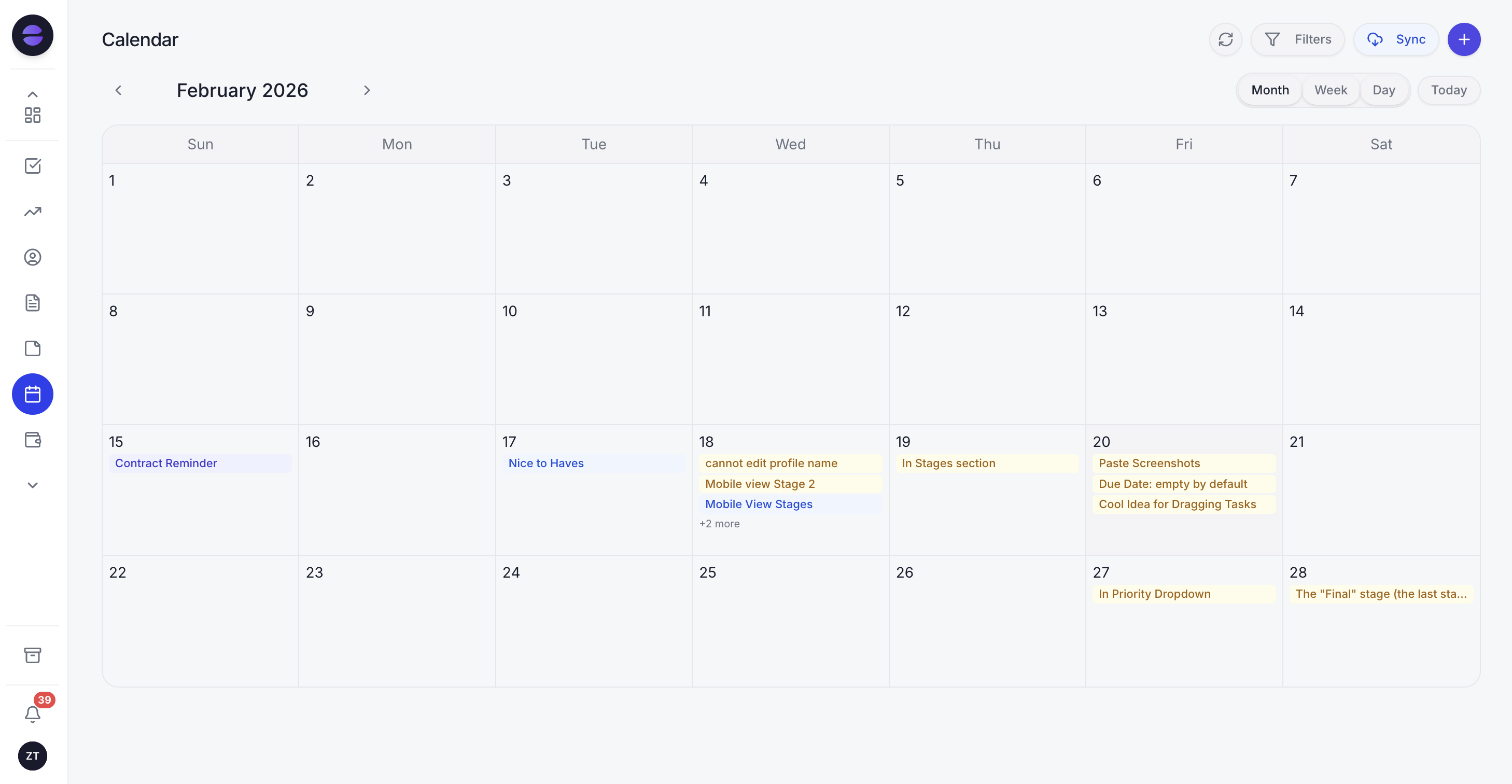 Tasks and follow-ups appear on the Zoye calendar automatically, so renewals and policy check-ins never slip through the cracks.
Where a generic CRM stores a policy expiry date and waits for you to notice it, the Zoye Assistant watches every renewal date and starts the follow-up automatically. It drafts the renewal message, chases the quotes that went quiet, and keeps each client record updated as conversations happen, so you are not doing data entry after every call.
The assistant takes action rather than just suggesting. It captures new leads from your website or an inbound message, files them against the right client, chases every prospect that has gone silent, books the client meeting, and updates the CRM itself. You can run all of it just by asking Zoye, including over WhatsApp, which is where most insurance clients already are. Ask it to "remind every client whose auto policy renews next month and offer a home policy quote," and it builds and runs that outreach without you touching a workflow builder.
Around the follow-up engine sits the broader workspace an agency needs: a client and policy CRM, a calendar where renewals and meetings live together, budget and commission tracking, and reports that pull the whole book of business into one exportable view. Because it is one workspace and not a stack of disconnected apps, nothing falls between the tools. For a solo agent, the Almost Free entry plan is $5 per month and covers one member, so a one-person agency can keep clients and renewals in one place at the most affordable price.
Pricing: Almost Free at $5 per month for 1 member with the core tools. Starter from $29 per month (10 members). Growth from $59 per month (20 members).
Best for: Solo agents and small agencies that want renewals and follow-ups handled for them, not just tracked.
2. Pipedrive - the visual sales pipeline
Pipedrive is a clean, visual sales CRM that many independent agents adopt for its simple deal pipeline. Moving a prospect from quote to bound policy across drag-and-drop stages is intuitive, and the interface is far lighter than enterprise suites.
The trade-off is that Pipedrive is a general sales tool with no native concept of a policy, a renewal cycle, or commission tracking. You can bolt those on with custom fields, but you still do all the chasing yourself, and the renewal reminders depend on you building and maintaining the automations.
Pricing: Paid plans from around $14 per user per month; check Pipedrive's pricing page for current figures.
Best for: Agents who want a simple visual pipeline and are comfortable customizing it.
3. Zoho CRM - the configurable all-rounder
Zoho CRM is a deep, configurable CRM that often appears on insurance shortlists because it is affordable and flexible. With enough setup it can model policies, renewals, and workflows, and it connects to the wider Zoho suite for email and documents.
The trade-off is the configuration burden. Getting Zoho to fit an insurance workflow takes real setup time, and the more you customize, the more there is to maintain. For a solo agent without a technical helper, the flexibility can become a project in itself.
Pricing: Free tier for up to 3 users; paid plans from around $14 per user per month.
Best for: Agencies with the time to configure a flexible CRM to their exact process.
4. HubSpot - the polished CRM with a free tier
HubSpot offers a polished CRM with a genuinely useful free tier, which is why many agents start there. Contact management, email tracking, and a clean interface make it easy to begin, and the marketing tools are strong if you run campaigns.
The trade-off is cost as you grow. HubSpot's useful automation and reporting features sit in paid tiers that get expensive quickly for a small agency, and like the others, it stores and reminds but does not do the renewal chasing for you.
Pricing: Free CRM tier; paid Sales Hub plans scale up quickly. Check HubSpot's pricing page.
Best for: Agents who want a polished free CRM and may run marketing campaigns.
5. Winsef - the Mexican insurance-agency specialist
Winsef is a Mexico-focused insurance-agency management system built specifically for the vertical, with policy administration, commission handling, and carrier-oriented features that generic CRMs lack. For an established agency that needs deep policy and commission mechanics, that specialization is valuable.
The trade-off is that specialist agency systems tend to be heavier, more administrative, and less focused on modern client communication and automated follow-up. They manage the back office well but leave the day-to-day chasing and the WhatsApp conversation to you.
Pricing: Contact the vendor for current pricing.
Best for: Established Mexican agencies that need deep policy and commission administration.
6. Kommo - the WhatsApp-centric sales CRM
Kommo (formerly amoCRM) is popular across Latin America because it is built around messaging, with WhatsApp, Instagram, and other channels feeding a shared sales inbox. For an agent whose leads all arrive by chat, seeing every conversation in a pipeline is genuinely useful.
The trade-off is that Kommo is a messaging-first sales CRM, not an insurance operator. It organizes the chats and the pipeline, but you still build the automations and do the renewal work, and its insurance-specific fields are whatever you configure yourself.
Pricing: Paid plans from around $15 per user per month; check Kommo's pricing page.
Best for: Agents whose leads arrive almost entirely through WhatsApp and social channels.
7. Bitrix24 - the free-heavy all-in-one
Bitrix24 packs a CRM, telephony, tasks, and collaboration tools into one platform with a generous free tier, which appeals to agencies wanting a lot of features at a low entry cost. For a team that will use the wider toolset, the breadth is real.
The trade-off is complexity. Bitrix24 is famously feature-dense, and getting it configured and adopted across a small agency takes patience. The learning curve is the price of the breadth, and much of it goes unused by a typical insurance agent.
Pricing: Free tier for unlimited users with limits; paid plans from around $49 per month per organization.
Best for: Agencies that want a broad free feature set and will invest time to configure it.
Want to see it in action?
See Zoye catch a new lead, answer on WhatsApp and set up the follow-up, all from one message.
See How It WorksBest CRM for managing insurance renewals
If renewals are the part of the job that keeps slipping, the deciding factor is not how well a tool stores the expiry date, it is whether the tool acts on it. Every CRM here can hold a renewal date and show it on a list. Only Zoye treats that date as a trigger for work it does itself: as a policy approaches its renewal window, the assistant drafts the outreach, sends the reminder, and chases the client if they go quiet, then logs the outcome against the record.
Pipedrive and Zoho can approximate this if you invest the time to build the automations and maintain them. Winsef administers renewals from a back-office angle. But the agent still has to drive the process in all of them. The difference with an operator is that the follow-up happens whether or not you remembered to open the app that morning.
Best CRM for insurance agents who live on WhatsApp
For most agents, the real client relationship happens in WhatsApp: quotes, photos of documents, quick questions, and renewal confirmations. A CRM that ignores that channel is blind to the actual conversation.
Kommo is built for this and does the inbox well. Zoye takes it a step further by not just centralizing the WhatsApp conversation but acting on it: the assistant can draft replies, follow up on a quote that went quiet, and remind a client about a renewal directly over WhatsApp, then update the client record automatically. You run the agency by talking to it in the same channel your clients already use, so there is no separate system to check.
See what Zoye can do for you
CRM, deals, tasks and your Instagram, Facebook and WhatsApp automations in one workspace. Just ask Zoye and it sets any of it up for you.
Explore FeaturesHow to choose the right insurance CRM for your agency
Three questions narrow the decision quickly.
1. Do you want the tool to track the work or do the work? If you have an operations person and want a system of record you drive, a configurable CRM like Zoho or a specialist like Winsef fits. If you are a solo agent or a small team and want the follow-up handled for you, an operator like Zoye removes the maintenance burden.
2. Where do your clients actually talk to you? If the answer is WhatsApp, prioritize a tool that treats messaging as a first-class channel rather than an afterthought. A pipeline that cannot see your real conversations will always be half-blind.
3. How much setup are you willing to own? Specialist and highly-configurable tools reward the time you invest but punish agencies that do not have it. If you want to be productive on day one without building workflows, choose the tool you can simply talk to.
Free CRM options for insurance agents
Cost matters most for a solo agent or a new agency, and several tools here have free entry points. HubSpot and Zoho both offer capable free CRM tiers, and Bitrix24 is free for unlimited users with feature limits. These are genuine starting points, though the useful automation usually sits behind a paid plan.
Zoye is the standout on value because its entry plan is not a stripped teaser. Almost Free, at 5 dollars per month (4 dollars per month billed annually), includes the core tools for up to 1 member, so a solo agent can keep clients, policies, renewals, and follow-ups in one place on one small flat fee. The agency only moves up a plan when it grows past one person, not when it needs the features that matter.
Why insurance agents pick Zoye
A few themes come up consistently among agents who switch.
The renewals get chased for them. Instead of filtering a list and hoping they remembered, the assistant watches every expiry date and starts the outreach itself, so retention stops depending on the agent's memory.
The WhatsApp conversation becomes part of the system. Client messages, quotes, and reminders live where the work happens, and the assistant can act on them directly.
The maintenance disappears. There is no workflow builder to wire up and no data entry after every call. The agent says what they need, and Zoye does it, which is the opposite of buying software and slowly abandoning it.
Try Zoye with your agency. The entry plan is Almost Free, with the core tools, so you can put your renewals and follow-ups on autopilot without a maintenance burden.
For more context, see our guide to CRM for insurance agents, the best real estate CRM, and the best Leadsales alternatives.