
Most WhatsApp CRM software solves the wrong half of the problem. The category is crowded with shared-inbox tools that help you and your team answer customers faster: canned replies, labels, broadcasts, a tidy queue of chats. That is genuinely useful when the bottleneck is response speed. But answering faster is not the same as running the business. The lead still has to be logged. The quote still has to be chased. The client who went quiet three days ago still has to be nudged, and if nobody remembers, that deal quietly dies.
For a small business in India or anywhere WhatsApp is the front door, the real leak is not slow replies. It is everything that has to happen after the reply: the follow-up nobody sent, the record nobody updated, the reminder nobody set. A faster inbox does not fix that. It just makes you type quicker while the same work piles up behind the scenes.
This guide ranks the seven best WhatsApp CRM software tools in 2026 by a single, honest question: how much of the work does the tool actually do for you? At the top is software that runs the follow-up itself. Below it are capable inboxes and pipelines that still leave the work on your plate. Both have a place. Knowing which one you are buying is the whole point.
Pricing reflects published rates as of July 2026; check each vendor's pricing page for current figures.
Why a WhatsApp CRM matters more than ever in 2026
Four shifts have made the WhatsApp CRM a must-have rather than a nice-to-have.
WhatsApp is now the primary sales channel, not a side channel. In India, the Gulf, Latin America, and much of Southeast Asia and Africa, customers expect to enquire, negotiate, and buy over WhatsApp. A business that runs sales through a personal WhatsApp account loses history the moment a phone is lost, cannot share the thread with a teammate, and has no record of who promised what. A WhatsApp CRM makes those conversations a shared, permanent asset.
Speed to first reply decides who wins the deal. When a prospect messages three businesses, the one that answers first usually closes. But first reply is only round one. The businesses that actually win are the ones that keep following up after the second message, and that is exactly where manual WhatsApp breaks down. People answer the new chat and forget the one from Tuesday.
Owners are drowning in tools they bought and stopped using. The graveyard of half-configured CRMs is real. Most WhatsApp CRMs ask you to build pipelines, wire automations, and maintain fields, and within a month the owner is back to running everything from their thumb. The tools that survive are the ones that reduce work, not the ones that add a second job.
AI has moved from suggestion to action. The previous generation of "smart" tools surfaced hints: this lead looks hot, you have not replied here. The 2026 shift is software that does the thing. It captures the lead, writes the follow-up, books the slot, and updates the record without waiting for you to click. That is the dividing line this ranking is built around.
The 7 best WhatsApp CRM software in 2026
1. Zoye - the operator that runs your business from WhatsApp
Zoye is the strongest pick because it is not a WhatsApp inbox you operate. It is an AI Business Operator that runs the customer work for you, and WhatsApp is one of the channels it runs on.
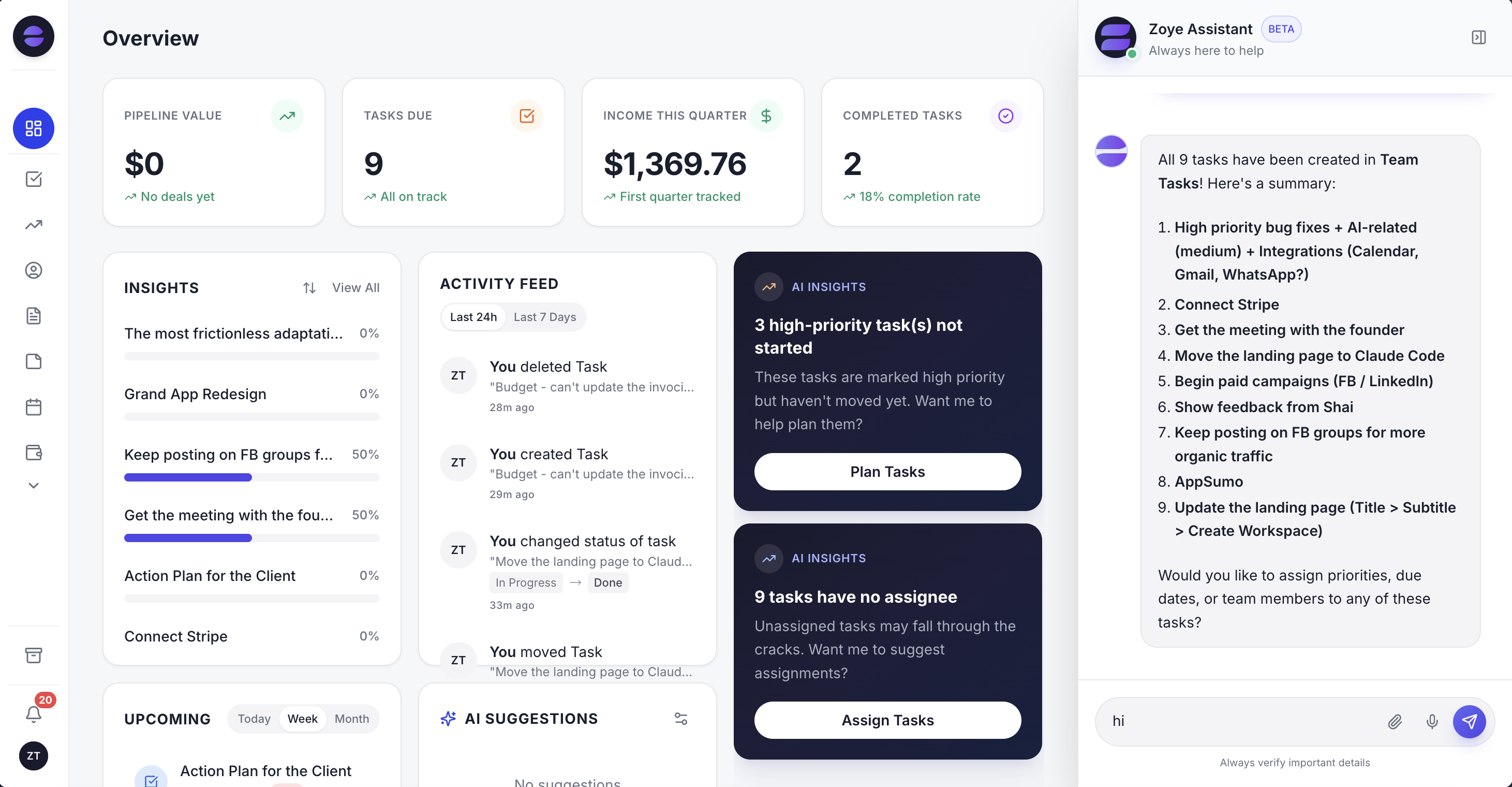 The Zoye dashboard: your whole business at a glance, with proactive AI Insights and Zoye Assistant always available on the right
Here is the practical difference. When a message comes in on WhatsApp, Zoye captures the person as a contact and the enquiry as a deal automatically. You do not open a form. When a quote goes out and the customer goes quiet, the assistant chases it on a sensible cadence without you setting a reminder. When you want a new behaviour, for example "message every lead who has not replied in two days and offer a call", you tell Zoye exactly that and it builds and runs the automation. There is no canvas of nodes to wire, no fields to maintain. You talk to it, including over WhatsApp itself, and it does the work.
The customer-facing side is built in as well, on the official WhatsApp Business Platform:
- Instant first message. Every new lead, from any source, hears from you straight away.
- Lead Bot. It answers, qualifies, books a slot, and follows up when the chat goes quiet. In free-text mode Zoye, as an AI agent, holds the conversation.
- Click-to-chat link and QR code. Put them on your website, packaging, or shop window and every chat starts as a tracked lead.
- Everything lands on the contact card. The chat, the answers to your questions, the booking, and any payment taken in the chat sit on one record, so nobody copies anything across.
You turn these on by asking. Tell Zoye "send new WhatsApp leads a welcome message, ask what service they want, and offer two times this week" and it sets that up. The full list of ready-made flows is on the WhatsApp Automations page.
That matters most for the owner who is not technical and does not want a second job administering software. Zoye is the tool you talk to, not the tool you maintain. The villain in most owners' lives is the CRM they bought, configured for a weekend, and abandoned. Zoye is designed to be the opposite: it keeps its own records current as conversations happen, so there is never a database to feed.
Because Zoye is a full operator and not a single-channel inbox, WhatsApp sits alongside the rest of the business in one place: contacts, deals, tasks, a shared calendar, budgets, and reports. The assistant works across all of it. It can turn a WhatsApp conversation into a booked appointment on the calendar, add the follow-up task, draft the confirmation, and later pull a report on how many WhatsApp leads converted. The customer conversation and the work it creates never live in separate apps.
Pricing: Almost Free from $5 per month ($4 per month billed annually) for 1 member with the core tools, cancel or upgrade anytime. Starter from $29 per month (10 members). Growth from $59 per month (20 members).
Best for: Owners and small teams who want their WhatsApp customer work to run itself instead of buying another inbox to operate.
2. WATI - the popular shared team inbox
WATI is one of the best-known WhatsApp CRMs, especially in India, and it does the shared-inbox job well: team access to one WhatsApp number, broadcasts, templates, chatbots, and a clean agent view. For a support or sales team that mostly needs to answer and route conversations faster, it is a solid choice.
The limitation is that WATI is fundamentally an inbox and broadcast tool. It helps your team reply and send campaigns, but the pipeline, the follow-up discipline, and the wider business operations still depend on you and your agents doing the work manually or wiring up integrations.
Pricing: Paid tiers typically starting around $39 per month plus WhatsApp conversation charges; check WATI's pricing page for current figures.
Best for: Support and sales teams that want a shared WhatsApp inbox with broadcasts and basic bots.
3. Kommo - the pipeline-first WhatsApp CRM
Kommo (formerly amoCRM) attaches a proper sales pipeline to WhatsApp and other messengers, with a visual board, lead stages, and a decent automation builder. For a team that thinks in pipelines and wants messaging feeding a structured sales process, Kommo is capable and widely used across Latin America and beyond.
The trade-off is that Kommo is something you build and maintain. The pipeline, the automations, and the digital-pipeline logic are powerful, but you configure them, and keeping it all tidy is ongoing work. It is the classic capable-but-you-operate-it tool, in a WhatsApp wrapper.
Pricing: Per-user tiers typically from around $15 per user per month; check Kommo's pricing page for current figures.
Best for: Sales teams that want a configurable WhatsApp pipeline and are willing to build and maintain it.
4. respond.io - the omnichannel conversation platform
respond.io handles WhatsApp alongside Instagram, Messenger, and other channels in one inbox, with routing, automation, and reporting aimed at larger or higher-volume teams. If your customers reach you across many messaging apps and you need one professional platform to manage the lot, respond.io is a strong contender.
The limitation is depth of setup. respond.io is built for teams that will invest in configuring workflows and managing agents; for a solo owner or a small shop, it is more platform than the job needs, and it still positions you as the operator of the system rather than the beneficiary of it.
Pricing: Paid plans typically from around $79 per month; check respond.io's pricing page for current figures.
Best for: Mid-size and larger teams handling high volume across several messaging channels.
Want to see it in action?
See Zoye catch a new lead, answer on WhatsApp and set up the follow-up, all from one message.
See How It Works5. AiSensy - the WhatsApp marketing and broadcast tool
AiSensy leans toward WhatsApp marketing: broadcasts to large audiences, campaign templates, click-to-WhatsApp ad support, and a shared inbox, popular with Indian D2C and marketing-led businesses. If your priority is sending WhatsApp campaigns at scale on the official API, AiSensy is built for that.
The trade-off is that AiSensy is marketing-first. It is excellent at outbound broadcasts but thinner as a true CRM: the individual follow-up discipline, the pipeline, and the wider operations are not its focus. It fills the campaign role well and leaves the one-to-one relationship work to you.
Pricing: Paid tiers typically from around $40 per month plus conversation charges; check AiSensy's pricing page for current figures.
Best for: Marketing-led businesses that mainly need WhatsApp broadcasts and campaigns at scale.
6. Interakt - the WhatsApp commerce toolkit
Interakt, from the Haptik and Jio stable, bundles WhatsApp CRM with commerce features: catalogues, order notifications, payment prompts, and a shared inbox aimed at small and mid-size Indian retailers selling on WhatsApp. For a shop that wants to run a WhatsApp storefront with order flows, Interakt is a practical fit.
The limitation is scope. Interakt is optimised for WhatsApp commerce and notifications; as your needs grow into structured sales follow-up, cross-channel operations, or proactive relationship management, you feel the edges of a tool built primarily for transactional messaging.
Pricing: Paid plans typically from around $35 per month plus conversation charges; check Interakt's pricing page for current figures.
Best for: Small and mid-size retailers running a WhatsApp storefront with order notifications.
7. TimelinesAI - the multi-number WhatsApp layer
TimelinesAI takes a lighter approach: it sits on top of your existing WhatsApp numbers (including personal ones) to give a shared view, basic automation, and syncing into other CRMs like HubSpot or Salesforce. For a team that already lives in another CRM and just wants WhatsApp conversations visible and synced, it is a pragmatic bridge.
The trade-off is that TimelinesAI is a connective layer rather than a full system. It is designed to feed another CRM, so it does not run your pipeline alone or your follow-up. It solves visibility and sync, not the underlying work of chasing and closing.
Pricing: Per-user tiers typically from around $25 per user per month; check TimelinesAI's pricing page for current figures.
Best for: Teams that already use another CRM and need WhatsApp conversations synced into it.
Inbox versus operator: the distinction that decides your shortlist
Almost every tool in this category falls into one of two groups, and confusing them is why so many owners end up disappointed.
An inbox helps you answer customers faster. Shared access, canned replies, labels, broadcasts, a tidy queue. WATI, AiSensy, and Interakt are strong inboxes. They are worth buying if response speed is genuinely your bottleneck and you have people ready to do the follow-up work. But the inbox does not do that work. It hands you a faster keyboard.
An operator does the work for you. It captures the lead, updates the record, schedules the follow-up, and chases the quiet conversations without being told each time. Zoye is built as an operator. The difference shows up on your worst week, when everyone is busy and nobody has time to work the pipeline. An inbox goes quiet along with your team. An operator keeps chasing, booking, and updating anyway. That is the week that decides whether leads convert or leak.
If you take one thing from this ranking, take this: decide whether you are buying a faster keyboard or a teammate, then shortlist accordingly.
Best WhatsApp CRM for small business
For a small business, the decisive factor is not features on a comparison table. It is whether the tool reduces work or adds it. A solo owner or a five-person team does not have someone whose job is to administer software. Every hour spent configuring pipelines and maintaining fields is an hour not spent serving customers.
That is why Zoye is the clearest small-business pick. The entry plan, Almost Free, covers 1 member for just $5 per month ($4 per month billed annually) with the core tools, so a solo owner can keep customers and follow-up tasks in one place for the price of a cup of coffee. See pricing for what each plan includes. The owner talks to Zoye like a colleague, including over WhatsApp, and the work gets done.
Among the inbox tools, WATI and Interakt are the friendlier small-business options if you specifically want a shared inbox or a WhatsApp storefront and you have someone to do the follow-up. But be honest about that last condition. If no one on the team will reliably chase every quiet lead, an inbox will not save those deals, and an operator will.
See what Zoye can do for you
CRM, deals, tasks and your Instagram, Facebook and WhatsApp automations in one workspace. Just ask Zoye and it sets any of it up for you.
Explore FeaturesHow to choose a WhatsApp CRM
Four questions cut through the noise.
1. Do you need a faster inbox or a teammate? If your only bottleneck is reply speed and you have people to do the follow-up, an inbox tool is enough. If the follow-up itself is what keeps slipping, you need an operator that does it for you.
2. Will someone actually maintain it? Configurable pipeline tools like Kommo and respond.io are powerful in the right hands, but they assume ongoing setup and administration. If nobody owns that, pick a tool that maintains itself.
3. Is WhatsApp the whole job, or one channel of many? If WhatsApp sits alongside tasks, a calendar, deals, and reporting, a single-channel inbox will leave you app-switching. An operator that treats WhatsApp as one channel inside the wider business keeps everything in one place.
4. What does the total cost look like at your team size? Per-user tools get expensive as you grow, and conversation charges stack on top. Flat-rate pricing with a low entry price, like Zoye, is usually the better economics for a small team, especially before revenue is predictable.
Why owners pick Zoye as their WhatsApp CRM
A few themes come up again and again.
It runs the work instead of adding it. The lead capture, the follow-up chasing, the record-keeping, and the booking happen without the owner doing them by hand. WhatsApp stops being a place where deals quietly die.
You talk to it, you do not maintain it. There is no pipeline to build or fields to feed before it is useful. You describe what you want, including over WhatsApp, and Zoye builds and runs it.
Customers get answered too. The instant first message and the Lead Bot reply to new leads, qualify them, and book them, and the whole conversation is waiting on the contact card when you look.
WhatsApp lives with the rest of the business. Contacts, deals, tasks, calendar, budget, and reports are all in one place, and the assistant works across all of them, so a conversation flows straight into a booking, a task, and a report without switching apps.
Zoye holds a 4.4 TrustScore on Trustpilot. As Liana N put it in her review: "Amazing one stop shop to manage all my clients, leads, opportunities, sales, etc. The WhatsApp agent is great and very useful and helpful! I recommend it for any type of business." Read more Zoye reviews on Trustpilot.
Turn the WhatsApp chats you are already having into a CRM that updates itself and drafts your replies. Almost Free starts at $5 per month (or $4 per month billed annually) for the core tools, and you can cancel or upgrade at any time.
For more context, see how to sell on WhatsApp, our guide to WhatsApp automation, and WhatsApp CRM for clinics.
See the six automations Zoye ships for this, and how each one stays inside WhatsApp's rules, on the WhatsApp Automations page.