
Small Business Productivity: 10 Habits That Win Back Your Week
Running a small business in 2026 means doing the work of 3 people on the time of 1. This is not sustainable. Burnout, missed opportunities, and slow growth are all symptoms of the same underlying problem: small business owners spend their time on the wrong things because they have not built systems to do otherwise.
The good news is that productivity for small business owners is not actually about doing more in less time. It is about doing the right things consistently and letting systems handle the rest. The 10 habits in this guide, drawn from common patterns across small businesses, can give a solo operator or small team back hours every week. None require special software, though some are significantly easier with the right tools.
This guide is written for founders, small business owners, and small team operators who are tired of working 60-hour weeks and ready to build the habits that make 40-hour weeks productive enough.
Habit 1: Plan tomorrow before you finish today
The end-of-day planning ritual is the single highest-ROI productivity habit. Spend the last 10 minutes of each work day writing tomorrow's top 3 priorities. Not 10 priorities. Three.
Three priorities forces you to choose what actually matters. Ten priorities is just a to-do list, and to-do lists do not survive contact with the morning. Three priorities you can hold in your head, plan your day around, and protect from the inevitable distractions.
The downstream benefits are larger than the 10-minute investment suggests. You sleep better because the next day is planned. You start the next day with focus instead of staring at email asking "what should I do?" You make better choices about what to say no to during the day because you know what you committed to.
Most small business owners discover that doing this consistently for one month produces more output than the prior three months combined.
Habit 2: Batch similar work into time blocks
Context switching is the silent productivity killer. Every time you move from email to a customer call to a budget review to a Slack message to a project task, you lose 2 to 5 minutes of focus rebuilding. Across a typical fragmented day, that is 1 to 2 hours of pure overhead.
Batching is the antidote. Group similar work into dedicated time blocks. Two email blocks per day (one mid-morning, one late afternoon). One call block per day (early afternoon, when energy is steady). One deep-work block of 90 minutes (typically morning, before email opens). One admin block for invoices, expenses, and routine paperwork.
The schedule does not need to be rigid. The principle is: same type of work, grouped together. Once you build this rhythm, the productivity gain is immediate and large.
Habit 3: Use one platform, not five
Every tool switch costs 2 to 5 minutes of context rebuilding. If you use 5 separate tools daily (email, CRM, task manager, calendar, budget tracker), that is 30+ minutes per day wasted on switching, plus the cognitive overhead of remembering which tool holds what.
The fix is consolidation. Move to an all-in-one platform where CRM, tasks, calendar, and budget live in one workspace. Zoye is designed specifically for this use case: one workspace, one assistant, one place where customer relationships, project work, calendar, and budget all connect.
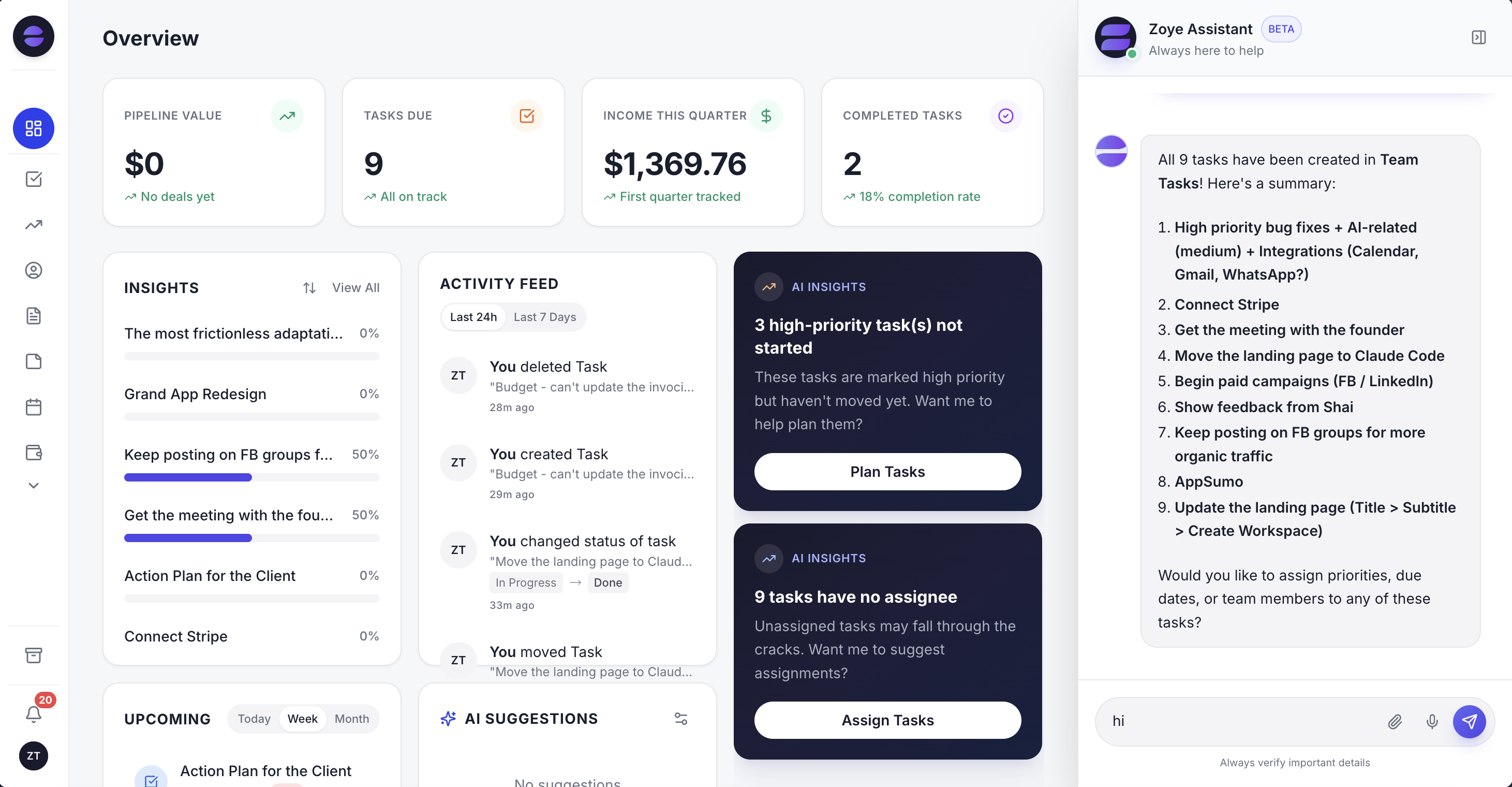
The time savings are real, but the bigger benefit is the cognitive simplification. Instead of holding context across 5 separate tools, you operate from one place. Decisions get easier. Reports get more accurate. The team aligns faster because everyone is looking at the same workspace.
Tasks in one place
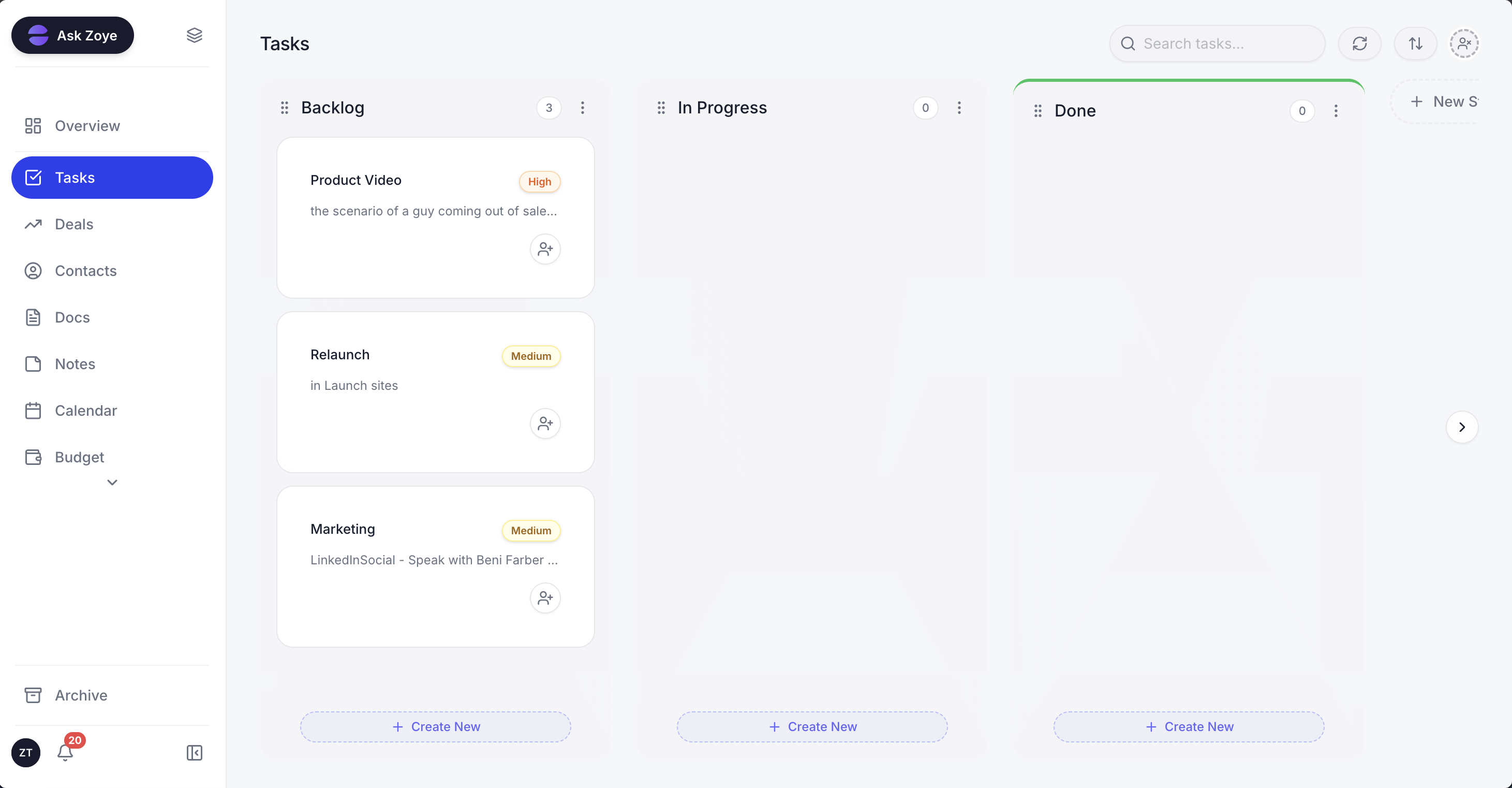
Tasks land on the same board whether they came from email, a CRM follow-up, or a calendar prep step. List, board, calendar, and timeline views show the same data; the small business owner picks the view that fits the moment.
Calendar that knows the work
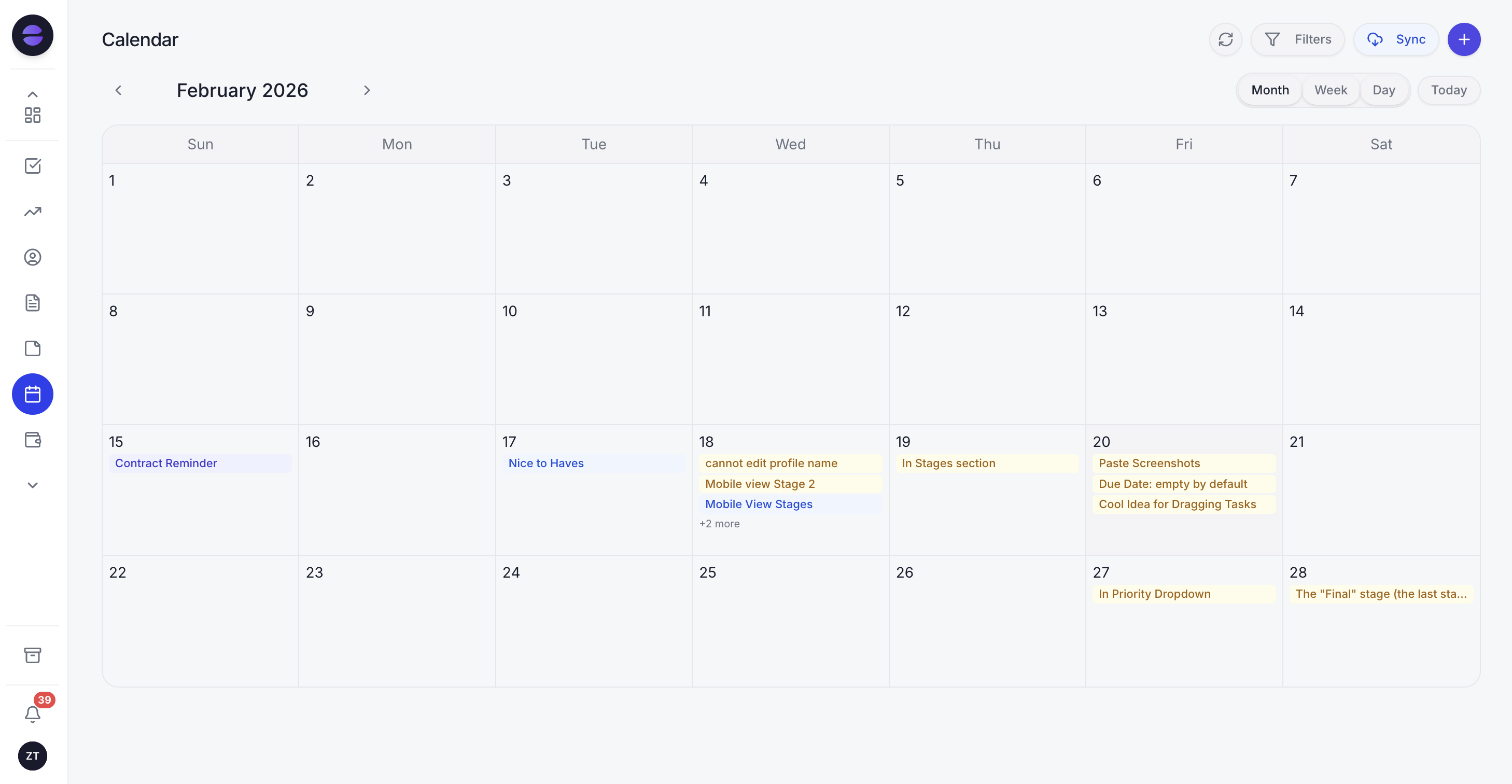
Tasks appear on the calendar automatically. Meetings layer over deadlines. Habit 2 (batching work) and Habit 8 (email twice a day) get easier when the calendar already knows what the priorities are.
Reports that surface what mattered
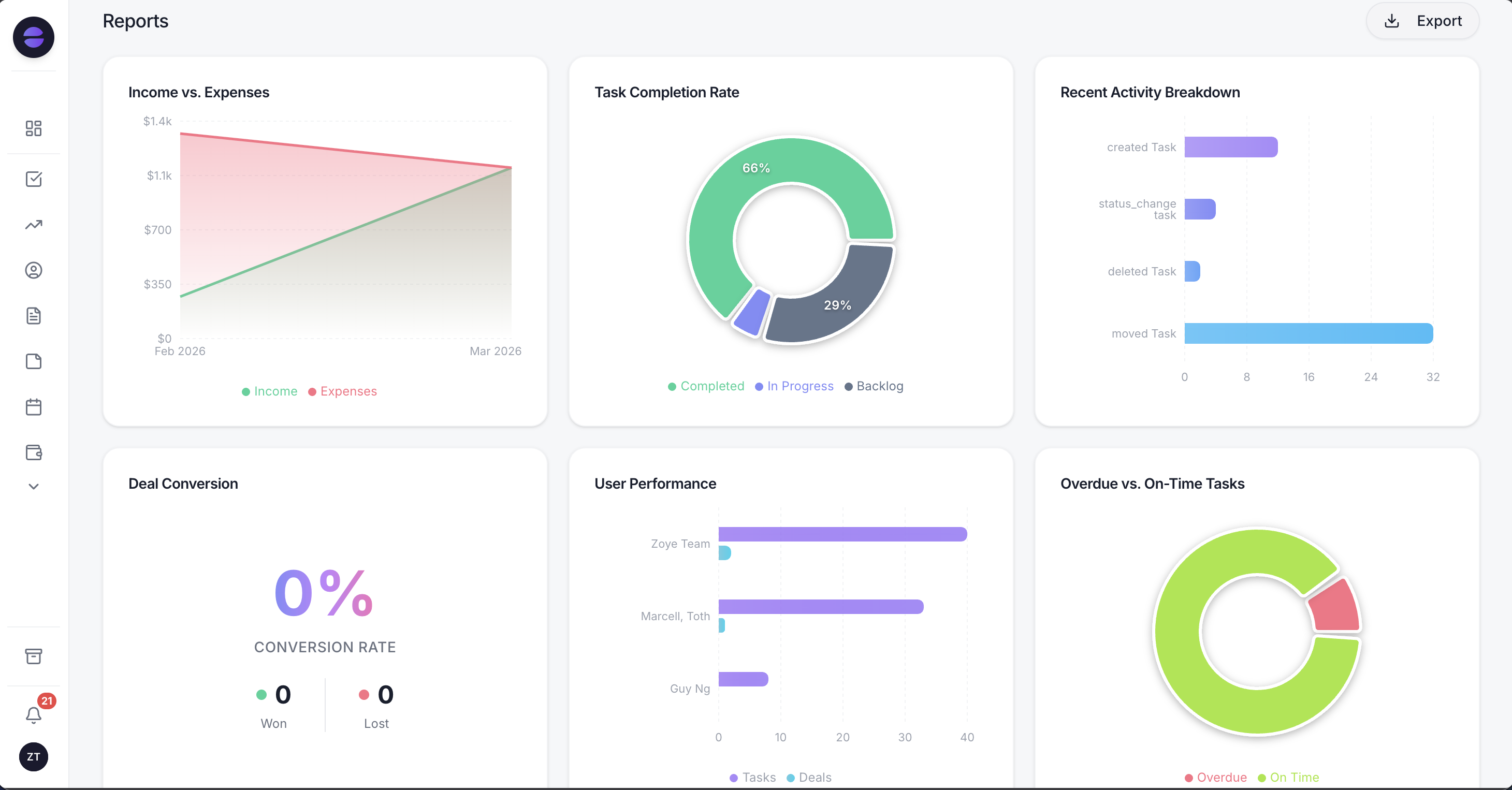
Habit 9 - the weekly review - takes minutes instead of an hour because Zoye Reports pulls task completion, deal progress, and budget movement into one dashboard. The data is already where the review needs it.
Habit 4: Delegate to AI before delegating to humans
In 2026, AI can handle a meaningful chunk of the routine work that small business owners do daily. Use it.
Delegate to AI:
- Drafting follow-up emails to customers, vendors, and team members.
- Summarising meetings, calls, and long email threads.
- Logging customer interactions into the CRM automatically.
- Generating weekly status reports, pipeline summaries, and team activity reviews.
- Setting reminders, scheduling meetings, and managing calendar logistics.
- Researching prospects, enriching contacts, and surfacing context about people you are about to meet.
What remains for humans is the judgment work: deciding what to commit to, building relationships, solving novel problems, creative work, strategic thinking. That is where small business owners should spend their time. AI handles the rest.
For small business owners who have not yet adopted an AI assistant, this is the single highest-leverage step available in 2026. A good AI assistant pays for itself in the first week.
Habit 5: Say no by default
Every yes is a no to something else. Most small business owners say yes too often because saying no feels uncomfortable, and the cost of the yes is invisible at the moment of decision.
The fix is a default-to-no policy on new commitments. New meeting requests, new customer asks, new project ideas, new tool evaluations: the default answer is no unless the commitment clearly advances the top priorities for the week.
This is not about being rude. It is about being honest with yourself about what you actually have time for. A polite no is far better than a yes that you then deliver late or poorly.
The most productive small business owners are also the people most willing to decline things. That is not a coincidence.
Habit 6: Track time for one week
You think you know where your time goes. You do not.
Every small business owner who tracks their actual time use for a week discovers 5 to 10 hours of work that should not exist. The discovery is uncomfortable but valuable. Once you see where the time actually goes, you can choose to redirect it.
Use any simple time tracking tool, or just keep a notebook. Log what you do in 30-minute increments for 5 working days. At the end of the week, categorise the entries: customer-facing work, internal work, admin, communication, deep work, distractions. The breakdown is almost always surprising.
The act of tracking changes behaviour. Most people start working differently within 2 days simply because they are paying attention. The week of tracking is a productivity intervention in itself.
Habit 7: Automate follow-ups
The number-one reason small businesses lose customers is forgetting to follow up. The customer expressed interest, the founder promised to follow up next week, the next week became next month, and the customer went cold.
Automated follow-up systems prevent this. An AI assistant like Zoye sets follow-up reminders automatically when a customer interaction happens, drafts the follow-up message based on the prior conversation context, and surfaces the reminder at the right moment. The follow-up still happens with human judgment (you decide whether to send the drafted message), but it does not depend on remembering.
This single habit recovers deals that would otherwise be lost purely to a forgotten follow-up. For most small businesses, deals lost to silence rather than to a real objection are some of the easiest revenue to win back, and an automated follow-up system is what wins it.
Habit 8: Do email twice a day, not all day
Email pings break focus. Every notification, even one you do not respond to, costs cognitive overhead. Across a full day of constant email checking, that overhead adds up to 1 to 2 hours of lost productivity.
The fix is structured email windows. Check email at two specific times: late morning (after the deep-work block is done) and late afternoon (before end-of-day planning). Outside those windows, email is closed and notifications are silenced.
The benefit shows up in two places: you reclaim the cumulative overhead of constant checking, and the work that gets done in your protected deep-work blocks is qualitatively better because focus stays unbroken.
The objection most small business owners raise is that customers expect fast email responses. The reality is that customer expectations are set by what you actually do. If you respond at noon and 5pm consistently, customers will adjust. They want responsive, not instantaneous.
Habit 9: Weekly review on Friday afternoon
Spend 30 minutes every Friday afternoon reviewing the week. What worked. What did not. What needs adjusting next week. This single habit compounds across months and years.
The weekly review covers four areas:
- Wins: what worked well, what should continue.
- Misses: what did not work, what should change.
- Customer commitments: anything outstanding, anything at risk.
- Next week's three priorities: what matters most.
The 30 minutes feels like a sacrifice in the moment. Across a year, the compounding effect is enormous. Small business owners who do this consistently make better decisions, recover faster from setbacks, and learn from their experience instead of repeating it.
Habit 10: Sleep 7+ hours
Chronic sleep deprivation degrades focus, decision quality, and memory. No tool, no habit, no AI assistant can compensate for a tired brain. This is the one productivity input that every other habit on this list depends on.
Small business owners often treat sleep as an optional efficiency cost, trading hours of rest for hours of work. The trade usually loses. A short night of sleep producing degraded, error-prone work is rarely worth more than a full night producing sharp work, because the deficit costs you more in quality than the extra waking hour gains you in quantity.
Treat sleep as a non-negotiable productivity input, not a luxury. The output is dramatically higher.
The tools that make these habits stick
Habits are easier to sustain when the tools support them. The most consequential productivity tools for small business owners in 2026 are:
1. An all-in-one workspace. Zoye consolidates CRM, tasks, calendar, budget, and AI into one platform. This eliminates the context-switching tax and centralises the data you operate from.
2. An AI assistant that takes action. Zoye's assistant drafts emails, schedules meetings, summarises calls, prioritises tasks, and surfaces follow-ups. It handles the routine work so you do not have to.
3. A calendar that defends focus time. Whatever calendar you use (Google, Outlook, native Zoye calendar), block deep-work time on the calendar as if it were a meeting with the most important client. Defend that block ruthlessly.
4. A simple capture tool for ideas. Whether it is a notebook, a Notes app, or Zoye's capture, you need somewhere to put ideas the moment they appear so they do not interrupt your current focus.
5. A weekly review template. Whatever template you use, having a structured format for the Friday review makes the habit easier to keep.
Why Zoye is built for small business productivity
Three reasons make Zoye particularly aligned with these productivity habits.
First, the all-in-one workspace directly addresses Habit 3. Small business owners stop switching between 5 separate tools because everything lives in one place.
Second, the AI assistant directly enables Habits 4 and 7. Routine work gets delegated to AI automatically: emails get drafted, meetings get scheduled, follow-ups get surfaced, reports get generated. The owner gets back hours per week of routine work.
Third, the pricing rewards small business owners specifically. The Almost Free entry plan covers solo founders with the full platform for $5 per month ($4 billed annually). Paid plans are flat-rate so the cost does not multiply as the team grows.
Try Zoye with your team. The entry plan is Almost Free.
For more context, see the AI business automation guide, what is business process automation, how to choose a CRM, and the best AI tools for business in 2026.