
Notion vs Trello 2026: Which One Fits Your Team, and the Third Option
Notion and Trello end up on the same shortlist constantly, which is odd, because they are almost opposites. Notion is a blank, endlessly flexible canvas: pages inside pages, databases you design, views you configure. It can become anything, which is exactly the problem, because until you architect it, it is nothing. Trello is the other extreme. It is a board of columns and cards that anybody understands in a minute, and it stays a board of columns and cards forever.
So the real dilemma is not "which tool is better". It is which kind of work you are willing to do yourself. With Notion you do design work up front and maintenance work forever. With Trello you skip the design work and instead do the moving: someone still has to drag every card, remember every follow up, and notice when a card has been sitting in the same column for three weeks.
This comparison is fair about where each one genuinely wins, walks through the six dimensions that decide it, and then covers the option most small teams never consider: software that does the work instead of being another surface you maintain.
Pricing reflects published rates as of August 2026; check each vendor's pricing page for current figures.
Notion vs Trello at a glance
| Dimension | Zoye | Notion | Trello |
|---|---|---|---|
| What it is | AI operator that runs the work | Flexible docs and database workspace | Kanban boards of cards |
| Time to first value | Same day, no setup project | Days to weeks of design | Minutes |
| Structure | Records that connect by default | Databases you design and relate | Boards, lists, cards, labels |
| Docs and notes | Notes module, rolling out | Best in class | Card descriptions only |
| Automation | Described in a plain sentence, then run for you | Simple database automations on paid tiers | Butler rules, per board |
| Clients, deals, follow ups | Native CRM records the AI updates itself | You build it yourself as a database | Not really, cards stand in for it |
| AI | Executes across the workspace | Notion AI writes and summarises | Assists on upper tiers |
| Messaging | WhatsApp and Slack, by text or voice | Not native | Not native |
| Pricing model | Flat tiers, not per seat | Per seat | Per seat |
| Entry price | Almost Free, $5/month, 1 member | Free plan, paid from about $10/user/mo | Free plan, paid from about $5/user/mo |
| Who maintains it | The assistant keeps records current | You do, continuously | Whoever moves the cards |
Getting started: the first hour tells you everything
Trello wins this dimension outright and it is not close. Create a board, name three columns, add cards. A new hire, a freelancer, or a client who has never used a project tool understands it immediately, because the metaphor is a physical board with sticky notes and everyone already has that model in their head. There is no schema, no configuration, no training session. For a small team that just needs shared visibility this week, Trello is the shortest path that exists.
Notion starts as an empty page with a blinking cursor, and that is a design decision, not a flaw. The power arrives after you decide what your workspace is: which databases exist, how they relate, which properties each record carries, which views each team sees. Done well, it is genuinely impressive. Done at the speed a busy owner actually has, it turns into a half built structure that two people understand and nobody trusts.
The pattern is predictable. Teams adopt Trello in an afternoon and outgrow it in a year. Teams adopt Notion over a month and then quietly stop maintaining it in month four.
Verdict: Trello for immediate adoption with zero training. Notion if someone on the team genuinely enjoys building the system and will keep owning it.
Structure: databases versus boards
Notion has the deeper data model by a wide margin. A database can hold properties of every type, relate to another database, roll up values, filter into as many saved views as you want, and render as a table, board, calendar, timeline, or gallery. You can model clients linked to projects linked to tasks linked to meeting notes, all in one place, which is exactly why people fall in love with it in week one.
Trello has no data model to speak of. A card has a title, a description, members, labels, a due date, a checklist, and attachments. Custom Fields exist on paid plans and help, but a board never becomes a relational system. There is no clean way to say "this card belongs to that client and that client owes us this amount". Teams work around it with naming conventions and extra boards, and that workaround is where Trello quietly gets expensive in human time.
The honest catch on the Notion side: its structure is only as good as the person maintaining it, and it degrades. Properties get added and never filled. Two people create two versions of the same database. The relation nobody updates makes the rollup wrong, and once a number is wrong once, nobody trusts the dashboard again.
Verdict: Notion for anything with real structure behind it. Trello when the work genuinely is just a queue of items moving left to right.
Want to see it in action?
Watch how Zoye automates your daily workflow - from lead management to team collaboration.
See How It WorksAutomation: rules you configure, on both sides
Trello's Butler is better than its reputation. You can move a card when a due date passes, post a checklist when a card lands in a column, assign a member on a label, or run a scheduled command every Monday. It is genuinely useful and it is configured in near English. The limits are that rules live per board, they act on cards rather than on your business, and they are blind to anything outside Trello. Butler can move a card to "Waiting on client". It cannot notice the client never replied and chase them.
Notion added database automations that trigger on property changes and can send updates or create pages, plus buttons that run a defined set of steps. Useful for keeping a database tidy. Also entirely inside Notion, and also something you sit down and build.
The shared limitation matters more than the feature difference. Both tools automate the record of the work. Neither does the work. When a card says "send the proposal", the automation can label it, notify a channel, and move it, and you still write and send the proposal. When a deadline passes, both can flag it, and neither one calls the customer.
Verdict: Trello's Butler is easier to live with; Notion's automations are tied to a richer data model. Both leave the actual doing on your desk.
See what Zoye can do for you
From CRM and deal tracking to AI-powered task management - explore everything Zoye offers in one workspace.
Explore FeaturesBreadth: does it hold clients, deals, and follow ups?
This is where most small businesses discover they picked the wrong category of tool entirely.
Notion can hold clients and deals, in the sense that you can build a CRM database with a pipeline property and a board view, and thousands of people have. It works, it looks great in a screenshot, and it is a system you now own the maintenance of. Every stage change, every logged call, every note about what the customer asked for is typed in by a human. The day the team gets busy is the day the pipeline stops reflecting reality, and a pipeline that is out of date is worse than no pipeline, because you make decisions from it.
Trello cannot really hold this at all. People try, with a card per lead and lists as pipeline stages, and it survives until you want a contact history, a quote, an invoice, or a report on conversion by source. Then you are exporting cards into a spreadsheet, and the spreadsheet becomes the real system.
The pattern is the same in both: the tool is a place to record what happened, and recording it is your job. That works fine for an internal project. It falls apart for the customer facing side of a business, where the cost of forgetting one follow up is a lost sale, not a late task.
Verdict: Notion can be shaped into a client system if you commit to feeding it. Trello cannot. Neither one will chase anything for you.
AI: helpful, but it does not operate
Notion AI is the stronger of the two on its own turf. It drafts, rewrites, summarises long pages, fills database properties from context, and answers questions across your workspace, and it is bundled into the higher paid tiers rather than sold separately as it once was. If your workspace is full of documents, it saves real time.
Trello leans on Atlassian Intelligence on its upper plans, alongside Butler, for things like summarising a busy card or drafting a description. It is helpful inside the board, and it is modest by design.
Both are assistive. They generate text and answer questions about content you already put in. The distinction that actually changes a working week is between an AI that suggests and an AI that acts: one hands you a better draft, the other sends the message, updates the record, books the slot, and tells you it is done.
Verdict: Notion AI for writing and finding things. Trello's AI for tidying a board. Neither is an operator.
Ready to streamline your business?
Zoye brings AI-powered CRM, task management, and automation into one workspace.
Get StartedPricing: what each actually costs a growing team
Both bill per seat, which means both get more expensive on the day you hire, regardless of whether the new person uses them much.
Trello pricing:
- Free: $0, unlimited cards, up to 10 boards per workspace, limited automation runs
- Standard: about $5 per user per month billed annually
- Premium: about $10 per user per month billed annually, adds views, dashboards, and AI features
- Enterprise: custom, quoted per seat at scale
Notion pricing:
- Free: $0 for personal use, generous for one person, limited for teams
- Plus: about $10 per user per month billed annually
- Business: about $20 per user per month billed annually, with Notion AI included
- Enterprise: custom
Zoye pricing (flat, not per seat):
- Almost Free: $5 per month, 1 member, 1GB storage, full platform including AI
- Starter: $29 per month, 10 members, 5GB storage
- Growth: $59 per month, 20 members, 10GB storage, 24/7 support
- Scale: $119 per month, 100 members, 25GB storage
- Customize: custom limits and dedicated support
The 15 person math: Trello Premium comes to roughly $150 a month. Notion Business with AI comes to roughly $300 a month. Zoye Growth covers 20 members at $59 a month with every tool and connector included, and it does not go up when the sixteenth person joins.
Worth saying plainly: Trello's free plan is genuinely good for a very small team, and Notion's free plan is excellent for one person. If your needs are that small, use them. The cost that catches businesses out is not the subscription anyway, it is the hours spent operating a tool that only records.
Verdict: Trello is the cheapest per seat. Notion costs more and gives more. Flat pricing wins once you pass roughly eight or ten people.
The third option: Zoye
Notion and Trello are both surfaces. You look at them, you update them, and the business moves because you moved it. Zoye is built on the opposite premise: the software should run the routine work, and you should check on it.
Zoye is an AI business operator. It captures leads from your channels, keeps the customer records current itself, chases the follow up you would have forgotten, books appointments, and builds automations from a plain sentence you type, including over WhatsApp and Slack. Tasks, boards, calendar, customer records, budget, and reports live in one workspace, so the assistant can act across all of them from one instruction instead of asking you to switch tools.
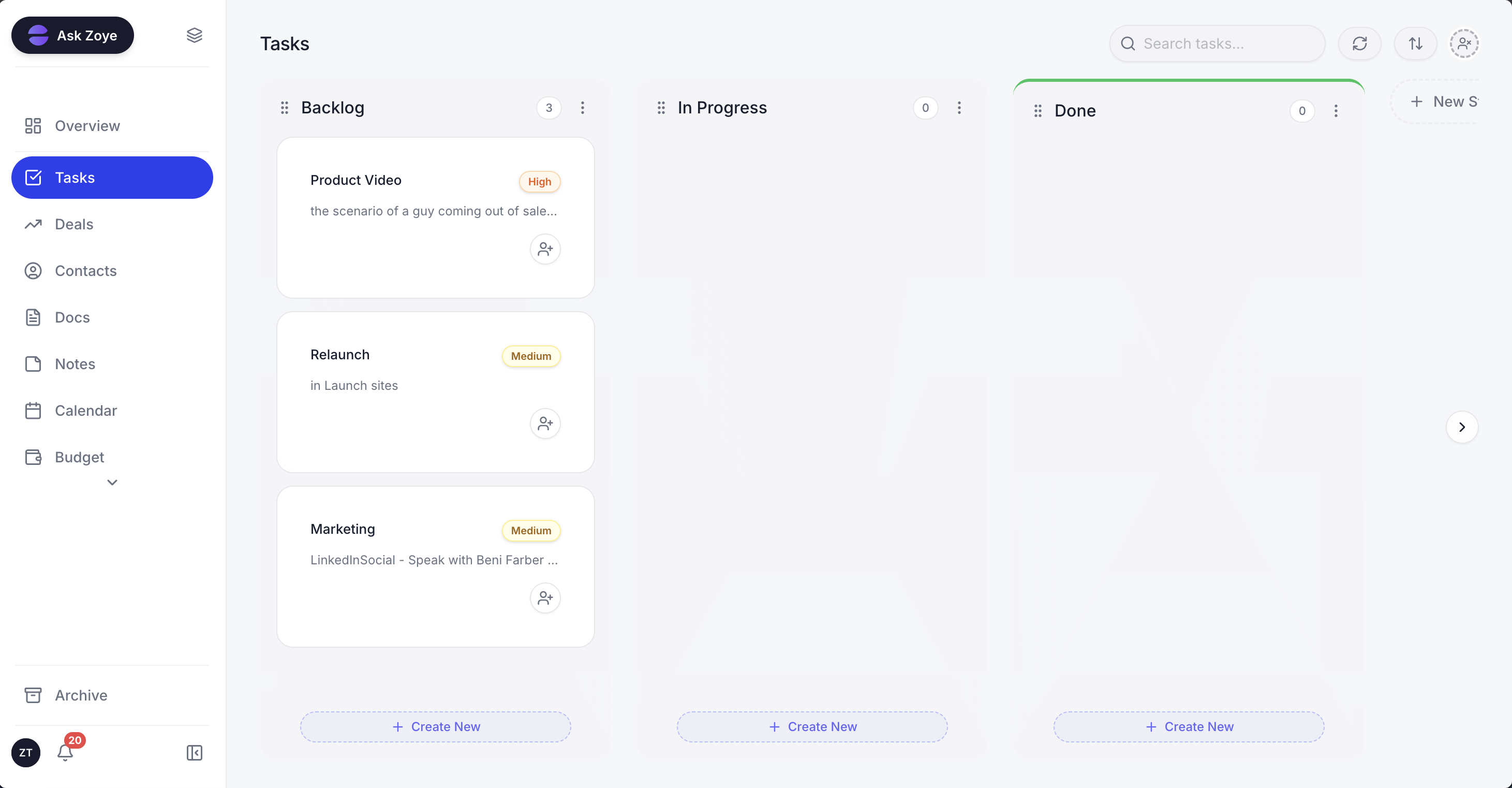 Zoye: the same board view you know from Trello, with an assistant that moves the work instead of waiting for you to
The board looks familiar on purpose. List, board, calendar, and timeline views are all there, so nothing about the day to day is a relearning exercise. The difference is behind it. Say "when someone asks about pricing on WhatsApp, reply with the quote, add them as a lead, and remind me in two days if they go quiet" and Zoye builds that routine and then runs it. Nobody drags the card. Nobody remembers the two days.
Real example: A two person consultancy gets an enquiry on WhatsApp at 9pm. Zoye answers, captures the contact, files the enquiry with the budget the person mentioned, offers three consultation slots from the real calendar, books the one they pick, and pings the owner in the morning with the appointment already on the day. In Trello that is a card somebody has to create tomorrow. In Notion it is a database row somebody has to type.
Pricing is flat rather than per seat: Almost Free at $5 per month covers 1 member with the full platform including AI, Starter is $29 per month for 10 members, Growth is $59 per month for 20 members with 24/7 support, and Scale is $119 per month for 100 members.
When to choose each
Choose Trello if:
- You want a shared board running this afternoon with no training
- Your work really is a queue of items moving through stages
- The team is small and the process is simple enough to stay in one place
- Budget is the deciding factor and the free or Standard plan covers you
Choose Notion if:
- Documents, wikis, and connected knowledge are the core of how you work
- Somebody on the team genuinely enjoys designing systems and will keep owning it
- You need one flexible space rather than five specialised tools
- You accept that the structure is yours to build and maintain
Choose Zoye if:
- The expensive failures in your business are missed follow ups, not missed tasks
- You want customer records that update themselves instead of records you feed
- You want automations you describe in a sentence rather than rules you configure per board
- You run a lot of your business through WhatsApp or Slack and want it handled there
- You would rather pay a flat monthly price than a price that rises with headcount
Want to see it in action?
Watch how Zoye automates your daily workflow - from lead management to team collaboration.
See How It WorksFrequently asked questions
It depends on what you need it to hold. Notion is better when your work is information heavy: docs, wikis, client notes, and databases that connect to each other. Trello is better when your work is a queue of things that move from one stage to the next and you want the team using it on day one. Notion gives you more range and asks you to design it. Trello gives you less range and asks almost nothing.
Yes, clearly. A new person understands a Trello board in about a minute: columns are stages, cards are work, you drag a card to the right. Notion asks you to decide what a page is, what a database is, which properties matter, and which views to build before it does anything useful. Most teams are running in Trello the same hour and still redesigning their Notion setup weeks later.
Yes, functionally. A Notion database with a board view gives you columns, cards, and drag and drop, plus properties Trello cards do not have natively. What you lose is the instant simplicity: the Notion board is a view of a database you built and have to maintain, so it is only as tidy as the schema behind it. Teams that just want a shared board usually find Trello less work.
Trello, at almost every stage. Trello Standard is around $5 per user per month billed annually and Premium around $10, while Notion paid plans start around $10 per user per month and its business tier is roughly double that. Both bill per seat, so both grow every time you hire. (Pricing as of August 2026; check each vendor's pricing page for current figures.)
Both have AI attached, and in both cases it assists rather than operates. Notion AI writes, summarises, and answers questions about your pages, bundled into the higher paid tiers. Trello leans on Atlassian Intelligence and Butler automation on its upper plans for card summaries and rule based actions. Neither one goes out and captures a lead, updates a customer record, or chases a follow up for you.
For a business that runs on clients rather than just tasks, yes. Zoye is an AI business operator: it captures leads, keeps the customer records updated itself, chases follow ups, books appointments, and builds automations from a plain sentence you type, including over WhatsApp and Slack. Pricing is flat rather than per seat, starting with the Almost Free plan at $5 per month for 1 member with the full platform including AI.
The bottom line
Trello is the easiest tool in this category to start using and the hardest to grow with. Notion is the most capable blank canvas on the market and the one most likely to become a beautiful structure nobody updates. Both are honest about what they are, and both leave the same thing on your plate: the software holds the record, and you do the work.
If your business is projects and internal process, pick the one that matches your appetite for setup and get on with it. If your business is customers, and the thing that actually costs you money is the enquiry nobody answered and the follow up nobody sent, neither surface will fix that, because neither one acts. Zoye is built for that business: it captures, updates, reminds, books, and chases by itself, and you describe what you want in a sentence. Start on the Almost Free plan at $5 per month for 1 member with the full platform including AI, and move up only when the team does.
For more context, see the best Notion alternatives, the best Trello alternatives, Notion vs Asana, and the rest of the Zoye blog.