
Best Notion Alternatives in 2026: 7 Platforms That Do More Without the Setup
Notion's flexibility is both its appeal and its most common complaint. Teams adopt it expecting a ready-to-use workspace and discover a blank canvas that requires significant configuration before it becomes useful. The CRM does not exist until someone builds it. The AI writes summaries but cannot take action.
This guide covers the seven best Notion alternatives - split between platforms that do documentation better, and platforms that go further by covering the business functions Notion was never built for.
Why teams look for Notion alternatives
- Configuration overhead: every workflow needs to be built from scratch - databases, relations, templates
- No real CRM: Notion's CRM is a database approximation with no pipeline view and no AI-assisted contact creation
- AI that writes, not acts: Notion AI cannot create a deal, assign a task, or update a contact record
- Per-seat pricing with no business tools: $15/user/month for a documentation tool that still needs separate CRM and budget tools
1. Zoye - For teams that need more than a wiki
Zoye is the alternative for teams that have realised Notion is not a business platform. Zoye includes everything Notion covers for knowledge management - docs, notes, shared workspace - plus a complete CRM, task management, calendar sync, budget tracking, and business reporting. All connected. All tools and connectors included. And an AI assistant that takes action rather than just summarising pages.
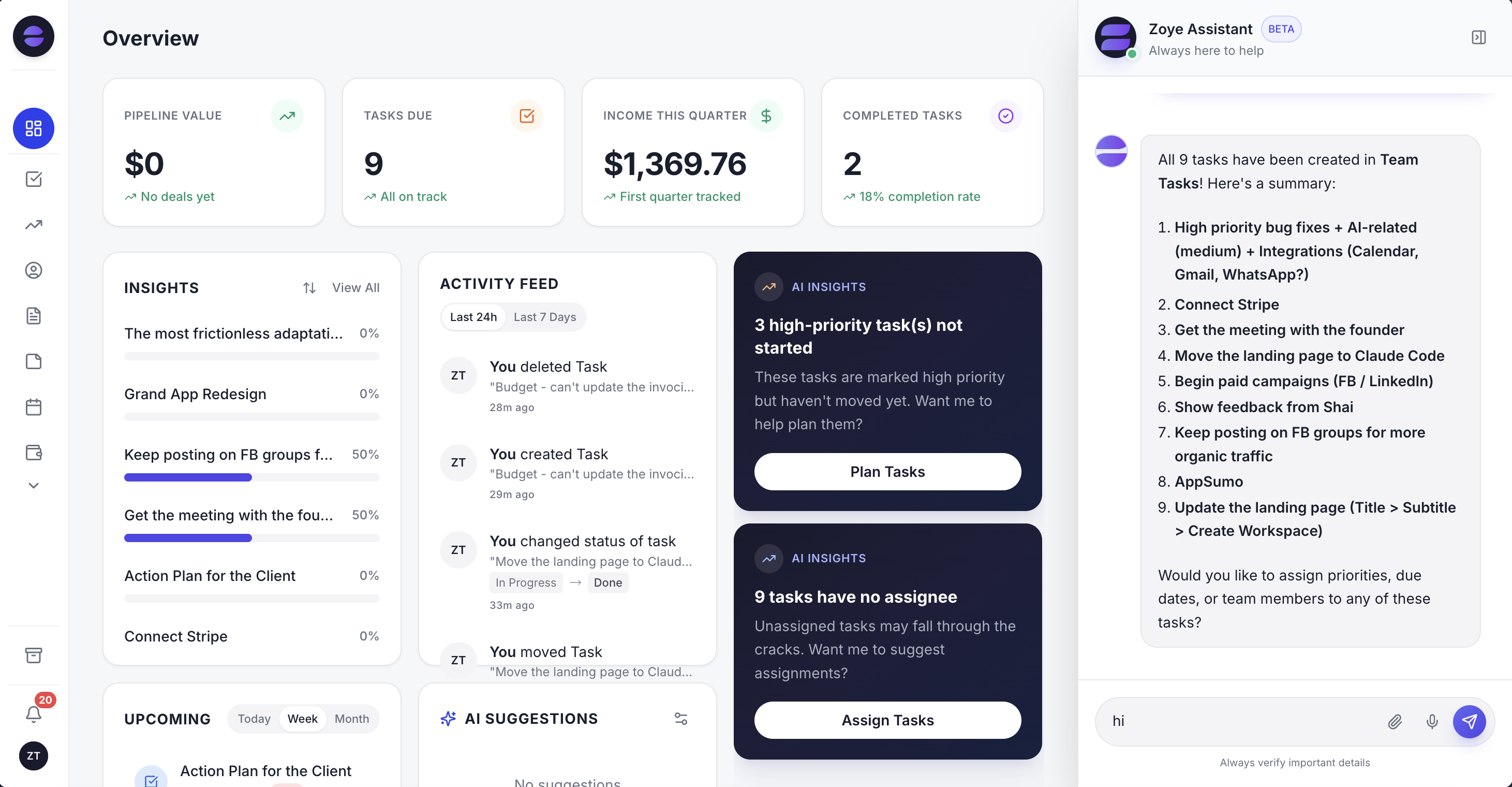 Zoye: docs and notes included alongside CRM, tasks, budget, and AI
Where Zoye beats Notion:
- Ready to use immediately - no database configuration required
- Real CRM built in - Deals pipeline and Contacts connected to tasks and calendar
- AI that executes - Zoye Assistant creates contacts, assigns tasks from a single instruction
- Business analytics included - live reports across pipeline, finance, and team performance
- Flat-rate pricing - covers your whole team at one price
Pricing:
Pricing reflects published rates as of June 2026; check each vendor's pricing page for current figures.
| Plan | Monthly | Annual | Includes |
|---|---|---|---|
| Zoye | $5/mo | $4/mo | 1 member, 1GB - all tools + connectors included |
| Zoye Starter | $29/mo | $23/mo | 10 members, 5GB - all tools + connectors included |
| Zoye Growth | $59/mo | $47/mo | 20 members, 10GB, priority support |
| Zoye Scale | $119/mo | $95/mo | 100 members, 25GB |
All tools and all connectors included at every tier.
See what Zoye can do for you
From CRM and deal tracking to AI-powered task management - explore everything Zoye offers in one workspace.
Explore Features2. Confluence - For enterprise teams that need structured documentation at scale
Confluence is Atlassian's documentation platform and the natural choice for organisations already using Jira. Deep Jira integration, structured page hierarchies, and enterprise admin controls make it genuinely useful for technical teams at scale.
Pricing: Free (10 users) | Standard around $5/user/mo | Premium around $10/user/mo
The trade-off: Outside the Atlassian ecosystem, its advantages largely disappear.
3. Coda - For docs-meets-database teams who want powerful automation
Coda sits closest to Notion: flexible documents that embed tables and automations. Its Packs connect directly to external services, allowing more sophisticated workflow automation within documents than Notion supports.
Pricing: Free (personal) | Pro $10/user/mo | Team $30/user/mo
4. ClickUp - For teams that want docs and tasks in one place
ClickUp includes native document creation alongside its task management core. Briefs and specs live alongside the work being done to execute them. AI writing assistance is built into the doc editor.
Pricing: Free | Unlimited $7/user/mo | Business $12/user/mo | Note: AI (ClickUp Brain) is a paid add-on of around $9/user/mo
Ready to streamline your business?
Zoye brings AI-powered CRM, task management, and automation into one workspace.
Get Started5. Obsidian - For individuals who want local-first knowledge management
Obsidian stores notes as local Markdown files with no subscription required for personal use. Bi-directional linking and a large plugin ecosystem make it a favourite among individuals who want complete data ownership.
Pricing: Personal free | Sync $10/mo | Publish $20/mo
The catch: Primarily a personal tool - team collaboration requires workarounds.
6. Slite - For remote teams who need simple, fast async documentation
Slite is designed specifically for remote team knowledge management. Simpler than Notion, faster search, and easier to maintain for non-technical team members.
Pricing: Free (3 members) | Standard $8/user/mo | Premium around $12/user/mo
7. Slab - For teams that want clean, structured, searchable company knowledge
Slab's topic-based hierarchy keeps large knowledge bases navigable as they grow. Unified search across Slab and connected tools surfaces relevant knowledge in the flow of work.
Pricing: Free (10 users) | Startup $8/user/mo | Business $15/user/mo
Want to see it in action?
Watch how Zoye automates your daily workflow - from lead management to team collaboration.
See How It WorksHow to choose the right Notion alternative
- If you need docs plus a full business workspace: Zoye covers documentation alongside CRM, tasks, budget, and reporting - all connected, all included
- If you are in the Atlassian ecosystem: Confluence integrates most deeply with Jira
- If you want docs tightly integrated with tasks: ClickUp covers both
- If your team needs simple async documentation: Slite is easier to maintain than Notion
- If you want local-first personal knowledge management: Obsidian gives complete data ownership
Ready to streamline your business?
Zoye brings AI-powered CRM, task management, and automation into one workspace.
Get StartedFrequently asked questions
Zoye is the most affordable full-platform alternative, starting at just $5/mo. The Almost Free plan ($5/mo) includes docs, notes, CRM, tasks, calendar, budget, reports, and Zoye Assistant. For pure documentation needs, Confluence (10 users), Coda, and Obsidian also offer free plans.
Zoye is the only platform on this list with a purpose-built CRM natively connected to documentation and task management. Every other alternative requires a separate CRM subscription.
Zoye is operational from the moment you sign up. Every module is pre-built and connected. Slite and Slab also require minimal configuration for documentation-focused use.
Notion Business for 15 people: $225/month - documentation only. Zoye Growth for 15 people: $59/month - full business workspace with AI and all connectors included.
The most common reasons are configuration overhead (every workflow has to be built from scratch), lack of a real CRM, AI that writes but cannot take action, and per-seat pricing for a platform that still requires separate CRM and budget tools. Teams that need a ready-to-use business workspace find Notion's blank-canvas approach increasingly hard to justify.
Yes. Zoye includes Docs and Notes modules for collaborative documentation alongside CRM, tasks, calendar, and reports. Where Notion stops at documentation, Zoye continues into the business functions documentation usually supports - so you can keep all your context in one workspace instead of paying for Notion plus a CRM plus a budget tool.
Migrating off Notion without losing your knowledge base
The thing that keeps most teams on Notion longer than they want is the migration itself: months of pages, databases, and links that nobody wants to recreate by hand. It is more manageable than it looks if you approach it in order.
- Audit what you actually use. Most Notion workspaces accumulate abandoned databases and one-off pages. Before moving anything, separate the documents your team genuinely relies on from the clutter. You rarely need to migrate everything.
- Export your pages as Markdown. Notion exports to Markdown and HTML, which most modern workspaces can import. Documentation, SOPs, and meeting notes usually transfer with formatting intact.
- Rebuild structured data as structured data. Notion databases that approximate a CRM or a task tracker should not be re-imported as documents. In a platform with a real CRM and task module, recreate them as records so they connect to the rest of your workspace rather than sitting as static tables.
- Move the team in one cutover, not gradually. Running two documentation tools in parallel splits your knowledge base and confuses people about where the source of truth lives. Pick a date, migrate, and archive the old workspace read-only.
- Connect the gaps Notion left open. The reason many teams leave is that documentation alone was never enough - they were running a separate CRM, budget tracker, and task tool alongside it. A workspace like Zoye lets you fold those back in, so the move is a consolidation rather than a sideways swap.
Done in that order, most teams complete the switch in days, not weeks, and come out the other side with fewer tools than they started with.
The bottom line
The right Notion alternative depends on the gap. If documentation quality is the issue, Confluence, Slab, or Slite fill it well. If Notion was never really a business platform - no CRM, no budget, no AI that executes - Zoye is the answer.
For more context, see Notion vs Airtable, Notion vs Obsidian, ClickUp vs Notion, the best ClickUp alternatives, the best project management software, and the rest of the Zoye blog.