
Lodgify vs OwnerRez 2026: Which One Fits Your Operation?
Lodgify and OwnerRez appear on the same shortlist constantly, and they are barely the same kind of product. Lodgify started as a way to put a proper booking website in front of a rental and grew a management platform around it. OwnerRez started as a management engine for people who wanted control over every rule, statement and template, and added websites because owners needed somewhere to send guests. That origin story is not trivia. It decides which of the two will feel like a relief in your third month and which will feel like a compromise you keep working around.
The cleanest way to read this comparison is as a question about who you actually work for. If the homes are yours, or you co-host a few for people you know, your bottleneck is demand: being found, looking credible, and taking a reservation without handing a listing site a cut. Lodgify exists for exactly that. If you manage homes belonging to other people, your bottleneck is accountability: what each owner earned this month, what you deducted and why, which nights were blocked, and a record you can defend on a phone call in February. That is the problem OwnerRez was engineered to survive.
The second split is how you pay. OwnerRez publishes flat rates that scale with how many properties you run, so your annual software cost is arithmetic you can do before you talk to anyone, and nothing in the model tracks your revenue. Lodgify publishes tiers too, but its cheapest one adds a percentage fee on every reservation the platform processes, which means the real price rises with your success. Those two models look similar on a comparison table and behave completely differently by your second good season.
One more fact worth putting up front, because it surprises people: OwnerRez holds the highest user ratings in this whole category, 5.0 on G2 and 4.9 on Capterra as of August 2026, which is unusual for software that reviewers openly describe as hard to learn. Read that as a signal about who stays rather than who arrives. This article walks through the website and booking engine, channel management, accounting and owner statements, guest messaging, reporting, the two pricing models, the learning curve, and who outgrows which. Then it covers the work that sits outside both, which for a management company is where next year's growth actually lives.
Vendor figures reflect published rates or third-party-reported estimates as of August 2026; check each vendor's own pricing page before you budget.
Lodgify vs OwnerRez at a glance
| Dimension | Lodgify | OwnerRez | Zoye |
|---|---|---|---|
| Built for | Hosts and small brands selling stays directly | Operators and small managers accountable to owners | The business around the bookings |
| Core strength | Website builder and booking engine | Configurability, statements and reporting | Owner pipeline and follow-through |
| Website quality | The best reason to choose it | Functional, hosted or WordPress-based | Not a website builder |
| Channel management | Reliable on the major OTAs, simpler inventory | Solid, with far more control over the rules | None, by design |
| Owner statements | Light | Native, with deductions and commission splits | Owner invoicing and per-property costs |
| Reporting | Basic operational views | Deep and genuinely queryable | Pipeline, response times and lead sources |
| Pricing model | Published tiers by rental count | Published flat rates by property count | Flat for the workspace |
| Fee per reservation | Percentage fee on the entry tier | None reported | None |
| Dynamic pricing | Sold separately, not part of the base plan | No native engine, integrations only | Not a pricing tool |
| Learning curve | Gentle, live in days | Steep, then it does exactly what you configured | Same day |
| Geography | Broad international footprint | Strongest in the United States | Works wherever you do |
| Homeowner acquisition | Not covered | Not covered | The pipeline and the chasing |
Who each one is really built for
Lodgify's assumptions are visible everywhere in the product. It assumes one person, or two, doing everything. It assumes the guest is the customer. It assumes that if your site looks amateur you lose the booking, so design and the checkout flow get the attention. It does not assume that somebody else owns the house and will want a statement, and that is not an oversight, it is a decision about which customer to serve well.
OwnerRez assumes the opposite. It assumes rules differ by property because owners differ, that money passing through you needs a paper trail, that you would rather set something up once precisely than have a wizard guess, and that reporting is how you keep an owner relationship calm. Its defaults ask you questions instead of answering them for you, which is exhausting in week one and the reason people stay for five years.
A quick test that beats any feature grid. Write down the last three things that went wrong in your operation. If they are things like an empty week you did not market, a guest who bounced off an ugly booking page, or an enquiry that went to a competitor because your site looked less trustworthy, Lodgify is aimed at your problem. If they are an owner disputing a deduction, a cleaning fee you could not evidence, a rate rule you set on one house that quietly applied to four, or a month-end you spent in a spreadsheet, OwnerRez is aimed at your problem.
There is a third possibility, and it is the most common one among small management companies. The last three failures were not in the software at all: the homeowner you met at a viewing and never called back, the enquiry that arrived on Instagram at 11pm and got answered at noon, the management agreement sitting unsigned in someone's inbox. No property management system covers that, which is what a vacation rental CRM is for, and it is the second half of this article.
Verdict: Lodgify if your customer is the guest. OwnerRez if your customer is the owner.
The website and booking engine
This is Lodgify's dimension and it is not close. The templates look current, property pages are structured properly, photos are handled well, the booking flow and payment collection are built in, and a non-technical operator can have a real site on their own domain inside a few days without an agency. If your growth strategy is reducing OTA dependence, that single module is the strategy, and paying for the rest of the platform to get it is a defensible decision on its own.
OwnerRez gives you a website too, and it is honest rather than beautiful. You can run a hosted site or drive an existing WordPress site through its plugin and booking widgets, which is genuinely useful if you already have a site you like or a designer you trust. The inquiry-to-quote-to-booking path underneath is strong, arguably stronger than Lodgify's in terms of what you can control about quotes, deposits and terms. What you do not get is a design-led builder that makes a plain portfolio look expensive.
Worth naming the strategic gap that applies to both, because vendors never do. A direct-booking site produces two things: completed reservations and questions. The questions arrive as form submissions, WhatsApp messages, Instagram replies and phone calls asking whether the dates are still free, whether the dog is allowed, whether the price moves for a fortnight. Neither platform answers those. Both hand you the demand and leave you the reply, and the reply is where most direct-booking revenue is actually lost.
Verdict: Lodgify, clearly, on the site itself. OwnerRez on control over quotes, terms and the booking rules behind it.
Channel management and OTA sync
Both platforms sync availability, rates and reservations with Airbnb, Booking.com and Vrbo, and both have done it long enough to be dependable. Neither is where a small operator will hit a wall first.
Lodgify's channel management is straightforward and suits straightforward inventory. Six apartments across the big three channels will behave. What you get less of is granularity: the way rules are expressed is simpler, and complex arrangements such as multiple unit types under one roof, or one house that must never be listed on a particular channel during certain weeks, take more working around.
OwnerRez gives you more control over the same job. Rate rules, minimum stays, gap rules, channel-specific adjustments and blocking logic can be configured to a level of detail that most competitors do not expose at all, and that precision is exactly what stops the classic mistake of a rule you set for one property silently applying to the whole portfolio. The cost is that you have to understand the model before you can express what you want, and a misconfigured rule in a powerful system does more damage than a missing feature in a simple one.
Neither prices your nights for you, and this is where buyers get caught. OwnerRez has no dynamic pricing engine of its own and expects you to connect a specialist, which it supports properly. Lodgify treats dynamic pricing as something you pay for separately rather than a capability included in the plan you already bought. Either route, revenue management is a separate line in your stack, so put it in the budget when you compare monthly prices.
Verdict: OwnerRez on control, Lodgify on simplicity. Neither on nightly rate optimisation.
Want to see it in action?
Watch how Zoye automates your daily workflow - from lead management to team collaboration.
See How It WorksAccounting and owner statements
If you manage homes for other people, this section decides the comparison and everything above it is detail.
OwnerRez treats owner accounting as a first-class part of the product. Owner statements, expense and deduction handling, commission arrangements, payment tracking, and exports into general accounting tools are native rather than bolted on. For a small management company that means month-end is a process inside the system instead of an evening rebuilding a spreadsheet, and an owner asking why they received a particular figure gets an answer with a line-item behind it. This is also the least glamorous capability in the category, which is why it is underweighted in most comparisons and overwhelmingly the reason experienced managers pick OwnerRez.
Lodgify is light here, consistently with what it is. You will get reservation and payment records and the basics needed to see what came in, and you can export data to work on elsewhere. What you will not get is a statement you would hand an owner without editing it first. For a host running their own units that absence costs nothing, since the money is simply yours. For a manager splitting revenue eleven ways, it is the gap you will feel every single month.
One clarification that saves arguments later. Neither product does trust accounting in the regulated sense, where client money is held in a segregated account with the controls a jurisdiction requires. OwnerRez gets you far closer to defensible owner reporting than Lodgify does, but if your regulator or your accountant requires genuine trust accounting, that is a conversation with your accountant and possibly separate software, not a feature comparison.
Verdict: OwnerRez, decisively. This is the single strongest argument for it.
Guest messaging and daily communication
Both platforms automate guest messages around the reservation lifecycle, and both do it competently. Lodgify covers templated and scheduled messaging tied to booking, check-in and checkout, plus payment reminders, and it does so in a way you can set up in an afternoon. It suits an operator who wants the standard sequence running reliably and does not want to think about it again.
OwnerRez goes further and expects more of you. Message templates support field substitution, conditional logic and triggers with a level of precision that lets you build genuinely tailored sequences, such as different arrival instructions per property, or a message that only fires when a booking came from a particular channel. Operators who invest a weekend in this end up with guest communication that reads as personally written and runs entirely on its own.
The shared boundary matters more than the difference. Both systems message guests who have a reservation. The conversations that decide whether your business grows are with people who do not: the homeowner weighing up whether to hand you their cabin, the enquirer comparing three villas, the past guest who might return if asked. Neither platform has an opinion on those, because neither is a customer relationship system.
Verdict: OwnerRez for precision and conditional logic, Lodgify for getting the standard sequence live today.
Reporting and knowing what the portfolio did
Lodgify's reporting is operational and adequate for a small self-managed portfolio. You can see bookings, revenue and occupancy at a level that answers how last month went. If you want to ask a more specific question, you will usually be exporting to a spreadsheet.
OwnerRez reporting is one of its quiet strengths and a real differentiator at this price point. The reports are numerous, filterable and detailed enough to answer specific questions directly: performance by property, by channel, by season, by owner, tax summaries, and comparative views across periods. For a manager who has to explain performance to owners, or who wants to know whether the two coastal houses are actually carrying the portfolio, that saves hours a month and produces better decisions.
The reporting gap that neither closes is upstream. Neither one can tell you how many homeowner conversations you are in, how many enquiries you failed to answer within an hour, which marketing channel produced them, or how long a signed agreement takes from first meeting. Those are the numbers that predict whether you have twelve doors next year or twenty, and they do not exist in a reservation database.
Verdict: OwnerRez, comfortably, on anything past the basics.
See what Zoye can do for you
From CRM and deal tracking to AI-powered task management - explore everything Zoye offers in one workspace.
Explore FeaturesPricing: a flat rate on a page versus a tier that takes a cut
This is where the two products differ most in kind, not just in amount.
OwnerRez publishes flat pricing that scales with how many properties you run. No percentage of revenue, no commission, no demo required to see a number. That predictability is a genuine feature: you can forecast your software cost for next season on a napkin, a strong month costs you nothing extra, and you are never wondering whether a peer with the same portfolio negotiated better. It also means the price does not fall in a quiet season, which a heavily seasonal operator should note.
Lodgify publishes tiers based on how many rentals you have, and the entry tier adds a percentage booking fee on reservations processed through the platform, while higher tiers remove it in exchange for a larger subscription. Confirm the current numbers on Lodgify's own pricing page, because tiers move.
Now do the sum the tier table will not do for you. A percentage fee is a share of revenue, so it grows precisely when the business is working. Push 300,000 of bookings through an entry plan that carries a booking fee and the fee alone runs to thousands for the year, dwarfing the subscription you chose it to save. Push 30,000 and the same fee is trivial, and nobody sane would upgrade to avoid it. So the entry tier is a good deal for a host testing whether direct bookings work, and a quietly expensive one for a brand where they already do. Redo that calculation at the start of every season, not once at signup.
Comparing the two models properly means comparing total stack cost rather than headline price. Add dynamic pricing to both sides, since neither includes it. Add whatever you use for cleaning operations. Add payment processing. At that point the difference between a flat property-based rate and a tier plus a revenue share is usually smaller than the difference in how predictable your bill is, and predictability is worth paying for when you are quoting management fees to owners a year ahead.
Verdict: OwnerRez for predictability and for anyone with real booking volume. Lodgify for a low-volume start, provided you revisit the arithmetic annually.
Learning curve and time to live
Lodgify's onboarding is close to self-serve. Sign up, pick a template, add properties and photos, connect channels, take bookings. There is a weekend of fiddling with descriptions and images, but there is no implementation project, nobody needs training, and the product does not require you to hold a mental model of it before you can use it.
OwnerRez asks for that mental model up front. Almost everything is a setting, and settings interact: rules, triggers, templates, custom fields, statement configuration. Reviewers who love it, and the ratings suggest that is most of them, generally describe a hard first week and then years of software that does exactly what they told it to. Reviewers who gave up almost always gave up during that week. Its interface is built for function rather than for a demo, and it looks like it.
Two practical notes on this dimension. First, budget the learning time as a real cost when you compare prices, because ten hours of your attention is not free and OwnerRez wants more than ten. Second, decide who on your team owns the configuration. Powerful software with no owner drifts into a default state, and a defaulted OwnerRez is worse value than a fully used Lodgify.
Verdict: Lodgify on time to value. OwnerRez if you will genuinely invest the setup week.
Who outgrows which
Operators leave Lodgify in a predictable direction, and it is rarely the website, which stays good. It is the owner-facing and financial half: statements they can send without editing, reporting an owner will accept, rules precise enough for a portfolio where every house is different, and a cost that stops climbing with revenue. That usually bites somewhere between eight and twenty units, and much sooner if the homes belong to other people. The booking-fee arithmetic tends to turn painful at roughly the same moment, so the two pressures often arrive together and make the decision for you.
Operators leave OwnerRez in a different direction. Some leave because they are outside the United States and the tax, payment and integration edges never fully smooth out. Some leave because they need a brochure-grade website and would rather buy a platform that ships one than build around widgets. And some leave because nobody ever learned it, so they are paying for depth that is sitting at its defaults, which is the most avoidable reason on this list and also the most common. If that is you, the honest first step is a week of configuration rather than a migration, and if you still want to look around, the wider market is mapped in our guide to the best vacation rental software.
Then there is the pattern that is not about either product. Plenty of operators are not outgrowing their platform at all. They are outgrowing the parts of the business it was never built to hold: the owner leads, the enquiries that never became reservations, the agreements, the invoices, the follow-up nobody did. Switching platforms cannot fix that, because both platforms are right to leave it alone.
Verdict: Grow past Lodgify on owner accounting and cost at volume. Grow past OwnerRez on geography, design or unused depth.
What neither one runs: the business around the bookings
Both products stop at the reservation, and that is the correct place for a reservation system to stop. For a management company, though, what sits outside it is not a rounding error. It is the growth.
So let us be exact about the boundary, since comparison articles usually blur it. There is no availability calendar inside Zoye. It sets no nightly rate, connects to no OTA, ships no channel manager and no booking engine, never opens an Airbnb or Booking.com message thread, and does no trust accounting on owner money. Lodgify or OwnerRez keeps doing every one of those things exactly as it does today. Zoye runs next to it, handling the work the reservation system was never asked to handle.
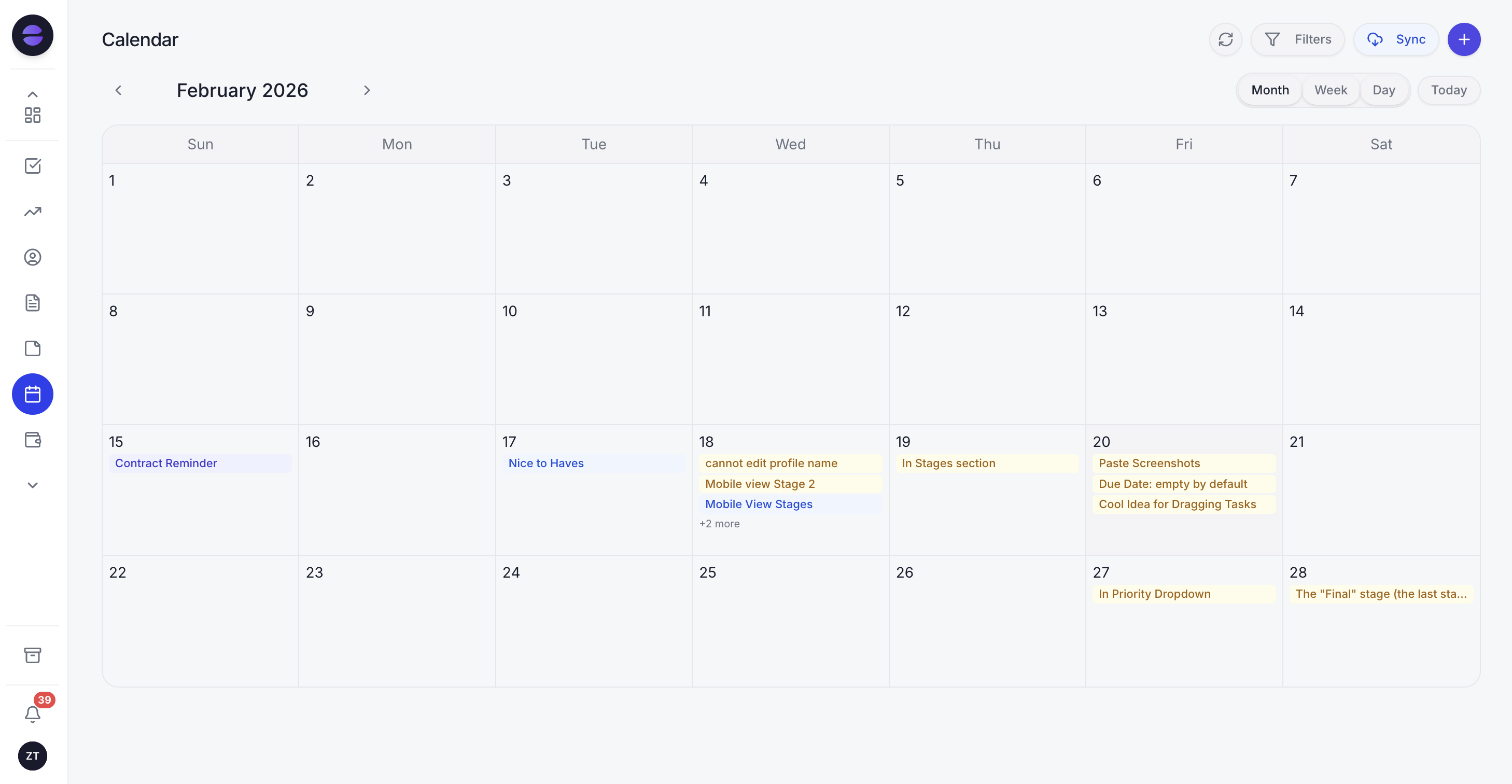 The Zoye calendar: owner viewings, follow-up calls and turnover work in one place, so a promised call back on Thursday is a scheduled commitment rather than a note on a phone
In practice that comes down to four jobs. The homeowner pipeline is a real pipeline with stages, owners, next actions and dates, so the three people you met at a viewing become records with a follow-up attached, and the one who went quiet in week three gets chased without you remembering to. Every enquiry lands as a lead with its source on it, whether it arrived through the website form, WhatsApp, Instagram or a referral from a cleaner, and the assistant replies and follows up on the ones nobody has touched. The paperwork lives on the record: management agreements, owner documents, per-property notes and photos, so nothing depends on which laptop it was saved to or who is on holiday. And the back office is one system: cleaner and staff tasks assigned and chased to completion, owner invoicing, per-property costs, and a report you can ask for in a sentence instead of building.
The way you operate it is the part that surprises people. You can talk to Zoye, including over WhatsApp, which matters when you are standing in a hallway rather than sitting at a desk. Say "new owner from the harbour viewing, three cottages, call back Thursday" and the record exists with the reminder on it. Ask which owner conversations have gone a week without contact, hear the list, then tell it to write to all of them. Describe a routine in one sentence, such as chasing any agreement still unsigned after five days, and that becomes how the business behaves, with no builder to learn and no weekend spent wiring it up.
Pricing is flat for the whole workspace rather than per seat, so adding a cleaner, an assistant or a co-host does not change the invoice, and the current plans are on the pricing page. Because so many rental enquiries arrive as chat messages in the first place, the fuller case for running an operation this way is in our roundup of the best WhatsApp CRMs.
Ready to streamline your business?
Zoye brings AI-powered CRM, task management, and automation into one workspace.
Get StartedPick Lodgify if, pick OwnerRez if
Pick Lodgify if:
- The homes are yours, or you co-host a small number, so nobody needs a statement from you
- Your growth plan is your own brand and your own bookings
- You want a site you are proud of without hiring a designer
- You want to be live this week with no implementation and no training
- Your booking volume is still low enough that a percentage fee beats the higher tier, and you will redo that sum next season
Pick OwnerRez if:
- You manage properties for other owners and their money passes through you
- Owner statements, deductions and commission splits are a monthly reality
- You want reporting detailed enough to answer an owner's question directly
- You want a flat published price you can forecast, with no cut of your revenue
- You are US-based, or comfortable working around the non-US edges, and you will invest a real setup week
Pick one of them and add the business layer if:
- What actually slips is the owner conversation nobody returned to, not the availability calendar
- The same question gets a two-minute reply on one channel and a next-day reply on another
- Signed agreements and owner paperwork are scattered between an inbox, a drive and someone's desktop
- The rota and the owner numbers are in workbooks that only open properly on your machine
- You would rather the chasing simply happened than depend on somebody remembering to do it
Frequently asked questions
It is deeper, which is not the same as better. OwnerRez gives you more control over rules, rates, templates, statements and reporting than almost anything else at its price, and it publishes flat rates you can budget from before you speak to a salesperson. Lodgify gives you a far better website with far less effort, and a guest can be booking on your own domain within days. If you manage homes for other owners and have to account for their money, OwnerRez fits your day. If your growth plan is your own brand and your own bookings, Lodgify fits your day.
It turns a fixed software cost into a share of your revenue. Lodgify publishes its tiers, and the least expensive one adds a percentage fee on reservations processed through the platform, while the higher tiers drop it in exchange for a bigger subscription. At low volume that trade is clearly in your favour. Once your own site is producing real reservation value, the percentage can exceed the gap between tiers without anyone noticing, because it never arrives as a price increase. Model it against your actual annual booking value each season, and check Lodgify's pricing page for current figures.
Yes, and that is arguably its strongest scenario. At twenty doors belonging to several different owners, the things that hurt are owner statements, deductions, commission splits, per-property reporting and rules that differ house by house, and OwnerRez handles all of that natively rather than through an add-on. The honest caveat is that you will spend real hours configuring it, and someone on the team needs to own that configuration. If nobody has time to learn it properly, its depth turns into an expensive default setup.
It works, but it is unmistakably built US-first, and that shows in the places that are hardest to work around: tax and lodging-tax handling, supported payment processors, and the integration set. Operators in Europe, the Middle East and Asia do run it successfully, usually by accepting some manual work on tax and by choosing a payment route that suits their market. If local tax automation and a local card processor are non-negotiable for you, verify both before you commit rather than after your first booking.
Lodgify, by a wide margin. It is designed so a non-technical operator can pick a template, load properties and photos, connect the main channels and go live without help. OwnerRez asks you to understand its model first, because almost everything is a setting: rules, triggers, templates, fields, statements. Reviewers who love it usually describe a difficult first week followed by years of it doing exactly what they told it to. Reviewers who abandon it usually never got past the first week.
No. Zoye carries no availability calendar, sets no nightly rate, connects to no OTA, has no channel manager and no booking engine, never opens an Airbnb or Booking.com message thread, and does no trust accounting on owner money. Whichever of the two you run keeps doing every one of those jobs. Zoye handles the half that sits outside the reservation: the homeowner pipeline and the follow-up that wins agreements, enquiries captured from every channel with their source attached, management agreements and property documents on the record, cleaner and staff tasks assigned and chased, and owner invoicing.
The bottom line
Lodgify and OwnerRez are both good products aimed at different people, and the comparison only gets confusing when you ignore that. Lodgify wins on the website, on speed to live and on how little it asks of you, and for a host or a small brand whose plan is direct bookings, that combination is worth more than any amount of configurability. OwnerRez wins on owner statements, on reporting, on precision and on a flat price you can forecast, and for anyone managing homes belonging to other people, those four things describe most of the month. Its ratings suggest the people who survive the setup week do not leave.
What neither one will do is grow your portfolio. The reservation system sits downstream of the decisions that determine whether you have twelve doors next year or twenty: the owner conversations, the enquiry answered while the guest is still choosing, the agreement signed because somebody chased it. Both are right to stay out of that, and most operators fill the gap with a spreadsheet, a shared inbox and their own memory, which works until the week it does not.
That is the half Zoye runs, next to whichever platform you pick: enquiries captured with their source and chased automatically, the homeowner pipeline moving without anyone nudging it, agreements and owner documents on the record, staff tasks and owner invoices in one place, and all of it operable from a WhatsApp message while you are standing in a property.
Add Zoye alongside your property management system and see what stops slipping.
For more context, see the vacation rental CRM for property managers, our Hostaway vs Lodgify comparison, the best vacation rental software by category, the Hostaway alternatives worth knowing, and the rest of the Zoye blog.