
Guesty vs Hostaway 2026: An Honest Head to Head for Managers
Guesty and Hostaway end up on the same shortlist constantly, and for good reason. Both are serious short-term rental platforms, both connect the major channels properly, both automate guest messaging, and both are used by real management companies to run real portfolios. If you are choosing between them you are not choosing between a good product and a bad one. You are choosing between two different philosophies about how much a platform should do natively.
That is the actual dilemma, and it gets lost in feature checklists. Guesty leans toward owning more of the stack itself: accounting, owner reporting, CRM, dynamic pricing and multi-unit complexity live inside the platform. Hostaway leans toward being an outstanding operational core with a large integration marketplace around it, so you plug in the specialist tool for pricing, cleaning ops or guest screening and keep your PMS focused. Neither approach is wrong. They just fail differently: native depth you do not use is money wasted, and a stack of five integrations is five logins, five bills and five things that can break.
This comparison walks through who each platform is really for, then goes dimension by dimension: channel management depth, automation, native accounting and CRM, integrations, onboarding, support and the pricing models. It ends with a clear "pick Guesty if" and "pick Hostaway if", plus an honest section on the half of a management business that neither of them was built to run. If you manage between 5 and 40 properties, mostly for other owners, that last part is probably the part costing you the most.
Neither Guesty nor Hostaway publishes a simple public price list. Pricing described below reflects the vendors' pricing models as reported by independent reviewers and comparison sites as of August 2026, not published rates. Treat any specific figure you find online as a third-party estimate and get a written quote for your own listing count.
Guesty vs Hostaway at a glance
| Dimension | Guesty | Hostaway |
|---|---|---|
| Core identity | Broad PMS that owns more natively | Operational core plus a large marketplace |
| Sweet spot | Larger, more complex portfolios | Scaling management companies |
| Channel management | Deep, mature, wide channel list | Deep, strong, well-regarded reliability |
| Automation | Extensive, more configuration to learn | Extensive and a common reason people pick it |
| Native accounting | Yes, including owner-facing reporting | Lighter natively, commonly integrated |
| Native CRM | Yes, though reviewers call it clunky | Limited, filled by integrations |
| Dynamic pricing | Native module available | Via integration partners |
| Integrations | Good, plus native breadth reduces need | Extensive marketplace, a core strength |
| Onboarding | Structured, can be a longer project | Structured, usually a one-time fee |
| Support | Tiered, complex issues a common complaint | Generally well reviewed, still tiered |
| Pricing model | Commission plus fixed fees, hard to forecast | Quote-only, priced on listing count |
| Public price list | No | No |
Two rows in that table deserve more weight than the rest: the pricing model and the native versus integrated split. Everything else is close enough that your team's preferences will decide it. Those two will decide your bill and your daily workflow for the next three years.
Who each one is really for
Guesty makes most sense when your portfolio has real complexity and you want the platform to absorb it. Multi-unit buildings, mixed property types, several legal entities, owners who need proper statements, a finance function that wants the numbers in the same system as the reservations. It is also the more natural fit when you are large enough that a specialist integration per function becomes an administrative burden rather than a benefit. If you are at 100-plus units with an operations team and an accountant, native depth is worth paying for.
Hostaway makes most sense when you are scaling and want an operational core that is excellent at the things you touch fifty times a day: channel sync, unified inbox, automated messaging, task generation, reporting on what actually happened. It is regularly the platform of choice for management companies in the 10 to 100 listing range precisely because it does that core extremely well and then gets out of the way, letting you bolt on PriceLabs or Wheelhouse for rates, Breezeway or Turno for cleaning, and whatever else your market demands.
The honest version of the split is this. Guesty asks you to buy into its ecosystem and rewards you with fewer moving parts. Hostaway asks you to assemble a stack and rewards you with best-in-class components. A five-property co-host will find both heavier than they need. A 200-property company with an in-house finance team will find Guesty's native modules genuinely valuable. Between those poles, at 5 to 40 properties, Hostaway plus two integrations is the more common shape, and the thing that usually still goes missing is the business layer around the bookings, which is exactly what a dedicated CRM for vacation rental operators is for.
Verdict: Guesty for complexity you want absorbed natively. Hostaway for an operational core you extend deliberately.
Channel management depth
This is table stakes for both, so the differences are about breadth and behaviour under stress rather than whether it works.
Guesty has a long-established, wide channel footprint: Airbnb, Booking.com, Vrbo, Expedia, Agoda, TripAdvisor and more, plus deeper API relationships that matter at scale. Multi-unit and room-type mapping is handled well, which is genuinely hard and a real differentiator if you manage buildings rather than individual homes. If you list on more than four channels or have complex unit hierarchies, this depth is the reason to look at Guesty.
Hostaway covers the major channels with a reputation for reliable, fast two-way sync, and operators consistently rate the calendar and rate push as dependable. The channel list is a little narrower at the long tail, but for a company living on Airbnb, Booking.com and Vrbo plus a direct site, that is not a limitation you will feel. What you will feel is the unified inbox, which is where most managers spend their day and which Hostaway does well.
The failure mode to ask about in both demos is the same: what happens on a sync error, how quickly are you told, and what is the manual override path. Every channel manager fails occasionally. The difference between a good and a bad experience is whether you find out from the platform or from a double booking.
Verdict: Guesty for channel breadth and complex unit mapping. Hostaway for dependable everyday sync on the major channels.
Automation
Both platforms automate the operational routine, and both are strong here. The difference is in learning curve and in how far the automation reaches.
Hostaway is frequently the reason an operator switches to it. Automated guest messaging across the stay lifecycle, conditional rules, auto-generated cleaning and maintenance tasks on checkout, review automation, and templates that can be scoped per property. Managers with 20 doors regularly report that the messaging automation alone gives back several hours a week, and the builder is approachable enough that a non-technical owner can maintain it.
Guesty matches the capability and in places exceeds it, with automated messaging, task management, workflows tied to reservation events, and automation that can reach into the accounting and reporting side because those modules are native. The tradeoff is configuration depth. There is more to set up, more terminology to learn, and more that can be left half-built if nobody owns it after onboarding.
Neither platform automates the parts of your business that are not attached to a reservation. Chasing a homeowner who said "not right now" in April, following up an enquiry that came in on Instagram, getting a management agreement signed: none of that has a reservation to hang an automation rule on, which is why it stays manual in both.
Verdict: Hostaway for automation that a small team can actually own and maintain. Guesty for automation that reaches across native finance and reporting too.
Want to see it in action?
Watch how Zoye automates your daily workflow - from lead management to team collaboration.
See How It WorksNative accounting, CRM and owner reporting
This is the clearest philosophical split between the two, and the one most likely to decide your choice.
Guesty runs accounting natively, including owner statements, expense handling and revenue splits, plus a native CRM and a native dynamic pricing module. For a management company paying out to multiple owners every month, having that inside the same system as the reservations removes a whole class of reconciliation work. The caveat is quality rather than existence: reviewers commonly describe the CRM as clunky, and it is designed around guests and bookings rather than around prospective homeowners. It will store a contact. It will not run an owner acquisition pipeline the way a sales tool does.
Hostaway is lighter here natively and is honest about it, filling the gaps with integrations: accounting through connectors to mainstream bookkeeping tools, pricing through PriceLabs or similar, guest screening and damage protection through partners. Each one is usually the better tool in its own category, which is the upside. The downside is real and worth pricing in before you sign: every integration is another login, another subscription, another support relationship, and another place where a field mapping can drift.
If you need trust accounting in the formal sense, verify carefully with both vendors and your accountant. Requirements vary by jurisdiction and neither platform should be assumed to satisfy yours without confirmation.
Verdict: Guesty if native accounting and owner statements in one system is worth real money to you. Hostaway if you would rather use the best specialist tool per function and accept the extra bills.
Integrations and ecosystem
Hostaway's marketplace is a genuine strength and one of the main reasons it wins deals. Dynamic pricing, cleaning and maintenance operations, guest screening, upsells, smart locks, insurance, direct booking sites, accounting: the partner list is long and the connections are generally well maintained. If your market has a niche requirement, the odds are better here.
Guesty also integrates broadly, but its native breadth means the strategic pressure to integrate is lower. That cuts both ways. Fewer integrations to manage is a real operational win. It also means that when Guesty's native module is weaker than the specialist alternative, as many reviewers feel about its CRM, you are either living with the weaker version or paying twice.
A practical test for either demo: list the five external tools you already use or intend to use, and ask for a live look at each connection, not a logo wall. Ask specifically what syncs, in which direction, how often, and what happens when the connection drops.
Verdict: Hostaway for ecosystem breadth. Guesty for fewer moving parts.
Onboarding and support
Onboarding is a project on both platforms and should be planned as one. Expect listing import, channel relinking, rate and fee configuration, message template building, task rule setup and user permissions. Hostaway typically charges a one-time onboarding or implementation fee, which independent reviewers report consistently as of August 2026, and assigns an onboarding contact. Guesty's onboarding is structured too, and operators with complex portfolios often describe it as a longer engagement because there are more native modules to configure.
Support is where the reviews diverge most. Hostaway is generally well reviewed on responsiveness, with the usual caveat that support quality varies by tier and time zone. Guesty draws a recurring complaint pattern on complex issues: first-line responses that do not resolve the problem, escalation that takes longer than an operator with guests arriving can comfortably wait, and support levels that differ by plan. Both vendors have plenty of satisfied customers, so read recent reviews rather than old ones, and ask directly in the sales call what the escalation path and response target are for a live sync failure at the weekend.
One question that reliably separates good vendors from good demos: who do I contact at 9pm on a Saturday when a guest cannot get into a property and the calendar shows the wrong booking. Ask both.
Verdict: Hostaway currently has the friendlier support reputation. Guesty has more native depth to support, which is part of why complex tickets are harder.
See what Zoye can do for you
From CRM and deal tracking to AI-powered task management - explore everything Zoye offers in one workspace.
Explore FeaturesPricing models, and why they are hard to compare
Neither vendor publishes a simple public price list, so the useful comparison is the shape of the bill rather than a number.
Guesty uses a hybrid model: a commission on booking revenue plus fixed fees, with the mix varying by plan and portfolio. Operators frequently describe this as hard to predict, and the reason is structural rather than unfair: your cost rises with your revenue, so a strong season increases the bill at the same time as the payout, and forecasting next year means forecasting your own bookings. Some managers like that alignment. Others find it makes budgeting and per-door margin maths genuinely difficult.
Hostaway is quote-only and demo-gated, priced on listing count, usually with a one-time onboarding fee. Once you have the quote it is easier to forecast, because a per-listing subscription scales with doors rather than with revenue, and doors are something you already plan. The friction is upstream: you cannot self-serve a budget, and you have to sit through a sales process to find out whether the platform is even in your range.
As of August 2026, any specific dollar figure published online for either platform is a third-party estimate rather than a vendor-published rate, so treat every comparison table you find, including the ones claiming precision, with that in mind.
Three things to do before you sign either contract. Get the quote in writing with the onboarding fee, the contract term and the renewal terms stated. Model your total stack cost, not the PMS line, because the integrations you will need are part of the real price. And ask what happens to the price when you add ten listings, because that is the moment a commission model and a per-listing model diverge sharply.
Verdict: Hostaway is easier to forecast once quoted. Guesty aligns cost with revenue, which some operators prefer and many find hard to budget. Neither can be compared honestly without two written quotes.
What neither Guesty nor Hostaway does
Here is the part most comparisons skip. Both platforms are built to run bookings. Neither is built to run the business around the bookings, and at 5 to 40 properties that business is where growth actually comes from.
Think about what is not attached to a reservation. The three homeowners you met at a viewing and never followed up, one of whom signed with the manager down the road. The enquiry that arrived on Instagram at 11pm and got answered at noon. The management agreements scattered across email, a shared drive and someone's laptop. The cleaning rota and owner statements living in five spreadsheets only you can open. None of that has a booking ID, so no PMS rule fires for it.
That is the gap Zoye is built for, and it is worth being precise about scope. Zoye is an AI Business Operator that sits alongside your PMS rather than replacing it.
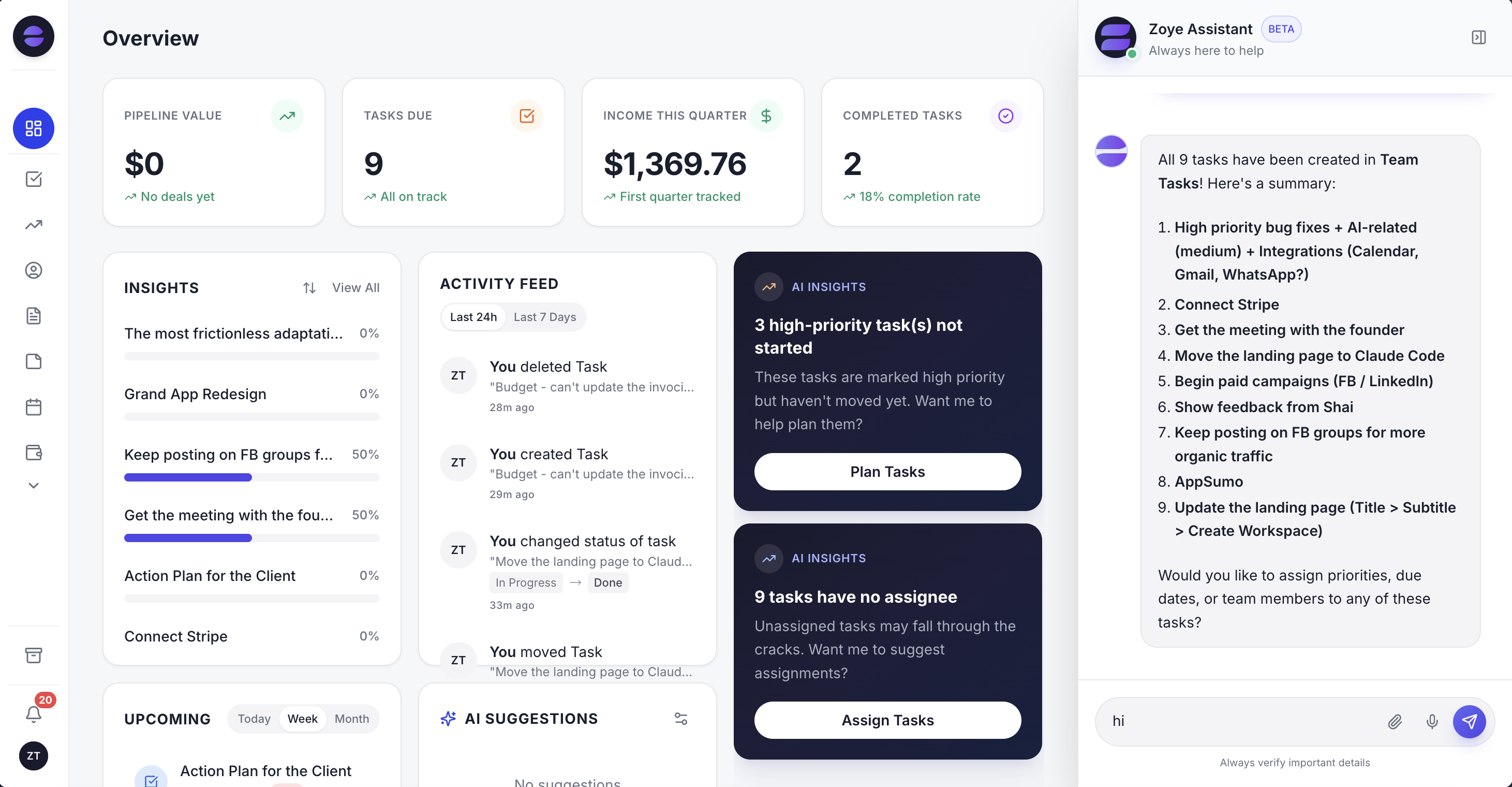 Zoye keeps the owner pipeline, the enquiry follow-up and the back office in one place, while the PMS keeps the bookings.
What Zoye does: captures every homeowner and guest enquiry as a lead with its source attached, whether it arrives from your site, your inbox, WhatsApp or social. Runs the homeowner pipeline with real stages and does the chasing itself, drafting and sending the follow-ups when a lead goes quiet. Holds management agreements, owner documents and property notes against the owner record instead of a shared drive. Coordinates cleaner and staff tasks on the same board as everything else. Handles owner invoicing and builds the reports from data it captured itself. You describe the automation you want in one plain sentence, including from WhatsApp or Slack, and it builds and runs it.
What Zoye does not do, plainly: there is no channel manager, no Airbnb, Booking.com or Vrbo sync, no availability calendar, no nightly rate engine, no booking engine, no OTA guest inbox and no owner statements with trust accounting. Keep Guesty or Hostaway for all of that. Zoye is the other half.
Pricing: plans start at $5 per month for 1 member, then $59 per month for 10 members, $99 per month for 20 members, and $199 per month for 100 members, with a Customize tier for larger portfolios. Pricing is flat per plan rather than per seat. Check the pricing page for current figures.
Best for: vacation rental and short-term rental management companies from roughly 5 to 40 properties, co-hosts, and villa or cabin brands that already run a PMS and need the owner acquisition and back-office half to stop living in spreadsheets.
Ready to streamline your business?
Zoye brings AI-powered CRM, task management, and automation into one workspace.
Get StartedPick Guesty if, pick Hostaway if
Pick Guesty if:
- Your portfolio has real structural complexity: multi-unit buildings, room types, several entities
- You want accounting and owner reporting native rather than integrated
- You would rather manage one vendor relationship than five
- You need a wide channel list beyond the big three plus direct
- You have someone who will own the configuration after onboarding ends
- A cost that moves with your booking revenue is acceptable, or even preferable, for your model
Pick Hostaway if:
- You are a scaling management company and the daily operational core matters most
- Automated guest messaging and auto-generated cleaning tasks are your biggest time win
- You want best-in-class specialist tools for pricing, cleaning ops and screening
- Predictable per-listing cost is easier for you to budget than commission
- Support responsiveness is high on your list
- You are willing to run several integrations, each with its own login and bill
Whichever you pick, plan for the business layer separately:
- Your homeowner pipeline and its follow-up cadence
- Enquiry capture and response time outside the OTA inbox
- Management agreements and owner documents in one findable place
- Staff and cleaner coordination beyond checkout tasks
- Owner invoicing and the reporting that grows the company
Want to see it in action?
Watch how Zoye automates your daily workflow - from lead management to team collaboration.
See How It WorksFrequently asked questions
Neither is better in the abstract, and both are genuinely strong platforms. Guesty tends to fit larger and more complex portfolios that want native modules for accounting, owner reporting, CRM and dynamic pricing inside one platform, and it has the enterprise depth to match. Hostaway tends to fit scaling management companies from roughly 5 to 100 listings that want excellent multi-channel control, deep automation and a big integration marketplace, and are happy to assemble the rest of the stack from best-in-class partners. The right answer depends on whether you would rather buy depth natively or compose it from integrations.
Nobody can answer that honestly from public information, because neither vendor publishes a simple price list. Guesty uses a hybrid of commission on booking revenue plus fixed fees, which operators frequently describe as hard to forecast because the bill moves with your revenue. Hostaway is quote-only and demo-gated, priced on listing count, and usually with a one-time onboarding fee. As of August 2026, any figure you see quoted online for either platform is a third-party estimate rather than a published rate, so the only reliable comparison is two written quotes for your own listing count and revenue.
No. As of August 2026 Hostaway does not publish public pricing. You book a demo and receive a quote based on your listing count, and independent reviewers consistently report a one-time onboarding or implementation fee on top of the recurring subscription. That is not unusual in this category, but it does mean you cannot self-serve a budget, and it makes side-by-side comparison with a commission-based competitor genuinely difficult until both quotes are in front of you.
Guesty does include CRM and guest-facing relationship features natively, which is a real advantage over platforms that have none. That said, reviewers commonly describe the CRM as clunky, and it is built around guests and bookings rather than around homeowners. If your growth depends on a homeowner pipeline with stages, qualification, follow-up cadence and management agreements, most operators end up running that somewhere else, because a guest-centric CRM does not model an owner who has not signed with you yet.
Usually yes. Both platforms run the bookings side extremely well: channels, calendars, rates, guest messaging and reservations. Neither is built to run the business around the bookings, which is homeowner acquisition, enquiry follow-up, management agreements and documents, cleaner and staff coordination beyond checkout tasks, and owner invoicing. Most operators fill those gaps with spreadsheets, and that is where the growth work quietly gets lost during a busy changeover week.
Yes, and plenty of operators do, but treat it as a project rather than a swap. Listings, rate rules, automation templates, saved messages, custom fields and historical reservations all have to be rebuilt or migrated, channel connections need to be relinked carefully to avoid double bookings, and both vendors will want an onboarding phase. Plan it between peak seasons, keep the old system readable for at least one full reporting cycle, and export your historical data before you cancel anything.
The bottom line
Guesty versus Hostaway is not a quality contest. It is a decision about where depth should live. Guesty puts it inside the platform, which suits complex portfolios and finance teams and comes with a commission-shaped bill that many operators find hard to forecast and a support experience that draws real criticism on hard tickets. Hostaway puts it in the ecosystem, which suits scaling management companies who want a reliable core and the best specialist tool per job, and comes with a quote-only price and a stack of extra subscriptions to manage.
Run the same test on both: two written quotes, five integration checks done live, one escalation question about a Saturday night failure. Then decide which philosophy you want to live inside for the next three years.
And whichever way that goes, remember that both of them stop where the reservation stops. The homeowner who never got followed up, the 11pm enquiry, the agreement nobody can find: those are not PMS problems, and they will not fix themselves when you migrate. Put that half of the business somewhere it cannot be forgotten, alongside the PMS you just chose.
For more context, see the full map of the best vacation rental software, the Hostaway vs Lodgify comparison, the CRM for vacation rental operators, and the guide to business automation for small business.