Quick answer: Drift is being sunset by its owner, Clari + Salesloft, which now refers Drift customers to 1mind. If you sell to enterprise accounts through Salesforce, Qualified and 1mind are the closest replacements. If you are a small team whose buyers would rather message than wait on a website chat, Zoye ranks first, and Intercom, HubSpot, LiveChat, Tidio and Crisp cover the website chat widget at very different prices.
Key takeaways (October 2026)
- Salesloft bought Drift on 13 February 2024, merged with Clari in December 2025, and announced the gradual sunset of Drift on 5 March 2026, naming 1mind as the successor.
- No public end-of-life date was published. Your contract and account notices decide how long you keep access, so export data now.
- Published prices in this comparison start at $45 a month (Crisp Mini, 4 agents) and $19 per seat (LiveChat Essential, yearly), while Qualified and 1mind publish no prices.
- AI answers are increasingly billed per result: Intercom charges $0.99 per Fin outcome, and LiveChat sells extra AI resolutions at $49.50 per 50.
- Zoye plans are sized by team members, not billed per chat: $59 a month for 20 members ($47 billed yearly) on Growth, the plan that includes the WhatsApp and Meta automations, with replies on WhatsApp, Instagram and Facebook landing on the lead's record.
What happened to Drift, and where it stands in October 2026
Drift was a conversational marketing platform for B2B websites: chat, chatbots, routing to sales reps and meeting booking from the chat window. Salesloft acquired it in February 2024, Salesloft merged with Clari in December 2025, and on 5 March 2026 the combined company announced a gradual sunset of Drift with 1mind as the named successor.
Here is the timeline from the companies' own announcements:
- 13 February 2024. Salesloft announced the acquisition of Drift, describing it as a buyer experience and conversational AI company. Existing customers were told at the time that their product and price would not change.
- August 2025. Google's Threat Intelligence Group reported that attackers used OAuth tokens tied to the Salesloft Drift integration to pull data from customers' Salesforce instances between 8 and 18 August 2025. Salesloft revoked the connections and notified affected customers.
- 3 December 2025. Clari and Salesloft announced that their merger had closed, operating as Clari + Salesloft.
- 5 March 2026. Clari + Salesloft announced "the gradual sunset of its Drift conversational marketing solution" and said it would refer existing Drift clients to 1mind.
As of October 2026, drift.com redirects to a Salesloft page whose chat section is headed "We've transitioned from Drift to 1mind". Salesloft's pricing page lists no Drift package and no prices at all; every path ends at "Talk to sales". The March announcement gives no end-of-sale or end-of-life date, so the date that matters is the one in your own order form or account notice.
Drift deserves credit for what it built. It popularised the idea that a website visitor should be able to talk to a person, or a bot that books a meeting, instead of filling a form and waiting days for a reply. That idea is not going away. The question is which tool now carries it for your business, and whether the conversation still belongs on your website at all.
Why teams are leaving Drift (beyond the sunset)
The sunset is the obvious reason to move, but most teams were already questioning the fit. The documented issues are a product with no roadmap left, pricing that was never public, an integration incident that touched connected CRMs, and a design aimed at high-traffic enterprise websites rather than small teams whose buyers message them on their phones.
No roadmap. A product its owner has announced it will sunset gets maintenance, not new features. Anything you build into it now is work you will redo during the migration.
Pricing behind a sales call. As of October 2026, Salesloft publishes no prices for any of its products. That is normal for enterprise software, and it is also why many small teams never got a straight answer about what the next renewal would cost.
Connected-app risk. The August 2025 incident did not stem from a flaw in Salesforce itself; it came through the tokens a connected app held. It is a fair reminder to review which apps can read your CRM, and to revoke Drift's access as part of any move.
Built for website traffic at scale. Drift's strength was routing high-value visitors on a busy B2B site to the right rep. A 6-person team with a modest site often gets more leads from Instagram, Facebook lead ads and WhatsApp than from its chat widget, and those conversations never touched Drift.
Who should stay for now: an enterprise team on a contract with a working setup can keep running Drift until renewal, plan the move calmly, and evaluate 1mind alongside the alternatives below.
What to look for in a Drift replacement
A good Drift replacement answers a new lead within minutes, qualifies them with a few questions, books a meeting or hands over to a person, and records all of it on the lead in your CRM. Check these eight points before you sign anything, because the demo will show the first one and skip the rest.
- Where your buyers actually start the conversation. Website chat, WhatsApp, Instagram DMs, Facebook comments, lead forms or email. Pick the tool for the channels that bring you customers, not the ones that look good in a demo.
- Response speed outside office hours. An AI that can answer and qualify at night, with a clear handover to a person in the morning.
- Qualification that writes into your records. Answers to "budget" or "timeline" should land in fields on the lead, not stay in a transcript.
- Booking from the conversation. Offering real times from your calendar, with reminders.
- One place for the follow-up. The lead, the deal, the next task and the notes from the sales call in the same system.
- How the price grows. Per seat, per AI outcome, per conversation, per contact or flat per workspace. Model next year, not this month.
- Data you can take with you. Exports for contacts and transcripts, so the next move is easier than this one.
- Honest AI. The tool should say when a reply is automated, never confirm an action that failed, and hand over to a person when it should.
For the difference between a scripted bot and an AI agent that acts on your data, our AI agent vs chatbot explainer goes deeper.
The 8 best Drift alternatives in 2026
These eight cover the realistic routes away from Drift: an AI operator for small teams that sell through messaging, Drift's official successor, an enterprise AI SDR, two support-first suites with strong chat, and three affordable website chat tools. Prices come from each vendor's own page as of October 2026; where a vendor hides pricing, we say so.
1. Zoye - for small teams whose buyers would rather message than fill a form
Zoye is an AI Business Operator: one workspace where the tools already link to each other (CRM and contacts, deals, tasks, calendar, documents, reports, workflow automations, WhatsApp automations, Facebook and Instagram, email tracking, AI Notetaker and more), plus an AI that operates them. It does not try to be a better website chat widget. It replaces what Drift was for, which is turning a raised hand into a booked conversation fast, on the channels small teams actually hear from.
What that looks like day to day:
- A new lead gets a WhatsApp message the moment it lands, whether it came from an ad, a website form, your site, the API or was added by hand. Per-source switches decide which leads get it, and nobody receives it twice.
- A qualification bot asks your questions and writes the answers straight into fields on the lead, so "budget" and "timeline" are filterable, not buried in a chat log.
- A WhatsApp button on your site turns anyone who taps it into a tracked lead with a welcome message and no form to fill.
- Instagram and Facebook are covered too. DMs and story replies are answered right away with buttons, a file or a reply in your brand's voice; a comment on a post can trigger a public reply plus a private message within seconds; lead-ad form submissions become contacts with the campaign and ad name saved. Anything the AI should not answer goes to a person with the whole chat on the lead's card.
- Booking happens in the chat. Times are offered from one Booking list and reminders go out automatically. Payment links can be sent in the conversation (Stripe, or Grow in Israel).
- After the sales call, the AI Notetaker joins Zoom, Google Meet or Teams, writes the summary, decisions and action items, and puts updates onto the right contact and deal.
Conversations live in Chats, one inbox for Instagram and Facebook messages and comments plus the WhatsApp conversations Zoye holds with your leads, with assignment, team notes and quick replies. To change any rule, you describe what should happen in the app, on WhatsApp or in Slack; Zoye builds the rule, shows it to you, and nothing runs until you approve it. Every run is logged and can be reversed. If Meta rejects a send, you hear the reason instead of a false "sent". More on the agent side is on the AI agent on WhatsApp page.
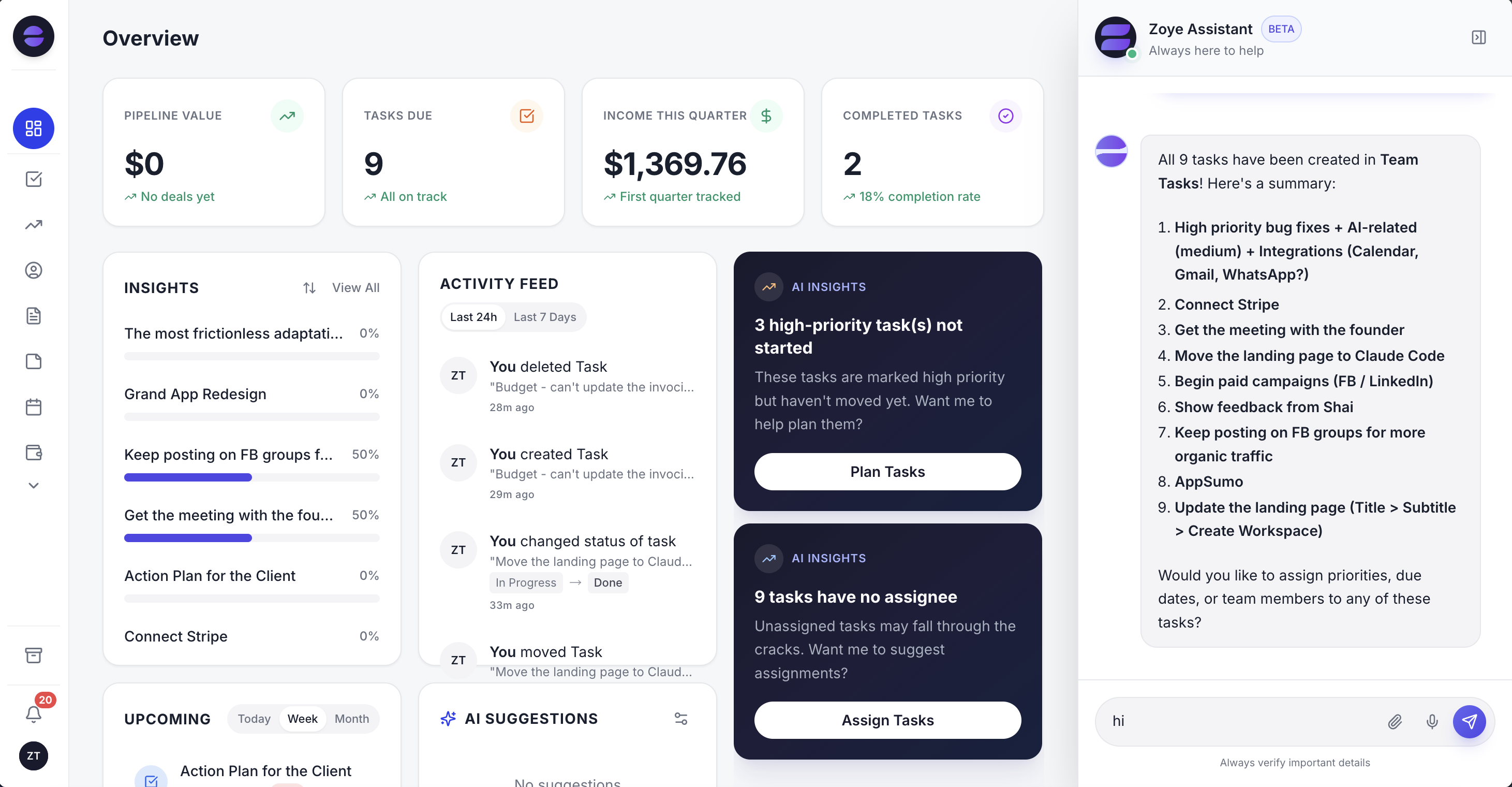
The overview shows new leads, open deals and today's follow-ups together, so a conversation that started in a DM is visible as pipeline.
Honest limits. Zoye does not put a live chat widget on your website and does not identify anonymous website visitors or companies, so it is not an account-based marketing tool. It is not a helpdesk ticketing suite and it does not run ads. Connecting your own business WhatsApp number is coming soon (awaiting WhatsApp approval); today Zoye holds the WhatsApp conversations with your leads through the official WhatsApp Business Platform. If your pipeline depends on chatting with anonymous visitors on a high-traffic website, pair Zoye with a widget below or choose one of them.
Pricing (as of October 2026): Zoye plans are sized by the people in your workspace, each with a monthly AI allowance, rather than billed per chat or per AI outcome. The entry plan, Almost Free, runs $5 monthly ($4 when paid annually) and gives one person the core tools, the Google integrations and 15 AI prompts each month; automations are not part of it. Starter, at $29 monthly or $23 annually, covers a team of up to 10. Growth is $59 ($47 yearly) for 20 members, Scale is $119 ($95 yearly) for 100, and Customize is quoted. What each plan includes is on the pricing page.
Best for: service businesses and small B2B teams whose leads arrive through WhatsApp, Instagram, Facebook and forms, and who want every reply to end as a booked meeting with an owner.
2. 1mind - Drift's official successor
1mind builds AI sales agents it calls "Superhumans": visible AI team members that answer questions on your website, can give a product demo, and also work inside the product, on live sales calls and in customer success. Salesloft named it the successor for Drift clients in March 2026, and its agents feed buyer information into Salesloft's forecasting.
The catch is fit. 1mind is aimed at B2B revenue teams with a sales motion big enough to justify an AI that runs demos, and the deepest value comes if you already live in Salesloft. A small team that mostly needs fast replies and booked calls may be buying more than it uses.
Pricing (as of October 2026): not published. The website has no pricing page and routes buyers to "Get a Demo Now".
Best for: existing Drift and Salesloft customers with an enterprise sales motion who want the vendor-supported path.
3. Qualified - the closest like-for-like for B2B on Salesforce
Qualified is the product most often compared with Drift: website conversations, meeting booking and an AI SDR agent called Piper that engages inbound buyers on your site and by email. Its footer now reads Salesforce, Inc., and every plan lists integration with Salesforce CRM and more than 20 go-to-market systems.
Plans are sized by website traffic. As of October 2026, Premier includes 250,000 monthly web sessions and 2,500 monthly active email contacts, Enterprise 2 million sessions and 10,000 contacts (adding agent handoff, MCP and API access and a Salesforce sandbox), and Ultimate 5 million sessions and 24,000 contacts with multiple agent profiles.
Pricing (as of October 2026): not published. Each plan ends in "Contact us".
Best for: mid-market and enterprise B2B teams running Salesforce with heavy website traffic and a dedicated pipeline team.
4. Intercom - support-first chat with a strong AI agent
Intercom is a customer service platform with a messenger, a shared inbox and Fin, its AI agent. Many companies used Intercom for support and Drift for sales chat; consolidating onto one messenger is a common move. The trade-off is that Intercom is built for support teams, so lead qualification and booking need configuration rather than coming ready.
Pricing (as of October 2026): Essential is listed at $29 per seat a month, shown at $19 for new customers with a 35% saving; Advanced is $85 and Expert $132 per seat a month, with 20 and 50 free Lite seats respectively. Fin costs $0.99 per outcome, with a monthly minimum (the page gives 50 outcomes as an example). Copilot is $29 per agent a month, and there is a 14-day trial. An outcome counts when a customer confirms the issue is solved, does not ask for more help after Fin replies, or Fin completes a workflow, including handoffs.
Best for: product companies that want one messenger for support and sales, with the volume to make per-outcome AI pricing worthwhile. Our best Intercom alternatives covers who outgrows it.
5. HubSpot - free chat inside a CRM many teams already have
HubSpot offers a live chat widget and a no-code chatbot builder that start free and log every chat to HubSpot's free CRM, with a Slack integration for notifications. For a team that already runs on HubSpot, it is the lowest-friction way to replace Drift's chat. AI answers come from Breeze Customer Agent, which runs on HubSpot credits.
Pricing (as of October 2026): the chat and bot builder start free. Service Hub Starter is shown at $7 or $20 per seat a month depending on billing, with 500 HubSpot credits. Professional is $90 per seat a month with an annual commitment or $100 monthly, plus a required $1,500 onboarding fee and 3,000 credits. Enterprise is $150 per seat with a $3,500 onboarding fee and 5,000 credits. Buying a Professional or Enterprise seat unlocks a 14-day Customer Agent trial; the ongoing credit cost per conversation is not listed on that page.
Best for: teams already on HubSpot who want chat and its records in the same CRM.
6. LiveChat - a dedicated chat tool with clear seat pricing
LiveChat is one of the longest-running website chat products, now with AI agents included in every plan. It is straightforward to install and run, but it is a chat tool, so the pipeline still lives in a separate CRM you connect.
Pricing (as of October 2026): on yearly billing, Essential works out to $19 a user each month ($25 if you pay month to month) and comes with one AI agent handling up to 10 resolutions a month. Growth is $79 a user yearly or $99 monthly, adding 10 AI agents and 200 resolutions. Extra AI resolutions cost $49.50 per pack of 50, roughly $0.99 each. Enterprise is quoted, and there is a 14-day trial. Every person who answers chats needs a seat.
Best for: teams that want a reliable website chat with AI help and are happy to connect it to a CRM.
7. Tidio - affordable chat and AI for smaller websites
Tidio combines live chat, a ticketing view, a visual Flows builder and Lyro, its AI agent, with a free plan to start. It is popular with online stores and small service sites. The pricing has three moving parts, so read it closely.
Pricing (as of October 2026): Free covers 50 billable conversations a month and 10 seats. Starter is listed at $24.17 a month for 100 billable conversations, Growth from $49.17 for 250 or more, Plus from $300 a month plus usage, and Premium on request. Lyro starts at $32.50 a month from 50 AI conversations, and Flows from $24.17 a month for 2,000 visitors reached. A billable conversation is one where a person replies; Lyro and Flows replies are counted separately. These match the figures in our earlier best ManyChat alternatives review.
Best for: small websites and stores that want chat plus a bit of AI on a modest budget.
8. Crisp - flat workspace pricing with an omnichannel inbox
Crisp prices per workspace rather than per seat, which makes it one of the easiest chat tools to budget. Its higher plans add an omnichannel inbox that connects WhatsApp Business, Instagram DMs, SMS and other channels to the same view as website chat.
Pricing (as of October 2026): the free plan gives a workspace 2 agents and 100 customer profiles, with no AI credits. Paid workspaces start with Mini at $45 monthly (4 agents, $5 in AI credits, roughly 90 automated chats), then Essentials at $95 (10 agents, $25 in credits, plus the omnichannel inbox) and Plus at $295 (20 or more agents, $75 in credits). Each additional agent adds $10 a month, and prices exclude VAT.
Best for: small teams that want website chat and messaging channels in one inbox at a predictable price.
Want to see it in action?
See Zoye catch a new lead, answer on WhatsApp and set up the follow-up, all from one message.
See How It WorksSide-by-side comparison
The table compares the eight options on what decides a Drift replacement: where the conversation happens, how AI is billed, what the bill grows with, and where a qualified lead ends up. Prices are from each vendor's page as of October 2026; "not published" means the vendor quotes after a sales call.
| Tool | Main channel | Starting price (Oct 2026) | AI billed by | Bill grows with | Where the lead ends up |
|---|---|---|---|---|---|
| Zoye | WhatsApp, Instagram, Facebook, forms | $59/mo Growth, 20 members | Monthly allowance in each plan | Plan tier, sized by team members | Contact, deal, task and booking |
| 1mind | Website, product, sales calls | Not published | Not published | Contract | Salesloft and your CRM |
| Qualified | Website and email | Not published | Not published | Web sessions, email contacts | Salesforce |
| Intercom | Website messenger | $29/seat Essential (new-customer price shown) | $0.99 per Fin outcome | Seats, outcomes | Intercom, synced to CRM |
| HubSpot | Website chat | Free; Service Hub Pro $90/seat + $1,500 | HubSpot credits | Seats, credits | HubSpot CRM |
| LiveChat | Website chat | $19/user/mo yearly | Resolutions included, then $49.50 per 50 | Seats, resolutions | LiveChat, synced to CRM |
| Tidio | Website chat | Free; Starter $24.17/mo | Lyro conversations | Conversations, Lyro, Flows | Tidio, synced to CRM |
| Crisp | Website chat plus messaging | Free; Mini $45/mo per workspace | AI credits | Plan tier, extra agents | Crisp contact profile |
Two things the table cannot show. First, automations are part of Zoye's Growth plan and above, so for lead follow-up the realistic Zoye starting point is Growth at $59 a month ($47 billed yearly) for up to 20 members. Second, "synced to CRM" means an integration someone sets up and maintains; it works, but it is one more connection to watch, which is a lesson the Drift token incident made concrete.
What it really costs: an illustrative 5-person team
The cheapest sticker price rarely survives a year of real use. Per-seat pricing grows with every hire, per-outcome AI pricing grows with every busy month, and enterprise tools add onboarding fees. The worked example below uses October 2026 list prices and an assumed volume, so treat it as a method, not a quote.
Assume a 5-person team that wants AI to handle 300 conversations a month before a person steps in.
- Intercom Essential: 5 seats at $29 is $145 a month (or $95 at the $19 new-customer price shown), plus about 300 Fin outcomes at $0.99, or $297. Roughly $392 to $442 a month.
- LiveChat: Growth at $79 per user yearly is $395 a month and includes 200 AI resolutions; 2 extra packs of 50 add $99, for $494. Essential at $19 per user is $95 with 10 resolutions, and 6 packs would add $297.
- HubSpot Service Hub Professional: 5 seats at $90 is $450 a month plus $1,500 once, with Customer Agent running on included and purchased credits.
- Crisp Essentials: $95 a month for up to 10 agents with about 450 automated conversations of AI credit.
- Zoye Growth: $59 a month ($47 billed yearly) for up to 20 members, the plan that includes the WhatsApp and Meta automations. Zoye has no website widget, so this only replaces Drift if most of your leads arrive by forms, ads, WhatsApp and DMs.
- Qualified and 1mind: request a written quote that names the traffic, contacts and agents included.
Now change one assumption: hire two more people. Seat-priced tools rise by 40%, and per-outcome AI does not change. Double the volume instead, and outcome-priced AI doubles while flat plans stay put. Model both before you sign.
See what Zoye can do for you
CRM, deals, tasks and your Instagram, Facebook and WhatsApp automations in one workspace. Just ask Zoye and it sets any of it up for you.
Explore FeaturesWhy many conversations moved off the website
For a lot of small businesses, the first message no longer arrives in a website chat window. It arrives as a WhatsApp message, an Instagram DM, a comment on a post or a lead-ad form, and the rules for answering those channels are set by Meta. Knowing the rules tells you what any tool can and cannot automate.
According to Meta's developer documentation, as of October 2026:
- WhatsApp's customer service window lasts 24 hours from the customer's last message. Inside it you can reply freely; outside it, only an approved message format can reopen the chat.
- Since 1 October 2026, each business phone number gets 1,000 free service messages a month, with no rollover. Meta bills other WhatsApp messages per delivery, by category and country, so check Meta's rate card rather than any figure copied from an article.
- Click-to-WhatsApp ads open a longer free window. When someone taps such an ad in the WhatsApp mobile app (Android or iOS) and you reply in time, messages in that chat are free for up to 7 days. Clicks on desktop or web do not count. Our click-to-WhatsApp ads guide covers setup.
- Business-specific AI is allowed on WhatsApp, such as an assistant that answers your customers, qualifies leads or books appointments. General-purpose AI chatbots, where the AI itself is the product, have been barred from the Business Platform since 15 January 2026.
- On Instagram and Messenger, you can reply within 24 hours of a person's message, and a private reply to a comment is one message per comment, sent within 7 days of it.
The practical lesson: speed matters more than the widget. A lead who comments on a post at 10pm and gets a useful private reply within seconds is in a better place than one who fills a form and waits until morning. Our guide on how to stop losing leads goes into the follow-up habits, and the WhatsApp lead qualification bot guide shows what good qualifying questions look like.
How to switch off Drift without losing pipeline
A clean move off Drift takes about two weeks of overlap: export what you have, rebuild only the playbooks that still produce meetings, run the new tool in parallel, then remove Drift and revoke its access. Most of the risk sits in the data you forget to export and the integrations you forget to disconnect.
- Find your dates. Read your order form and the latest account notice for renewal, end-of-access and data-retention dates. The sunset announcement gave none.
- Export everything you are allowed to. Contacts, conversation transcripts, meeting history and the copy of your best playbooks. Ask your account team which exports your contract includes.
- Audit what Drift was doing. List each playbook, routing rule and meeting link. Keep the ones that booked meetings in the last quarter; drop the rest.
- Bring records into the new tool. Into Zoye you can import from Trello, Monday.com or a spreadsheet, and the assistant can pull records out of a CSV, PDF or screenshot you send it. Jira, Notion and ClickUp imports are coming soon.
- Rebuild the follow-up, not just the chat. In Zoye, describe the rule ("when a new lead arrives from the website form, send the welcome, ask the three qualifying questions and offer times from the booking list"); Zoye shows the rule and waits for your approval.
- Run both for two weeks. Compare response times and meetings booked, not chat counts.
- Remove the Drift script and revoke access. Take the tag off your site, disconnect Drift from your CRM, email and calendar, and rotate any keys it held.
Ready to hand off the busywork?
Zoye brings AI-powered CRM, task management, and automation into one workspace.
Get StartedWhich Drift alternative should you choose?
Choose by where your buyers start the conversation and how your bill should grow. Enterprise teams on Salesforce should look at Qualified and 1mind. Support-led product companies fit Intercom, HubSpot users should start with HubSpot's chat, and LiveChat, Tidio and Crisp cover affordable website chat. Small teams that sell through WhatsApp, Instagram and forms should start with Zoye.
A few typical shapes:
- A 4-person service business whose leads come from Instagram, lead ads and referrals: the website chat was never the main door. Zoye answers DMs and comments, qualifies, and books the call, on Growth for $59 a month ($47 billed yearly).
- A 40-person SaaS company on Salesforce with steady inbound traffic: shortlist Qualified and 1mind, and ask both for a written quote and a migration plan.
- A product company already on Intercom for support: move sales chat into the same messenger and model Fin outcomes at your real volume.
- A HubSpot shop: turn on HubSpot's free chat first, then decide whether Service Hub's paid AI is worth the seats and credits.
- A small online store: Tidio or Crisp, with the AI allowance you will actually use priced in from day one.
Whatever you shortlist, judge it on one number after two weeks: how many conversations became a booked meeting with an owner and a next step. That is what Drift was for, and it is the fairest test of whatever replaces it. If your buyers already message you more than they chat on your site, book a Zoye demo and bring a week of real leads to walk through.