
Best ManyChat Alternatives 2026: 7 Options When the Chat Tool Stops Being Enough
Almost nobody leaves ManyChat because it broke.
They leave because the business changed shape around it. The account that ran one comment-to-DM campaign a quarter now runs four a month. The solo founder who read every DM personally now has two people who need to see the same conversation. The invoice that used to be a rounding error started tracking upward every time a post did well. And somewhere in there, a question surfaced that the tool cannot answer: of the eleven hundred people who commented on our posts this year, which ones actually bought anything?
That is the honest reason this article exists, and it is worth saying up front that ManyChat is not the villain of it. It is a mature product with a well-built flow editor, deep Meta channel coverage, and a very large community of people who know how to get results out of it. Plenty of businesses on this page should stay exactly where they are. This guide is for the ones who have hit a specific wall, and it tries to name the wall precisely rather than manufacturing outrage about a tool that works.
Below are seven alternatives grouped by the shape of the problem they solve, with pricing checked against each vendor's own page in August 2026. Where a vendor does not publish a figure, that is stated rather than guessed. This article sits alongside our Facebook and Instagram automations page, which covers how Zoye handles the same Meta channels.
What ManyChat is genuinely good at
Skip this section if you are already convinced. Read it if you are about to spend a weekend migrating.
The flow builder is the best-known in the category for a reason: the visual model is easy to hold in your head, branching is straightforward, and a non-technical marketer can build a working comment-to-DM sequence in an afternoon without asking anyone for help. The Instagram and Messenger integrations are maintained closely against Meta's platform changes, which matters more than it sounds, because Meta's messaging rules move and a tool that lags on them simply stops delivering messages one Tuesday morning.
There is also an enormous body of shared knowledge around it. Templates, agency playbooks, community threads, tutorials for every use case. If your problem is "I want to run the mechanic that every Instagram creator runs, and I want to copy someone who already made it work", ManyChat is the path of least resistance and no alternative on this list beats it on that axis.
The three walls people actually hit
1. The price is tiered on your best month
ManyChat prices against active contacts, not seats. Its help centre documents a free tier plus plans named Essential, Pro, Business and Advanced, each carrying a monthly active contact allowance and a per-contact charge once you exceed it. The current dollar figure per tier is published on ManyChat's own pricing page, and the lineup changed during 2026, so check it there rather than trusting a number in an article, this one included.
The mechanic matters more than the number. Under a contact-based model, cost is driven by how many people interacted with your automation this month. A reel that outperforms is a bill increase. A campaign that reaches an unqualified audience costs the same per contact as one that reaches buyers. You are paying for volume of conversation, in a business where the thing you actually want is a small number of the right conversations. That is not dishonest pricing, it is a coherent model, but it is aimed at growth by volume and not everyone grows that way.
2. The flow lives outside the system you run the business from
Your automation knows that someone commented PRICE and received a DM. Your CRM, spreadsheet or invoicing tool knows nothing about it unless you built and maintained a connection between the two. Most people do build one, usually through an integration platform, and it works right up until a field is renamed, a token expires, or someone edits the flow and forgets the downstream step. Integrations do not fail loudly. They fail on a Thursday and you notice in three weeks.
3. A chat platform stores conversations, not customers
This is the deepest one and the hardest to see until it bites. A subscriber in a chat tool is a messaging identity with tags attached. A customer in a business system is a person with a history: what they asked, what they were quoted, what they bought, who owns the relationship, what is due next. Those are different objects. Tags can approximate a customer record for a while, and then you try to answer a question like "show me everyone who engaged twice and never got a follow-up call" and discover that the data to answer it was never structured that way.
The tell is duplicates. The same human comments in March, opts into a lead magnet in May, and messages you on WhatsApp in July, and your system holds three unrelated things.
The 7 best ManyChat alternatives in 2026
Pricing reflects the figures published on each vendor's own page as of August 2026. Vendors change prices; check the live page before you commit.
1. Zoye, for when the conversation should become a customer record
Zoye is not a chat marketing platform, and pretending otherwise would waste your time. It is an AI Business Operator: one workspace holding thirteen tools that already link to each other, with an assistant that operates them for you. Facebook and Instagram automation is one of those tools, sitting next to CRM, tasks, deals, calendar, invoices and reports.
That structure is the entire reason to consider it here. When a comment fires a rule in Zoye, the public reply and private DM go out within seconds, exactly as you would expect. What differs is the next step: the commenter becomes an ordinary contact in the same workspace as everything else, matched back to an existing record if that person has engaged before rather than duplicated, with the comment text and its permalink kept on the record as evidence. One Page connection covers both Facebook and Instagram, and per-Page routing lets an agency or multi-brand operator send each Page into the right workspace.
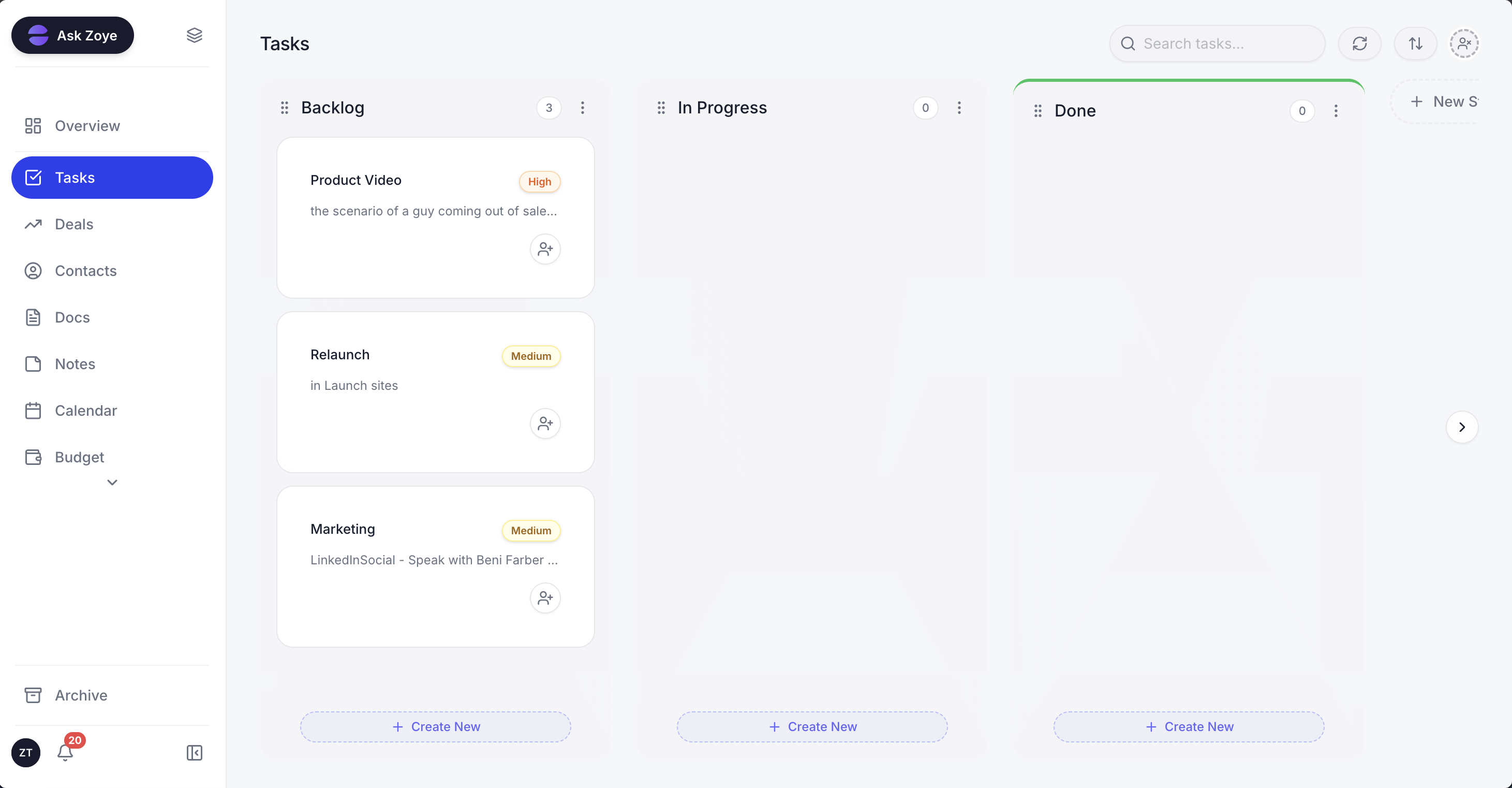
A lead that arrived from a comment turns into ordinary work: an owner, a follow-up task, a due date, visible next to everything else the team is doing.
Once the person is a normal contact, everything else already built applies to them without new wiring. Lead ad Instant Form submissions arrive the same way with campaign and ad names attached, so you can eventually tell which ad produced revenue rather than which ad produced form fills. The WhatsApp welcome can fire. A qualifying conversation can write its answers onto real fields instead of into a chat log. An owner gets assigned, a task appears, and the person shows up in pipeline reports next to leads from every other source.
You build the rules by describing them in a sentence, in the app, on WhatsApp or in Slack. Zoye turns that into a real trigger with conditions and actions, shows you the finished rule in plain English, and nothing runs until you approve it. Every run is logged with what fired, what changed and what it sent.
The honest boundaries: Zoye does not run your ads and it will not rescue content nobody engages with. Its flow builder is not trying to out-feature a dedicated chat marketing tool, and if elaborate multi-branch DM funnels are the product you sell, a specialist will give you more knobs.
Pricing: Almost Free at $5 per month for 1 member with the full platform including AI, Starter from $29 per month for 10 members, Growth from $59 per month for 20, Scale from $119 per month for 100. Priced on people in your workspace rather than on how many strangers messaged you this month.
Best for: owners and small teams who want Meta conversations to land as customers in the same place they run the rest of the business.
2. Chatfuel, the closest like-for-like
Chatfuel is the other long-standing Meta-native automation platform and the most natural side-by-side comparison. It covers Instagram, Messenger and WhatsApp, has leaned hard into AI agents that hold a conversation rather than following a fixed branch tree, and will feel familiar to anyone who has built in ManyChat.
Chatfuel publishes a free tier called Chatfuel Light, and an AI PRO plan at $49 per month with a discount for yearly billing, noting that usage limits apply and directing you to a separate limits page for the detail. As of August 2026 the pricing page does not state on its face whether that plan is metered on contacts or conversations, so read the limits page carefully before you switch.
Best for: teams who want to stay in the same category with a different vendor and a stronger AI conversation layer.
3. Respond.io, the inbox for teams with agents
Respond.io is built for the situation where several humans handle real inbound volume across WhatsApp, Instagram, Messenger and live chat, with routing, assignment, escalation and reporting. If the problem you are solving is "four people are stepping on each other in one inbox", this is a category-appropriate answer and ManyChat is not.
Pricing as published in August 2026: Starter $79 per month, Growth $159, Advanced $279, Enterprise on request, charged on monthly active contacts rather than per seat. Note that it is the same contact-based mechanic you may be leaving ManyChat over, at a higher entry point, so run your own numbers before assuming it is cheaper.
Best for: support and sales teams with agents, handling multichannel volume that needs routing.
4. Tidio, if the website matters more than Instagram
Tidio's centre of gravity is website chat with an AI agent, with social channels connected alongside rather than leading. For an ecommerce store where most conversations start on a product page, that is the right way round, and the shopping-focused features are more relevant than a comment trigger.
Published pricing in August 2026: a free plan, Starter at $24.17 per month for 100 billable conversations, Growth from $49.17 per month for 250 or more, Plus from $300 per month plus usage, and Premium on request. Billing is on billable conversations, which Tidio defines as chats involving a human agent response, with separate charges for its AI agent conversations and for flow reach.
Best for: online stores whose customers ask questions on the site before they ask on social.
5. Landbot, for structured conversations rather than campaigns
Landbot treats the conversation as an interface: a chat-shaped alternative to a form, used for qualification, surveys, bookings and onboarding on a website or over WhatsApp. It is a genuinely different job from broadcast-style chat marketing, and if what you actually needed was a better intake form, this is a cleaner fit than a DM funnel.
Published pricing in August 2026 is in euros: a free Sandbox with 100 chats a month and one seat, Starter at 40 euros a month, Pro at 100 euros a month, Business from 400 euros, plus WhatsApp-specific plans starting at 200 euros a month, all metered on chat volume with per-chat overage above the allowance.
Best for: conversational forms, qualification and booking flows where structure beats reach.
6. WhatsApp-first platforms, if the real channel is WhatsApp
If most of your revenue conversations happen on WhatsApp and Instagram is a top-of-funnel afterthought, the WhatsApp Business Platform specialists deserve a look: shared team inboxes, template management, broadcasts and click-to-WhatsApp ad capture, built around Meta's official API. We cover this category in detail in our guide to the best WATI alternatives.
The shared caveat is worth repeating: most price per user or per contact on top of Meta's own per-conversation charges, so compare the total, not the headline. And the structural limitation is the same one that brought you here. A better inbox is still an inbox.
Best for: businesses whose sales conversations genuinely live on WhatsApp.
7. Meta's own tools plus an automation layer
The option nobody sells you. Facebook and Instagram both ship native inbox tools with saved replies and basic automated responses, and Meta's own lead ad forms will hand you submissions. Add an integration platform to push those into wherever you keep records and you have a functioning setup for zero platform subscription.
The trade-off is that you become the maintainer. There is no support desk for the join between three systems you assembled, and the failure mode is silent. Reasonable for very low volume or for testing whether the mechanic works before paying for it. Painful at scale.
Best for: low volume, tight budgets, and people comfortable owning the plumbing.
Want to see it in action?
Watch how Zoye automates your daily workflow - from lead management to team collaboration.
See How It WorksCompared by shape
| Tool | What it really is | Priced on | Where the person ends up |
|---|---|---|---|
| Zoye | Business workspace with Meta automation inside it | Members in your workspace | A contact record with deals, tasks and reports |
| ManyChat | Meta chat marketing platform | Active contacts | A subscriber with tags |
| Chatfuel | Meta chat automation with AI agents | Plan usage limits, see vendor page | A subscriber in the platform |
| Respond.io | Multichannel agent inbox | Monthly active contacts | A conversation assigned to an agent |
| Tidio | Website chat with social attached | Billable conversations | A chat thread, plus ecommerce context |
| Landbot | Conversational forms and flows | Chat volume | A completed flow with collected answers |
| WhatsApp platforms | Shared WhatsApp inbox and broadcasts | Users or contacts, plus Meta fees | A WhatsApp thread |
The question that actually decides this
Strip away the feature grids and one question separates these products: after the automation runs, where does the person live?
If the answer is "in the chat tool", then everything downstream is integration work you own forever. Every report needs data from two systems. Every follow-up needs someone to notice. Every duplicate has to be reconciled by hand, and the question of which content produced revenue stays unanswerable, because the half of the story with money in it lives somewhere else.
If the answer is "in the system where the rest of the business already happens", the automation stops being a separate discipline. A commenter is a lead. A lead has an owner and a next action. The report already exists because the data was never in two halves.
Neither answer is universally correct. A creator selling a digital product through DMs may genuinely never need the second one. A business with a pipeline, invoices and more than one person almost certainly does.
See what Zoye can do for you
From CRM and deal tracking to AI-powered task management - explore everything Zoye offers in one workspace.
Explore FeaturesHow to choose in four questions
Is the constraint cost, capability, or structure? If cost, model your real active contact count for a good month, not an average one, and compare that against flat member-based pricing. If capability, name the specific thing you cannot do today, because the answer is often a different plan rather than a different vendor. If structure, meaning the data ends up in the wrong shape, no chat platform on this list fixes it and you are looking for something built round records.
How many humans touch a conversation? One person handling DMs has very different needs from four people who need assignment, visible ownership and a way to see who replied. Below two, an inbox product is overkill. Above three, it stops being optional.
Which channel actually produces revenue? Be empirical about this. Teams routinely optimise the channel that produces the most engagement rather than the one that produces the most money, and those are frequently different. Pick the tool that leads with your revenue channel, not your loudest one.
What happens on the second contact? Take one real person who engaged with you twice, months apart, and trace what your current setup did. If it created two of them, that is the structural problem showing itself, and it is the single most useful thing to test any alternative against.
Migrating without losing what works
There is no export format for chat flows. Every migration is a rebuild, and pretending otherwise sets people up for a bad weekend. The good news is that the rebuild is smaller than the account makes it look.
Start by finding out what actually runs. Most accounts have three or four flows carrying nearly all the volume and a dozen abandoned experiments. Rebuild the three or four. The others should never have survived and this is a good moment to admit it.
Export the data before you cancel anything. Contacts, subscriber fields and tags come out as CSV. Do this while the account is still live, because access ends with the subscription and the data does not come back.
Keep the copy. The message wording that converts is the genuinely valuable asset here, more than any branch structure. Save the trigger words, the public reply variants and the first DM text, then rebuild around them.
Run both in parallel for one campaign. Point one post at the new setup, leave the rest where they are, and compare. Nothing about migrating a Meta automation requires a hard cutover, and the parallel run is where you find the thing you forgot.
For teams moving to Zoye, the assistant handles the rule-building half of this conversationally: describe what should happen when someone comments, and it builds the trigger, conditions and actions, shows you the finished rule in plain English, and waits for your approval before anything fires.
Ready to streamline your business?
Zoye brings AI-powered CRM, task management, and automation into one workspace.
Get StartedWhen ManyChat is still the right answer
It would be dishonest to end without this. Stay where you are if your business is essentially content plus DMs, if Instagram and Messenger are the whole surface, if one person handles the conversations, and if the branch-tree builder is a tool you enjoy rather than tolerate. The product is mature, the community is large, and switching costs are real. "It works and I know it" is a legitimate reason to keep paying for something.
Change when the bill starts moving with your best months rather than your revenue, when a second person needs to see the same conversation, when the follow-up depends on someone remembering, or when you cannot answer which content produced customers. Those are structural signals, and structural problems do not respond to a plan upgrade.
See what it looks like when an Instagram comment lands as a real customer record rather than a subscriber. Explore Zoye's Facebook and Instagram automations.
For more context, read our guides to Instagram comment to DM automation, Facebook lead ads and your CRM, and the best WATI alternatives.