
Best WATI Alternatives 2026: 7 Options for Selling on WhatsApp
WATI is one of the better known WhatsApp Business API tools, and it does what it promises: it turns WhatsApp into a shared team inbox, sends broadcast templates to segmented lists, and runs simple no-code chatbots. For a business that just needed to get off a single phone and give a few agents access to one WhatsApp number, that was a real upgrade. The problem is not what WATI does. It is everything WATI still leaves on your plate.
Because when you look closely, WATI (and the whole category of shared-inbox tools like it) hands you a console and nothing more. Every reply is typed by a person. Every lead is tagged by a person. Every follow-up depends on someone remembering to send it. The broadcast goes out, the replies come flooding back, and now you are the bottleneck: reading, sorting, answering, and chasing, one conversation at a time. It organises the work beautifully. It does not do the work. And the moment you stop staffing it, it becomes another tool you bought and stopped using.
For an owner who is running sales and support from WhatsApp while also delivering the actual service, that gap is the whole problem. This guide compares the seven best WATI alternatives in 2026, ranked not by how many inbox features they pack in, but by how much of the work they take off your hands.
Pricing reflects published rates as of July 2026; check each vendor's pricing page for current figures.
WATI alternatives at a glance
| Tool | Category | Does the work for you? | Best for | Pricing from |
|---|---|---|---|---|
| Zoye | AI Business Operator | Yes - captures, qualifies, books, chases and updates records itself | Owners who want WhatsApp handled, not staffed | $5/mo (1 member), then $29/mo (10 members) |
| WATI | Shared inbox + broadcast | No - your agents work every thread | Teams happy to staff an inbox | ~$39/mo + Meta fees |
| Respond.io | Omnichannel inbox | No - you build and maintain the routing | Mid-size multichannel teams | ~$99/mo + Meta fees |
| AiSensy | Broadcast-first marketing | No - campaigns you plan and monitor | Marketing-led broadcast teams | ~$12/mo + Meta fees |
| Interakt | Commerce inbox | No - thin CRM layer | Retail and ecommerce on WhatsApp | ~$12/mo + Meta fees |
| DoubleTick | Sales-team inbox | No - reps still send every message | Outbound WhatsApp sales reps | ~$20/user/mo + Meta fees |
| Generic CRM + add-on | CRM with WhatsApp bolted on | No - you enter the data | Teams already committed to a CRM | Varies, usually per user |
Pricing reflects published rates at the time of writing and excludes Meta's per-conversation charges. Check each vendor's page for current figures.
What WATI actually costs in 2026
The reason most people start looking for a WATI alternative is not a missing feature. It is the invoice. WATI's advertised entry price is only one of three numbers that end up on your bill.
The platform fee. WATI's paid plans start around $39 per month on annual billing and rise with tier. Additional users are charged on top on most plans, so the price grows with the team rather than staying flat.
Meta's conversation fees. Because WATI runs on the official WhatsApp Business API, Meta bills you separately for every 24-hour conversation window, priced by category (marketing, utility, authentication, service) and by the customer's country. Marketing conversations to India cost a fraction of marketing conversations to the UK, Germany, or the Gulf. A business sending a few thousand marketing messages a month commonly adds $100 to $500 to its bill, and this appears on no pricing page.
The staffing cost. Someone builds the chatbot flows, writes the templates, submits them to Meta for approval, monitors the campaigns, and answers the replies. This is hours every week, and it is the largest cost in the category even though it never shows up in a comparison table.
Here is what a realistic monthly total looks like for a five-person business at moderate volume:
| Tool | Platform fee (5 users) | Meta conversation fees | Realistic monthly total |
|---|---|---|---|
| Zoye | $29 flat (10 members included) | None required for owner-side operation | ~$29 |
| WATI | ~$39 and up, extra users charged | Yes, billed by Meta | ~$80 to $250 |
| Respond.io | ~$99 and up | Yes, billed by Meta | ~$150 to $400 |
| AiSensy | ~$12 and up | Yes, billed by Meta | ~$60 to $300 |
| Interakt | ~$12 and up | Yes, billed by Meta | ~$60 to $300 |
| DoubleTick | ~$20/user = $100 | Yes, billed by Meta | ~$140 to $350 |
Conversation-fee ranges are illustrative and depend heavily on volume, message category, and customer country.
The structural point is worth stating plainly: a tool whose purpose is to send messages to customers inherits a variable cost that scales with your growth. A platform you use to run your own operations does not, because the AI works on your side of the counter rather than blasting your contact list.
What people actually complain about with WATI
Reading past the marketing, the same handful of frustrations come up repeatedly among businesses shopping for an alternative. None of them are reasons to say WATI is a bad product. They are reasons the category itself has a ceiling.
The price climbs faster than expected. The headline plan looks affordable until you add seats and Meta's conversation fees. Teams routinely report the real bill landing at two to four times the advertised figure once campaigns are running.
The chatbot builder becomes a second job. No-code flow builders are genuinely no-code, but they are not no-work. Every branch is assembled by hand and then has to be maintained as offers, prices, and processes change. For a technical team that is fine. For an owner who also sells and delivers, the flows quietly go stale.
Template approval slows everything down. Marketing and utility templates go to Meta for review, and rejections for vague or overly promotional wording are common. A campaign you wanted out on Monday can slip a week.
It answers, it does not act. This is the deepest one. WATI makes replying faster, but nothing in it captures a lead into a real pipeline, qualifies it, books the appointment, or chases the quote that went quiet. When the team is busy, the follow-ups simply do not happen, and the tool has no opinion about it.
Support and onboarding vary. As with most fast-growing SaaS in this space, experiences differ widely by plan tier and region.
If your complaint is the first three, another inbox may genuinely fix it. If your complaint is the fourth, no inbox will, because that is the category boundary rather than a product gap.
Why owners are looking beyond WATI in 2026
Three reasons drive the search for an alternative.
It is an inbox, not an operator. WATI centralises WhatsApp conversations and lets several agents share one number, which is genuinely useful. But it stops at organising. Someone still has to read each message, decide what happens next, reply, tag the contact, and remember the follow-up. It routes the work to you faster; it does not remove it.
You build and staff the automations yourself. The no-code chatbot and the keyword flows sound like automation, but you assemble every branch by hand in a builder, then keep them maintained as your offers change. For a technical team that is fine. For an owner who sells, delivers, and invoices, that flow builder is a second job that never quite gets finished.
The per-user and per-conversation price stacks up. WATI is billed per user per month, on top of the WhatsApp Business API conversation charges Meta levies, plus limits on contacts and broadcasts on the lower tiers. As you add agents and volume, the real monthly cost climbs well past the headline number, before you have paid for a CRM, a calendar, or anything beyond the chat.
The 7 best WATI alternatives in 2026
1. Zoye - the AI Business Operator that runs the conversations
Zoye is the strongest WATI alternative for the owner who does not want to staff a WhatsApp inbox, but wants the WhatsApp conversations handled for them. It is not a nicer inbox with more broadcast templates. It is an AI Business Operator that actually runs the business: it captures the lead, qualifies it, books the appointment, updates the customer record itself, and chases every follow-up, without you working each thread by hand.
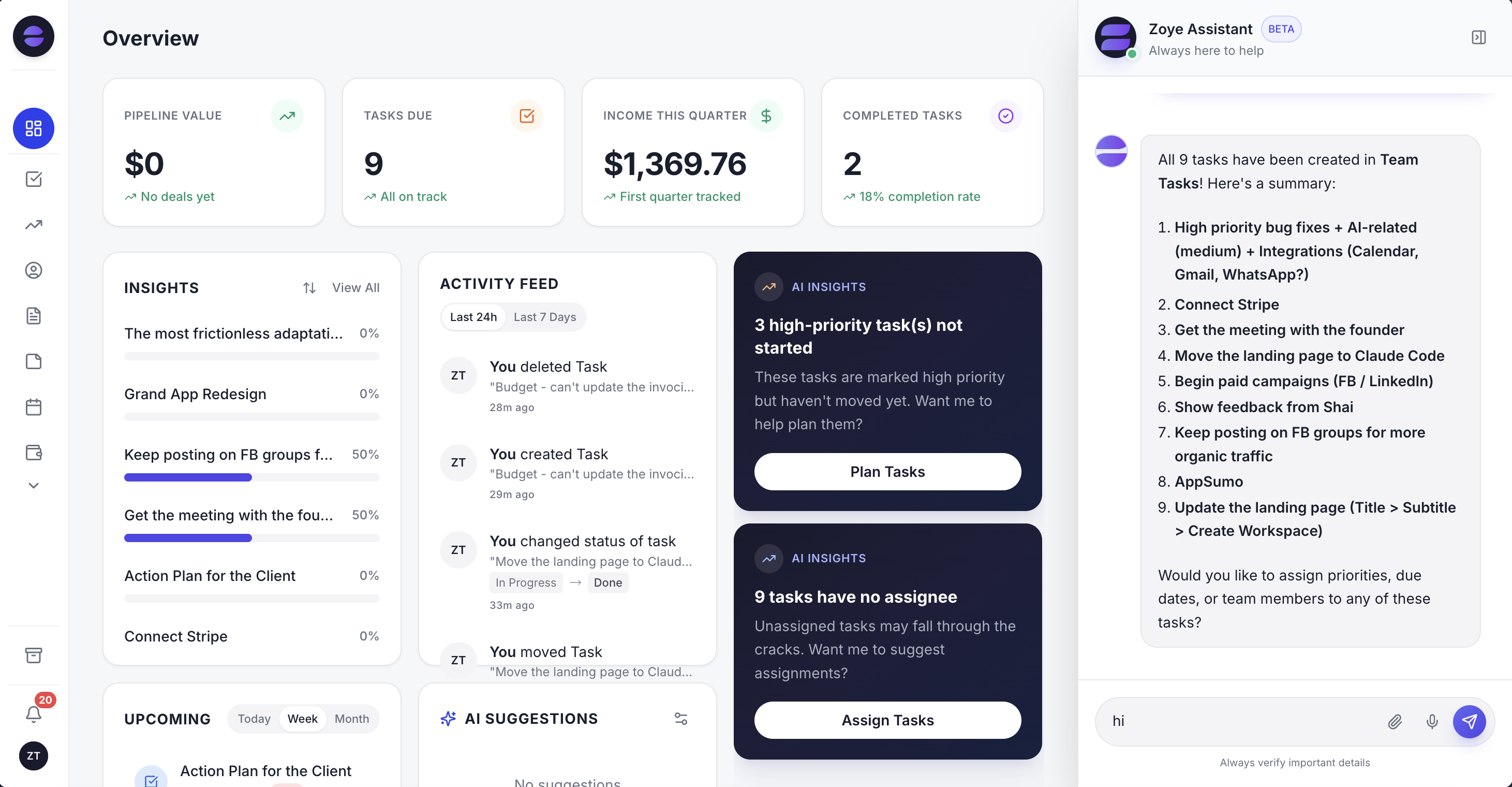 The Zoye dashboard: your whole business at a glance, with proactive AI Insights and the Zoye Assistant always available.
The difference is in who does the work. Where WATI gives you a console to reply from and a builder to assemble flows in, Zoye reads the WhatsApp message the moment it lands, drafts and sends the reply, captures the lead into the CRM on its own, asks the qualifying questions, and schedules the appointment, then remembers to chase the ones who went quiet. Nobody has to sit on the inbox for it to keep moving. The first response does not wait for a free agent, and the follow-up does not depend on anyone's memory.
Building automations does not mean opening a flow editor either. You describe what you want in one plain sentence, for example "reply to every new WhatsApp lead within five minutes, ask for their budget, and book them if they are ready, otherwise follow up after two days", and the assistant builds and runs that automation for you, including over WhatsApp. When the offer changes, you tell it in another sentence rather than rewiring branches in a builder.
And it does not stop at the chat. Zoye brings leads, customers, tasks, calendar, budget, and reports into one place, with the assistant acting across all of it. The owner does not maintain a database by hand: the conversation with the customer updates the record by itself. That is the shift away from "software you bought and stopped using". WATI is one more console to work. Zoye is the operator you just talk to, and it keeps running when you step away.
Pricing: Almost Free at $5 per month for 1 member with the full platform, including AI. Starter from $29 per month (10 members). Growth from $59 per month (20 members). Scale from $119 per month (100 members).
Best for: business owners and small teams that run sales and support on WhatsApp and want the conversations captured, qualified, booked, and followed up without staffing an inbox.
2. WATI - the shared WhatsApp inbox and broadcast tool
WATI is the incumbent this list is built around, and it is a solid one. On the official WhatsApp Business API it gives you a shared team inbox, broadcast templates to segmented lists, no-code chatbots, and a decent set of integrations. If your only need is to get a few agents onto one WhatsApp number and send campaigns, it does that well.
The limit is the one this whole guide turns on: WATI organises the conversations, but you and your agents still operate every one of them. It is an inbox and a broadcast tool, not something that captures, qualifies, and follows up on its own.
Pricing: paid plans billed per user per month, plus WhatsApp conversation charges; check its page for current figures.
Best for: teams that want a reliable shared WhatsApp inbox with broadcasts and are happy to staff it.
3. Respond.io - the omnichannel conversation platform
Respond.io centralises WhatsApp along with Instagram, Facebook Messenger, and live chat into a single console, with advanced routing, reporting, and automation for mid-size and larger teams. If you handle real volume across several channels, it is more capable than a WhatsApp-only inbox.
The trade-off is complexity and price. It is built for teams with a dedicated administrator to configure the routing and flows, not for the owner who wants something that works on its own from day one. The work still lands on a human at the end of every rule.
Pricing: monthly plans that scale by contacts and users; check its page for current figures.
Best for: larger support and sales teams handling high multichannel volume.
4. AiSensy - the broadcast-first WhatsApp marketing tool
AiSensy is popular with businesses that lean heavily on WhatsApp broadcasts and campaigns. It offers unlimited agents on some tiers, broadcast messaging, click-to-WhatsApp ad integration, and basic chatbots, which makes it attractive for marketing-led teams.
The catch is that its centre of gravity is outbound broadcasting, not running the individual conversation to a sale. Once the replies come in, you are back to working them by hand, and the deeper CRM and follow-up logic is thin.
Pricing: monthly plans by contacts, plus WhatsApp conversation charges; check its page for current figures.
Best for: marketing-led teams that send a lot of WhatsApp broadcasts and campaigns.
5. Interakt - the small-business WhatsApp commerce inbox
Interakt bundles a WhatsApp shared inbox with catalogue and commerce features, notifications, and simple automations, aimed at small and mid-size businesses, especially in retail and ecommerce. For selling products over WhatsApp with order notifications, it is a tidy fit.
The limit is the familiar one: it is an inbox with commerce add-ons, so the qualifying, chasing, and record-keeping still depend on your team being on it. It organises orders and messages; it does not operate the pipeline for you.
Pricing: monthly plans by contacts and features, plus WhatsApp conversation charges; check its page for current figures.
Best for: small retail and ecommerce businesses selling over WhatsApp.
6. DoubleTick - the sales-team WhatsApp CRM
DoubleTick targets WhatsApp sales teams with a shared inbox, bulk broadcasting, catalogues, and quick replies, with a strong focus on outbound selling. Sales reps who live in WhatsApp find the broadcasting and catalogue tools handy.
As with the rest of the category, though, it accelerates the manual work rather than removing it. The rep still sends every message, and the follow-up discipline depends on the person, not the tool. It is a faster inbox, not an operator that chases on its own.
Pricing: monthly plans per user; check its page for current figures.
Best for: outbound WhatsApp sales teams that want fast broadcasting and catalogues.
7. Generic CRMs with a WhatsApp add-on
Plenty of mainstream CRMs (the big all-in-one suites and pipeline tools) now offer a WhatsApp integration or add-on. If you already run your whole business inside one of them, bolting WhatsApp on keeps everything in one database, which has real appeal.
The drawback is two-fold: the WhatsApp experience is usually shallower than a purpose-built inbox, and, more importantly, it is still a CRM you operate. It stores the contact and shows the pipeline, but you enter the data, send the messages, and remember the follow-ups. The WhatsApp add-on does not change who does the work.
Pricing: varies widely by CRM and add-on; typically billed per user per month.
Best for: teams already committed to a general CRM that want WhatsApp inside it.
Want to see it in action?
Watch how Zoye automates your daily workflow - from lead management to team collaboration.
See How It WorksThe best WATI alternative for actually selling on WhatsApp
If your business lives on WhatsApp and what you really want is for someone to answer first, qualify, book, and never let a lead slip, the question is not which inbox has the nicest layout. It is who does the work. WATI, Respond.io, AiSensy, Interakt, and DoubleTick all organise the chats well, but the reply, the qualifying, and the follow-up still depend on your team's time and memory.
Zoye is the only option on this list that acts the way you would act if you had time to sit on the inbox all day. It captures the lead the moment they message, replies and qualifies, books the appointment, chases the one who went quiet, and updates the record without anyone touching it. In a market where whoever answers first usually wins, having an operator that never gets distracted changes the result.
The low-cost WATI alternative
Searching for a "free WhatsApp CRM" usually ends in disappointment: the free tiers of specialised inboxes tend to cap you at one number, a handful of contacts, or a short trial, and the WhatsApp conversation fees arrive regardless. Zoye takes a different route: a flat, honest entry price. Its entry plan is called Almost Free and costs $5 per month for 1 member with the full platform, including AI, so a solo owner can capture leads, manage customers, and follow up on WhatsApp for less than a coffee a month. When you outgrow one person, Starter is $29 per month for 10 members and Growth is $59 per month for 20, with every tool and connector included rather than sold as add-ons.
See what Zoye can do for you
From CRM and deal tracking to AI-powered task management - explore everything Zoye offers in one workspace.
Explore FeaturesBest WATI alternative by use case
Different businesses are running from WATI for different reasons, and the right replacement follows the reason.
You want the conversations handled, not staffed. This is the largest group: owners who are the bottleneck because every reply, qualification, and follow-up routes through them. Zoye is the only operator on this list, and the only one that keeps working when nobody is watching the inbox.
You need heavy outbound broadcast at low cost. If your growth genuinely is campaign-driven, AiSensy is the value pick, especially in India, and Interakt is strong if you are selling catalogue products. Budget for Meta's conversation fees and for someone to own compliance.
You have real multichannel volume. If WhatsApp is one of four or five channels and you have a team plus an administrator to configure routing, Respond.io is the more capable console. It is genuinely better than WATI at that job, and genuinely heavier.
You have an outbound sales floor. DoubleTick is built for reps who broadcast and send catalogues all day. It speeds the rep up. It does not remove the dependence on the rep.
Your business already lives inside a CRM. If you run everything in one general CRM and only need WhatsApp threads attached to contacts, a WhatsApp add-on keeps one database. Accept that the WhatsApp experience will be shallower and that you still do the work.
You are in India specifically. WATI, AiSensy, and Interakt all compete hard in the Indian market, and local pricing there is far below global rates. If your customers are Indian and your motion is broadcast-led, the local players are difficult to beat on cost per message. If your motion is conversational and the problem is that admin work is eating your week, cost per message is the wrong metric to optimise.
Free and low-cost WATI alternatives
"Free WATI alternative" is a common search, and it deserves a straight answer, because the free options in this category are narrower than they look.
Meta's WhatsApp Business app is the real free tier. It gives you labels, quick replies, a catalogue, and away messages on one phone, at no cost. For a solo operator testing whether WhatsApp works as a sales channel, it is the correct starting point and it costs nothing. Its ceiling is hard: no pipeline, no follow-up automation, no reporting, and no genuine multi-agent access.
Most "free" plans in this category are trials. WATI, AiSensy, Interakt, and Respond.io offer time-limited trials rather than free tiers. When the trial ends you are on a paid plan, and Meta's conversation fees have been running the whole time regardless.
The genuinely free tiers that exist are capped to demo size. A few hundred contacts, one user, no automation. That answers the question "does this work?" and not the question "can I run my business on this?".
Free has a cost you pay elsewhere. Without automation, every follow-up depends on a person remembering. One lead that goes cold because nobody chased the quote costs more than a year of any subscription on this page.
The most honest low-cost answer is a flat entry price rather than a capped free tier. Zoye's Almost Free plan is $5 per month, or $4 per month billed annually, and includes the full platform and the AI assistant for 1 member rather than a stripped-down preview. That is less than most tools in this list charge for a single additional seat, and it does not carry Meta conversation fees for owner-side operation.
Do you still need the WhatsApp Business API?
Worth checking before you shortlist, because the API is the source of most of WATI's cost and friction, and not every business needs it.
You need the official API if you send outbound marketing at volume, you need several agents on one number with real routing and SLAs, or you need delivery guarantees and compliance documentation for a regulated industry.
You probably do not if customers message you, you reply, and the actual failure is that the resulting work falls through the cracks. That describes most small businesses leaving WATI.
The API route carries business verification with Meta, display-name review, template approval before you can send, a 24-hour service window governing free replies, and per-conversation billing forever. Zoye's approach sidesteps it: the assistant works on the owner's side, so you get the WhatsApp workflow without standing up an API messaging operation. If you are leaving WATI because of cost and admin overhead, this is the part that removes both.
How to choose the right WATI alternative
Three questions narrow the decision.
1. Do you want to organise chats or run the business? If you only need to get a few agents onto one WhatsApp number and send broadcasts, WATI, AiSensy, Interakt, or DoubleTick will do it. If you want the lead captured, qualified, booked, and followed up on its own, Zoye is the only operator on the list.
2. How much do you want to build and maintain? WATI, Respond.io, and generic CRMs give you power in exchange for setup and upkeep: flow builders, routing rules, and data entry. Zoye is run by talking to it. You describe the outcome in a sentence and the assistant builds the automation, then keeps it running.
3. How far does it need to reach? An inbox covers WhatsApp. Zoye covers leads, customers, tasks, calendar, budget, and reports in the same place, with the assistant acting across all of it, so you do not stack another tool on top when the business grows.
How to migrate from WATI to Zoye
Moving off WATI sounds heavy, but it is rarely a data problem. It is a change in how you work. Instead of rebuilding every chatbot flow and broadcast segment, you export your contacts and open conversations, bring them into Zoye, and describe how you operate in plain language, for example "answer every new WhatsApp lead within five minutes, ask what they need, book them if they are ready, and follow up after two days if they go quiet". The assistant builds that flow for you rather than you assembling it branch by branch. What was hours of chatbot configuration in WATI becomes a short conversation here, and from then on the operator runs it.
Why owners pick Zoye
The same reasons come up. There is nothing to staff: the assistant works the WhatsApp conversations instead of handing them to you. There is nothing to build: you describe the automation in a sentence and it runs. It does not stop at WhatsApp: leads, customers, tasks, calendar, budget, and reports live together, updated by the conversations themselves. And the price is flat rather than per seat: the entry plan, Almost Free, is $5 per month for 1 member with the full platform including AI, so you can start small and move up only when the team grows. Against "software you bought and stopped using", Zoye is the operator you just talk to, and it keeps running.
Try Zoye with your team. The entry plan, Almost Free, is $5 per month for 1 member with the full platform including AI.
For more context, see how to sell on WhatsApp, the guide to automated WhatsApp customer service, and the best Respond.io alternatives.