
Best Respond.io Alternatives 2026: 7 Tools That Run the Conversations For You
Respond.io does one thing well: it pulls WhatsApp, Instagram, Messenger, live chat, and email into a single shared inbox so your team stops jumping between apps. For a support team that lives inside a console all day, that consolidation is genuinely useful.
The problem shows up the moment a small business tries to run sales and support from it. An omnichannel inbox centralises the conversations, but it is still a manned console. Someone has to read every message, tag it, decide who handles it, type the reply, and remember to follow up two days later when the lead goes quiet. The tool moved the mess into one window. It did not do the work. For an owner who is already delivery, admin, and salesperson at once, "one place to do all the manual replying" is not the win it sounds like.
This guide compares the seven best Respond.io alternatives in 2026, ranked for small and service businesses that want fewer conversations to operate by hand, not just a tidier place to operate them.
Pricing reflects published rates as of July 2026; check each vendor's pricing page for current figures.
Why teams are looking beyond Respond.io in 2026
Four pressures push small teams to look elsewhere.
A shared inbox still needs a full-time human on it. Respond.io shows every WhatsApp and Instagram thread in one view, but a view is not an answer. Every reply, tag, assignment, and follow-up is still a manual action. During a busy week the inbox fills faster than a small team can clear it, and leads slip between the messages nobody got to.
Automations mean building flows, not describing outcomes. Respond.io has a workflow builder, and it is powerful once configured. But you have to design the branching logic, map the triggers, and maintain it as your process changes. For a non-technical owner, the builder becomes another thing bought and half-configured, then abandoned when it needs updating.
The AI only suggests; it does not act. Most inbox tools have added an AI panel that drafts a suggested reply for a human to approve and send. That is a keystroke saver, not an operator. The human is still in the loop on every single message, so the workload never actually drops.
Per-seat and per-conversation pricing punishes growth. Omnichannel platforms commonly charge per user, per active contact, or per message volume. As your conversations grow, the tool that was supposed to help you scale becomes the line item you dread. The economics reward staying small, which is backwards.
The 7 best Respond.io alternatives in 2026
1. Zoye - the operator that works the conversations itself
Zoye is the strongest Respond.io alternative because it is not another inbox for your team to staff. It is an AI Business Operator that reads, replies, routes, and follows up on customer conversations itself, and only brings a human in when a thread genuinely needs one.
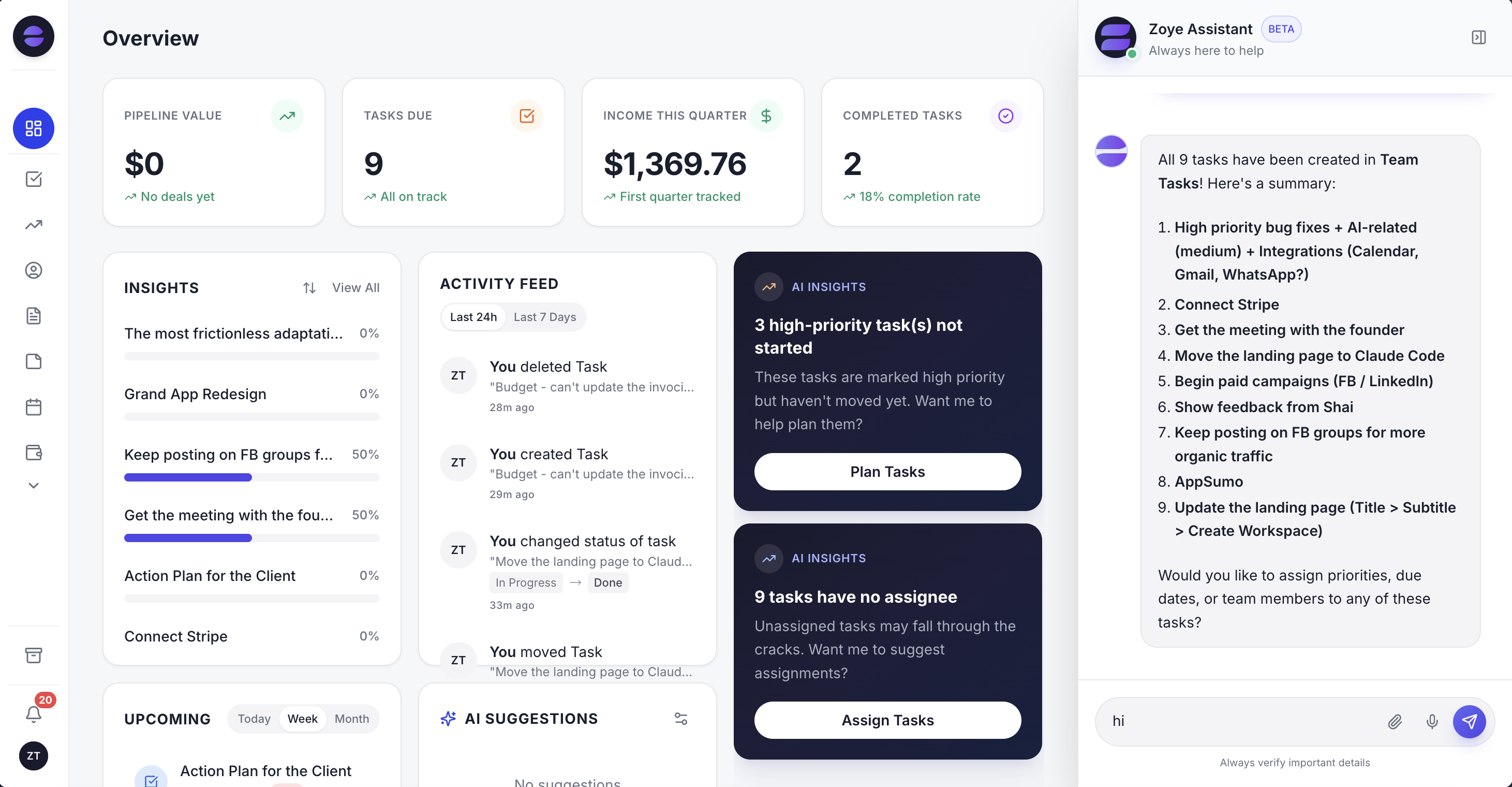 The Zoye dashboard: your whole business at a glance, with proactive AI Insights and the Zoye Assistant working conversations on the right.
Point Zoye at your WhatsApp, Instagram, and web chat and the operator starts working the messages. It reads an incoming enquiry, answers the routine questions itself (hours, pricing, availability, "is this still in stock"), captures the person as a lead, and books the call or appointment without a human touching the thread. When a conversation needs judgement, a discount, a complaint, a delicate negotiation, it escalates that one thread to you with the full context already summarised.
The Zoye Assistant does the work, it does not suggest it
This is the line that separates Zoye from every inbox on this list. Respond.io, Trengo, and Chatwoot can show you a suggested reply. Zoye sends it, logs it, updates the contact record, and sets the follow-up itself. It chases the lead that went quiet three days ago, drafts the payment reminder, and surfaces the deals about to go cold, all without you opening the inbox to trigger it. The workload actually drops, rather than getting a faster keyboard.
Build automations by describing them in plain language
You do not open a flow builder in Zoye. You tell the operator what you want in a sentence. Say "when a new WhatsApp lead asks about pricing, send them the rate card and book a callback if they reply" and Zoye builds and runs that automation, over WhatsApp too. Change your mind, and you edit it by describing the change. There is no branching diagram to maintain, which means there is no automation to abandon.
One place where the conversation becomes a customer
Because Zoye keeps its own records, every conversation lands as a real contact with history, notes, deals, tasks, and follow-ups attached, not a chat thread that vanishes into scrollback. The operator updates the CRM as it works, so your customer data stays current without anyone doing data entry. The inbox stops being a black hole and becomes a business that runs itself in the background.
Pricing: Almost Free at $5 per month for 1 member with the full platform including AI. Starter from 29 dollars per month (10 members). Growth from 59 dollars per month (20 members). Every channel and tool is included on every plan, with no per-conversation charges.
Best for: Small and service businesses that want their WhatsApp and omnichannel conversations run for them, not just shown to them.
Want to see it in action?
Watch how Zoye automates your daily workflow - from lead management to team collaboration.
See How It Works2. Respond.io - the omnichannel inbox itself
Respond.io remains a solid choice if what you actually want is a well-built shared inbox and you have the staff to work it. The channel coverage is broad, the interface is mature, and the workflow builder is genuinely capable once someone configures it.
The limitation is the one this whole guide is about: it centralises conversations but does not operate them. Every reply and follow-up is a human action, and the pricing scales with contacts and seats as your volume grows.
Pricing: Paid plans typically start in the low hundreds of dollars per month, with contact-based and seat-based tiers; check the current pricing page.
Best for: Support teams with the headcount to staff a busy omnichannel inbox.
3. WATI - the WhatsApp-first shared inbox
WATI focuses tightly on WhatsApp, giving small teams a shared inbox, broadcast templates, and a chatbot builder on top of the WhatsApp Business API. For a business whose customers live almost entirely on WhatsApp, the focus is a strength.
The trade-off is scope and effort. WATI is WhatsApp-centric, so other channels are secondary, and the automations still need building and maintaining. It gives you the WhatsApp inbox and the tools, but you and your team still operate every reply and tag.
Pricing: Tiered monthly plans (broadly starting around the tens of dollars per month) plus WhatsApp conversation charges; check the current pricing page.
Best for: WhatsApp-only businesses that want a focused inbox and are happy to staff it.
4. Trengo - the team inbox for multichannel support
Trengo is a shared team inbox that pulls WhatsApp, email, chat, and social into one place, with a clean interface and solid collaboration features like internal notes and assignments. Support teams like the tidy, collaborative feel.
The catch is familiar: Trengo is a place to work conversations together, not a system that works them for you. The AI features assist a human agent rather than replacing the manual load, and pricing is per user, so a growing team's costs climb steadily.
Pricing: Per-seat monthly plans; check the current pricing page.
Best for: Support teams that want a collaborative multichannel inbox.
5. Chatwoot - the open-source shared inbox
Chatwoot is the open-source, self-hostable option. If you have technical resources, you can run it yourself for the cost of infrastructure, which makes it the cheapest tool here and appealing to teams that want control over their data.
The trade-off is ownership. Self-hosting means you maintain, update, and secure it, and the AI and automation capabilities are lighter than the commercial tools. It is an inbox you host, not an operator you deploy, so the manual conversation work remains entirely yours.
Pricing: Free and open source if self-hosted (infrastructure cost only); paid cloud plans available.
Best for: Technical teams that want a self-hosted, data-controlled inbox.
6. SleekFlow - the social-commerce conversation platform
SleekFlow leans into social commerce, connecting WhatsApp and social channels to catalogues, payments, and broadcast campaigns. For a business selling directly through chat, the commerce-flavoured features are a nice fit.
The limitation is that it is still a conversation-management and marketing platform you operate, with campaigns to build and messages to send. The automation and AI help, but the day-to-day of qualifying and following up with each buyer stays a manual, human job.
Pricing: Tiered monthly plans plus messaging costs; check the current pricing page.
Best for: Chat-commerce sellers who want messaging tied to catalogue and campaigns.
7. Generic CRMs with a WhatsApp add-on
Traditional CRMs (HubSpot, Zoho, and similar) increasingly offer a WhatsApp or messaging integration, so you can log chats against contact records. For a business that already lives in one of these CRMs, bolting on messaging keeps everything in one database.
The weakness is that the CRM was built for a sales rep to update, not to run conversations. The WhatsApp integration is a logging layer, not an operator: it records the message, but a human still reads and answers it, and the record only stays current if someone maintains it. It is a database with a chat window attached, which is exactly the manual-upkeep trap that gets CRMs abandoned.
Pricing: Varies widely by CRM and tier; WhatsApp features are often add-ons or higher-tier only.
Best for: Teams already committed to a CRM who just need to log messages against records.
Best Respond.io alternative for small business
For a small or service business, the deciding question is not "which inbox looks nicest" but "how many of these conversations can I stop handling by hand". On that test, Zoye is the clear pick, because it is the only option here that actually works the conversations: reading, replying, qualifying, booking, and following up itself, and escalating only the threads that need a person.
Respond.io, Trengo, and WATI are all reasonable if you have the headcount to staff a busy inbox and you mostly want tidier collaboration. Chatwoot wins on raw cost if you can self-host. But all of them share the same shape, a place for humans to do the work, whereas Zoye removes the work.
See what Zoye can do for you
From CRM and deal tracking to AI-powered task management - explore everything Zoye offers in one workspace.
Explore FeaturesBest AI-powered Respond.io alternative
Every tool on this list can now show you an AI-suggested reply. That is not the same as an AI that runs your conversations. The suggestion still needs a human to read the thread, approve the draft, send it, tag the contact, and set the follow-up. The workload barely moves.
Zoye is the only genuinely AI-native pick here. The operator answers routine messages itself, qualifies and books leads, keeps the CRM current as it works, chases quiet conversations before they go cold, and builds automations from a plain-language instruction, across WhatsApp and your other channels. It acts on your behalf instead of prompting you from a sidebar, which is why the manual load actually falls rather than getting a marginally faster keyboard.
How to choose the right Respond.io alternative
Three questions narrow the decision.
1. Do you want to work the conversations, or have them worked? If you have a support team that is happy staffing an inbox, a shared-inbox tool (Respond.io, Trengo, WATI, Chatwoot) does that job well. If you are a small team drowning in manual replies, you want an operator that handles them, which points to Zoye.
2. How many channels, and how technical are you? WhatsApp-only and non-technical points toward WATI or Zoye. Broad omnichannel with a support team points to Respond.io or Trengo. Self-hosting with engineering resources points to Chatwoot.
3. What should the AI actually do? If an AI that suggests replies is enough, most tools offer that. If you want AI that answers, qualifies, books, follows up, and updates records itself, Zoye is the only option built that way.
Why teams pick Zoye as their Respond.io replacement
A few themes come up again and again.
The conversations get handled, not just displayed. The operator reads, replies, and follows up itself, so the inbox stops being a growing pile of manual tasks.
The follow-through happens on its own. Quiet leads get chased, payment reminders get drafted, and cold deals get surfaced without anyone remembering to do it.
Automations are a sentence, not a project. You describe what you want and Zoye builds and runs it, including over WhatsApp, so there is no flow builder to maintain and nothing to abandon.
The records stay current on their own, with no extra effort. Because the operator keeps its own CRM as it works, your customer data never rots, which is the exact failure that kills most tools you buy and stop using.
Try Zoye with your team. The entry plan is Almost Free, with the full platform including AI, so you can watch the operator handle real conversations for the price of a coffee.
For more context, see WhatsApp for customer service, automated WhatsApp customer service, and the best WATI alternatives.