
Quick answer: a CRM for mortgage brokers has three jobs that a loan origination system ignores: keeping pre-approved borrowers warm until they find a home, getting documents in without ten reminder calls, and staying in touch with past clients and referral partners for years. Shape, Jungo and BNTouch are built around loan officer workflows; Surefire and Total Expert serve larger lenders. For a small brokerage whose deals leak through follow-up, Zoye is the strongest first pick.
Key takeaways (October 2026)
- Published mortgage CRM prices start at $95 per user a month (BNTouch Team, 2-user minimum) and $96 per user a month billed annually (Jungo), before setup fees.
- 3 of the 7 tools (Shape, Surefire, Total Expert) show no dollar price on their pricing pages; you need a sales call.
- A 4-person brokerage pays about $380 a month on BNTouch Team or $384 on Jungo at list prices, against $59 a month ($47 billed yearly) for up to 20 members on Zoye Growth, the plan that includes the WhatsApp and workflow automations.
- On WhatsApp, a message sent more than 24 hours after the borrower's last reply must be an approved template, per Meta's developer documentation.
- Rate-watch follow-ups need two fields per past client (rate and closing date) and a filter; no tool on this list predicts rates for you, and none should.
How a brokerage really wins and loses loans
A mortgage brokerage earns from three sources: new enquiries, past clients who come back to refinance or move, and referral partners who send buyers. Loans are lost mostly between stages: a pre-approved buyer goes quiet for three months, a file stalls on one missing payslip, or a past client refinances with whoever called first.
The loan itself lives in the loan origination system (LOS). That is where the application, the conditions and the lender submission sit. What the LOS rarely tracks well is everything around the file. Here is where small brokerages tend to leak, as an illustration rather than survey data.
The pre-approval waiting room
A buyer gets pre-approved and then searches for a home for weeks or months. During that time the broker has nothing to process, so nobody calls. When the buyer finally makes an offer, the agent they met at an open house may have introduced another lender. A broker with 40 pre-approvals open and no check-in rhythm will lose some of them without ever hearing why.
The document chase
Every file needs pay stubs, bank statements, tax returns, identity documents, sometimes a gift letter or an explanation of a large deposit. Borrowers send half, then forget. A processor spends hours each week asking for the same item twice, and the file waits. The work is not hard; it is repetitive and easy to drop.
Past clients after closing
Once a loan funds, most brokers send a thank-you and then go silent. Yet the past client book is the cheapest source of the next loan: refinances when rates move, a move up when the family grows, a second property, a referral to a sibling. A book of 600 closed loans with no follow-up plan is a list of people other lenders are contacting.
Referral partners
Real estate agents, accountants, financial planners and builders send buyers to brokers they trust and remember. Trust comes from fast updates on shared clients; memory comes from regular contact. Partners who never hear about the buyer they sent stop sending.
Where the leaks show up, in one list
- Pre-approved buyers with no touch for 30 days or more.
- Files waiting on a document nobody has chased since Monday.
- Past clients who have not heard from you since closing.
- Referral partners with no update on the client they sent.
- Website, ad and social enquiries answered the next day instead of the next minute.
What a CRM for mortgage brokers must do: a 9-point checklist
A mortgage CRM earns its price if it keeps every borrower moving to the next stage, chases documents without a person remembering to, and keeps past clients and partners in contact for years. Judge each option on the nine points below. The weighting depends on whether your bottleneck is new leads, files in progress or the past client book.
- Pre-approval pipeline. Stages from enquiry to funded, with a next step and a date on every borrower, and an alert when a borrower sits too long in one stage.
- Document checklist per borrower. A list of what is still missing, with reminders that repeat until it arrives.
- Rate-watch audiences. Loan details stored as fields (rate, product, closing date, anniversary) so you can filter past clients when you decide conditions have changed.
- Referral partner records. Each partner as a contact, each borrower linked to the partner who sent them, and a report of introductions and closed loans per partner.
- Speed to lead. A reply within minutes to web forms, ad leads and messages, at any hour.
- Channels borrowers read. Email with open tracking, and messaging for borrowers who prefer chat, inside the platform rules of each channel.
- Meeting notes. Calls and video meetings summarised, with promises turned into tasks.
- LOS fit. Either a native integration with your loan origination system or a clear split: the LOS holds the file, the CRM holds the relationship.
- Price that matches your team. Per-user seats add up quickly; model the cost at your size today and at double.
A note on compliance. Mortgage marketing, consent for calls and texts, and record keeping are regulated in most markets, and the rules differ by jurisdiction. No CRM makes you compliant. Check messages, consent and retention with your compliance adviser before you automate anything, and treat any vendor's compliance wording as something to verify, not a guarantee.
The 7 best CRMs for mortgage brokers in 2026
These seven cover the realistic choices: one AI operator for a small brokerage, three mortgage CRMs aimed at loan officers and brokers, two platforms built for lenders and banks, and one general CRM. Each entry names the limitation first, then the price as the vendor's own page showed it in October 2026, then the brokerage it suits.
1. Zoye - follow-up, documents and partners for small brokerages
The limits first. Zoye is not a loan origination system, a borrower application portal or a pricing engine. It takes no 1003-style application, pulls no credit, does not watch market rates and makes no claim to meet any lending-compliance standard. E-signatures are coming soon. Keep your LOS for the file and use Zoye for everything around it.
Zoye is an AI Business Operator: one workspace in which the CRM, deals, tasks, calendar, documents, email tracking, reports, workflow automations, WhatsApp automations, Facebook and Instagram, the AI Notetaker, team, budget and invoices are already connected, with an AI that operates them for you. The features page covers each tool. For a brokerage, five uses stand out.
A pre-approval pipeline that flags quiet borrowers. Each borrower is a deal moving through your stages: enquiry, fact-find, documents requested, pre-approved, offer accepted, submitted, approved, funded. The stale-deal recipe creates a task when a borrower sits in a stage too long, say 14 days in "pre-approved", so someone calls before an agent introduces another lender.
Document chasing with a visible checklist. A task list per borrower holds every outstanding item, each with an owner and due date. Describe the reminder you want, for example "every Tuesday and Friday, email borrowers in documents requested about whatever is still open, and create a task for the processor after the second reminder", and Zoye builds the rule, shows it to you in plain English and waits for your approval before anything runs. Email tracking shows whether the borrower opened the request. Every run is logged and can be reversed.
Rate-watch audiences for past clients. Store the rate, product type and closing date on each past client. When you decide the market has moved enough to matter, a smart audience such as "past clients who closed more than 12 months ago with a rate above the figure I set" lists them, and it stays live as records change. Zoye fills each person's name and details into a scheduled message and paces the sends. Zoye gives no lending advice and makes no rate prediction; you choose the threshold and the wording, and your compliance adviser checks it.
Referral partners as real records. Agents, accountants and planners are contacts with their own company, and each borrower links to the partner who sent them. Ask the assistant "which partners sent us a borrower this quarter, and which of those borrowers closed?" and the answer comes from live data. A rule can remind you to update a partner when their client reaches a milestone, and another can schedule a quarterly check-in call with each partner.
Speed to lead and meetings. A new enquiry from your website, a form or a Facebook or Instagram lead ad becomes a contact with its source saved, and a first reply goes out on WhatsApp within moments. A qualifying bot can ask the basics (purchase or refinance, timeline, rough budget) and write the answers into the contact's fields. The AI Notetaker joins Zoom, Google Meet and Teams calls, returns a summary, decisions and action items, and turns promises into tasks once you approve them.
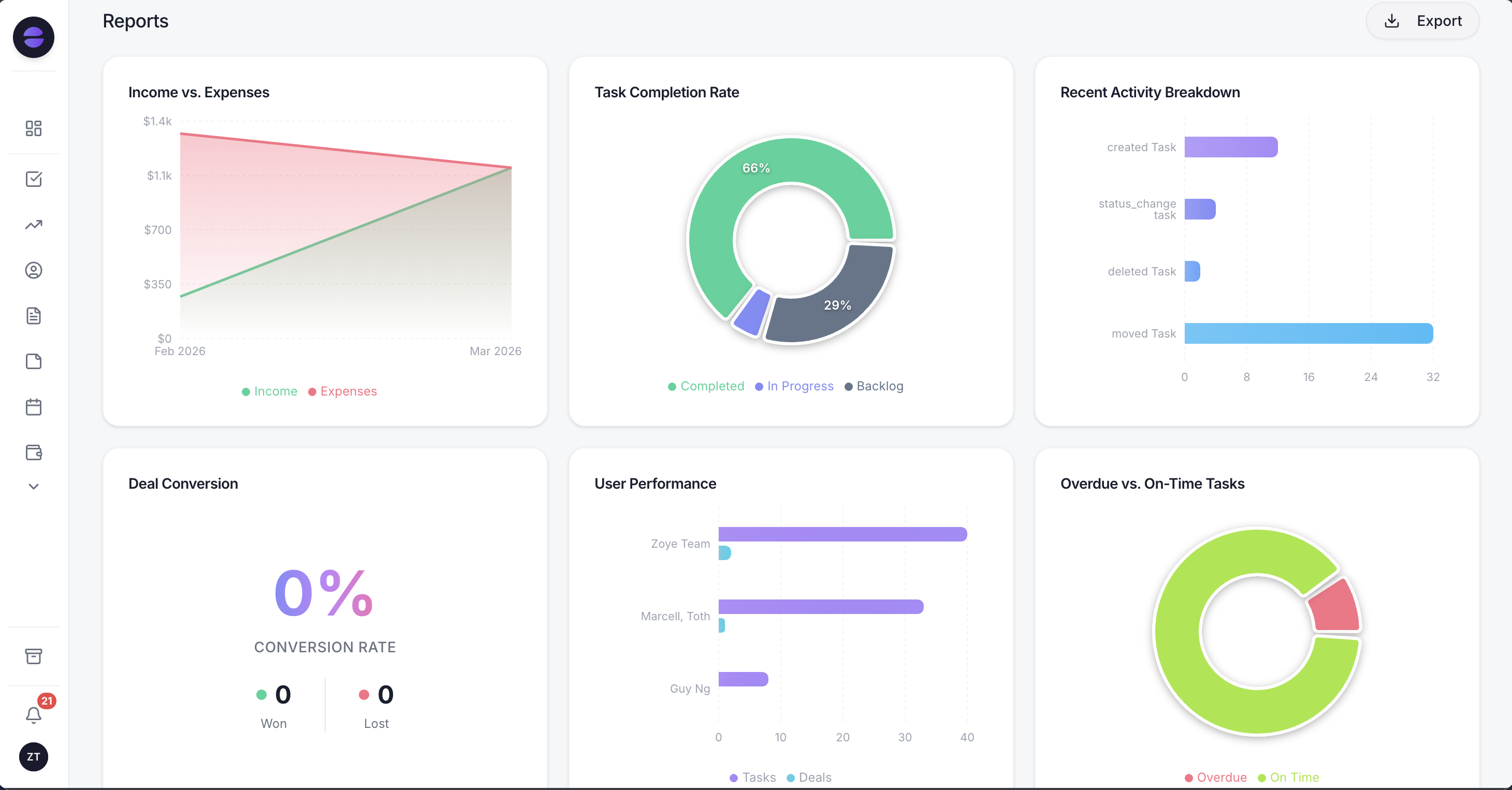
Pipeline by stage and introductions by referral partner in one report, built from live records.
The same assistant works in the app, on WhatsApp, by voice note, in Slack and in Claude. Between appointments, a broker can say "log the call with the couple from this morning, they want to wait for a lower rate, set a rate-watch reminder and tell the agent who referred them" and see the records updated. Bulk changes and deletions ask for confirmation first. A borrower can also send a photo or PDF, and the assistant reads it and adds the details to the right record; how long your brokerage keeps identity and income documents, and where, belongs in your own data policy.
On WhatsApp, Zoye holds conversations with your leads on the official WhatsApp Business Platform, and Chats keeps those together with Instagram and Facebook messages and comments, with assignment, team notes and every chat on the contact card. Connecting your brokerage's own WhatsApp number is coming soon.
Pricing (as of October 2026): Zoye charges per workspace plan, not per loan officer. Starter is $29 a month, or $23 a month billed yearly, for up to 10 members with 5GB of storage. Growth is $59 ($47 yearly) for 20 members and 10GB, Scale is $119 ($95 yearly) for 100 members and 25GB, and Customize is quoted. A solo broker can begin on Almost Free at $5 a month ($4 yearly): 1 member, the core tools, 15 AI prompts a month and the Google Calendar, Gmail and Google Drive integrations, with no automations, so the reminder rules and rate-watch messages above run on Growth or Scale, the plans that include the workflow and WhatsApp automations. See the pricing page.
Best for: independent brokers and brokerages of up to about 20 people whose lost loans come from slow replies, stalled documents and a past client book nobody works.
2. Shape - all-in-one mortgage CRM with a built-in application
Shape offers a mortgage edition with native LOS sync (its page names Encompass, LendingPad and LendingDox, plus Arive for enterprise), a borrower point of sale for applications, uploads and e-signature, a dialer, two-way texting and AI calling. The limitation is transparency and weight: the pricing page shows plan names but no dollar figures, and the tool is broad enough that a two-person brokerage may pay for a dialer and AI calling it never uses.
Its mortgage page lists referral partner tools that identify top partners and track referrals through to funded loans, and a "rate drop outreach" campaign template. It does not describe automatic rate monitoring.
Pricing (as of October 2026, Shape's pricing page): Core is "priced per user", Complete includes 5 users, and Enterprise is custom; no dollar amounts are shown. Plans bill monthly or annually with savings on annual, and every plan includes an onboarding package. Ask for a quote.
Best for: brokerages and lenders of 5 or more loan officers that want CRM, application intake and dialer in one product and will spend time setting it up.
3. Jungo - mortgage CRM on Salesforce
Jungo is a mortgage app that runs on Salesforce, so it inherits Salesforce's data model, reporting and integration list. The limitation is the platform: Salesforce is powerful and demanding, customisation is billed as professional services, and contracts run for a minimum of one year according to Jungo's site.
Jungo is a good fit for teams that already know Salesforce, or that want room to grow into it, and can accept setup and annual terms.
Pricing (as of October 2026, Jungo's site): from $96 per user a month billed annually, with a one-time setup fee of $249; a Bundle tier is listed at $125 per user a month billed annually with a $299 setup fee; Enterprise is custom. Jungo's pages blocked our direct check in October 2026, so these figures come from its own pages as indexed by search; confirm them and ask whether Salesforce licensing is included in your quote.
Best for: loan teams comfortable with Salesforce that want a mortgage layer on a platform they can extend.
4. BNTouch - mortgage CRM with published per-user pricing
BNTouch is built for loan officers and brokerage teams, with an AI sales assistant, native LOS integrations and more than 400 pre-built campaigns included on every plan, according to its own pages. The limitation is the seat model for small teams: Team needs at least 2 users, and every added loan officer adds a full seat.
Team adds lead routing and manager dashboards on top of the Individual plan, which suits brokerages from 2 to 50 loan officers by BNTouch's own description.
Pricing (as of October 2026, BNTouch's site): Individual $165 a month for one loan officer; Team $95 per user a month with a 2-user minimum; Enterprise custom. BNTouch's pricing page blocked our direct check, so these figures come from its own pages as indexed by search, and one of its pages mentions an activation fee while others say there is none. Confirm before you sign.
Best for: loan officers and brokerage teams that want a mortgage-specific CRM with prebuilt campaigns and a published price.
5. Surefire - marketing automation for mortgage, now part of ICE
Surefire is ICE Mortgage Technology's CRM for mortgage marketing: automated campaigns, loan milestone updates from application through funding, co-branded campaigns with real estate agents and other partners, video and a creative library of more than 1,000 pieces. The limitation is that it is marketing-first and priced privately; a small brokerage pays for a large content machine.
ICE's product page also mentions support for RESPA, TCPA and CCPA requirements with audit-ready reporting. As with any vendor wording, confirm what that means for your own obligations.
Pricing (as of October 2026): not published on ICE's Surefire page; contact ICE for a quote.
Best for: lenders and larger brokerages that want polished, content-heavy marketing to past clients and partners, often alongside Encompass.
6. Total Expert - customer engagement for lenders, banks and credit unions
Total Expert calls itself a customer operating system for financial services and says it serves more than 200 financial institutions. It combines customer data and insights, journeys, co-marketing, SMS, a content library and AI assistants trained on mortgage conversations. The limitation is scale: it is designed for institutions with marketing and compliance teams, not a three-person brokerage.
Pricing (as of October 2026): not published; Total Expert's site offers only a demo booking.
Best for: mortgage lenders, banks and credit unions with dozens of loan officers and a central marketing team.
7. HubSpot - a general CRM you shape into a mortgage tool
HubSpot offers pipelines, forms, email marketing and reporting, and many brokers have used it before. The limitation is that nothing about mortgages exists out of the box: loan stages, rate fields, document checklists and partner links all have to be built as custom properties and workflows, and the useful automation sits on Professional.
Pricing (as of October 2026, HubSpot's pricing page): a set of free tools, then Starter from $20 per seat a month (about $7 on some offers); Sales Hub Professional at $90 per seat a month billed yearly or $100 monthly, plus a one-time $1,500 onboarding fee.
Best for: brokerages with a marketing person who want a familiar general CRM and are willing to build the mortgage structure themselves.
Want to see it in action?
See Zoye catch a new lead, answer on WhatsApp and set up the follow-up, all from one message.
See How It WorksMortgage broker CRMs compared
The table puts the seven side by side on what matters to a brokerage: how close each sits to the loan file, the lowest published price as of October 2026, and how each handles the three leaks of this guide. Prices come from vendor pages; where a page hid figures or blocked our check, the table says so.
| Tool | Built for | Lowest published price (Oct 2026) | LOS link | Past client and rate-watch outreach | Referral partner tracking |
|---|---|---|---|---|---|
| Zoye | Small brokerages, 1 to 20 people | $29/mo for up to 10 members (Starter, no automations); $59/mo for up to 20 with automations (Growth) | None; runs next to your LOS | Live audiences on your own loan fields, approved messages | Partners as linked records, report per partner |
| Shape | Brokerages and lenders | Not shown on pricing page | Native (Encompass, LendingPad, LendingDox, Arive) | Rate drop campaign template | Partner tools listed |
| Jungo | Salesforce-based loan teams | $96 per user/mo billed annually + $249 setup | Via Salesforce integrations | Campaigns on Salesforce | Yes, on Salesforce |
| BNTouch | Loan officers and teams | $95 per user/mo (Team, 2-user minimum) | Native LOS integrations | 400+ prebuilt campaigns | Yes |
| Surefire | Lenders and large brokerages | Not published | Part of ICE Mortgage Technology | Milestone and post-close campaigns, 1,000+ creative pieces | Co-branded partner campaigns |
| Total Expert | Lenders, banks, credit unions | Not published | Not stated on home page | Journeys, insights and alerts | Co-marketing |
| HubSpot | General sales and marketing | Starter from $20 per seat | Build it yourself | Build it yourself | Build it yourself |
What a 4-person brokerage pays
Seat prices look modest until you multiply them. Take an illustrative brokerage with two brokers, a processor and an assistant, at list prices as of October 2026, before taxes, add-ons and messaging costs. The comparison is about what each line buys, not just which line is lowest.
- BNTouch Team: 4 x $95 = $380 a month.
- Jungo: 4 x $96 = $384 a month billed annually, plus $249 once for setup, and possibly Salesforce licensing.
- HubSpot Sales Hub Professional: 4 x $90 = $360 a month billed yearly, plus $1,500 once for onboarding, before you build any mortgage fields.
- Shape, Surefire, Total Expert: quote only.
- Zoye Growth: $59 a month ($47 billed yearly) for up to 20 members, with the CRM, pipeline, tasks, calendar, reports, workflow and WhatsApp automations and AI Notetaker in the same plan.
Read that honestly. If your brokerage depends on a CRM that writes into the LOS and runs the borrower application, a mortgage CRM such as Shape or BNTouch is worth its seat price, and Zoye will not replace that link. If your files run fine in the LOS and the money leaks through follow-up, documents and the past client book, the cheaper workspace covers exactly that layer.
See what Zoye can do for you
CRM, deals, tasks and your Instagram, Facebook and WhatsApp automations in one workspace. Just ask Zoye and it sets any of it up for you.
Explore FeaturesAn illustrative week in a small brokerage
This worked example shows how a typical 3-person brokerage could split the work between its LOS and Zoye. It is not a description of a real firm. The LOS owns the loan file; Zoye owns every follow-up, reminder and partner update around it.
Monday. Zoye's report shows 34 borrowers in "pre-approved", 9 of them untouched for 14 days. The stale-deal rule has already created a call task for each. The broker clears six calls before lunch; two buyers have made offers, and one agent asks for an updated pre-approval letter.
Tuesday. The approved document rule emails the 12 borrowers in "documents requested" about their open items. Email tracking shows 10 opened by the afternoon. A borrower replies on WhatsApp with photos of two pay stubs; the assistant attaches them to the contact and the processor ticks the items off.
Wednesday. A Facebook lead ad brings in four enquiries overnight. Each becomes a contact with the campaign saved, and each gets a first WhatsApp message within moments. The qualifying bot records purchase or refinance, timeline and budget range, and the two serious ones get a booked call from the Booking list.
Thursday. The broker decides, after reading the week's market news, that it is worth contacting past clients on higher rates. The rate-watch audience lists 41 past clients who closed more than a year ago above the threshold she set. She edits the wording, her compliance adviser approves it, and Zoye paces the scheduled message over the afternoon. Nine reply asking for a review.
Friday. The AI Notetaker summarises a video call with an accountant partner and creates three tasks. A rule sends each referring agent a short milestone update on their clients. Three borrowers still owe documents; their tasks are overdue, so the processor calls them, which is the right job for a person.
The LOS knew the status of every file. Zoye made sure every person behind those files heard from the brokerage at the right time.
How to switch without losing a single borrower
Move the relationship layer in stages: contacts and partners first, then open borrowers, then rules, and keep your old process running until one full month closes cleanly. A small brokerage can do this in one to two weeks. Your LOS stays where it is throughout.
- Export contacts from your current CRM, LOS reports or spreadsheets: borrowers, past clients and partners, each tagged by type.
- Add the loan fields you will filter on: rate, product, closing date and referring partner. Clean duplicates first; a tidy book of 600 beats a messy one of 1,500.
- Import into Zoye from a spreadsheet, or from Trello or Monday.com (Jira, Notion and ClickUp imports are coming soon). You can also send the assistant a CSV, PDF or screenshot and approve the records it extracts.
- Rebuild the pipeline with your stages and move every open borrower to the right one, with a next step and a date.
- Start with three rules: quiet pre-approved borrower, missing documents, new enquiry with no reply. Add the rate-watch audience and partner updates once those run cleanly.
- Check messaging rules. On WhatsApp, a message outside the 24-hour window after the borrower's last reply must use an approved template, and since 1 October 2026 each business number gets 1,000 free service messages a month, per Meta's developer documentation. Our guide to WhatsApp follow-up sequences covers timing.
Ready to hand off the busywork?
Zoye brings AI-powered CRM, task management, and automation into one workspace.
Get StartedWhich CRM should a mortgage broker choose?
Choose by where your loans leak. If you need the CRM to drive the application and sync deeply with the LOS, pick Shape or BNTouch, or Jungo if your team knows Salesforce. If you are a lender with a marketing team, look at Surefire or Total Expert. If your loans leak through slow replies, stalled documents and a silent past client book, start with Zoye.
Some typical shapes:
- A solo broker with a book of past clients and no assistant: Zoye Almost Free at $5 a month to keep every borrower, partner and note in one place (no automations on that plan), or Growth at $59 a month ($47 billed yearly) once you want reminders and rate-watch messages to go out automatically.
- A 3-person brokerage where enquiries arrive on WhatsApp and documents arrive late: Zoye Growth, with the three rules above and the LOS you already use.
- An 8-officer team that wants applications and dialing in the CRM: Shape or BNTouch, with Zoye alongside only if partner and past client follow-up keeps slipping.
- A lender with branches and a marketing department: Surefire or Total Expert.
- A brokerage already on HubSpot: stay if someone has built the mortgage fields and workflows; otherwise compare the cost of building them with a tool that has them.
Whatever you shortlist, measure one month: how many pre-approved borrowers heard from you every two weeks, how many files waited more than three days on a document, and how many past clients you contacted. Those three numbers decide more than any demo.
If your brokerage loses loans between the stages rather than inside the file, book a Zoye demo and bring your list of open pre-approvals: we will show you which reminders and partner updates would have gone out last month, and when.