
There is an unspoken rule in the short-term rental world that you are supposed to feel slightly embarrassed about running your business from a spreadsheet. Every vendor pitch opens with a picture of a messy grid and the words "still using spreadsheets?" It is a good hook and mostly a dishonest one, because for a large share of hosts and small managers the spreadsheet is genuinely the correct tool, and it stays correct for a lot longer than anybody selling software wants to say out loud.
A well-built sheet costs nothing to run, breaks in ways you can see and fix yourself, changes shape in ten seconds when your business changes shape, and never sends you an invoice for a seat you forgot to remove. It also does the one thing most software makes weirdly hard: it lets you look at every number you have on a single screen. If you own two units and want to know whether last summer beat the one before, a spreadsheet answers that faster than any dashboard.
So this article does two things in order. First it gives you a structure you can actually build today: the six tabs, the columns that go in each, the three formulas that carry most of the weight, and the habits that keep the whole thing honest. Then, once the sheet is genuinely good, it makes the harder argument: the four specific failures that mean the spreadsheet has stopped being the right tool, and what to move off it first when that day comes.
Pricing reflects published rates as of September 2026; check each vendor's pricing page for current figures.
Why the spreadsheet holds up longer than vendors admit
It helps to be precise about what a spreadsheet is good at, because that is what tells you when it stops being good.
Arithmetic over a known set of rows is its home turf. Revenue by property by month, expenses by category, net after channel commission, occupancy across a season. There is no property management system on earth that does this better than a sheet you built yourself, because the sheet has exactly your categories and nobody else's.
Change is nearly costless. You buy a third unit, you add a row. An owner wants their statement split by unit rather than combined, you add a column. In software that same request is a support ticket or a workaround. A small portfolio changes shape often, and the sheet keeps up.
You can see the whole thing. Trust in your own numbers comes from being able to trace them. In a spreadsheet you click a cell and read the formula. That transparency is worth more than most features, and it is the reason people who leave a sheet often keep one on the side anyway.
The real cost is your attention, not money. A sheet is not actually cheap; it is paid for in the twenty minutes a week you spend keeping it current, and in the risk that those twenty minutes get skipped during a busy August. That is a fair trade at two properties. It stops being fair somewhere between ten and forty, and the section further down tells you where your own line is.
The point is that the spreadsheet is a tool with a working range, like any other. Build it well and use it inside that range.
Three decisions to make before you build anything
Most short-term rental spreadsheets go wrong in the first ten minutes, not the tenth month. Three decisions set the ceiling on how far yours will get.
One row per event, always. Every tab holds one kind of thing, one per row, and nothing else. One row per booking, one row per expense, one row per turnover. The temptation is to put a booking and its cleaning cost and its owner payout on the same line because that is how you think about it. Do not. Mixed rows cannot be filtered, summed or pivoted, and the day you want to answer a new question you will be retyping the whole tab.
IDs, not names. Give every property a short code and every owner a short code, and use the code everywhere. A property is SEA-02, not "the seafront two-bed (Anna's)". Names get typed differently every time, and a SUMIFS that misses one variant will quietly return the wrong number without any error at all. Codes let a lookup fill the readable name in for you.
Dates as dates and money as money. Set the column formats before you enter a single row. Text that looks like a date will not sort, will not subtract, and will not filter. Money stored with a currency symbol typed into the cell is text too. This is boring and it is the single most common reason a sheet stops calculating correctly halfway through the year.
Get those three right and everything below works. Get them wrong and you will rebuild in six months.
Want to see it in action?
See Zoye catch a new lead, answer on WhatsApp and set up the follow-up, all from one message.
See How It WorksThe six tabs, and the columns each one needs
Here is the structure. It works for a solo host with two listings and it stretches to a co-host running thirty units for other owners.
1. Properties
One row per unit. This is your reference table, and every other tab looks things up here.
Columns: property_id (your short code), nickname, address, owner_id, bedrooms, max_guests, base_cleaning_fee, management_fee_pct, channels_listed, active_from, active_to, notes.
The active_from and active_to pair matters more than it looks. Occupancy is meaningless if you divide by 365 days for a unit you only took on in April. Keep the dates and your occupancy formula can use them.
2. Owners
Only needed if you manage for other people. One row per owner, not per property, since one owner may hand you three units.
Columns: owner_id, owner_name, email, phone, preferred_contact, agreement_start, agreement_end, fee_model, fee_value, payout_method, statement_day, notes.
statement_day is the day of the month you owe them a statement. Put it in the sheet, because that is the promise you are most likely to break.
3. Bookings
The heart of the whole thing. One row per stay.
Columns: booking_id, property_id, channel, guest_name, booked_on, check_in, check_out, nights, guests, gross_booking_value, channel_commission, cleaning_fee_charged, taxes_collected, net_payout, payout_date, status.
Two of those are the ones people leave out and regret. payout_date is what lets you reconcile against the bank, because the money for an August stay often lands in September and every mismatch you will ever chase lives in that gap. status (confirmed, cancelled, altered, refunded) is what stops a cancelled booking from silently inflating your year.
4. Expenses
One row per cost. Resist the urge to group.
Columns: expense_id, date, property_id, category, vendor, amount, payment_method, owner_recharged (yes or no), receipt_link, notes.
owner_recharged is the column that turns this tab into half of an owner statement. Costs you pass through to the owner and costs you absorb are different animals, and if you do not separate them at entry you will separate them by hand every single month. Categories should be short and fixed: cleaning, linen, consumables, maintenance, utilities, listing fees, software, travel, other. Ten categories you use beat forty you guess at.
5. Turnovers
One row per clean or maintenance job. This is the operational tab, and it is the one that saves your weekends.
Columns: turnover_id, property_id, booking_out_id, date_due, time_due, assigned_to, type (clean, deep clean, linen, maintenance, inspection), status, cost, confirmed_by_cleaner, notes.
assigned_to and status are non-negotiable. A turnover with no name against it is not scheduled, it is hoped for. Conditional formatting that turns a row red when date_due is today and status is not done will earn its keep in the first week.
6. Owner statements
A summary tab, built entirely from formulas. You should never type a number into it.
Columns: owner_id, property_id, month, gross_income, channel_fees, recharged_expenses, management_fee, net_to_owner, sent_on.
The whole discipline of this tab is that every figure is a SUMIFS pointing at Bookings and Expenses. The moment you start typing a number in here because a formula was awkward, the statement stops being reproducible and you have lost the audit trail that made the spreadsheet trustworthy in the first place.
The three formulas that do the actual work
You do not need to be an advanced spreadsheet user. Three patterns carry almost everything.
SUMIFS, for every total you will ever want. This is the engine of the owner statement. Total the gross booking value for one property in one month:
=SUMIFS(Bookings!J:J, Bookings!B:B, $A2, Bookings!F:F, ">="&$C2, Bookings!F:F, "<="&EOMONTH($C2,0), Bookings!P:P, "confirmed")
Read it as: sum the gross column, where the property matches, the check-in falls inside the month, and the status is confirmed. Swap the sum column and you get commissions, taxes or expenses from the same shape. If you learn one formula, learn this one.
XLOOKUP, so you type an ID once. Pull the readable name and the owner from the Properties tab:
=XLOOKUP($B2, Properties!$A:$A, Properties!$B:$B, "UNKNOWN ID")
The fourth argument matters. Returning UNKNOWN ID instead of an error means a typo shows up as a visible flag in the row rather than as a #N/A you scroll past. On older files INDEX with MATCH does the same job.
Nights in a given month, so a stay that straddles month end lands correctly. A guest checking in on 29 August and out on 3 September gave you three August nights and three September ones. Splitting that is the difference between an occupancy figure you trust and one you fudge:
=MAX(0, MIN($D2, EOMONTH($F$1,0)+1) - MAX($C2, $F$1))
where C2 is check-in, D2 is check-out and F1 is the first day of the month you are measuring. Occupancy is then that total divided by the available nights, which is where the active_from and active_to columns from the Properties tab come back and pay you.
From those three, everything else falls out. ADR is revenue divided by nights sold. RevPAR is revenue divided by nights available. Neither needs a new formula, only a different denominator.
See what Zoye can do for you
CRM, deals, tasks and your Instagram, Facebook and WhatsApp automations in one workspace. Just ask Zoye and it sets any of it up for you.
Explore FeaturesHabits that keep a spreadsheet honest
The structure is half of it. These five habits are the other half, and they are what separate a sheet that lasts three years from one that gets abandoned in March.
Enter on a schedule, not on impulse. Fifteen minutes on the same day every week beats an hour whenever you remember. A spreadsheet degrades from the moment you fall behind, because catching up feels like a project.
Never edit a formula in a data row. If a single row needs different logic, you have found a missing column, not an exception. Hard-coded one-offs buried in a column of formulas are the number one cause of a total that is quietly wrong.
Reconcile against the bank monthly. Take the payouts that actually landed, match them to payout_date in Bookings, and find every difference. Do it every month and each check takes ten minutes. Do it twice a year and it takes a weekend and you will not fully trust the result.
Protect the reference tabs. Lock Properties, Owners and the statement formulas. The most common data disaster is not a hack, it is somebody sorting one column instead of the whole range and shuffling every row out of alignment.
Keep a dated copy each month. One file per year with monthly snapshots. When an owner queries a statement from four months ago you need to show what you sent, not what the live formulas would produce today.
The four failure points that mean it is time to stop
None of this is about the spreadsheet being crude. It is about four specific things a grid of cells structurally cannot do. One of them is enough. If you recognise two, you have already been paying for the upgrade in unpaid hours for a while.
1. Two people need to edit at once. The moment a cleaner, a co-host or a virtual assistant needs the same file, the sheet becomes a coordination problem. Shared editing helps until two people touch adjacent things, and then you get overwritten rows, an accidental sort, or a filter view one person applied that another mistook for the real data. There is no permissions model inside a spreadsheet fine enough to say "this person may update turnover status and nothing else".
2. A follow-up exists but nobody owns it. This is the big one, and it is the failure that costs actual money. An owner asks a question in a WhatsApp message on Tuesday. A prospective owner says call me back in the spring. A contract renews in ninety days. None of these are rows in any tab, because a spreadsheet stores what happened, not what should happen next. So they live in your head and your phone, and the ones that get dropped are invisible: you never find out about the owner who went with somebody else because you did not call.
3. You rebuild an owner statement by hand every month. If the statement tab has stopped being pure formulas, if there is a manual adjustment column, if you copy figures into a document to send, then you are doing skilled data-entry work every month forever and the time only grows with the portfolio. This is the point where the sheet has become a job rather than a tool.
4. A number disagrees with the bank and nobody can say which is right. The most serious one. When the sheet says one thing and the account says another, and there is no version history or entry log to trace, you have lost the trust that made the spreadsheet worth building. Once you stop believing your own totals, every decision you make from them is a guess.
Notice what these four have in common. Not one of them is fixed by a better template, a tidier layout or more discipline. They are limits of the format: no concurrent editing with roles, no concept of a future obligation with an owner and a due date, no reusable document output, no audit history. Software is worth buying at the exact moment you hit one of those, and not really before.
Ready to hand off the busywork?
Zoye brings AI-powered CRM, task management, and automation into one workspace.
Get StartedWhat to move first, and what to keep
When you do outgrow it, do not migrate everything at once and do not start with the money. The order that works is the reverse of what most people try.
Move the people and the promises first. Owners, prospective owners, every conversation with a next step, and the contract dates. This is the part living in your head, so it is the part with the highest chance of being lost and the lowest chance of breaking anything when it moves. It is also where a business layer starts paying immediately, since a follow-up with an owner and a due date is something a system can chase and a cell cannot.
Move the documents next. Owner agreements, insurance certificates, inventories, warranties. Attached to the owner or the property they belong to, rather than in a folder tree only you can navigate.
Move invoicing and the chasing third. Owner invoices, management fees, the overdue reminder nobody enjoys sending.
Move the reporting fourth, once the three above are producing clean data to report on.
Leave the operational core exactly where it is. Your calendar, channel sync, nightly rates and OTA guest messaging belong to your property management system. If you are still running those from the spreadsheet at any real volume, a PMS is the more urgent purchase than anything on this list. And keep a personal sheet for scratch analysis afterwards if you like. Plenty of good operators do.
Zoye: the business layer after the spreadsheet
Zoye is where the first four items on that list go. It is an AI Business Operator: one workspace holding contacts, deals, tasks, calendar, documents, invoices and reports that already link to each other, with an assistant that operates them for you rather than only suggesting things.
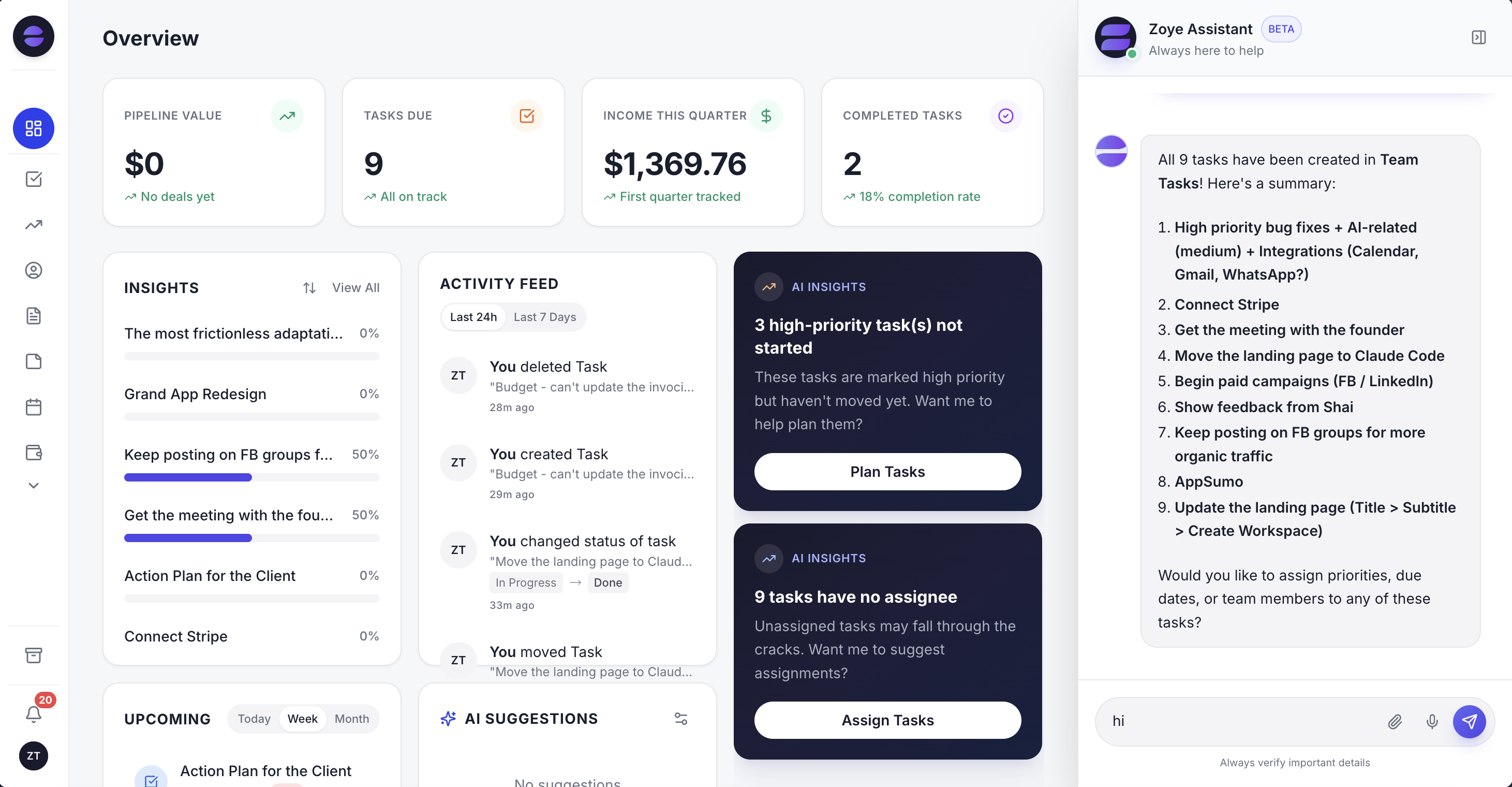 Owners, enquiries, tasks and invoices in one linked workspace, with the assistant keeping the records current.
Be clear on the boundary, because it decides whether this is useful to you. Zoye is not a property management system and does not pretend to be one. There is no channel manager, no OTA sync, no availability calendar, no nightly rates, no booking engine, no OTA guest inbox and no trust accounting. Guesty, Hostaway, Lodgify, OwnerRez and Smoobu do that work and you should keep whichever one you use. Zoye sits alongside it and runs the side your spreadsheet was covering, which is exactly the side that broke.
In practice that means an owner pipeline with real stages, so a prospective owner who said "call me in the spring" is a record with a date rather than a memory. Every enquiry carries its source, so you learn which of your channels actually produces owners. Tasks carry an assignee and a due date and can be viewed as a list, a board, a calendar or a timeline, which covers turnover coordination without a shared file anyone can accidentally sort. Documents attach to the owner or the property they belong to. Invoices and the overdue chase live next to the relationship instead of in a separate tool. Reports pull from all of it, which is the part that ends the monthly statement rebuild.
The assistant is what changes the daily rhythm. It creates and updates records when you tell it what happened, drafts the follow-up, and works the same way on WhatsApp as in the app, including from a voice note dictated between two turnovers. Send it a photo of a business card from a property meetup and you get a contact. Send it a spreadsheet and it extracts the records, which is a fairly convenient way to bring the tabs you built above across. Anything destructive or sent in bulk asks for your confirmation first, and automation rules you describe to Zoye are shown back to you in plain English before anything runs.
Pricing: flat rate, not per seat. Almost Free at $5 per month, or $4 per month billed annually, for 1 team member with 1GB storage. Starter at $29 per month, or $23 annually, for 10 members and 5GB. Growth at $59 per month, or $47 annually, for 20 members and 10GB. Scale at $119 per month, or $95 annually, for 100 members and 25GB. A Customize option is quoted for larger requirements. Full details on the pricing page.
Best for: hosts and co-hosts whose spreadsheet still handles the numbers fine but has run out of room for the owner relationships, the follow-ups and the paperwork around them.
Why hosts and managers pick Zoye
The same three reasons come up.
It takes the part the spreadsheet genuinely cannot hold. Future obligations with an owner and a due date, conversations with a source attached, contracts that expire. None of those are rows in a grid, and all of them are money.
It sits next to the PMS instead of arguing with it. Nobody has to rip out their channel manager or migrate a booking calendar. The operational core stays exactly where it is and the business layer arrives around it.
The assistant does the admin the sheet was making you do by hand, and it does it from WhatsApp, which is where a lot of this work actually happens when you are standing in a doorway waiting for a cleaner.
Bring your properties and owners into Zoye and see how much of the monthly admin disappears. The entry plan is Almost Free at $5 per month, with the core tools.
For more context, see vacation rental CRM, vacation rental marketing, CRM without data entry, and the best vacation rental software.