
Two people search this term, and they want opposite things. One owns a property and wants to know whether the percentage somebody just quoted them is reasonable or cheeky. The other manages properties for a living and is trying to work out what to put on a proposal without either scaring the owner off or signing themselves into a year of unpaid work.
This article is written for both, deliberately, because the two questions are the same question seen from either side of a table. An owner who understands how the fee is built stops shopping on the percentage alone. A manager who understands what the owner is comparing stops losing deals to a competitor who is quietly a third cheaper and quietly doing a third of the work.
What you will not find here is a benchmark presented as gospel. There is no published, audited standard rate for short term rental management, and anyone quoting you one to the decimal point is guessing with confidence. What there is: a clear map of the fee models in use, honest ranges with the reason each one moves, a plain list of what usually is and is not included, the structures that lose managers money without them noticing, and the way to present a number so it survives being compared with two others.
Every figure in this article is a range, not a quote. Percentages described as commonly advertised reflect what short term rental managers and co-hosts publish on their sites and marketing material as of September 2026; they are not survey data, not a benchmark and not a rate anybody is obliged to charge. Platform fee mechanics are described as the platforms document them as of September 2026 and change without notice. Confirm current figures on the source before you build a budget on them.
Why there is no standard Airbnb management fee
Start here, because it dissolves most of the argument that follows.
Airbnb does not set management fees. Its Co-Host Network, which connects hosts with local co-hosts, leaves the rate to be agreed between the host and the co-host rather than fixing one, and as of September 2026 Airbnb publishes no standard management rate for third party managers. The number on your proposal is a private commercial agreement between two businesses, which is exactly why the spread you see online is so wide.
The second reason is that the phrase "management fee" describes wildly different amounts of work. Consider two properties at the same nightly rate. A one bedroom city flat with a keypad, a cleaner who lives four streets away, mostly two and three night stays, and guests who need nothing more than a check in message. Then a lakeside cabin ninety minutes out of town, with a hot tub that needs testing, a septic system, seasonal heating, firewood, a cleaner who has to be booked a week ahead and guests who call about the wifi, the barbecue and the nearest supermarket. The same percentage produces the same revenue and a completely different hourly reality. Fees vary because the work varies.
The third reason is structural: some managers front load costs into a setup fee, some bury them in the percentage, some bill maintenance at cost and some at a markup. Two proposals with headline rates several points apart can leave the owner with an identical amount of money. Comparing the headline percentage without comparing the structure is the mistake almost every owner makes on their first hire.
If you are the manager reading this, that third point is also your opening. The fee conversation is winnable on clarity long before it is winnable on price, and clarity is mostly an operational problem: knowing what you quoted, having the agreement to hand, and invoicing the same way every month. That is the vacation rental CRM side of the job rather than the software that runs your calendars.
The five fee models in real use
Almost every arrangement in the market is one of these, or a blend of two.
Percentage of gross booking revenue. The most common shape by a distance. The manager takes an agreed percentage of what the booking brings in before costs. Easy to explain, easy to reconcile against a platform payout report, and it aligns both parties around the same goal, which is more revenue. Its weakness is that it pays nothing in an empty month, which is either a fair risk share or a cash flow problem depending on your seasonality.
Percentage of net. The same idea, but the percentage is taken after certain costs come off. Sounds fairer to owners and is far messier in practice, because "net" has to be defined precisely and never quite is. Which deductions come off first? Platform fees? Card fees? Cleaning? Consumables? Every unlisted item becomes a monthly negotiation. If you use this model, define net in one sentence in the agreement and show a worked example on the proposal.
Flat monthly fee. A fixed amount per property per month regardless of bookings. Predictable for both sides and genuinely attractive to owners of high revenue properties who resent watching a percentage grow. It suits stable, year round urban stock and punishes managers of seasonal properties, who carry the same off season workload with none of the peak upside unless the flat fee is set high enough to average it out.
Hybrid. A modest flat retainer covering the fixed work that happens whether or not anyone books, plus a smaller percentage on revenue. This is the model most experienced managers drift toward after a bad winter, because it matches the actual cost shape of the business: some of your work is per property, some is per booking. It is harder to explain on a one page proposal, which is the only real reason it is not more common.
Per service or a la carte. Listing setup, photography, pricing management, guest messaging and turnover coordination priced individually, with owners choosing. Popular with light touch co-hosting and with owners who want to keep guest communication themselves. It creates admin overhead and it makes your revenue per property unpredictable, but it is an honest way to serve owners who genuinely only need two of your five services.
Alongside all five sit the charges usually handled separately: cleaning and turnover, linen and consumables, maintenance, and one off setup work. How those are treated changes the owner's real cost far more than a two point difference in the headline percentage.
The ranges, and why they move
Here is the part people came for, framed carefully.
As of September 2026, these are the bands you will see advertised by managers and co-hosts on their websites and marketing material. They are not survey results, not benchmarks and not a rate anyone is obliged to meet. They exist to tell you whether a quote sits in normal territory or needs a question asked about it.
| Arrangement | Commonly advertised band | What moves it |
|---|---|---|
| Light co-hosting, owner keeps some tasks | Low teens as a percentage of booking revenue | How much the owner still does; guest messaging is the big one |
| Standard short term rental management | Mid teens to mid twenties | Property type, distance, stay length, whether you carry staff |
| Full service, high touch or luxury | Up to roughly a third, occasionally beyond | Concierge work, linen standards, remote locations, guest expectations |
| Long term residential management | Far lower, typically single digit to low double digit percentages of monthly rent, often plus a separate leasing fee | Volume of units, local rental law, tenant placement work |
| Flat monthly, per property | Set to approximate the manager's cost plus margin | Seasonality, revenue level, workload predictability |
Five things move a fee inside those bands, and it is worth naming them explicitly because they are the arguments you will actually have.
Average nightly rate. The same percentage on a 90 dollar night and a 600 dollar night are different businesses. High rate properties can support a lower percentage and still pay you well, which is why luxury owners negotiate hardest and often win.
Length of stay. Revenue per turnover is what matters, not revenue per month. A property doing twelve two night stays is roughly four times the turnover coordination of one doing three week long ones at the same occupancy.
Distance and density. Ten properties within twenty minutes of each other is a different cost base to ten spread across a county. Managers with density can charge less and earn more; managers with sprawl cannot, and should not pretend otherwise.
Who carries the staff. A manager with employed cleaners and a maintenance person carries payroll through the off season. A manager who subcontracts everything has lower fixed costs and less control. Their fees should not be the same.
Regulation and admin load. Markets with licensing regimes, occupancy tax filing, registration renewals and inspection requirements add real recurring hours that have nothing to do with guests. Fees in those markets run higher for a reason worth explaining to owners.
One platform mechanic belongs in the same conversation, because owners frequently confuse it with your fee. Airbnb's own host service fee is deducted by Airbnb before the payout arrives, under either a split structure where a smaller share is taken from the host and a larger share from the guest, or a host-only structure where the whole fee comes off the host side. Which applies depends on listing type and how the listing is connected, and the percentages are documented by Airbnb rather than by your management agreement. As of September 2026 those mechanics are published on Airbnb's own help pages and are worth reading before you build any owner projection, because a projection that ignores them overstates the owner's take.
Want to see it in action?
See Zoye catch a new lead, answer on WhatsApp and set up the follow-up, all from one message.
See How It WorksWhat the fee usually includes, and what it usually does not
The most useful page a manager can put in front of an owner is not a price. It is this table, filled in honestly for their own service.
| Line | Typically inside the management fee | Typically billed separately |
|---|---|---|
| Guest communication and screening | Yes | Rarely separate |
| Calendar and rate management | Yes | Sometimes a separate pricing service |
| Turnover scheduling and coordination | Yes, the coordination | The cleaning itself is charged separately |
| Cleaning labour | No | Guest cleaning fee, or billed to owner |
| Linen and consumables | Varies, and this is the most argued line | Often a per stay linen or supply charge |
| Routine maintenance coordination | Yes | The work itself, at cost or with a stated markup |
| Emergency call outs | Coordination yes | Contractor cost, plus any out of hours premium |
| Listing creation and photography | Sometimes | Often a one off setup fee |
| Owner statements and reporting | Yes | Rarely separate |
| Licensing, registration and tax filing support | Varies widely by market | Often a separate annual charge |
| Restocking runs and supply purchases | Coordination yes | Goods at cost, sometimes with a handling fee |
Two lines on that table cause most of the disputes. Linen is the first: whether laundry sits inside the guest cleaning charge, inside your fee or on the owner's invoice is a genuine choice, and every version is defensible as long as it is written down. Maintenance markup is the second: charging a coordination margin on contractor work is completely normal, and hiding it is what turns a normal practice into a trust problem. State the percentage in the agreement and it never becomes a conversation.
The fee structures that quietly lose managers money
If you manage properties, this is the section that pays for the reading. None of these look like mistakes at signature. All of them show up in your bank account.
Percentage only, on a seasonal portfolio. Your workload does not stop when the bookings do. Winterising, maintenance windows, owner reporting, licensing renewals and re-listing all happen in the quiet months, and a pure percentage pays you nothing for any of it. Managers of seasonal stock who never move to a hybrid or a minimum monthly are subsidising their owners from November to March.
No minimum monthly fee. Related, and more specific. A property that earns almost nothing in a month still costs you your fixed per property overhead. A small floor, stated plainly and set at your genuine cost of carrying a door, removes the worst month of the year from your risk without making you look expensive.
Absorbing turnover risk you did not price. A guest cancels inside the window, the cleaner is booked and expects paying. Who pays? If your agreement does not say, you do, every time, and it is invisible because it never appears as a line anywhere.
Maintenance at pure cost, with no coordination charge. Sourcing a plumber on a Sunday for a property ninety minutes away is real work. Passing the invoice through at exactly cost means the more problems a property has, the more unpaid labour you do. A stated coordination percentage on contractor work fixes it and is easily justified.
A percentage that never moves after year one. Costs rise. Cleaners rise. Insurance rises. Agreements signed three years ago at a rate that was thin then are losing money now. An annual review clause, with a defined notice period, is normal commercial practice and dramatically easier to invoke than a renegotiation from nothing.
Unbilled extras. The furniture delivery you waited in for. The locksmith. The four hours spent on a licensing renewal. Each one feels too small to invoice and collectively they are your margin. Either price them into the fee or bill them, but do not do them for free while telling yourself they are goodwill.
Onboarding done for nothing. Listing creation, photography coordination, pricing setup, cleaner briefing and the walkthrough are days of work that happen before a single booking. A setup fee is standard in the category as of September 2026, and managers who skip it are the ones who feel the pain when an owner leaves after five months.
How to present a fee so it survives comparison
An owner comparing three proposals will read three percentages and pick the lowest unless you give them something better to compare. Give them something better.
Lead with the owner net figure, not the fee. The number an owner actually cares about is what lands in their account. Show projected booking revenue, then every deduction in order including platform fees, cleaning, consumables and your fee, then the owner net at the bottom. A proposal that ends at your percentage forces them to do the maths. A proposal that ends at their money does the work for them and quietly reframes the comparison.
Be conservative in the projection and say so. Overstated occupancy wins the signature and loses the client in month four. Show a realistic scenario and name your assumptions on occupancy and average nightly rate. Owners who have been burned once can tell the difference immediately, and they are the owners worth having.
Put the exclusions in writing on the same page. Counter-intuitively, listing what is not included makes you look more expensive and win more often, because the owner can now see that the cheaper quote did not mention it either. Silence on exclusions is what the cheapest proposal relies on.
Show one worked month. A single realistic month, line by line, from gross to owner net. It answers ninety percent of the questions before they are asked and it is the page owners forward to their partner.
Give the fee a job. A bare percentage is a number. "Our fee covers guest communication seven days a week, pricing managed weekly rather than set and forgotten, turnover coordination with our own cleaning team, maintenance handled without you being called, and a monthly statement on the fifth" is a service. Same fee, entirely different question in the owner's head.
Answer the self management objection before they raise it. Many owners genuinely can do this themselves, and pretending otherwise insults them. Make the trade explicit in hours and in lost revenue from slow enquiry responses and flat pricing, then let the numbers argue. If the numbers do not favour you for that property, say so. The manager who told an owner the truth is the one they call the following season.
See what Zoye can do for you
CRM, deals, tasks and your Instagram, Facebook and WhatsApp automations in one workspace. Just ask Zoye and it sets any of it up for you.
Explore FeaturesWhere Zoye fits, and where it does not
Be clear about the boundary first, because this is a fees article and the tempting misread is that a cheaper tool replaces an expensive one.
Zoye is not a property management system and it does not price your management work. It has no channel manager and no sync with Airbnb, Booking.com or Vrbo. There is no availability calendar, no nightly rate engine, no booking engine, no OTA guest inbox and no trust accounting for owner payouts. Whatever you charge and however you structure it, your PMS keeps every one of those jobs, whether that is Guesty, Hostaway, Lodgify, OwnerRez or Smoobu. Zoye sits next to it and runs the commercial half of the fee: winning the owner, agreeing the number, papering it, and collecting it.
That half has a shape most managers recognise. A quote goes out and the owner says they will think about it. The agreement is a PDF in an inbox and a signed copy somewhere on a drive. The monthly owner invoice is rebuilt by hand from three sources. Two owners are late paying and nobody has chased them, because chasing an owner is the least appealing task in the business.
Zoye holds that as records rather than as memory. Each owner is a contact with their properties, their agreed fee structure, their documents and their whole history attached. The quote is a deal in a pipeline with a stage and a dated next action, so the owner who said "let me think" gets followed up on the day rather than three weeks later. The signed agreement, the schedule of fees and the insurance certificate live on the owner, not in an inbox. Monthly invoices go out and the unpaid ones surface without you remembering to look.
The part that changes the working day is that the assistant acts rather than reminds. Tell it on WhatsApp, between properties, that the owner from the harbour viewing wants a percentage-fee quote with a setup fee, and the record, the deal and the follow up task exist. Ask which owner quotes have gone quiet for more than ten days and you get the list, then tell it to chase them and they get chased. Ask what your average fee percentage is across signed owners this year, or which properties are costing more in unbilled call outs than they earn, and you get the figure rather than a chart to interpret.
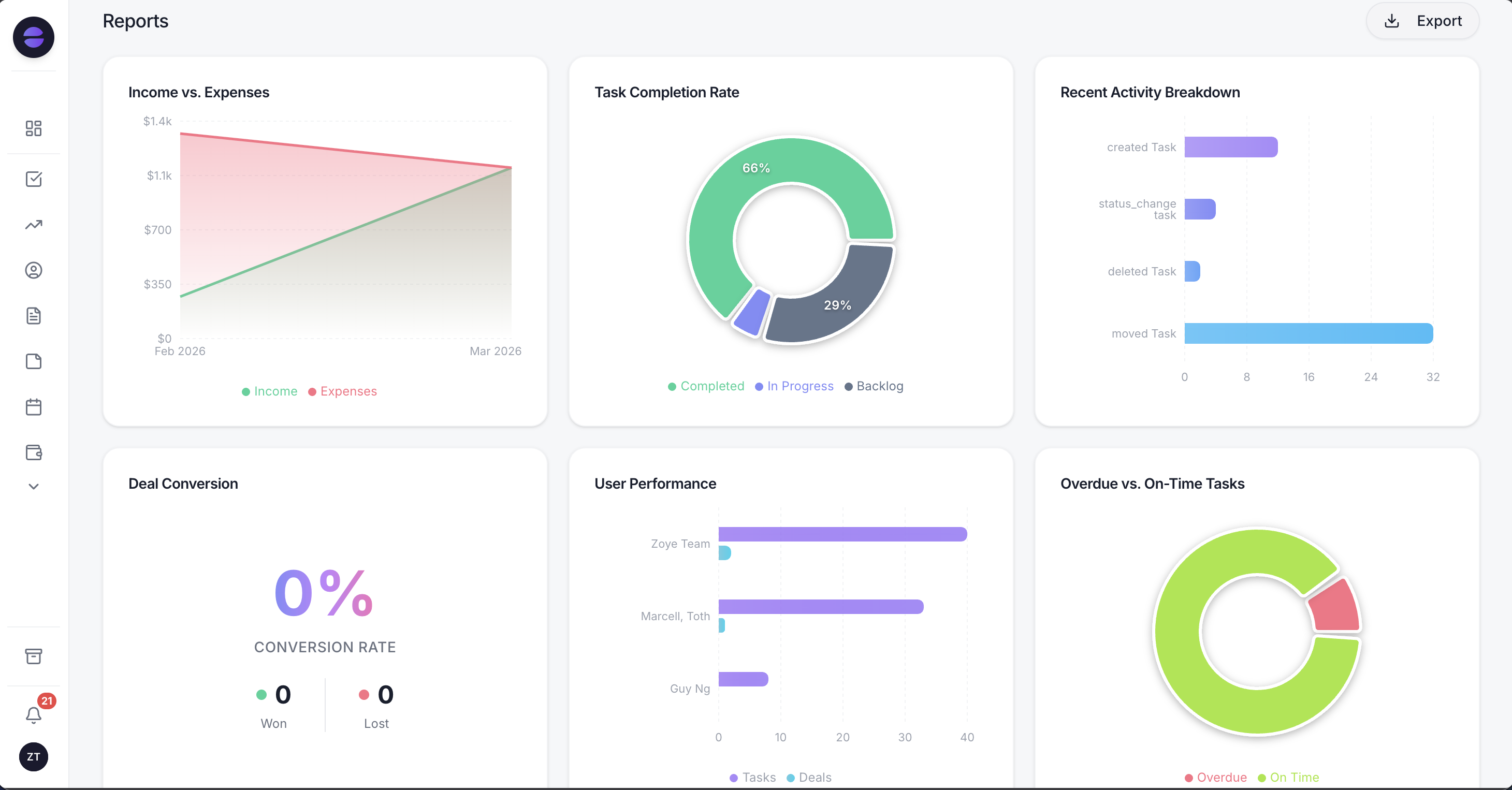 Owner quotes, average agreed fee and outstanding owner invoices as figures you can act on, next to the system that runs your calendars
On cost, Zoye is priced as flat monthly plans for the whole workspace rather than per property or per booking, which matters in an industry where almost every other line scales with door count. As of September 2026 the plans are Almost Free at 5 dollars a month, or 4 dollars a month billed annually, with 1 team member and 1GB of storage; Starter at 29 or 23 with 10 members and 5GB; Growth at 59 or 47 with 20 members and 10GB; Scale at 119 or 95 with 100 members and 25GB; and a Customize plan quoted for larger operations. Current details are on the pricing page.
Ready to hand off the busywork?
Zoye brings AI-powered CRM, task management, and automation into one workspace.
Get StartedReviewing your fee once a year
Whichever side of the table you are on, a management fee is not a decision you make once.
Managers should run the same short exercise every year, per property rather than in aggregate. Take one property. Estimate the hours it genuinely consumed over twelve months across guest messaging, turnovers, maintenance, owner communication and admin. Multiply by what your time has to be worth for the business to work. Add a share of fixed overhead. Compare that to what the property actually paid you. Do it across the portfolio and you will usually find the same pattern: a small number of properties earn most of the margin, a few break even, and one or two cost you money while feeling busy. That is not a pricing problem across the board. It is a pricing problem on three specific doors, and it is fixable with a conversation.
Owners should review from the other direction. What did the manager actually do this year, what did occupancy and average nightly rate do, and what would self managing have cost in your own hours? A fee that looked high in January often looks obvious in December, and occasionally the reverse. Either way, the review is the point.
The last word on the number itself: a fee is a price for a scope of work, so make the scope the conversation. Managers who compete on percentage attract owners who leave for a lower percentage. Managers who compete on what the owner nets, and can show it every month without rebuilding it by hand, keep them.
Ready to run the owner side of your business properly? Explore Zoye and see how the quote, the agreement, the follow up and the owner invoice can live in one place, with an assistant that works them for you.
For more context, see our guides to winning property management clients, generating property management leads, what a Hostaway based stack really costs, and the vacation rental CRM that runs the owner relationship alongside your PMS.
Frequently asked questions
There is no single fair number, because the fee is a price for a scope of work rather than a market rate. As of September 2026 the ranges you will see advertised by short term rental managers commonly run from around the low teens as a percentage of booking revenue for light co-hosting up to roughly a third for genuinely full service management in high touch markets, and long term residential management sits far lower again because the work is far smaller. The honest test is not whether your number sits inside a range. It is whether the owner can see, on one page, what the fee buys, what is billed separately and what they take home after everything.
Percentage of gross booking revenue is simpler to explain, easier to reconcile against a payout report and harder to argue about, which is why most managers end up there. Percentage of net rewards you for costs you do not control and invites a monthly argument about what counts as a deduction. If you do quote on net, define net in one unambiguous sentence in the agreement, naming exactly which deductions come off first, and show a worked example on the proposal. Ambiguity in this clause is the single most common source of owner disputes.
Usually not. In most arrangements the cleaning or turnover charge is collected from the guest and passed to the cleaner, and the management fee is separate. Where managers differ is on whether they keep a coordination margin on it, whether linen and consumables are inside that charge or billed to the owner, and who absorbs the cost when a guest cancels late and the turnover is already scheduled. All three of those need to be written down before the first season, not discovered in month four.
Work it backwards from your own cost rather than copying a competitor. Estimate the hours a property genuinely takes you per month across guest messaging, turnover coordination, pricing, maintenance and owner reporting, multiply by what your time has to be worth, add a share of your fixed overhead and your target margin, then divide by the property's realistic monthly booking revenue. That gives you the percentage this specific property must earn you. Compare that against local advertised rates as a sanity check, and if the two disagree badly, the property is probably not the right fit rather than your price being wrong.
Because the fee prices work, and the work is genuinely different. A city apartment with a keypad, a nearby cleaner and mostly two night stays takes a fraction of the labour of a remote lakeside cabin with a hot tub, a septic system, a ninety minute drive and guests who arrive with questions. Average nightly rate matters too, since the same percentage produces very different revenue on a 90 dollar night and a 600 dollar night. Regulation, licensing, local tax filing and whether you carry staff or subcontract all move it further.
Neither. Zoye does not price your management work and it is not a property management system: no channel manager, no OTA sync, no availability calendar, no nightly rates, no booking engine, no OTA guest inbox and no trust accounting. It sits alongside Guesty, Hostaway, Lodgify, OwnerRez or Smoobu rather than replacing them. What it runs is the commercial side of the fee: the owner pipeline and the quote, the management agreement and its documents, the follow up while the owner decides, monthly owner invoicing and the chasing when one goes unpaid, and reporting you can put in front of an owner.