
Property Management Leads: How to Qualify Owner Leads in 2026
Ask a small vacation rental management company where growth comes from and you will usually hear a list of channels. Ask the same company which of the owner names in its pipeline are actually worth calling this week and the room goes quiet. That gap is the real bottleneck at 5 to 40 properties. Not the volume of property management leads, but the fact that nobody has decided what a good one looks like, so every lead gets treated the same and the two or three that would have signed drown in the noise.
The cost of that is easy to miss. An unqualified pipeline does not fail loudly. It just spreads your attention across owners who were never going to hand over their property, while the owner who was ready in May quietly signs with the manager down the road in June. Meanwhile the leads you do win are sometimes the wrong ones: a single cabin ninety minutes outside your cleaning cluster, or an owner who expects a number the property cannot produce, and both of those eat margin for a year before the contract ends.
This guide is about the leads themselves rather than where to find them. It covers what an owner lead actually is, the trigger events that mean someone is ready, what a genuinely good owner lead looks like on paper, which leads to politely decline and why declining protects your business, a five minute scoring model, and the follow-up cadence that turns a not right now into a signed management agreement. If your problem is volume rather than judgement, the companion piece on property management lead generation covers the channels.
Fee ranges, timelines and cadence intervals below reflect commonly reported norms in short-term rental management as of August 2026. Your market, service level and cost base will shift all of them.
What a property management lead actually is
The single most useful distinction in this business is between a guest enquiry and an owner lead. A guest enquiry is demand for a property you already manage: valuable, time sensitive, and finite, because it is capped by the doors you have. An owner lead is demand for your company. Win one and you add revenue that recurs every month for as long as the agreement lasts, plus the guest enquiries that come with the new listing. They are not the same asset and they should not sit in the same pipeline with the same stages.
Owner leads arrive in recognisable shapes, and knowing the shape tells you most of what you need to know before the first call. The self-managing host has been running the property themselves and has hit the wall: messages at midnight, a cleaner who cancelled on a Saturday, a calendar they cannot leave alone on holiday. The switching owner already pays a manager and is unhappy about performance, communication or a fee increase. The new investor has just closed on a unit and has no operational setup at all, which makes them the fastest to sign and the most likely to have unrealistic revenue expectations. The accidental owner has inherited or relocated and never wanted to be a host in the first place. And the multi-unit owner, the person with three apartments in one building or a small portfolio of cabins, is the lead that changes your year if you win it.
Each shape needs a different conversation. The self-managing host is buying their time back, so lead with what disappears from their week. The switching owner is buying reliability, so lead with reporting and response times, and never with a lower fee. The new investor is buying certainty, so lead with realistic numbers and how you produce them. The accidental owner is buying distance, so lead with how little they will ever have to touch. One generic pitch sent to all four converts worse than four short, specific ones, and the only way to know which to send is to have qualified the lead first. This is also where a proper vacation rental CRM earns its keep, because the shape of the lead has to be recorded somewhere the next conversation can read it.
The signals that an owner is ready to hand over management
Owners rarely decide to hire a manager in the abstract. They decide after something happens. If you learn to recognise the events, you stop guessing at timing and start reaching people in the two or three weeks when they are actually deciding.
A recent purchase. An owner who has just bought is at the highest readiness of their whole ownership cycle, because there is no incumbent to displace and no habit to break. They also have a mortgage payment starting, which creates urgency.
A visible performance problem. A run of mediocre reviews, a listing that has slipped down the local results, a cancelled stay, or a guest incident that took the owner three days to sort out. Any of these turns a vague sense of inefficiency into a specific bad memory, and bad memories drive decisions.
An operational break. The cleaner quit, the co-host stopped replying, the handyman moved away. Self-management usually rests on one or two informal relationships, and when one of them breaks the owner discovers how much of the system was held together by luck.
A change in the owner's own life. A new job with less flexibility, a move to another country, a baby, a divorce, a retirement, an ageing parent. None of these are about the property, and all of them end self-management.
The end of a manager relationship. Contract renewal dates, a fee increase letter, or a manager who has been acquired or has quietly stopped answering. Switching moments are contractual as often as they are emotional, which means they are predictable if you know when the agreement runs.
Questions about numbers. The quietest and most reliable signal of all. When an owner starts asking what occupancy is normal, whether their nightly rate is right, or what the place next door earns, they have begun measuring themselves. Owners who measure themselves usually conclude they should not be doing this alone.
Seasonal exhaustion. In most markets there is a fortnight just after peak season when self-managing owners are tired, have just finished a hard summer, and are willing to have a conversation they would have refused in April. Knowing your local version of that window is worth more than any lead list.
What a good owner lead looks like
Once a lead is in front of you, six attributes decide whether it is worth pursuing, and all six can be established in a fifteen minute call.
Location relative to your cluster. This is first for a reason. Your margin lives in density: how many properties one cleaning team can turn in a day, how far a linen run travels, how quickly someone can get there when a guest is locked out. A property inside your existing cluster is cheap to serve. The same property forty minutes outside it is a different cost structure wearing the same fee.
Unit count and future units. One good unit is fine. One good unit from an owner who is buying another next year is much better. Ask directly whether they plan to add properties, because a multi-unit owner is both a bigger contract and a cheaper one to service.
Property standard and readiness. Is it ready to let at the standard your brand promises, or does it need photography, furniture, a smart lock, a mattress and a deep clean before it can list? Work is not automatically a problem, but it is either an investment the owner funds now or a discount you are giving them for a year.
Current setup. Self-managing, with another manager, or sitting empty. This tells you the sales cycle, the objections and the switching cost. It also tells you whether there is real data to work with: an owner with two years of booking history is far easier to make honest promises to than one with none.
Revenue potential against your fee. Estimate what the property can plausibly earn in your market, apply your standard fee, and compare it against the real cost of servicing that door. Commonly reported management fees in short-term rental sit somewhere between the mid teens and the low thirties as a percentage of booking revenue depending on market and service level, which means a low-earning property in an expensive-to-service location can be genuinely unprofitable at any fee an owner would accept.
Expectations and decision authority. What does the owner think the property will earn, how much personal use do they want to keep, and are they the only person who has to agree? An owner expecting a number twenty percent above the honest forecast is not a good lead until that gap is closed in conversation, and a lead where the spouse or sibling has not been in a single call is not really a lead yet.
Want to see it in action?
Watch how Zoye automates your daily workflow - from lead management to team collaboration.
See How It WorksThe owner leads to politely decline
Declining feels wrong when you are trying to grow, which is exactly why unprofitable doors accumulate. A bad property costs you onboarding time, guest complaints that damage your brand, staff hours you cannot bill, and eventually a lost contract anyway, so the decline is not lost revenue but avoided cost. These are the recurring patterns worth walking away from.
The owner who wants a guaranteed income. Guaranteed rent is a fundamentally different business with a different risk profile. If you do not run that model, say so plainly. An owner who insists on it will be unhappy every month that the market underdelivers, and will treat the shortfall as your failure.
The owner who keeps the calendar. Some personal use is normal and easy to accommodate. An owner who intends to block prime weeks at short notice, or who wants approval rights over individual bookings, has removed your ability to produce the revenue you are being judged on. Agree the personal-use rules before signing, or do not sign.
The property the owner will not invest in. Tired furniture, no photography budget, a bathroom that will generate its own reviews. You cannot deliver a premium result from a property the owner has decided is good enough, and their reviews become your reviews.
The fee shopper. An owner whose only question is your percentage is not comparing service, they are running an auction. They will churn to whoever undercuts you next year, and they will spend the intervening twelve months asking for extras that were never in the fee.
The disagreeing co-owners. Two siblings, a couple mid-separation, an investor group with no lead decision maker. These leads consume enormous time and stall at the agreement stage. Ask early who signs, and park the lead politely until there is an answer.
The property you cannot legally or practically operate. No permit where a permit is required, a building or association that forbids short lets, a lease that does not allow it. Verify before you invest a single hour, and never take on the regulatory risk on an owner's assurance.
Declining well is a business asset in itself. Explain honestly why the fit is not right, recommend a better shape of provider if you know one, and leave the door open. Owners talk to each other, and a straight no that saved someone money is remembered longer than a pitch.
A lead scoring model that takes five minutes
You do not need a complicated system. You need one that gets applied consistently, which means it has to be simple enough to fill in during the call.
Score each lead from 0 to 2 on five criteria: cluster fit, unit potential, property readiness, revenue against your fee, and motivation plus timeline. Two points means clearly good, one means workable with a caveat, zero means a real problem. That gives a total out of ten.
| Score | What it means | What you do |
|---|---|---|
| 8 to 10 | Strong fit, ready owner | Assessment or viewing booked within 48 hours, proposal within a week |
| 5 to 7 | Real but needs work | Qualify the weak criterion specifically, then decide. Most pipelines live here |
| 3 to 4 | Marginal | Long nurture only. No proposal, no site visit, quarterly check-in |
| 0 to 2 | Decline | Answer honestly, refer on if you can, close the record with a reason |
On top of the score, keep a short list of hard filters that override any total: outside your service radius, no legal permission to let, requires a revenue guarantee you do not offer, personal-use demands that break the calendar. A lead can score eight and still be a decline on a hard filter, and that is the point of separating them.
Two rules make this model work in practice. Write down the reason for every zero, because those reasons become your best pipeline report at the end of the quarter. And record a decline as a closed record with a reason rather than deleting it, because plenty of declined owners come back in two years having fixed the exact thing that disqualified them.
See what Zoye can do for you
From CRM and deal tracking to AI-powered task management - explore everything Zoye offers in one workspace.
Explore FeaturesThe owner pipeline: stages that mean something
Most owner pipelines fail because their stages describe your feelings rather than the owner's behaviour. New, warm, hot and maybe are not stages, they are moods, and they cannot tell you what to do next. Define stages by an observable event, and make the exit condition explicit.
New enquiry. The owner has made contact or you have made first contact. Exit condition: you have spoken to them and have a score.
Qualified. Scored 5 or above, no hard filter triggered, decision maker identified. Exit condition: an assessment or viewing is in the calendar.
Assessment booked. You are going to see the property or review its history and numbers. Exit condition: you have enough to produce a real forecast.
Proposal sent. Forecast, fee, what is included, what is not, and the onboarding timeline, in writing. Exit condition: the owner has responded to the substance, not just acknowledged receipt.
In negotiation. They are engaged and something specific is being resolved: fee, personal use, notice period, the work the property needs. Exit condition: agreement issued.
Agreement signed. Signed, dated, countersigned, stored somewhere you can find it in a year rather than in a mail thread.
Onboarding. Photography, listing setup in your PMS, keys and access, cleaning rota, first pricing pass. Exit condition: live and taking bookings.
The discipline is that a lead may not sit in a stage without a next action and a date. A lead with no next action is not in your pipeline, it is in your memory, and memory is where owner leads go to die during a bad changeover week.
The follow-up cadence that converts a maybe
Almost every owner lead you lose is lost to silence rather than to a competitor's better pitch. Owners are not evaluating you full time, they have day jobs and the property is a side concern until something breaks. Cadence is what puts you in front of them at the moment it does.
A rhythm that works looks roughly like this. Reply within the hour, or as close as you can manage, with something concrete rather than a holding message. Two days later, send the thing they cannot get elsewhere: a realistic revenue range for their specific property type and area, with your reasoning shown. A week in, send proof: an anonymised owner report, a before and after on a similar property, an example of your monthly statement. Two weeks in, make it easy to decide with a short summary of the agreement in plain language, fee, notice period, what happens in the first thirty days. At the month mark, ask the closing question directly and give them a clean exit, because a clear no is worth more than a fourth unanswered email.
Then, and this is the part almost nobody does, move the non-signers into a slow nurture rather than deleting them. A quarterly touch with something genuinely useful, a market note, a regulation change, a seasonal reminder about pricing, keeps you present at close to zero cost. Add one deliberate seasonal re-approach in the tired fortnight after peak season, and one before the pre-season scramble. A large share of signed agreements at this size come from owners who said not right now the first time.
Two details decide whether the cadence survives contact with reality. It has to be the default for every lead rather than a decision you make each time, and it has to run when you are on a roof looking at a broken air conditioner, which means it cannot depend on you remembering.
Ready to streamline your business?
Zoye brings AI-powered CRM, task management, and automation into one workspace.
Get StartedThe numbers worth tracking on your owner pipeline
Four numbers tell you almost everything about your owner acquisition, and none of them require a reporting tool you have to configure for a week.
Lead source and what each source converts to. Not how many leads a source produced, but how many signed agreements. Referrals from existing owners and from cleaners usually convert several times better than anything paid, and you will only know if the source is recorded at capture.
Time from first contact to first reply. This is the one metric where a small operator beats a large one consistently, and it slips quietly in busy months.
Score distribution and where deals die. If half your pipeline sits at 5 to 7 and never advances, the problem is a qualification conversation you are not having. If leads die at proposal, the problem is the forecast or the fee framing, not the lead quality.
Decline reasons. Read them once a quarter. If most declines say outside cluster, that is a marketing targeting fix. If most say owner would not invest in the property, that is a pitch and positioning fix.
How Zoye runs the owner pipeline for you
Everything above is achievable with a spreadsheet and unusual discipline. What breaks it is a busy week, and busy weeks are the job. Zoye is an AI Business Operator: rather than being another system you maintain, it captures the owner leads, keeps the pipeline honest, and does the chasing itself.
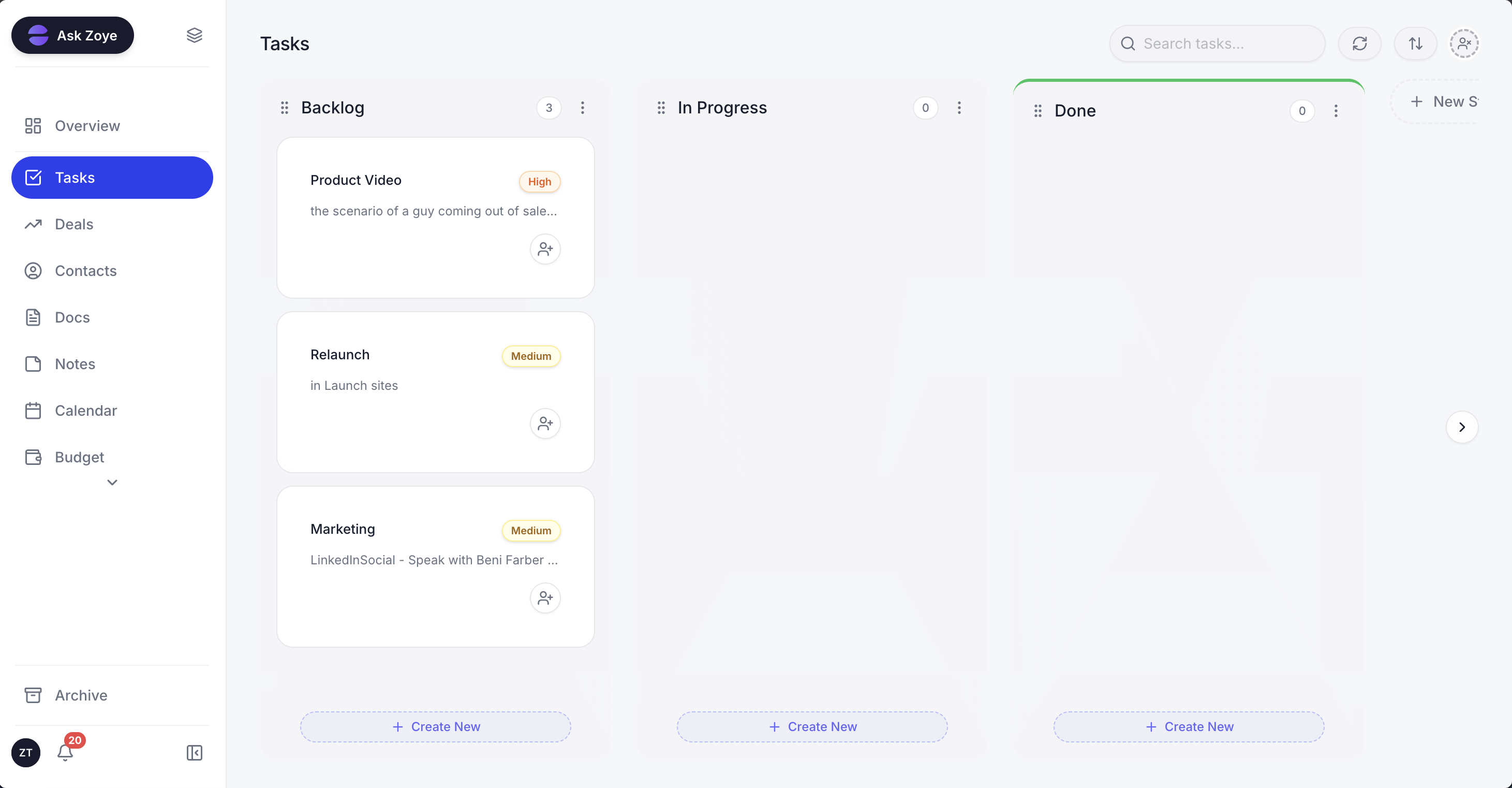 Every owner lead sits in a stage with a next step and a due date, so nobody goes quiet by accident.
In practice that means enquiries from your site, your inbox, WhatsApp and social all land as owner leads with their source attached, so your source-to-signed numbers exist without anyone typing them in. The stages, scores and decline reasons live on the record, and the operator updates them as the conversation moves rather than waiting for you to log it. When a lead goes quiet, it drafts and sends the next message in the cadence, and keeps going until the owner replies or clearly closes the door. You describe the sequence you want in a plain sentence, including from WhatsApp or Slack, and it builds and runs it. Management agreements, owner documents and property notes sit against the owner record instead of a shared drive, cleaner and staff tasks live on the same board, and the reports on owner acquisition build themselves from the data the operator has already captured.
To be honest about scope, Zoye is not a property management system and does not pretend to be one. There is no channel manager, no Airbnb, Booking.com or Vrbo sync, no availability calendar or nightly rate engine, no booking engine, no OTA guest inbox, and no owner statements with trust accounting. Keep Guesty, Hostaway, Lodgify, OwnerRez or Smoobu for the bookings. Zoye runs the business around them: the homeowner pipeline, the enquiry follow-up, the agreements and documents, the staff tasks and the owner invoicing, which is precisely the half that usually lives in five spreadsheets only you can open.
Pricing: plans start at $5 per month for 1 member, then $59 per month for 10 members, $99 per month for 20 members, and $199 per month for 100 members, with a Customize tier for larger portfolios. Pricing is flat-rate per plan rather than per seat. Check the pricing page for current figures.
Best for: vacation rental and short-term rental management companies from roughly 5 to 40 properties, co-hosts, and villa or cabin brands that already have a PMS and need the owner-acquisition and back-office half to run itself.
Why operators pick Zoye
Three themes come up consistently among managers at this size.
Nobody has to remember. The operator captures each owner lead, keeps its stage and next action current, and sends the follow-ups during the weeks when a human simply cannot, which is when most owner leads are lost.
It respects the stack you already have. The PMS keeps the calendar and the channels. Zoye takes the growth and admin work that the PMS was never built for, so you stop trying to make one tool do both jobs badly.
It works where owners actually talk. WhatsApp, email, your site form and referrals funnel into one place, and the chasing happens from an instruction you typed once in plain language.
Put your owner pipeline somewhere it cannot be forgotten. Get started with Zoye and let the operator do the qualifying and the chasing while you run the properties.
Property management leads are homeowners, not guests. A property management lead is an owner of one or more rentable properties who might hand over the running of those properties to you: a self-managing host who is tired of the work, an owner unhappy with their current manager, an investor who has just bought a unit, or someone who inherited a second home they do not want to operate. Guest enquiries are demand for the properties you already manage. Owner leads are demand for your management business, and they are the ones that grow revenue permanently.
Readiness almost always shows up as a trigger event rather than a stated intention. The strongest signals are a recent purchase, a run of poor reviews or a guest incident, a cleaner or handyman who has just quit, a change in the owner's own life such as a new job, a move, a birth or a retirement, and the end of a contract with an existing manager. A second class of signal is quieter: the owner has started asking questions about occupancy, rates and what other properties nearby are earning. That is someone measuring their own performance, which is usually the step before deciding they should not be doing it themselves.
There is no universal number, because unit count only matters relative to your cluster. One well-located property inside the area your cleaners already cover can be more profitable than three properties an hour apart in a market you do not serve. As a working rule, a single unit is worth taking when it sits in your existing cluster and meets your standard, and it becomes marginal when it forces a new travel route, a new cleaning team or a new local supplier for the sake of one door.
Yes, and the operators with healthy margins do it regularly. The leads worth declining are the ones that cost more to serve than they earn: the owner who wants a revenue guarantee, the owner who will keep blocking prime weeks for personal use, the property that needs work the owner will not fund, the owner who is negotiating only on fee percentage, and the co-owned property where the decision makers disagree with each other. Declining early is cheaper than onboarding, underperforming and then losing the contract anyway.
Longer than most operators plan for. An owner who has just had a bad month can sign within a week or two, but a comfortable owner is often deciding across a whole season, because the natural switching moment is between peak periods. That is why cadence matters more than pitch quality: the lead who says not right now in April is frequently the lead who signs in October, and the only reason they sign with you is that you were still in touch when the moment arrived.
It can, and that is the difference that matters at 5 to 40 properties. A traditional CRM stores the owner and reminds you to chase, which still depends on you remembering to act during a busy changeover week. Zoye is an AI Business Operator: it captures each owner lead with its source, moves it through your stages, drafts and sends the follow-ups to the ones that have gone quiet, and keeps the thread alive until the owner either signs or clearly says no, including over WhatsApp.
Conclusion
Property management leads are not a volume problem at 5 to 40 doors, they are a judgement problem. Decide what a good owner lead looks like for your cluster, score every lead the same way, decline the ones that would cost you more than they pay, and run a follow-up cadence that keeps you present until the owner's trigger event arrives. Do that consistently and your pipeline stops being a list of names and becomes a forecast. Do it with an operator that captures and chases on its own and it keeps working during the weeks you are too busy to look at it, which are the weeks it matters most.
For more context, see property management lead generation, how to get property management clients, the CRM for real estate agents, and the guide to automated follow-up emails.