
How to Get Property Management Clients: First Contact to Signed Agreement
You already have the lead. A broker passed on a name, an owner replied to your message, or you got talking at a viewing with a couple who bought a cabin last spring and cannot face another season of guest questions arriving at midnight. Generating that conversation is a separate skill. What decides whether your portfolio grows is the two to six weeks that come after it, and that is where small management companies quietly lose owners to the company one town over.
The pattern is depressingly consistent. Three warm owners in a month, three good conversations, one projection actually sent, zero proposals followed up, and a signature that happens somewhere else. Nobody dropped the ball deliberately. The manager was cleaning a unit, arguing with a hot water system, and answering a guest, and the owner who needed a nudge on Thursday got it three weeks late, by which point they had signed with someone who nudged on Thursday.
This guide is the sequence, in order: how to open the conversation, which numbers an owner actually wants to see, how to price and present your fee, the four objections you will hear every single time, the proposal that gets signed, what belongs in the management agreement, and how to onboard the property so the first thirty days produce a referral instead of a complaint. It assumes you already have the lead and want to convert it.
Fee percentages and revenue figures below are typical market ranges as of August 2026, not benchmarks. Your own numbers depend on your market, property type and service level.
Step 1: open the conversation as a diagnosis, not a pitch
The single biggest mistake in the first conversation is presenting. You arrive with a deck, list your services, name your fee, and the owner now has enough information to compare you on price with two other managers and nothing else. You have made yourself a commodity in twenty minutes.
Do the opposite. The first conversation is a diagnosis, and you should be talking for roughly a third of it. What you want is enough concrete detail to build a projection they cannot argue with, plus a clear read on why they are actually talking to you.
Ask, in roughly this order:
- How many nights did the property book last year, and at roughly what nightly rate?
- Which platforms is it listed on, and is there a direct booking channel?
- What are you doing yourself right now: messaging, pricing, cleaning coordination, maintenance?
- Which of those do you dislike most?
- Who cleans it, and what happens when they cancel?
- What happened the last time something broke while a guest was in the house?
- What are you actually trying to get out of the property: more income, protecting the asset, or your weekends back?
- Is there anyone else involved in the decision, and what would they need to see?
That last question saves more deals than any other. A surprising share of owner decisions stall because a co-owner or a spouse who was never in the conversation says no by default.
Two mechanical rules. First, ask for the listing link and last year's booking or payout summary before you quote anything. An owner who will not share numbers is not ready, and a projection built on guesses is the fastest way to lose credibility later. Second, end the call by booking the next one. Not "I will send something over", but a specific time to walk through the numbers together. A calendar invite in the owner's diary converts far better than a document in their inbox.
Whatever holds your owner pipeline, whether that is a spreadsheet you genuinely keep updated or a purpose-built vacation rental CRM, the record needs to carry more than a name and a phone number after this call. Write down the unit count, the current setup, the owner's stated goal, the objection you already heard, the decision maker, and the date of the next action. Six weeks later that is the difference between a follow-up that sounds like you were paying attention and one that sounds like a mail merge.
Step 2: the numbers an owner actually wants to see
Owners do not buy your service list. They buy one number: what lands in their bank account. Almost every proposal that loses on price lost because it presented a fee against a gross figure and left the owner to do subtraction in their head.
Build a one-page projection with the arithmetic visible. It has five parts:
- Nights booked, from comparable properties in the same area, of the same size and standard, split by season. Say where the comparables came from.
- Average nightly rate by season, not a single annual average, because a flat average hides the entire summer.
- Gross booking revenue, which is simply the two above multiplied out.
- Deductions, itemised: platform commission, cleaning, consumables and linen, and your management fee.
- Owner net, the number the whole page exists to produce, ideally next to what the owner earned self-managing last year.
Here is the shape of it. The figures are illustrative only, for a two-bedroom unit in a moderately seasonal market, with the management fee shown at a fifth of gross booking revenue:
| Line | Conservative case | Likely case |
|---|---|---|
| Nights booked | 165 | 205 |
| Average nightly rate | 140 | 155 |
| Gross booking revenue | 23,100 | 31,775 |
| Platform commission | 3,465 | 4,766 |
| Cleaning and consumables | 3,300 | 4,100 |
| Management fee | 4,620 | 6,355 |
| Owner net | 11,715 | 16,554 |
Three rules about this page. Always show two scenarios, a conservative one and a likely one, and lead with the conservative one. Never present an occupancy figure as a promise, because the first thing an owner will do at month three is check it. And never hide the fee in a footnote, because an owner who finds it themselves stops trusting the rest of the page.
Be equally clear about what your projection does not cover: mortgage, utilities standing charges, property taxes, insurance, and the capital cost of the linen and equipment the property needs before it can be let properly. Owners who discover those after signing feel misled even when you never claimed otherwise.
If the honest answer is that the property will underperform, say it in this conversation. A cabin down an unlit track with no dishwasher and one bathroom for six people will get poor reviews no matter who manages it. Telling an owner what needs fixing before you list it, with rough costs, is the most persuasive thing you can do, because nobody else in their inbox is telling them anything they did not want to hear.
Step 3: pricing your service and saying the number out loud
There are four common fee shapes, and the one you choose changes which owners say yes.
Percentage of booking revenue is the standard for full-service short-term and vacation rental management. It aligns you with the owner and it is easy to explain. Across most markets this lands in a band from the mid-teens to around a third of booking revenue, with the top of that range attached to genuinely full service, including linen, guest supplies, on-call maintenance coordination and in-person turnover checks.
Percentage of net looks smaller to the owner and is far harder to explain, because now you are arguing about which costs come off first. Use it only if your market expects it.
Flat monthly fee per property gives you predictable revenue and gives the owner a predictable cost. It suits properties with steady year-round demand and owners who hate variable bills, and it punishes you in a peak season you helped create.
Hybrid, a smaller percentage plus a flat monthly base, is increasingly common for managers who carry real fixed cost per door and cannot survive a dead February on percentage alone.
For lighter arrangements the market prices lower. A co-hosting setup where you handle guest messaging and calendar but the owner keeps cleaning and maintenance typically sits well below full-service rates. Long-term residential management is a different business with a different economics entirely, usually charged far lower again, often in the high single digits to low teens as a share of rent collected. Airbnb management fees and vacation rental management fees are quoted in so many shapes that owners comparing three managers are frequently comparing three different things, which is your opportunity: be the one whose numbers are legible.
Whatever shape you pick, write down explicitly what is included and what is billed separately. The usual separate items are deep cleans, linen replacement, consumables restocking, maintenance labour or a markup on trade invoices, professional photography, and any listing setup fee. Ambiguity here does not win deals, it produces an argument in month four.
Two practical points on presenting the fee. Say it in the same breath as the owner net figure, never on its own. And do not discount to win a door. A manager who cuts to 12 percent to sign a difficult owner has just committed to years of underpaid work on the property most likely to consume their weekends. It is better to reduce scope than to reduce price.
Want to see it in action?
Watch how Zoye automates your daily workflow - from lead management to team collaboration.
See How It WorksStep 4: the four objections, and what actually answers them
You will hear the same four, in roughly the same words, for the rest of your career. Prepare real answers, not rebuttals.
"Your fee is too high." Almost always this means the fee is being compared against gross revenue rather than against outcome. Answer with arithmetic: their self-managed net last year against your conservative projected net after your fee. If your net is genuinely not higher, your value is time and risk, so quantify those instead: the hours per week returned, and the cost of the things that go wrong when nobody is on call. If a cheaper manager down the road is the actual comparison, do not attack them. Ask what is included in their number, and let the difference in scope do the talking.
"I do not want to lose control of my house." This is rarely about rates. It is about the fear of strangers in a home they care about and decisions made without them. Answer with structure, not reassurance. Give them a maintenance approval threshold, so anything above a stated amount needs their sign-off. Give them owner-blocked dates they control. Give them a monthly statement and access to see their own calendar and bookings. Tell them your guest screening and house rules and what your damage process looks like. Control is a set of named mechanisms, and owners relax the moment they can see them written down.
"How do I know I can trust you with it?" They are asking for evidence and cannot say so directly. Give them three things: two owner references they can actually call, proof of your insurance and any licence your market requires, and a written process for the moment things go wrong, meaning who answers a guest at 1am, how fast, and what happens to a broken boiler on a Sunday. If you are new and have no references, substitute specificity: the exact cleaner you work with, response time commitments, and a shorter initial term so the risk is bounded.
"I could just do this myself." Agree, because they can. Then make the trade visible. Guest messaging, calendar and pricing maintenance, cleaner coordination, restocking, review responses and maintenance calls typically consume several hours a week per property even when nothing goes wrong, and they land in the evenings and at weekends. Set that against a slow reply losing a booking to whoever answered first, and a flat calendar leaving money on the table in peak weeks. Then be honest: if the property books itself in a strong market and the owner lives nearby and enjoys the work, they should keep doing it. Saying so costs you a mediocre door and gains you the owner's trust, which is why that owner calls you when they buy the second property.
There is a fifth you will meet often enough to prepare for: "I already have a manager." Do not pitch. Ask one question about what they wish worked better, note the answer and their contract renewal month, and follow up a month before it. Most switching decisions are made when an owner is already annoyed, and the manager they call is the one who stayed politely in touch.
Step 5: the proposal that gets signed
The proposal is not a brochure. It is the written version of the conversation you already had, sent within forty-eight hours while the conversation is still warm, and it should fit on two pages.
Include, in this order:
- The property as you understand it, in two or three lines, proving you listened. Bedrooms, capacity, standout features, the weaknesses you both discussed.
- The projection from step two, both scenarios, arithmetic visible.
- What you will do, as concrete operations rather than adjectives: listing creation and copy, photography, pricing and calendar management, guest communication with a stated response time, turnover cleaning and quality checks, linen and consumables, maintenance coordination, review management, monthly owner reporting.
- What you will not do, or what is billed separately. This section wins more deals than the previous one because it is the section nobody else includes.
- The fee, in one clear sentence, with how and when it is deducted.
- Onboarding timeline, with dates, so the owner can see themselves earning.
- The next step, named and dated. Not "let me know your thoughts" but "I will call you Thursday at 4 to walk through this, and if you are happy I will send the agreement the same day."
Walk them through it live if you possibly can, on a call with the document open. A proposal read alone gets skimmed and filed. A proposal walked through gets questions, and questions are the thing you can actually answer.
Then, the part that separates managers who grow from managers who plateau: schedule the follow-up at the moment you send the proposal, not later. Two business days for the first nudge, then roughly weekly, then a polite close-the-file message after three or four touches. Nearly all of the proposals you lose are not lost to a competitor or a no, they are lost to silence that nobody interrupted.
See what Zoye can do for you
From CRM and deal tracking to AI-powered task management - explore everything Zoye offers in one workspace.
Explore FeaturesStep 6: the management agreement itself
Your agreement is the document that decides how the next two years feel. Get a local lawyer to review your template once, then reuse it. What follows is what belongs in it, and none of this is legal advice.
- Parties and the exact property, including unit number, and every legal owner. Missing a co-owner signature causes real problems later.
- Term and renewal. An initial term of six or twelve months with automatic renewal is common. A shorter first term is a useful trust-builder with a nervous owner.
- Your authority. Whether you may list on which platforms, set and change nightly rates, accept and decline bookings, and sign in the owner's name where required.
- Exclusivity. Whether the owner may also let the property themselves or through anyone else, and what happens if they do.
- Fee and mechanics. The percentage or amount, exactly what it is calculated on, whether it is taken before or after platform commission, when it is deducted, and when the owner is paid out.
- Who pays what. Cleaning, laundry, consumables, utilities, internet, waste, platform fees, payment processing, and any listing setup cost.
- Maintenance authority and threshold. The amount you may spend without asking, how emergencies are handled, and whether you apply a markup on trade invoices. Say the markup out loud in the contract if you charge one.
- Owner-blocked dates. How much notice the owner must give to use their own property, and what happens to bookings already confirmed for those dates.
- Guest damage and deposits. Who claims, against what, who covers a shortfall, and the process for wear and tear disputes.
- Insurance. What the owner must carry, what you carry, and the requirement to notify their insurer that the property is being let short-term. Owners frequently have not done this.
- Termination. Notice period on both sides, what happens to bookings already on the calendar after termination, whether the owner must honour them, and how the final payout and any outstanding costs are settled. This clause is the one owners read most carefully and the one managers most often leave vague.
- Accounts, listings and data. Who owns the listing accounts and the reviews earned on them, and who holds guest data. If the listing lives in your account, say what happens to it on exit.
- Licences, permits and taxes. Who is responsible for registration, permits, tourist tax collection and remittance, and income reporting in your jurisdiction.
- Liability and indemnity, and governing law. Standard, and worth a lawyer's eye.
Two operational habits. Send it for e-signature rather than as a printable attachment, because a PDF that needs printing loses days. And store the countersigned copy somewhere with a consistent name, alongside the insurance certificate, licence number, bank details and access instructions for that property. The scattered version of this, some in email, some on a shared drive, some on a laptop, is the thing that makes a growing portfolio feel unmanageable long before the door count justifies it.
Step 7: onboarding the property in the first thirty days
The agreement is not the win. The first thirty days are, because they decide whether this owner refers you to the two other owners in their building.
Days one to three. Countersigned agreement filed. Owner bank details and invoicing set up. Keys, codes or smart lock access collected and tested. Wifi details, parking instructions, waste schedule, house manual notes. Utility and internet accounts confirmed. Licence or registration number obtained. Insurance certificate on file. Any bookings the owner already took, honoured and logged. Cleaner assigned and briefed.
Week one. Professional photography. Listing copy written for the property rather than pasted from a template. Pricing set by season with your rate strategy explained to the owner. Calendar live and synced in your property management system. Inventory and linen counted, with a photographed condition record of the whole property, which protects both of you in every future damage conversation. Maintenance walk-through with a dated list of what needs fixing and what it will cost.
Weeks two to four. First bookings, first turnover, first guest review. First owner report sent on the day you promised, even if the numbers are thin, because reporting reliability is what owners judge you on before revenue arrives. Then a thirty-day review call, which is also where you ask the only referral question that works: "Is there anyone else you know with a property who is doing all of this themselves?"
Give every one of those items an owner and a date. A property is either onboarded or it is not, and the half-onboarded property, live on a platform with no photographs and no linen count, is where reviews and owner relationships go to die.
Ready to streamline your business?
Zoye brings AI-powered CRM, task management, and automation into one workspace.
Get StartedThe pipeline that holds all seven steps together
None of the above is difficult in isolation. It is difficult across eleven owners at once while you are also running the properties you already have. That is what a property management sales pipeline is for, and it does not need to be sophisticated. It needs stages, a dated next action, and a rule that nothing sits still.
A workable set of stages: new owner lead, discovery call booked, discovery done, numbers sent, proposal sent, agreement sent, signed, onboarding, live. Three rules make it function. Every owner in the pipeline has a next action with a date and a name against it. Nothing sits in one stage longer than a stated number of days without either moving or being deliberately parked. And every loss gets a one-line reason, because after twenty losses the reasons tell you whether your problem is your fee, your market, or your follow-up.
Then there is the long game, which is where most doors actually come from. The owner who says "not this season" is not a dead lead, they are a lead with a date. Park them with a quarterly touch and one properly timed nudge in the month before their booking season starts, and a meaningful share of them sign a year later. Managers who grow steadily are almost never better at pitching than their competitors. They are better at remembering.
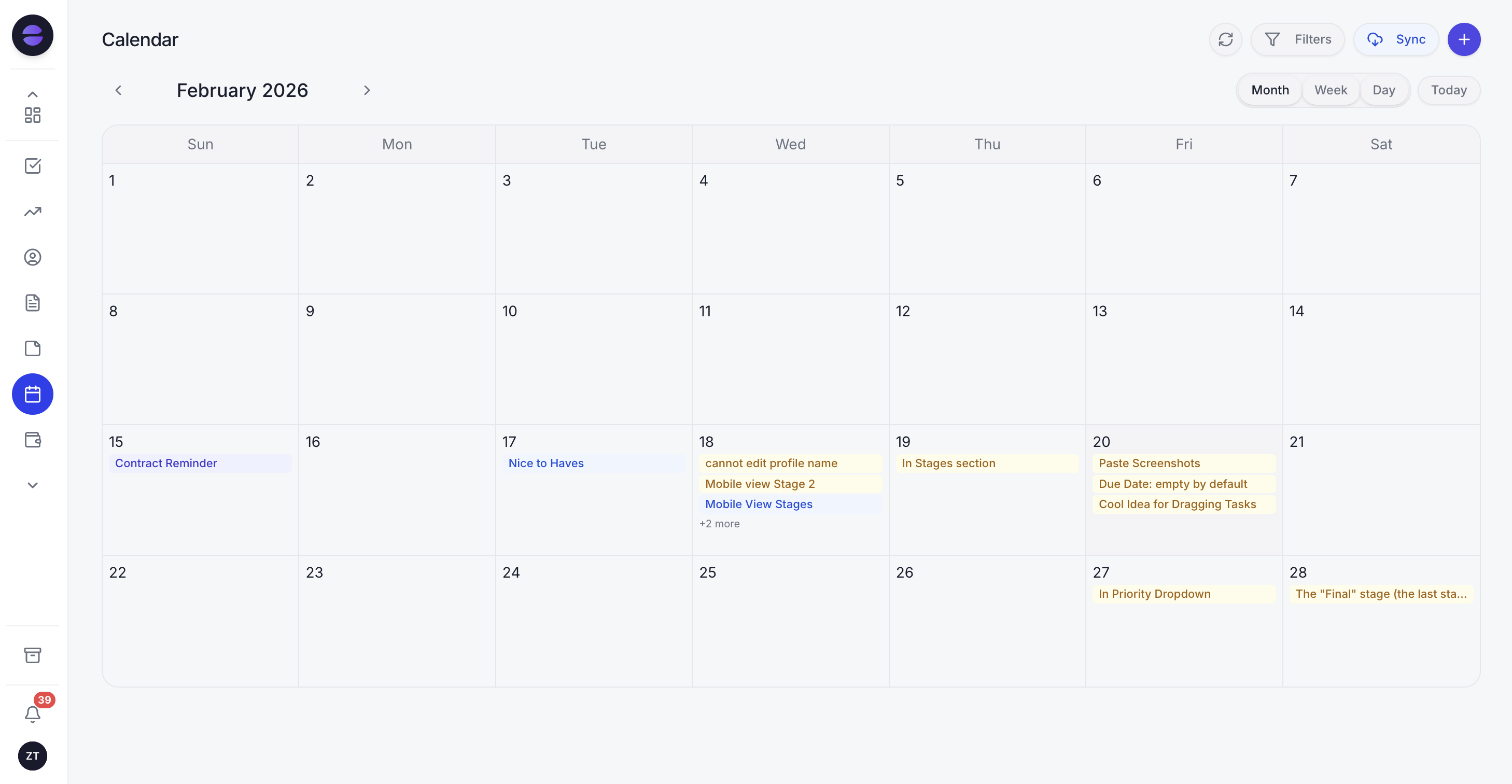 Discovery calls, dated proposal follow-ups and onboarding tasks for a new property, on one calendar instead of in your head.
This is the half of the job software usually leaves you holding. Your property management system is built for bookings: channel management, availability, rates, guest messaging, turnovers. It is not built for the six weeks before an owner signs, and it does not chase anybody.
Zoye is the layer that sits next to it. To be completely clear about what it is not: Zoye has no channel manager, no OTA sync with Airbnb, Booking.com or Vrbo, no availability calendar, no nightly rate engine, no booking engine, and no trust-accounted owner statements. Guesty, Hostaway, Lodgify, OwnerRez, Smoobu or whatever you run stays exactly where it is and keeps doing all of that.
What Zoye runs is the business around the bookings. Owner leads land as records with their source, unit count and current setup attached. The pipeline stages above are yours to name, and the assistant chases what has gone quiet: the projection sent nine days ago with no reply, the proposal that never got its Thursday call, the owner who said to circle back before spring. Management agreements, insurance certificates and licence numbers sit against the property they belong to instead of in three different inboxes. Onboarding runs as a task list with owners and dates. Cleaner and staff tasks, owner invoicing and follow-up all live in the same place, and you can tell the assistant what you want in a sentence, including over WhatsApp, rather than building a workflow.
How to grow a property management company from a handful of doors
Once the sequence above works reliably, growth comes from four places, in order of how cheap they are.
The owners you already have. Ask at the thirty-day review and again after their first strong season. An owner with money arriving and no problems is the only marketing that costs nothing, and roughly nobody asks them.
Second properties. An owner who trusts you and buys again is the easiest door you will ever sign. Know which of your owners are investors rather than accidental landlords, and be the person they call before they buy.
Your trade network. Cleaners, handymen, photographers, letting agents and accountants all meet self-managing owners weekly. A cleaner who likes working with you is a lead source, and treating cleaners well is therefore a growth strategy as well as an operational one.
Deliberate narrowing. Managers who grow past twenty doors without drowning almost always specialise: one area, one property type, one owner profile. It makes your pitch obvious, your operations tight, and your cleaning routes short.
And one subtraction. Say no more often. A poorly located property with an owner who wants weekly calls and a discounted fee will consume the capacity you needed for three good doors. Portfolio quality compounds, in both directions.
Frequently asked questions
Start with owners you can already reach: people who bought a second home nearby, contacts from brokers and agents, and owners who are self-managing badly and know it. Then treat the first conversation as a diagnosis rather than a pitch, send a conservative revenue projection with your fee shown inside it, and follow up on a schedule instead of when you remember. Your first two or three doors usually come from a personal relationship plus a follow-up nobody else bothered to make.
It varies by market and service level, so treat these as ranges rather than benchmarks. Full-service short-term and vacation rental management commonly sits in a band from the mid-teens to around a third of booking revenue, lighter co-hosting arrangements are often lower, and long-term residential management is usually far lower again, frequently in the high single digits to low teens. What matters more than the number is what is included, what you bill separately, and the owner net figure the owner ends up with.
At minimum: the parties and the exact property, the term and how renewal works, your authority to list and set rates, the fee and precisely how and when it is calculated and paid, who pays cleaning, consumables, utilities and platform fees, a maintenance spend threshold above which you need owner approval, owner-blocked dates, damage and deposit handling, insurance requirements, termination notice and what happens to bookings already on the calendar, who owns the listing accounts and guest data, and who is responsible for local licences and taxes. Have a local lawyer review your template once before you use it.
Agree with them first, because they usually can. Then make the trade explicit: the hours per week that guest messaging, cleaner scheduling, pricing and maintenance actually take, and the revenue lost when an enquiry sits unanswered overnight or a calendar is priced flat through peak weeks. Show your projection net of your fee against what they earned self-managing. If the numbers do not clearly favour handing it over, tell them so and stay in touch. Some owners genuinely should keep self-managing, and being the manager who said that is why they call you next year.
For a single owner with one property, two to six weeks from first conversation to countersigned agreement is normal, and much of that gap is the owner talking to a spouse or a co-owner rather than evaluating you. Deals slip when the owner is deciding at the start of their season or waiting on a licence. The variable you control is follow-up: a pipeline stage with a dated next action for every owner turns a slow decision into a signed one instead of a lead that quietly disappears.
No, and it is not meant to. Zoye has no channel manager, no OTA sync with Airbnb, Booking.com or Vrbo, no availability calendar, no nightly rate engine, no booking engine and no trust-accounted owner statements. Your property management system keeps doing all of that. Zoye runs the business around the bookings: the owner pipeline, enquiry follow-up, management agreements and owner documents, cleaner and staff tasks, and owner invoicing, with an assistant that chases the follow-ups instead of reminding you to.
The bottom line
Owners do not choose a manager because of a deck. They choose the one who asked better questions, showed them a number they could check, answered the fee objection with arithmetic instead of defensiveness, put the awkward parts in writing before being asked, and then followed up on the Thursday they said they would.
Every step in that sequence is learnable, and only one of them is genuinely hard to sustain: the following up, across eleven owners, while a boiler is broken and a guest is asking about parking. That is the part worth handing to something that does not forget.
Bring your owner pipeline, your agreements and your onboarding into Zoye and let the chasing happen without you. Get started in an afternoon, and leave your property management system exactly where it is.
For more context, see where property management leads come from and how to qualify them, the CRM for real estate agents, the vacation rental CRM page, and the rest of the Zoye blog.