
Search for Airbnb management software and you get the same twelve logos in a different order, scored on a feature grid, with no acknowledgement that the people reading are doing two completely different jobs. A person hosting three apartments they own is buying convenience. A co-host running forty units on behalf of other owners is buying a business system, and the thing that will actually break their week is not the calendar.
That distinction changes the shortlist more than any feature comparison does. Self-managing hosts overbuy, land on a platform designed for a management company, and use a tenth of it. Managers underbuy, run the owner side of a real business out of a spreadsheet and a phone, and lose contracts they never knew were slipping. Both mistakes come from the same source, which is a category that markets to everyone with the same page.
This guide segments first and compares second. It sets out the four layers a serious operator ends up paying for, names which tools are genuinely good at each, and is explicit that most roundups only cover the first two. The audience is anyone from a single-listing host up to a company running roughly forty units, and every platform below is judged on what it does for that reader rather than on how many integrations it lists.
Pricing reflects published rates as of September 2026; check each vendor's pricing page for current figures.
Start here: whose software is this?
Three buyer profiles sit behind the same search term, and they want almost nothing in common.
The self-managing host with one to three listings. You own the properties. Nobody is waiting on a statement from you. Your problems are the calendar staying honest across two listing sites, guest messages not eating your evening, and the cleaner knowing about tomorrow. A light platform solves this in an afternoon, and if you list on Airbnb only, you may genuinely need nothing beyond the Airbnb app plus a shared calendar.
The growing host at four to ten units. Something changed. You now have turnovers that collide, a pricing decision you keep making badly by instinct, and enough revenue that a mistake costs real money. This is where a property management system starts to pay, and where a dynamic pricing tool typically returns its subscription within a season.
The co-host or management company running units for other people. You have a second customer nobody sold you software for. The guest is the visible one. The homeowner is the one who signs the contract, asks where their money is, and leaves for the manager down the road when they stop hearing from you. You need everything the growing host needs, plus a pipeline for signing owners, plus somewhere the management agreements and the owner invoicing actually live.
If you are in the third group, most of what follows in a typical comparison article is only two thirds of your purchase. That is worth saying plainly before any logo appears.
The four layers you actually end up buying
Operators rarely buy one product. They accumulate a stack, usually in this order, usually without deciding to.
Layer one: the property management system and its channel manager. This is the operational core: reservations, availability, rates, the two-way sync that stops the same night being sold twice, guest messaging on confirmed stays, and basic reporting. Almost every modern platform bundles the channel manager, so for operators under roughly forty units this is one purchase rather than two. It is also the hardest to switch later, which is the argument for buying slightly ahead of where you are.
Layer two: dynamic pricing. Setting nightly rates by feel is the most expensive habit in short-term rentals, and it is the layer with the clearest return. A dedicated engine reacts to demand, seasonality, day of week, lead time and local events, and shows you what comparable properties nearby are doing. Some platforms include native pricing rules, and those are worth testing before adding a subscription, particularly below five properties. The difference in practice is rule depth and market data rather than presence or absence.
Layer three: guest communication and operations. Message automation across the stay lifecycle, review requests, cleaning schedules generated from checkouts, checklists and inspections. Your platform will cover some of this natively. Specialists exist and get bought when the native version starts missing cleans or when nobody can prove a property was ready.
Layer four: the owner-side business layer. Here is the one almost nobody sells you. The homeowner you met at a viewing and never followed up. The management agreement saved in someone's downloads folder. The enquiry that arrived on Instagram at eleven at night and scrolled out of sight. The owner invoice that went out four days late for the third month running. None of that is a reservation, so none of it exists in your property management system, and that is not a flaw in the software. It is a different job. For managers this is where growth and churn both live, and it is the layer a vacation rental CRM is built to hold.
Most roundups stop after layer two, occasionally three. The stack you end up running has four.
The 7 best Airbnb management software tools in 2026
1. Zoye - the owner-side business layer that sits next to your PMS
Zoye is on this list for layer four, and the boundary needs stating before anything else. Zoye is not a property management system and will not replace one. It holds no availability calendar, no nightly rates and no booking engine; it has no channel manager and no two-way sync with Airbnb, Booking.com or Vrbo; and it carries neither an OTA guest inbox nor trust accounting. Keep Hostaway, Guesty, Lodgify, OwnerRez or Smoobu for every one of those. Zoye runs alongside whichever one you chose.
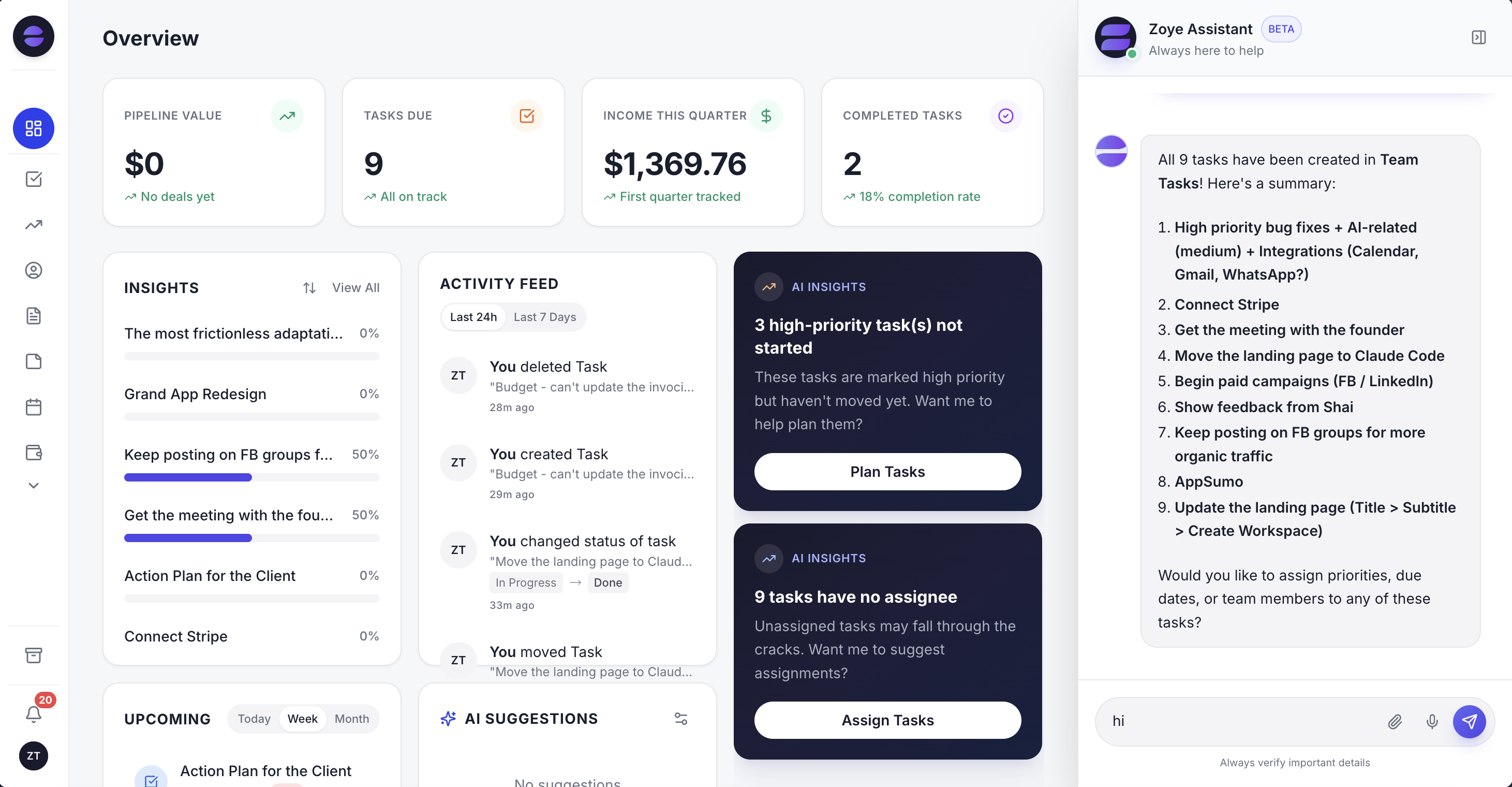
Zoye's dashboard for a short-term rental manager: owner leads, open enquiries, turnover tasks and the month's figures in one view
What it does hold is the business around the bookings. Every homeowner enquiry becomes a lead with a source, an owner, a next step and a date, whether it arrived by referral, website form, Instagram or WhatsApp. Management agreements, insurance certificates and property documents attach to the owner record rather than living in a drive nobody has permission to search. Turnover and maintenance work becomes assignable tasks with owners and due dates. Owner invoicing and the chasing that follows it happen in the same place as the relationship, so nobody has to reconcile two systems to find out who has paid.
The part that changes the day-to-day is the assistant, because it acts rather than suggests. Send it a voice note walking out of a viewing and it creates the owner contact, logs what was discussed and opens the follow-up task for Tuesday. Ask it which owner enquiries have gone quiet for two weeks and it answers from live records rather than from memory. Ask for this month's owner invoicing position and it produces the figures. It works the same in the web app, on WhatsApp and in Slack, with the same permissions, which matters when half your week happens between properties rather than at a desk.
Around that sit the rest of the workspace tools that a small management company otherwise buys separately: contacts and companies, a deal pipeline for owner acquisition, tasks, a calendar, documents, budget and invoices, and reports that pull from all of it. Records link to each other, so a property's owner knows its agreement, its tasks and its invoices without anyone maintaining the connection by hand. Workflow automations cover the recurring rules, such as chasing an overdue owner invoice or surfacing an enquiry that nobody has touched in seven days, and every run is logged and reversible.
Pricing: Almost Free at $5 per month, or $4 per month billed annually, for 1 team member with 1GB storage. Starter $29 per month, or $23 annually, for 10 members and 5GB. Growth $59 per month, or $47 annually, for 20 members and 10GB. Scale $119 per month, or $95 annually, for 100 members and 25GB. A Customize option is quoted directly. See pricing for current figures.
Best for: co-hosts and management companies who already have a property management system and need the owner relationship, the acquisition pipeline and the back office to stop living in spreadsheets.
2. Hostaway - the scaling manager's platform
Hostaway is aimed squarely at management companies that are growing, and the automation depth reflects that. Channel management across the major listing sites is dependable, the messaging and task rules are among the more configurable in the category, and the integration marketplace is large enough that most adjacent needs have a connector.
Two honest caveats. Hostaway does not publish simple public pricing: quotes follow a demo, scale with listing count, and independent reviewers commonly report a one-time onboarding fee on top of the subscription, so any figure on a comparison site is an estimate rather than a rate. And because much of the breadth arrives through third-party integrations, a capability that felt included during the demo may turn out to be a second subscription. Our Hostaway alternatives guide covers the cases where that trade lands badly.
Pricing: quote-only after a demo, priced on listing count, as of September 2026.
Best for: management companies past roughly fifteen units that want automation depth and an integration ecosystem.
3. Guesty - the enterprise end of the category
Guesty is built for larger portfolios and multi-market operators. Native accounting features, multi-unit handling, owner reporting and a deep operations toolset all point at a business with staff rather than a solo host with a laptop.
The two things to weigh are cost predictability and the CRM claim. Guesty also does not publish simple public pricing, and its model is commonly described as a percentage of booking revenue combined with fixed components, which makes an annual number hard to estimate before a quote. Reviewers frequently describe the built-in CRM as clunky, which matters specifically if you were hoping it would carry your homeowner pipeline rather than just your guest data.
Pricing: not published simply; commonly described as revenue share plus fixed components, as of September 2026.
Best for: portfolios heading past a hundred units that need depth and native accounting and can absorb a variable model.
Want to see it in action?
See Zoye catch a new lead, answer on WhatsApp and set up the follow-up, all from one message.
See How It Works4. Lodgify - the direct booking website route
Lodgify approaches the category from the website side and that is still its strongest card. The builder produces a presentable direct booking site quickly, with a booking engine, payments and templates that do not need a developer, and setup is among the fastest here.
The structural detail to model before signing up is the booking fee. Lodgify's entry plan charges a fee on reservations and you move to a higher tier to remove it, which changes the maths entirely once direct bookings grow. Beyond the website, management depth is lighter than Hostaway, Guesty or OwnerRez, particularly for a company running homes on behalf of other people.
Pricing: published plans; the entry plan carries a booking fee, removed on higher tiers, as of September 2026.
Best for: hosts and small brands whose first priority is a good direct booking site, live quickly.
5. OwnerRez - control, owner statements and published pricing
OwnerRez suits operators who want to configure things properly and will invest the time to learn a system. It is unusually strong on the requests management companies actually make: owner statements, accounting integration, rule and messaging templates, quoting, damage protection, and hosted or WordPress-based direct booking sites.
The trade-offs are an interface that prioritises function over polish, a real learning curve, and a US-centric feature set that fits North American operators best. In exchange you get flat published pricing that scales with property count, which is a genuine relief in a category full of quotes.
Pricing: published flat pricing, scaling with property count, as of September 2026.
Best for: US-based operators and management companies who want deep control and owner statements without a quote process.
6. Smoobu - the pragmatic small-portfolio pick
Smoobu covers the essentials without turning into a project. Channel manager, unified calendar, a simple website builder, guest messaging and a guest guide, with published pricing and setup measured in hours. For a host with two to ten units who wants the calendar problem solved and nothing more, it is a sensible default, and it is particularly common across Europe.
The limit is scope rather than quality. As a portfolio turns into management on behalf of owners, the reporting, owner-facing depth and automation are thinner than the platforms above. Plenty of operators start here happily and move once the owner side gets serious.
Pricing: published plans, as of September 2026.
Best for: self-managing hosts and small portfolios who want the essentials working this week.
7. Hospitable - guest messaging done properly
Hospitable specialises in the conversation with the guest: message rules across the whole stay lifecycle, review handling, team access and an AI-assisted reply layer, with published per-listing pricing. Operators often run it next to a platform specifically because the messaging is more reliable and easier to configure than the native equivalent.
The boundary is worth understanding. Hospitable handles confirmed stays. An enquiry that has not become a reservation, and every conversation with a homeowner, sits outside it, which is the same gap layer four exists to fill.
Pricing: published, charged per listing, as of September 2026.
Best for: hosts and managers who want stay-lifecycle messaging automated well without changing platform.
Best Airbnb management software for one to three listings
Buy the least you can. If everything is on Airbnb only and the calendar has never surprised you, the Airbnb app plus a shared cleaning calendar is a legitimate answer, and adding a platform will add admin rather than remove it.
The moment a second listing site appears, that stops being true, because a double booking becomes possible and manual calendar blocking is a matter of time rather than skill. Smoobu is the usual landing spot at this size for the channel sync and unified calendar, and Hospitable is the better pick if guest messaging rather than distribution is what is eating your evenings. Lodgify makes sense earlier than its feature depth suggests if a direct booking site is a real goal rather than an aspiration.
Skip dynamic pricing until you have enough booked nights for the tool to learn from, and skip the owner layer entirely. You have no owners.
See what Zoye can do for you
CRM, deals, tasks and your Instagram, Facebook and WhatsApp automations in one workspace. Just ask Zoye and it sets any of it up for you.
Explore FeaturesBest Airbnb management software for a co-host managing 40 units
At this size the shortlist is short: Hostaway, Guesty or OwnerRez for layer one, chosen on region, pricing tolerance and how much you want to configure yourself. Add a dedicated pricing tool. Add cleaning software when cleans start getting missed rather than before.
Then decide, deliberately, where the owner side lives. This is the decision most managers make by accident, and the symptoms are consistent: an owner enquiry from six weeks ago that nobody answered, a management agreement that takes ten minutes to find, an owner statement rebuilt by hand every month, and a churn conversation that starts with a homeowner saying they had not heard from anyone since spring.
Some platforms include owner reporting, and OwnerRez in particular is strong on statements. None of them handle owner acquisition, because that is a sales pipeline rather than a reservation. If you are signing new owners at all, that pipeline needs a home with follow-up dates attached, or growth stays dependent on you personally remembering things. Our guide to property management leads covers how that pipeline gets fed in the first place.
How to choose without buying the same feature twice
Four checks save most of the wasted money in this category.
Count the layers you are actually missing. Write the four layers down and mark which are covered. Buying a second tool for a job your platform already does well is the most common overspend here, and the channel manager is where it happens most.
Test the demo against your worst week, not your best. Ask how a double booking is surfaced, how a cancelled reservation cascades into the cleaning schedule, and what happens when a rate change fails to propagate. Every platform demos well against a clean calendar.
Price the stack, not the line item. A published monthly figure that excludes onboarding, a pricing subscription, a booking fee or a per-listing add-on is not the number you will pay. Model it against your actual property count and booking volume for a full year.
Ask where the homeowner lives. If the answer is a spreadsheet, a phone and your memory, you have found your next purchase, and it is not another property management system. There is a fuller map of the whole category in our guide to the best vacation rental software.
Ready to hand off the busywork?
Zoye brings AI-powered CRM, task management, and automation into one workspace.
Get StartedWhy managers pair Zoye with their PMS
Three reasons come up repeatedly when an operator adds a business layer rather than switching platform.
The reservation software keeps doing what it is good at. Nobody migrates a calendar, a channel connection or a rate structure, which removes the single scariest part of changing anything in this stack.
The owner relationship stops depending on memory. Enquiries have owners and next steps, agreements are attached to the record, invoices chase themselves, and a homeowner who has gone quiet shows up as a task rather than as a cancelled contract.
The admin happens where the manager already is. The assistant works over WhatsApp and voice notes, so a viewing turns into records and follow-ups before the car has left the street, instead of accumulating into an evening of typing that never quite happens.
Run Zoye alongside your property management system and see what the owner side looks like when it stops living in spreadsheets. The entry plan is Almost Free at $5 per month.
For more context, see our vacation rental CRM page, the guide to the best vacation rental software, the best Hostaway alternatives, and how to generate property management leads.