
Quick answer: in 2026 a chatbot costs anywhere from $0 for the built-in auto-replies in Meta's own apps to well over $150,000 for an agency-built AI assistant. Most small and growing businesses land between $15 and $500 a month in software. The real bill is the sticker price plus three meters that most pricing pages show in small print: AI usage, Meta's WhatsApp message fees and the staff time that handovers and upkeep take.
Key takeaways (October 2026)
- Five price bands: built-in replies ($0), no-code builders (from $14 a month billed yearly on ManyChat, $17 month to month), AI chatbot platforms (from $40 a month on Chatbase), metered AI support ($0.99 per outcome on Intercom Fin) and agency builds ($15,000 to $150,000+, per Master of Code Global).
- On WhatsApp, Meta has billed per delivered message since 1 July 2025; from 1 October 2026 each business number gets 1,000 free service messages a month, and utility templates sent inside an open window are charged again.
- Agency maintenance retainers start around $5,000 a month, per Master of Code Global's guide updated in September 2026.
- Staff time often beats software: at the $21.53 median hourly wage for US customer service representatives (Bureau of Labor Statistics, May 2025), 20 hours of handovers a month is about $430.
- In our three illustrative monthly bills, software is anywhere from under a fifth to about 70% of the true monthly cost.
How much does a chatbot cost in 2026?
A chatbot in 2026 costs $0 to about $500 a month if you buy a ready-made tool, and $15,000 to over $150,000 up front if an agency builds one for you. Where you land depends on three choices: whether answers come from fixed buttons or from AI, which channels it covers, and who maintains it.
The spread looks absurd until you see what each price buys. A free auto-reply answers one question with one fixed message. A $40 AI widget answers hundreds of varied questions from your own documents. A $100,000 custom build connects to your stock system, your booking engine and your customer database, and someone is paid to keep it working.
So the honest answer to "how much do chatbots cost" is a set of bands, each with its own meter. The rest of this guide prices each band with figures from the vendors' own pages as of October 2026, lists the costs that sit outside the sticker price, and then works through three illustrative monthly bills so you can see how the pieces add up.
One rule before the numbers: price the meter, not the plan. Vendors charge by seat, by contact, by conversation, by AI outcome or by message credit, and the same 1,000 chats can cost four times more on one meter than another. Our ManyChat pricing breakdown shows how a per-contact meter behaves as an audience grows; this guide compares the meters against each other.
The 5 chatbot price bands, compared
Chatbot pricing falls into five bands in 2026: built-in replies inside messaging apps, no-code flow builders, AI chatbot platforms, metered AI support suites and agency custom builds. A sixth option, an AI agent inside your business tools, prices like a SaaS plan but does more than answer, so it gets its own row.
| Band | What you get | Typical price (October 2026) | Meter that grows the bill | Who maintains it |
|---|---|---|---|---|
| 1. Built-in replies | Greeting, away and instant replies in WhatsApp Business app and Meta Business Suite | $0 | None | You, by hand |
| 2. No-code flow builder | Buttons, keywords, comment-to-DM flows | ManyChat from $14/mo billed yearly ($17 monthly); Chatfuel Business $18/mo billed yearly | Active contacts or AI credits | You, branch by branch |
| 3. AI chatbot platform | AI answers trained on your website and files | Chatbase from $40/mo ($32 yearly); Botpress Plus $150/mo billed yearly | Message credits or conversations | You, by updating sources |
| 4. Metered AI support | AI agent plus a human helpdesk | Intercom from $29/seat plus $0.99 per Fin outcome; Tidio Lyro from $32.50/mo | Seats plus outcomes or AI conversations | Support lead |
| 5. Agency custom build | Bespoke bot wired into your systems | $15,000 to $150,000+ up front, retainers from about $5,000/mo | Change requests and hosting | The agency, on retainer |
| AI agent in your business tools | Answers, books, updates records, hands over | Zoye from $29/mo for up to 10 members; respond.io Growth $159/mo billed yearly | Seats or plan allowance | You, by approving rules |
Prices come from each vendor's pricing page as of October 2026, except ManyChat, whose page blocked automated reading when we checked; its figures match our October 2026 review of Instagram automation tools. Agency ranges come from Master of Code Global's chatbot pricing guide. Check every live page before you sign.
Band 1: built-in replies, $0
The WhatsApp Business app gives you a greeting message, an away message and quick replies, and Meta Business Suite gives Facebook and Instagram instant replies and saved responses. None of it costs money. None of it is a real chatbot either: each trigger sends one fixed message, nothing is qualified, and nothing reaches a customer record. For a business that gets ten messages a day, this band is a perfectly sensible place to start.
Band 2: no-code flow builders, about $14 to $100 a month
Flow builders let you draw a conversation with buttons and keywords. ManyChat's tiers run from a free plan for 25 active contacts to Advanced from $139 a month billed yearly ($199 month to month) for 25,000, with Essential from $14 ($17) and Pro from $29 ($39). Chatfuel Business is $18 a month billed yearly ($216 a year) with $20 of AI credits, according to its pricing page in October 2026. The catch is labour: every new question means a new branch, and the meter (contacts or credits) rises with your best-performing posts. Our ManyChat vs Chatfuel comparison covers the two head to head.
Band 3: AI chatbot platforms, about $40 to $500 a month
These tools read your website, PDFs and help pages and answer in natural language. Chatbase's Hobby plan is listed at $40 a month, or $32 a month billed yearly, with 700 message credits and 2 members; Standard is $150 ($120 yearly) with 4,000 credits; Pro is $500 ($400 yearly) with 15,000. Extra credits cost $40 per 1,000. Botpress, which suits teams with some technical skill, lists Plus at $150 a month billed annually with 250 conversations, and Team at $750 a month with 1,500; extra conversations cost $65 or $50 per 100. Both are figures from the vendors' own pages in October 2026.
Band 4: metered AI support suites, about $100 to several thousand a month
Here the AI sits inside a helpdesk, and you pay for both. Intercom lists Essential at $29 per seat a month, Advanced at $85 and Expert at $132, and charges $0.99 for every Fin outcome. Tidio's Lyro AI Agent starts at $32.50 a month for 50 AI conversations, as its own meter next to the human chat plan. Crisp takes a different line, with flat workspace plans from $45 a month that include a small AI credit allowance. These meters reward high-value support, where one resolved ticket saves real money, and punish high-volume, low-value chat.
Band 5: agency custom builds, $15,000 and up
Custom work is priced by project. Master of Code Global's pricing guide, updated 30 September 2026, gives agency ranges of $15,000 to $30,000 for a rule-based bot, $75,000 to $150,000 or more for an AI chatbot and $150,000 or more for a generative AI build, with hourly rates of $50 to $200+ and a maintenance retainer of about $5,000 a month or more. BotsCrew's guide, updated 6 May 2026, is broader: $5,000 to $75,000 for a button-based bot, $10,000 to $150,000 for an AI bot with language understanding, $1,000 to $10,000 per integration and from $1,000 per extra language. Both firms sell chatbot development, so read their ranges as the opening position of a negotiation.
Want to see it in action?
See Zoye catch a new lead, answer on WhatsApp and set up the follow-up, all from one message.
See How It WorksWhat does an AI chatbot cost to run each month?
An AI chatbot's monthly cost is the plan fee plus a usage meter that counts conversations, outcomes or message credits. As of October 2026, the effective price per AI-handled chat on the platforms in this guide ranges from about 12 cents to 99 cents, so 1,000 AI-handled chats can cost about $120 on one meter and about $990 on another.
Four meters dominate:
- Per message credit. Chatbase includes 700 credits on Hobby and sells 1,000 more for $40. If one AI reply uses one credit, a three-reply chat costs about 12 cents at that top-up rate. Check how many credits your chosen model uses per reply before relying on this.
- Per conversation. Botpress counts conversations, then charges $0.65 (Plus) or $0.50 (Team) for each one above the allowance, and includes $0.10 of model usage per conversation. If the AI calls an expensive model, the rest is billed from AI spend grants of $10, which Botpress says it sells at cost.
- Per outcome. Intercom bills $0.99 only when Fin resolves the question or completes a workflow. You pay nothing for chats it fails, and a lot for chats it handles well.
- Per wallet. Chatfuel draws AI replies and Meta's WhatsApp charges from one balance, so a busy campaign spends credits twice.
There is no universally cheapest meter. A business with 2,000 short, repetitive questions a month will pay least on credits. A business with 200 expensive support issues may happily pay $0.99 an outcome, because each one saves a person 15 minutes. Divide your expected monthly chats by the allowance on each plan, add the overage at list price, and only then compare plans.
What does a WhatsApp chatbot cost?
A WhatsApp chatbot carries two separate bills: the tool you build it on and Meta's per-message charges, which every provider on the official WhatsApp Business Platform passes on. Instagram and Messenger have no Meta message fee, so WhatsApp is the channel where volume alone can move your bill.
Meta's rules, as of October 2026 on its developer documentation:
- Meta bills per delivered message by category (marketing, utility, authentication, service) and by the recipient's country, a model in place since 1 July 2025. Messages customers send you are not charged.
- From 1 October 2026, each business phone number gets 1,000 free service messages a month. Service replies beyond that are charged, and utility templates sent inside an open customer service window are charged again.
- Marketing templates are charged on every delivery, and Meta currently does not deliver marketing templates to US phone numbers, so a US-heavy contact list cannot be re-engaged that way.
- A chat that starts from a click-to-WhatsApp ad opened in the Android or iOS app and is answered in time opens a window of up to 7 days in which messages are free.
- Since 15 January 2026, general-purpose AI assistants, where the AI is the product, are barred from the Platform. A business-specific AI serving your own customers is allowed.
Rates differ by country, so take per-message prices from Meta's rate card for the countries you actually message, not from a blog. Some providers also add a markup or a platform fee on top of Meta's rate; our WhatsApp Business API pricing guide explains how those layers stack.
On the tool side, entry prices for WhatsApp-capable chatbots as of October 2026 include Chatfuel Business at $18 a month billed yearly, Wati Growth at $59 a month billed yearly for 3 users, and respond.io Growth at $159 a month billed yearly, the first respond.io tier with AI Agents and 10,000 AI credits. A WhatsApp chatbot also needs approved templates for anything sent more than 24 hours after a customer's last message, which costs time even when the approval itself is handled for you.
The hidden costs of a chatbot
The hidden costs of a chatbot are the ones that do not appear on the plan card: usage overages, Meta fees, seats for the humans who take over, branding removal, integrations, setup hours and ongoing upkeep. Together they often exceed the subscription, especially in the first three months.
Setup. Even a no-code tool needs someone to gather your 20 to 30 most common questions, write approved answers, connect channels and test. With an agency, setup is the project fee. With a tool, it is your own week, which is still a cost.
Integrations. A bot that cannot see your calendar, price list or customer records sends people elsewhere to finish the job. BotsCrew's guide prices custom integrations at $1,000 to $10,000 each. On SaaS tools, integrations are often limited to higher plans or to third-party connectors with their own fees.
Seats for the handover. Every chatbot hands some chats to a person, and on per-seat helpdesks that person needs a seat: $29 to $132 a month each on Intercom, for example.
Branding removal. Free and entry plans often show the vendor's badge in your chat window. Removing "Powered By Chatbase" costs $1,188 a year as of October 2026, and tawk.to charges $29 a month to remove its label.
Languages. If your customers write in more than one language, check whether the AI handles them on your plan. On a custom build, BotsCrew prices each extra language from $1,000.
Upkeep. Prices, opening hours and offers change. On a rule-based bot, each change means editing branches; on an AI bot, it means updating sources and reading transcripts for wrong answers. An agency retainer covers this for about $5,000 a month or more, per Master of Code Global.
Staff time. This is the one most budgets miss. The US Bureau of Labor Statistics gives a median wage of $21.53 an hour for customer service representatives (May 2025). Every hour spent on handovers, transcript reviews and answer updates is real money, whether you pay a team member or give up your own evening.
See what Zoye can do for you
CRM, deals, tasks and your Instagram, Facebook and WhatsApp automations in one workspace. Just ask Zoye and it sets any of it up for you.
Explore FeaturesThree worked monthly bills
The examples below are illustrative, built from list prices as of October 2026 and the assumptions stated for each. They are not quotes. They show how the plan fee, the usage meter, Meta's fees and staff time combine, and why the cheapest plan is rarely the cheapest month.
Common assumptions: staff time is costed at the $21.53 median hourly wage from the Bureau of Labor Statistics; each AI-handled chat takes three AI replies; a chat handed to a person takes about five minutes; Meta's per-message fees are shown as a count of billable messages, because the rate depends on your customers' country.
Bill 1: a one-person service business, about 400 chats a month
We assume 300 conversations start on Instagram (DMs, story replies and comments) and 100 on the website. AI or automation resolves 60% of them. The owner handles the other 160 at five minutes each and spends two hours a month updating answers.
- Instagram: ManyChat Pro from $29 a month billed yearly, $39 month to month (2,500 active contacts), since 300 active people pass Essential's 250.
- Website: Chatbase Hobby at $40 a month; 100 chats at three replies each is about 300 credits, inside the 700 allowance.
- Meta fees: none, because Instagram messages carry no Meta per-message charge.
- Staff time: about 15 hours and 20 minutes, roughly $330.
Total: about $69 in software and about $399 all in ($79 and $409 with ManyChat billed month to month). Software is under a fifth of the real cost, and the two tools keep separate records of the same customers.
Bill 2: a 6-person team, about 1,000 chats a month, mostly WhatsApp
We assume 700 conversations on WhatsApp and 300 on Instagram. The bot sends about four replies in each WhatsApp chat, so about 2,800 service messages. The team also sends 500 booking reminders (utility templates) and 300 follow-ups to past customers (marketing templates). AI resolves 65%; people handle 350 chats at five minutes each, plus four hours of upkeep.
- Software, option A: respond.io Growth at $159 a month billed yearly, covering 10 users with AI Agents and 10,000 AI credits.
- Software, option B: Wati Pro at $119 a month billed yearly for 5 users plus one extra user at $39, so $158, with Astra AI agents priced separately.
- Meta fees: 2,800 service messages minus the 1,000 free leaves 1,800 billable, plus 800 templates, so about 2,600 billable messages at your country's rates.
- Staff time: about 33 hours, roughly $715.
Total: about $158 to $159 in software plus Meta's fees on 2,600 messages, and about $875 all in before Meta. Cutting template volume by half saves more here than switching tools would.
Bill 3: a 25-person team, about 5,000 chats a month across three channels
We assume 2,000 website chats, 2,000 WhatsApp chats and 1,000 Instagram chats. AI resolves 60%, so 3,000 chats; people handle 2,000 at five minutes each, and eight support seats are needed.
- Intercom: 8 Advanced seats at $85 is $680, plus 3,000 Fin outcomes at $0.99, $2,970. About $3,650, with WhatsApp charged pay-as-you-go on top.
- Botpress Team: $750 a month billed yearly for 1,500 conversations, plus 3,500 extra at $50 per 100, $1,750. About $2,500, before a human inbox and any model usage beyond the included $0.10 per conversation.
- Agency AI build: $75,000 to $150,000 spread over 36 months is about $2,080 to $4,170 a month, plus a retainer from about $5,000. About $7,100 to $9,200 a month before hosting and model usage.
- Meta fees: 2,000 WhatsApp chats at four replies is 8,000 service messages, minus 1,000 free, so about 7,000 billable plus any templates.
- Staff time: about 167 hours, roughly $3,590.
Total: from about $6,090 to over $12,800 a month before Meta. At this size, the resolution rate matters more than the plan: every 10 points of extra AI resolution moves about 500 chats away from people.
| Example | Chats a month | Software | Meta fees | Staff time | All in before Meta |
|---|---|---|---|---|---|
| 1-person business | 400 | About $69 | None (Instagram) | About $330 | About $399 |
| 6-person team | 1,000 | About $158 to $159 | About 2,600 billable messages | About $715 | About $875 |
| 25-person team | 5,000 | About $2,500 to $9,200 | About 7,000 billable messages plus templates | About $3,590 | About $6,090 to $12,800 |
Ready to hand off the busywork?
Zoye brings AI-powered CRM, task management, and automation into one workspace.
Get StartedWhere Zoye fits in the bill
Zoye is not a chatbot you bolt onto a website. It is an AI Business Operator: the CRM, deals, tasks, calendar, invoices, reports, WhatsApp automations and Facebook and Instagram sit in one workspace, with an AI that works them. For the cost question, that changes two lines: there is no per-conversation AI meter, and the handover time shrinks because the chat is already on the customer's record.
On Instagram and Facebook, one Page connection covers both. Zoye answers DMs and story replies with buttons, a file or a reply in your brand's voice, posts a public reply and a private DM when someone comments a keyword, and turns lead-ad form submissions into contacts. On WhatsApp, Zoye runs on the official Business Platform and holds the conversations with your leads; connecting your own business WhatsApp number is coming soon. Meta's per-message fees apply on WhatsApp, as with any Platform provider.
You do not draw flows. Describe what should happen, in the app, on WhatsApp or in Slack, and Zoye builds the rule, shows it, and waits for your approval before anything runs. When a chat needs a person, it is handed over with the whole conversation on the lead's card, so the five minutes in our worked bills are spent replying rather than scrolling. If Meta rejects a message, you are told why.
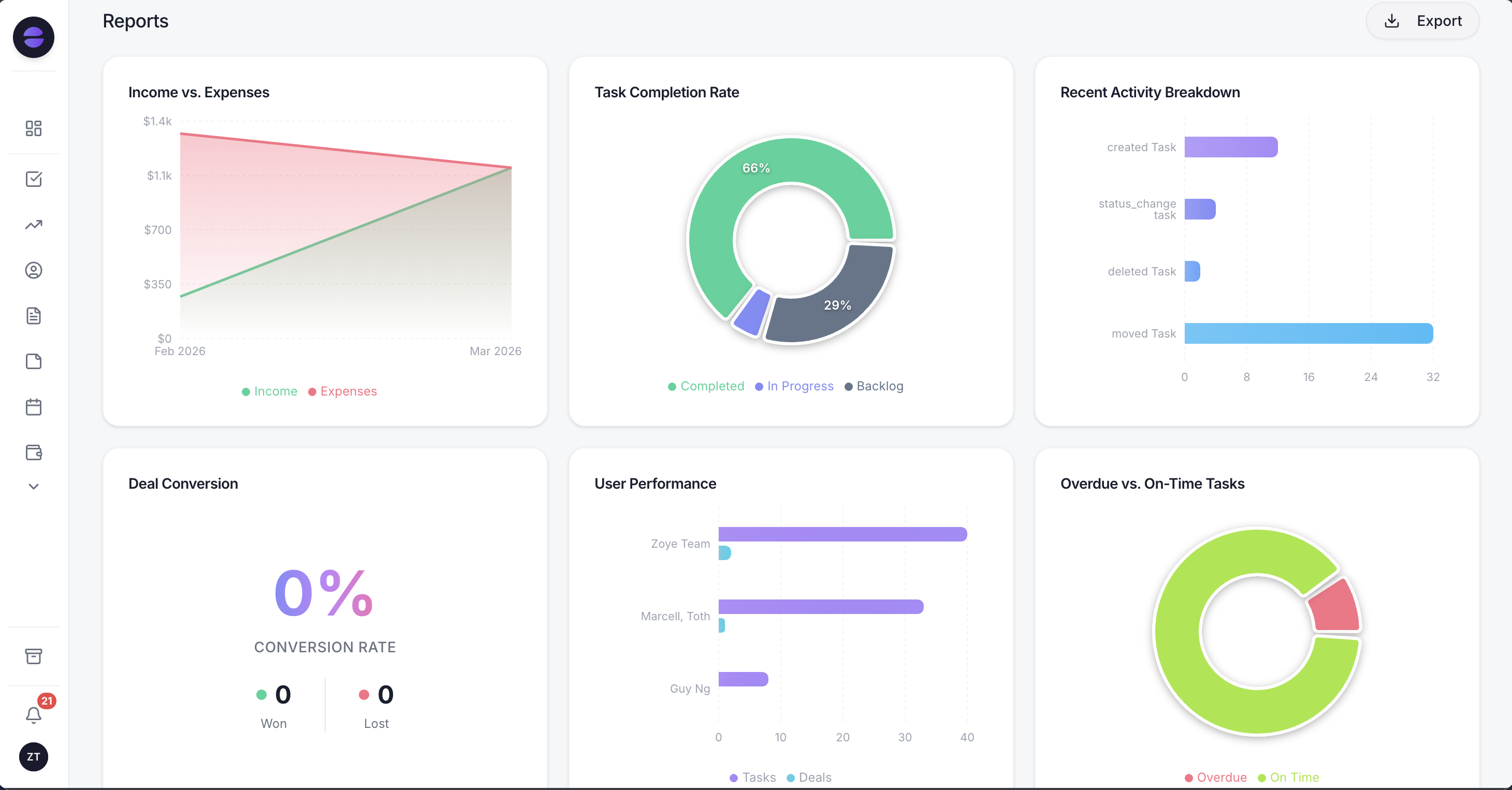
Reports show where leads come from and how far they move through your stages, so a chatbot is judged by the leads it produces rather than the messages it sends.
Pricing (as of October 2026): plans are priced by the team, not by chats. Almost Free is $5 a month ($4 billed yearly) for 1 member with the core tools, 15 AI prompts a month and the Google integrations; automations are not part of it. Starter is $29 a month ($23 yearly) for up to 10 members, Growth $59 ($47) for up to 20, Scale $119 ($95) for up to 100, and Customize is quoted. The pricing page lists what each plan includes, and the agent on WhatsApp page shows the WhatsApp side in practice.
Limits: Zoye has no website chat widget (a click-to-chat button sends visitors to WhatsApp instead), no help-centre deflection, and it does not run ads.
How to pick the right price band
Pick the band by volume, by what has to happen at the end of a chat and by who will maintain it. Low volume with simple questions belongs in bands 1 or 2; varied questions at moderate volume suit band 3; high-value support suits band 4; and only unusual integrations or regulated data justify band 5.
Work through these questions in order:
- How many chats a month? Under 300, start with built-in replies or a no-code builder. Between 300 and 3,000, an AI platform or an AI agent usually pays for itself in saved hours. Above that, model the meter carefully.
- What should the chat end in? If the answer is "an answer", any band works. If it is a booking, a payment or a follow-up task, you need a tool that writes to your records, or you will pay in staff time to copy things across. Our chatbot for small business guide lists the jobs a bot should do.
- Which channels? If WhatsApp carries the volume, budget Meta's fees separately and keep templates lean. Instagram and Messenger add no message fee.
- Who maintains it? A rule-based bot needs a builder. An AI bot needs someone to read transcripts. A custom build needs a retainer.
- What does a resolved chat save you? Multiply handover minutes by your hourly cost. If a chat saves $3 of time, a $0.99 outcome is cheap; if it saves 50 cents, it is not.
Then run a two-week trial on one channel and count completed outcomes, such as bookings, payments and follow-ups with an owner, not messages sent. Price is only meaningful against what the bot actually finished.
If your customers mostly write on WhatsApp and Instagram and you want each chat to end on a customer record, book a Zoye demo with a month of real chat volume and we will price it together.