
Quick answer: chatbot vs live chat is not an either-or choice for most small teams. A chatbot wins on volume, repeat questions and hours nobody is online; live chat wins on complaints, complex quotes and the final step of a big sale. The setup that works is a hybrid: an AI agent answers first and a person takes over with the whole conversation when it matters.
Key takeaways (October 2026)
- In a Gartner survey of 5,728 customers, 64% said they would prefer companies did not use AI for customer service and 53% would consider switching to a competitor over it. Their top worry was that reaching a person would get harder.
- A US customer service representative earned a median $21.53 an hour in May 2025, according to the Bureau of Labor Statistics. With our assumed overhead, a human chat costs roughly $4.65 in a busy hour and about $14 in a quiet one.
- AI answers are priced per result as of October 2026: Intercom Fin $0.99 per outcome, Zendesk $1.50 to $2.00 per automated resolution, LiveChat $49.50 per 50 extra AI resolutions, and Tidio's Lyro from $32.50 a month for 50 conversations.
- If you staff chat around the clock, that is 168 hours a week (24 × 7), more than four full-time people at 40 hours each before holidays and sick days.
- On Instagram and Messenger you may reply within 24 hours of a customer's message, so on those channels "live" is measured in minutes, not seconds.
What is the difference between a chatbot and live chat?
Live chat is a person from your team typing replies in real time, in a website widget or a messaging app. A chatbot is software that writes the replies, from scripted buttons or from AI reading your content. Almost every live chat software product sold in 2026 bundles both, so the practical question is who answers first.
Three different set-ups hide under these labels:
- Pure live chat. A widget or inbox where only people answer. If nobody is online, the customer sees an away message or a form.
- Chatbot first. Scripted menus or an AI chatbot answer every message, and a person is the exception.
- Hybrid. Automation or an AI agent answers first, and specific triggers pass the chat to a person, with the transcript.
There is a fourth term that matters here: an AI agent, which does not only answer but also acts, for example booking the slot or updating the customer record. We cover that distinction in detail in AI agent vs chatbot, so this guide uses "chatbot" for any automated first reply and focuses on the split between software and people.
Chatbot vs live chat at a glance
A chatbot is cheaper per conversation, never sleeps and answers in seconds, but it struggles with nuance and upset customers. Live chat builds trust and handles anything, but it costs staffed hours and only works when someone is online. The table compares them on the points that decide fit for a small team.
| What matters | Chatbot or AI agent | Live chat (people) | Hybrid |
|---|---|---|---|
| Speed of first reply | Seconds, any hour | Depends on who is online | Seconds, then a person when needed |
| Hours covered | All of them | Staffed hours only | All of them, with humans in staffed hours |
| Repeat questions | Strong | Wastes skilled time | Bot handles them |
| Complex or unusual questions | Weak, can guess wrongly | Strong | Escalated to a person |
| Complaints and upset customers | Risky | Strong | Escalated quickly |
| Cost driver | Per conversation or resolution | Staffed hours, busy or not | Mostly resolutions, fewer staffed hours |
| Capacity in a spike | Scales instantly | Queue grows | Bot absorbs the spike |
| Main failure | The customer cannot reach a person | Nobody answers in time | A clumsy handover that loses context |
The last row explains why the hybrid is not automatically the winner. A hybrid with a bad handover combines the weaknesses of both: the customer talks to a bot, gets passed on, and then repeats everything to a person.
When does a chatbot win? Four tests
A chatbot wins when at least two of these hold: volume is high enough that people spend hours on repeats, most questions have one right answer you can write down, a large share of messages arrives outside working hours, and the customer is early in the buying journey. Run the four tests on last month's chats.
Test 1: volume. Count the conversations per week and the minutes your team spends on them. A business with 15 chats a week can answer every one in person without strain. At 150 a week, the same questions start eating a working day. As a working rule, once chats take more than about one person-day a week, automation pays for its setup time.
Test 2: question type. Sort a sample of 50 chats into three piles: questions with one written answer (opening hours, delivery areas, what is included, price ranges), questions that need judgement (is this right for me, can you do it by Friday, what would this cost for my case), and problems (something went wrong). The first pile is chatbot territory. The second suits a hybrid where the bot gathers the details and a person answers. The third belongs to people.
Test 3: hours. Look at when messages arrive, not when you work. Many small businesses find that evenings and weekends hold a large share of first messages, because that is when customers have time. A person cannot cover those hours cheaply; an AI agent can answer, collect the details and book a call for the morning.
Test 4: buying stage. Early in the journey, people ask factual questions and want a quick answer before they move on to the next option. That is where a fast automated reply keeps you in the running. Near the decision, the questions get specific and the stakes rise, and a person who can make a judgement call closes more. After the sale, routine requests (rebook, change the time, where is my order) suit automation, while problems need a human.
If your chats pass none of the tests, keep live chat and add a good away message. If they pass two or more, you are a candidate for a chatbot first and people second.
When does live chat win?
Live chat wins when the conversation is the product: complex quotes, high-value purchases, complaints, sensitive personal matters and any case where a wrong answer costs more than a slow one. It also wins at very low volume, where a bot adds setup and upkeep without saving real time.
Keep a person answering first in these cases:
- Complaints and refunds. An upset customer who meets a bot first often gets angrier. Route these to a person straight away, even if the bot recognises them.
- Large or custom sales. When one deal is worth weeks of chat volume, the cost of a person's time is trivial and their judgement is the point.
- Regulated or sensitive topics. Health, legal, financial and insurance questions need a qualified human answer. A bot can collect details and book the call, nothing more.
- Very low volume. A solo owner with a handful of chats a day can answer from the phone. Automation still helps after hours, but full chatbot flows are overkill.
- Relationship businesses. If customers buy from you because they know you, a bot in front of you dilutes the thing they pay for.
Live chat has a hidden cost even in these cases: it only works when someone is watching. If the person who answers is also delivering the work, chats wait. That is the gap a hybrid closes, and it is why "live chat" in a small business often really means "the owner answers when they can".
What do customers actually expect from chat support?
Customers want fast answers and a guaranteed way to reach a person. Research from Gartner shows the fear is not AI itself but being blocked from a human. Bots that announce the handover and keep the context address that fear; bots that loop customers make it the reason they leave.
The most useful numbers come from a Gartner survey of 5,728 customers run in December 2023 and published in July 2024. It found that 64% of customers would prefer companies did not use AI in customer service, and 53% would consider switching to a competitor if they found out a company was going to use AI for it. The top concern was that AI would make it harder to reach a person, ahead of job losses and wrong answers. Gartner's advice in the same release is specific: an AI chatbot should tell the customer it will connect them to an agent if it cannot solve the problem, and the agent chat should pick up where the chatbot left off.
The US Consumer Financial Protection Bureau reached a similar conclusion from the other side. Its June 2023 report on chatbots in consumer finance estimated that about 37% of the US population interacted with a bank's chatbot in 2022, and noted complaints from customers stuck in "doom loops" that never reached a human. Banks are not small businesses, but the failure pattern is the same at any size.
On the supply side, vendors report high automation rates for their own customers. Intercom says Fin averages a 76% resolution rate across more than 12,000 customers, and Tidio says its customers average a 75% resolution rate with Lyro, both on their product pages as of October 2026. Treat these as vendor-reported averages from businesses with mature help content, not as what you will see in month one. Gartner's own forecast, published in March 2025, is that by 2029 agentic AI will resolve 80% of common customer service issues without a human, cutting operational costs by 30%. That is a prediction, not a measurement.
Put together, the research points to one design rule: automate the first reply, never the exit. The customer should always know how to reach a person and should never have to start over when they do.
Want to see it in action?
See Zoye catch a new lead, answer on WhatsApp and set up the follow-up, all from one message.
See How It WorksWhat does each option cost per conversation?
Human chat costs whatever the staffed hours cost divided by the chats handled, so it rises sharply in quiet hours. AI chat is priced per conversation or per resolution, roughly $0.50 to $2.00 as of October 2026. The figures below are illustrative, with every assumption stated, so you can swap in your own numbers.
The human side. The Bureau of Labor Statistics puts the median hourly wage for US customer service representatives at $21.53 in May 2025. We assume another 30% on top for payroll taxes, leave and tools, which gives about $28 an hour. If one person completes 6 chats in an hour, partly by handling two at once, each chat costs about $4.65. If only 2 chats arrive in that hour, each costs about $14, because you pay for the waiting too. In a small business the person answering is often the owner, whose hour is worth more than the median wage.
The AI side. Vendors meter AI differently, so compare the unit, not just the price:
| Who answers | Price basis (October 2026) | Illustrative cost per conversation |
|---|---|---|
| Your own staff, busy hour | $21.53/h median wage plus 30% assumed overhead, 6 chats an hour | About $4.65 |
| Your own staff, quiet hour | Same hourly cost, 2 chats an hour | About $14 |
| Tidio Lyro AI Agent | From $32.50/mo for 50 conversations; "from $0.50" per conversation on the Lyro page | $0.50 to $0.65 |
| Intercom Fin | $0.99 per outcome, plus seats from $29 ($19 shown to new customers) | $0.99 |
| LiveChat AI resolutions | 10 a month on Essential, 200 on Growth, then $49.50 per 50 | About $0.99 for extras |
| Zendesk AI agents | 5 automated resolutions per agent a month on Team plans, then $1.50 committed or $2.00 pay as you go | $1.50 to $2.00 |
| tawk.to hired agents | $1 an hour for people tawk.to supplies; the chat software itself is free | Low per hour, but outside agents do not know your business |
Read the units carefully. Intercom counts an outcome when the customer confirms the issue is solved, does not ask for more help after Fin replies, or Fin completes a workflow, and its pricing page says that includes handoffs. Tidio counts a Lyro conversation once even if the customer returns. Zendesk counts automated resolutions per agent per month.
A hybrid example (illustrative). Take 1,000 chats a month. Assume the AI resolves 60%, deliberately below the vendor averages above, at $0.99 each: 600 × $0.99 = $594. The other 400 go to people at the busy-hour rate of $4.65: about $1,860. Total: roughly $2,450, against about $4,650 if people answered all 1,000 at the same busy-hour rate. Seats and plan fees come on top in both cases, and Meta's message fees apply if the chats run on WhatsApp.
The saving is real, but notice where it comes from: fewer staffed hours, not cheaper ones. If you keep the same people online for the same hours, the bot only adds cost.
Staffing math: how many people does live chat need?
Live chat needs someone watching for every hour you promise to answer, and hours cost more than chats. Covering business hours on weekdays takes a bit more than one person; covering evenings and weekends takes two or three; covering every hour takes more than four, before holidays and sick days.
Work it out from the hours, not the chats:
- Weekdays, 9 to 6: 45 hours a week. With breaks, leave and sick days, assume about 1.2 people for one seat that is always staffed.
- Every day, 8 in the morning to 10 at night: 98 hours a week. If each person works 40 hours, that is about 2.5 people, and closer to 3 with leave.
- Around the clock: 168 hours a week. If each person works 40 hours, that is 4.2 full-time people, and around 5 once holidays and sickness are covered.
These seats are the minimum for one person online. Peaks need more: if a third of the day's chats arrive in two hours after lunch or after a campaign goes out, a single person handling two or three chats at once will build a queue.
The hybrid changes the question from "how many people for how many hours" to "how many people for the chats the bot hands over, in the hours we choose to staff". A common shape for a small team: the AI agent covers every hour, one person watches the handover queue during working hours, and anything handed over at night is answered first thing in the morning with the transcript and the customer's details already there. According to the Bureau of Labor Statistics, employment of customer service representatives is projected to fall 5% between 2025 and 2035; for a small business, the practical point is that the person you already have spends their hours on the conversations that need them.
The hybrid: AI agent first, a person on handoff
A good hybrid has three parts: an AI agent that answers and collects details, clear rules for when it hands over, and a handover that gives the person the whole conversation and the customer record. The customer is told what is happening at each step and never has to repeat themselves.
1. What the agent does first. It answers questions from your content, asks the two or three questions that tell you what the customer needs, and, if it can, books a time or creates the follow-up. Our guide to a chatbot for small business goes through those jobs in detail, so here is only the part that matters for the split: everything the agent learns should land on the customer's record, not stay in a chat log.
2. When it hands over. Write the triggers down before you switch anything on:
- The customer asks for a person, in any words.
- The agent does not have an answer in your content, or is unsure.
- The message is a complaint, a refund, a cancellation or an angry tone.
- The deal is above a value you set, or the customer is an existing high-value account.
- The topic is sensitive or regulated.
- The same question has come back twice, which means the answer did not land.
3. How the handover looks. The person who picks up sees the whole transcript, the details the agent collected and the customer's history. The agent tells the customer someone is taking over and, outside working hours, when to expect the reply. On Messenger and Instagram, Meta's policy expects automated experiences to be disclosed where the law requires it and recommends saying so at the start of a conversation, after a long gap and when a chat switches from a person back to automation.
Two rules keep a hybrid honest. First, never let the agent invent a price, a date or a promise it was not given; a clear "a colleague will confirm that" beats a confident wrong answer. Second, review a sample of handed-over chats every week for the first month. Each one shows either a missing answer you can add or a trigger that fired too late.
See what Zoye can do for you
CRM, deals, tasks and your Instagram, Facebook and WhatsApp automations in one workspace. Just ask Zoye and it sets any of it up for you.
Explore FeaturesDoes the channel change the answer?
Yes. On a website widget, live chat means seconds, because the visitor leaves if nobody replies. On WhatsApp, Instagram and Facebook, customers get notifications and come back, so a person replying within minutes still feels live, and an AI agent covers the gaps. Meta's messaging rules also shape what you can send and when.
Website widget. This is where the classic live chat software category comes from: Tidio, LiveChat, Intercom, Zendesk, tawk.to and others. The visitor is on your page right now, so a fast first reply matters most. A chatbot is useful here mainly for after-hours and peak coverage. If your website widget is your main channel, our best Tidio alternatives review compares the widget tools on price and AI metering.
WhatsApp. Conversations are asynchronous by nature. On the WhatsApp Business Platform you can reply freely within 24 hours of the customer's last message; outside that window, only approved templates can be sent. Meta has billed per delivered message since 1 July 2025, and since 1 October 2026 each business number gets 1,000 free service messages a month. Since 15 January 2026, Meta's terms bar general-purpose AI assistants from the Platform, while business-specific AI that serves your own customers is allowed. Our guide to WhatsApp for customer service covers the channel in depth.
Instagram and Facebook. Meta's Messenger Platform policy gives a 24-hour window after the customer's message, which can last up to 7 days after someone writes from a click-to-Messenger or click-to-Instagram ad. A Human Agent tag lets a person, not a bot, reply within a longer 7-day period, but it needs Meta's App Review approval and is not a way to send automated messages later. Instagram automation also needs a Business or Creator account linked to a Facebook Page through an approved Meta app.
The practical conclusion: on messaging apps, the hybrid is not a compromise, it is the natural shape. The agent replies in seconds, a person follows within the window when needed, and both work from the same thread.
Where does Zoye fit?
Zoye is not website live chat software. It answers customers on WhatsApp, Instagram and Facebook, hands a chat to a person in the Chats inbox with the whole conversation on the contact's card, and keeps the follow-up, booking and deal in the same workspace. If your customers start on your website widget, a widget tool fits better.
Zoye is an AI Business Operator: the CRM, deals, tasks, calendar, documents, invoices, reports and automations live in one workspace, with an AI that works them for you. For the chatbot vs live chat question, that means the agent-first, human-second setup is built in:
- Instagram and Facebook. One Page connection covers both. When someone sends a DM or replies to a story, Zoye answers right away with buttons, a file or a reply in your brand's voice. Anything Zoye should not answer goes to a person, with the whole chat on the lead's card.
- WhatsApp. Zoye runs on the official WhatsApp Business Platform and holds the conversations with your leads there. Zoye answers, asks your qualifying questions, offers times from your Booking list and can send a payment link in the chat. Connecting your own business WhatsApp number is coming soon.
- The handover. Chats is one inbox for Instagram and Facebook messages and comments, plus the WhatsApp conversations Zoye has with your leads. Your team assigns a chat, leaves notes for each other and replies from there, and Chats shows whether the 24-hour reply window is still open before anyone types.
- Setup without flowcharts. Describe what should happen, in the app, on WhatsApp or in Slack, and Zoye builds the rule, shows it to you and waits for your approval before anything runs. If Meta rejects a message, you are told why instead of seeing a false "sent".
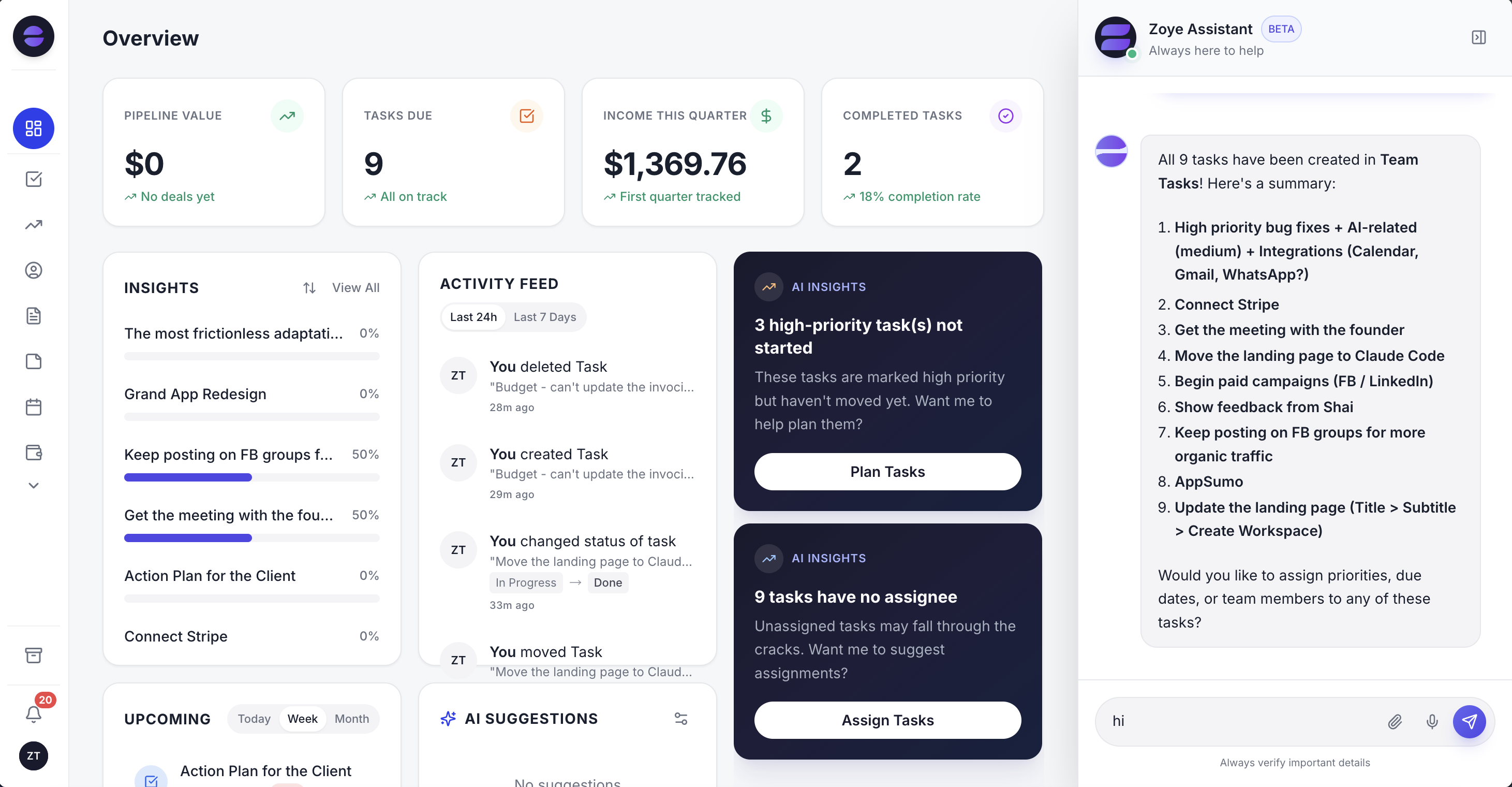
The overview shows which chats became deals and tasks, so the person who picks up a handover starts from the record, not from a blank screen.
Limits, plainly: Zoye has no website chat widget (a click-to-chat button and QR code send site visitors to WhatsApp instead), it is not a helpdesk with ticket SLAs and a public help centre, and it does not run ads.
Pricing (as of October 2026): the entry plan, Almost Free, costs $5 monthly or $4 on annual billing and covers one person with the core tools, the Google integrations and 15 AI prompts each month, without automations. For a team, Starter runs $29 monthly ($23 annually) and seats up to 10 people; Growth is $59 ($47) with room for 20; Scale is $119 ($95) with room for 100; Customize is priced on request. Each plan carries a monthly AI allowance and is priced by team size, never per chat or per resolution. The pricing page shows which plans include the WhatsApp and Meta automations.
Ready to hand off the busywork?
Zoye brings AI-powered CRM, task management, and automation into one workspace.
Get StartedChatbot or live chat: which should you choose?
Choose by your volume, your question mix, your hours and where in the buying journey people message you. Low volume and complex questions favour people; high volume, repeat questions and after-hours traffic favour a chatbot; most small teams with mixed traffic should run a hybrid with a clear handover.
| Your situation | Choose | Why |
|---|---|---|
| Fewer than about 20 chats a week, mostly custom questions | Live chat, with an honest away message | Automation saves little; your judgement is the service |
| The same 20 questions fill the inbox every day | Chatbot or AI agent first | Repeat answers do not need a person |
| Many first messages arrive evenings and weekends | AI agent first, a person next morning | Covering those hours with staff costs more than the chats are worth |
| Early-stage buyers asking price, availability, area | Chatbot first, then qualify | Speed keeps you on the shortlist |
| Late-stage, high-value or custom deals | Person, with the bot collecting details first | Judgement closes; the bot saves the first five minutes |
| Complaints, refunds, sensitive topics | Person, fast | A bot in front of an upset customer makes it worse |
| Customers write on WhatsApp, Instagram or Facebook | Hybrid on the messaging apps, handover in one shared inbox | The channel is asynchronous, so the agent and a person share the thread |
| Website visitors who leave in seconds | Website live chat software with an AI agent | The widget is where that customer is |
Whatever you choose, measure outcomes rather than chat counts for the first month: how many chats ended in a booking, a sale or a solved problem, how many were handed over, and how long a handed-over customer waited. Those three numbers tell you whether to shift the split towards the bot or towards people.
If your customers already message you on WhatsApp, Instagram and Facebook, book a Zoye demo and bring a week of real chats; we will show you which ones Zoye would answer and which ones would go to your team.