
Quick answer: lead qualification is deciding, as early as possible, which enquiries deserve a person's time today, which can wait, and which are not a fit. AI lead qualification hands the first part of that decision to an agent that asks a few questions on WhatsApp, Instagram, a web form or the phone, writes the answers onto the contact, scores them against your rules and routes the lead to the right person. The framework matters less than three choices: which questions you ask, where the answers are stored, and how fast a human picks up the hot ones.
Key takeaways (October 2026)
- In the 2011 Harvard Business Review lead-response study of 2,241 companies, the average reply that did arrive took 42 hours, and 23% of firms never replied at all.
- Salesforce's State of Sales survey of 5,500 sales professionals in 27 countries (July 2024) found reps spend 70% of their time on work other than selling, and only 35% fully trust their own company's data.
- A small business rarely needs BANT on the first message: a 3-question check of need, timing and fit routes most enquiries correctly.
- On WhatsApp, a message carries at most 3 reply buttons with labels of up to 20 characters, per Meta's developer documentation, so each question has to be short enough to answer in one tap.
- Since 15 January 2026, Meta's terms bar general-purpose AI assistants from the WhatsApp Business Platform; a business bot that qualifies your own leads is allowed.
What is lead qualification, and what does AI change?
Lead qualification is the step between "someone got in touch" and "a salesperson spends time on them". It answers three things: is this person a fit for what we sell, how soon do they want it, and who on the team should reply. AI changes when that step happens, moving it from whenever someone reads the inbox to the first minute of the conversation.
Three terms get mixed up, and separating them makes the rest of this guide easier to use:
- Qualification is the set of questions and the decision they feed: fit or not, now or later.
- Lead scoring turns the answers, plus anything you already know, into a number so leads can be sorted and compared.
- Routing uses that number and the answers to pick an owner and a deadline for the first human reply.
Marketing software adds two labels: a marketing qualified lead (MQL) has shown interest, and a sales qualified lead (SQL) has answered enough to earn a salesperson's time. A small business usually does better with one status on the contact: new, qualifying, qualified, not a fit.
Without AI, qualification in a small team often means the owner reading WhatsApp late at night, guessing from a two-word message, and writing nothing down. An AI agent asks the same questions at any hour and leaves the answers on the record. The final call on an unusual or valuable request stays with a person.
Why lead qualification is a speed problem first
Most enquiries are lost to delay, not to bad questions. The research that small teams still quote on this comes from Harvard Business Review, and the gap it found between when buyers ask and when companies answer is the gap AI lead qualification is built to close.
The 2011 HBR article "The Short Life of Online Sales Leads", by James Oldroyd, Kristina McElheran and David Elkington, timed how 2,241 companies replied to web enquiries. Fewer than four in ten (37%) answered inside an hour. Almost a quarter (23%) sent nothing back. Where an answer did come within 30 days, it took 42 hours on average. The same authors found that firms reaching out within the first hour were close to seven times as likely to qualify the lead as firms that waited longer. The numbers are fifteen years old and come from web forms, so read them as a direction, not a forecast for your market.
The second reason is time. Salesforce's sixth State of Sales report, published in July 2024 from a survey of 5,500 sales professionals across 27 countries, found that reps spend 70% of their working time on tasks other than selling. Reading, sorting and chasing unqualified enquiries is a large part of that. In a team of two or three, it often falls on the person who should be quoting the jobs.
So the job is narrow: reply in seconds, collect the facts that decide the next step, and put the lead in front of the right person while they still care.
Lead qualification frameworks: BANT, CHAMP and a 3-question check
A lead qualification framework is a fixed list of things you need to know before a lead earns a salesperson's time. BANT checks budget, authority, need and timeline; CHAMP starts from the buyer's challenge; MEDDIC is built for complex enterprise deals. For most small businesses, a 3-question check of need, timing and fit is enough for the first conversation.
| Framework | What it checks | Best for | Weak spot for a small business |
|---|---|---|---|
| BANT | Budget, Authority, Need, Timeline | B2B deals with a buying committee and a formal budget | Budget and authority questions feel blunt in a first chat and cost replies |
| CHAMP | Challenges, Authority, Money, Prioritization | Consultative sales where the problem shapes the offer | The open "challenges" question needs a typed answer, which phones discourage |
| MEDDIC | Metrics, Economic buyer, Decision criteria, Decision process, Identify pain, Champion | Long enterprise cycles with several stakeholders | Far too heavy for an enquiry that may be worth a few hundred in revenue |
| 3-question check | Need, Timing, Fit | Service businesses, bookings and considered purchases answered on WhatsApp, Instagram or a form | Leaves authority and exact budget for the first call, by design |
BANT is commonly credited to IBM's sales organisation and is still the framework most people learn first. Its strength is that it forces four honest questions. Its weakness, for a small business, is order: it opens with money. A person who sent "how much for a logo?" on Instagram does not want to be asked about budget authority. If you use BANT, keep it for the first call, and let the opening chat collect only need and timeline.
CHAMP starts from the buyer's problem before authority, money and priority, which suits consultants and agencies whose offer changes with the problem. But "what challenge are you facing?" is open, and open questions get fewer answers on a phone.
The 3-question check is what we recommend for most small businesses on the first contact:
- Need: what do they want, chosen from the three or four things you actually sell.
- Timing: when, as a choice between soon, this month or later, and just looking.
- Fit: one question that tells you whether you can serve them, such as size, area or the price band they expect.
Budget becomes "fit" asked as a range, and authority waits for the call, when a person can ask it naturally ("will anyone else be part of the decision?"). Our WhatsApp lead qualification bot guide covers question order and half-finished answers in detail; the rest of this article covers the wording per channel, the scoring and the handoff.
Lead qualification questions by channel (copy-ready)
Good qualification questions are short, answerable in a tap or a few words, and skip anything the channel already tells you. Below are 32 copy-ready questions, eight each for WhatsApp, Instagram DMs, web forms and phone calls. Pick three to five per channel; the rest are alternatives for different businesses.
Replace the placeholders in braces with your own values. Each set follows the same logic: need, timing and fit first, then the details a salesperson needs to act.
WhatsApp (8 questions)
WhatsApp already gives you the phone number and usually a first name, so never ask for either. Keep each question to three tappable options or fewer, with labels short enough to fit a 20-character button.
- "Hi {name}, thanks for reaching out to {business}. Three quick questions and I'll get you to the right person. What are you looking for? [{service A}] [{service B}] [Something else]"
- "When would you like to start? [This week] [This month] [Just looking]"
- "Roughly how big is it? [Small] [Medium] [Large]" (define each size in the line above the buttons, for example by number of people, rooms or items)
- "Which area should we come to?" (only if you travel to the customer)
- "Have you worked with {business} before? [Yes] [No]"
- "Is a call or a chat here easier for you? [Call me] [Chat here]"
- "What time of day suits you best? [Morning] [Afternoon] [Evening]"
- "Anything we should know before {owner name} gets back to you? You can send a photo or a voice note."
Instagram DMs (8 questions)
An Instagram lead usually starts from a specific post, reel, story or ad and arrives with a handle but no phone number or email. Tie the first question to what they saw, and ask for a contact detail only with a reason.
- "Hey {handle}, glad you liked the {post or offer}. Is it this one you're interested in, or something similar?"
- "Is this for you or for someone else?"
- "When are you hoping to have it? [Soon] [In a month or two] [No rush]"
- "Which option fits best? [{option A}] [{option B}] [Not sure yet]"
- "Do you have a rough price range in mind, so I can show you what fits?"
- "What is the best number or email to send the details to?"
- "Is it OK if {owner name} follows up there in the next day?"
- "Would you like to see a few examples first, or go straight to a quote?"
Web form (8 fields)
A form is the one channel where people expect to type, but every extra field still loses submissions. Keep the visible form to four or five fields and use the rest only when your offer truly needs them.
- Name
- Email or phone (one required, with a choice of which)
- "What do you need help with?" as a dropdown of your services plus "Other"
- "When do you want to start?" as a dropdown: within 2 weeks, within 3 months, later, just researching
- "Roughly what size is the job?" as ranges that match your price bands
- "Where are you based?" only if location changes who serves them
- "How did you hear about us?" only if your form cannot record the source automatically
- "Anything else we should know?" as an optional text box, never required
Phone call (8 questions)
A call can carry the authority and budget questions a chat cannot, because tone softens them. This is where BANT belongs.
- "You mentioned {need}. What made you look into it now?"
- "What would a good result look like for you in three months?"
- "Have you tried anything for this already? What did you like or not like about it?"
- "When would you ideally want this up and running?"
- "Who else will be part of the decision, if anyone?"
- "Do you have a budget range in mind, or would it help if I gave you our typical range first?"
- "Is there anything that would stop you from going ahead this month?"
- "What would you like to happen after this call: a written quote, a second call, or a booking?"
On every channel, never re-ask what the person already told you elsewhere: if they answered on WhatsApp, the caller opens with those answers. And two answers are enough to route a lead; a person can ask the rest.
How to qualify leads: a 6-step lead qualification process
A lead qualification process is the same six steps in any business: decide who you will not serve, choose your questions, store each answer in a field, score the answers, route by score, and review the result every month. AI speeds up steps three to five; steps one, two and six stay with you.
- Write your disqualifiers first. Three to five reasons you will say no: an area you do not cover, a job below your minimum, a service you do not offer. Disqualifying early is a kindness to the lead as well as to your team.
- Pick the questions. Start from the 3-question check and add one channel-specific question at most. If you cannot name what you would do differently with an answer, cut the question.
- Give every answer a field. Service, timing, size band, area, preferred contact. An answer that lives only in a chat transcript cannot be sorted, counted or used to route.
- Score the answers. Points for fit and urgency, minus points for disqualifiers, two thresholds. The next section has an example to copy.
- Route by score and by service. Hot leads to a named person with a deadline, warm leads to a same-day queue, cold leads to a slower follow-up or a polite no.
- Review monthly. Compare scores against deals actually won. If many leads scored 40 turn into customers, your hot threshold is too high.
Lead scoring for a small business: an illustrative scorecard
Lead scoring gives every enquiry a number so your team works the best ones first. A simple scorecard adds points for fit and urgency, subtracts points for clear mismatches, and uses two thresholds. The values below are an illustration to adapt, not a benchmark; tune them against your own won deals after a month.
| Signal | Example answer | Points |
|---|---|---|
| Service you sell well | Chose {main service} | +20 |
| Timing | This week or this month | +25 |
| Timing | Just looking | +5 |
| Size band | Matches your typical job or larger | +20 |
| Area or market | Inside the area you serve | +10 |
| Engagement | Answered every question within 10 minutes | +10 |
| Asked for a person | Tapped "Call me" or wrote "can someone call" | +15 |
| Returning contact | Has bought from you before | +15 |
| Clear mismatch | Service you do not offer or an area you do not cover | -40 |
| Below minimum | Size band under your minimum job | -20 |
With these values, 60 or more is hot: a named person replies within the hour during working time. 30 to 59 is warm: a same-day reply, or the first thing next morning if it arrives late. Under 30 is cold: an automatic reply with useful information and a follow-up in a week, or a polite pointer elsewhere when it is a clear mismatch.
Score the request, never the person making it. Keep the mismatch line large and negative so one strong signal cannot hide a disqualifier, and keep the card short enough that anyone on the team can explain a lead's number.
Want to see it in action?
See Zoye catch a new lead, answer on WhatsApp and set up the follow-up, all from one message.
See How It WorksRouting and handoff: who gets the lead and what they see
Routing decides who replies and by when; handoff decides what that person knows when they open the lead. Assign every qualified lead to one named owner automatically, give each score band a reply deadline, and attach the answers as fields with the transcript underneath, so the buyer never repeats themselves.
Routing rules that work for small teams.
- By service: each service line has an owner, and the "need" answer picks them.
- By score: hot leads go to whoever is on duty, warm leads to a shared queue with a same-day deadline.
- Round robin: when several people sell the same thing, rotate new leads so nobody hoards the good ones.
- Returning customers: always back to the person who served them last.
A copy-ready handoff note. Whatever tool you use, the owner should get something like this, filled from the fields rather than retyped:
"New lead: {name}, score {score}. Wants {service}, timing {timing}, size {size band}, area {area}. Came from {source}. Prefers {call or chat} in the {time of day}. Reply by {deadline}."
What the lead hears. Tell them who will reply and roughly when: "Thanks, {name}. {owner name} looks after {service} and will message you here by {time}." Then make sure that happens. Our lead generation chatbot guide lists the triggers for handing a conversation to a person mid-chat; here the point is that a promise in the handoff message is only worth the deadline behind it.
What AI does well in lead qualification, and what it does badly
AI is good at the repetitive, time-critical parts of qualification: replying at once, asking the same questions every time, writing answers into fields and applying your scoring rules. It is weak at judgement: unusual requests, custom pricing, tone and anything your records do not cover. Design the process so each side does what it is good at.
| Task | AI does it well? | Why | Guardrail |
|---|---|---|---|
| First reply at any hour | Yes | Answers in seconds, nights and weekends included | Say the reply is automated where the law requires it |
| Asking the same questions every time | Yes | No skipped questions on a busy day | Keep the set to three to five |
| Understanding free-text answers | Mostly | Reads "next month-ish" as a timing band | Show the chosen value on the record so a person can correct it |
| Applying a scorecard | Yes | Follows the rules exactly | You write the rules, and you review them monthly |
| Quoting a custom price | No | It does not know the job well enough | Give ranges only; a person confirms the quote |
| Judging an unusual request | No | It matches patterns rather than understanding the risk | Route anything unclear to a person |
| Reading frustration or urgency in tone | Partly | Catches clear words, misses subtle ones | One tap to reach a person, always |
| Working from bad data | No | Wrong fields in, wrong routing out | Clean up duplicates and stale contacts before you switch it on |
The last row matters more than it looks. In the same Salesforce survey, only 35% of sales professionals said they completely trust the accuracy of their organisation's data. An AI that scores leads against duplicate contacts, empty fields or out-of-date stages will route confidently and wrongly. Fix the records first; then automate.
On WhatsApp there is also a policy line to respect. Meta's WhatsApp Business Solution Terms have barred general-purpose AI assistants, where the AI itself is the product, from the Business Platform since 15 January 2026. A business-specific agent that answers and qualifies your own customers is allowed. Every qualification conversation also starts inside Meta's 24-hour window after the customer's last message; once it closes, only a template Meta has approved can restart the chat, so aim to finish qualification while the window is open.
See what Zoye can do for you
CRM, deals, tasks and your Instagram, Facebook and WhatsApp automations in one workspace. Just ask Zoye and it sets any of it up for you.
Explore FeaturesHow Zoye qualifies leads and routes them
Zoye is an AI Business Operator: thirteen linked tools, from contacts, deals and tasks to the calendar, reports and the WhatsApp, Facebook and Instagram automations, with an AI that works across all of them. For lead qualification that means the questions, the answers, the owner, the task and the report all sit on the same records.
Where the questions get asked. WhatsApp lead conversations run through the official WhatsApp Business Platform inside Zoye today; connecting your own business WhatsApp number is coming soon. A new lead can get an instant first message by source (ads, forms, website, API or manual entry), and the qualifying bot asks your questions and writes each answer into a field on the contact as it arrives. On Instagram and Facebook, a DM, a story reply or a keyword comment gets an answer within seconds, and a lead-ad Instant Form arrives as a contact that remembers which campaign and ad it came from. Your team answers all of it from Chats, the shared inbox where Instagram and Facebook messages and comments sit next to the WhatsApp conversations with your leads, with assignment and notes.
How the scoring and routing get built. You describe the rule to Zoye in the app, on WhatsApp or in Slack, for example: "when a new lead says this month and picks our main service, assign them to Dana, mark them high priority and create a call task due in an hour". Zoye builds the trigger, conditions and actions, shows you the finished rule, and nothing runs until you approve it. Every run is logged with what fired and what changed. Every WhatsApp automation is off by default and asks for confirmation before anything is sent.
What happens after. The qualifying bot can offer open slots and book one, follow up when someone goes quiet halfway, and send a payment link in the chat. Anything it should not answer goes to a person with the whole conversation on the lead's card. If Meta refuses a message, you see the reason rather than a false "sent".
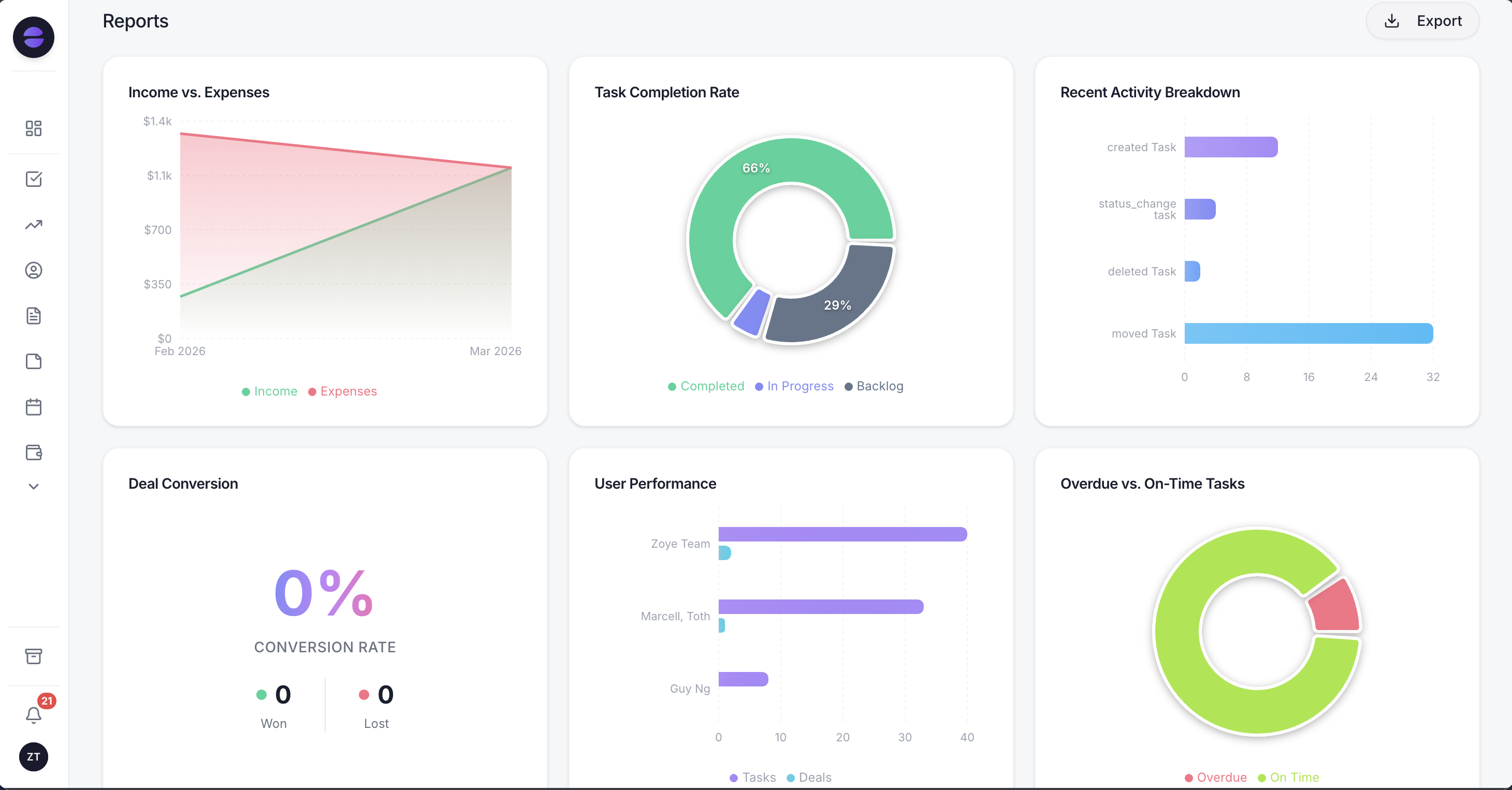
Because each lead keeps its source and its answers as fields, Reports can show which channel and which score band actually turn into won deals.
Limits, stated plainly. Zoye has no chat widget for your website; visitors reach it through a click-to-chat button or QR code that opens WhatsApp. It is not a help desk ticketing suite, and it does not run ads; it captures and works the leads your ads bring in. It does not replace the judgement call on a large or unusual deal.
Pricing (as of October 2026, from our pricing page): Almost Free at $5 a month ($4 on yearly billing) is for one person and covers the core tools and 15 AI prompts a month, without automations, so the qualifying bot and routing rules described here are not part of it. Team plans are Starter at $29 a month ($23 yearly) for up to 5 members, Growth at $59 ($47) for up to 10, Scale at $119 ($95) for up to 30, and a quoted Customize plan. See pricing for what each plan includes.
Ready to hand off the busywork?
Zoye brings AI-powered CRM, task management, and automation into one workspace.
Get StartedLead qualification mistakes, and where to start this week
The usual mistakes are a ten-question BANT script pasted into WhatsApp, budget asked in the first message, answers left in chat logs, qualified leads with no owner, and an AI allowed to promise prices. Avoid them with a one-week rollout on the channel where most enquiries already arrive, judged by deals won.
- Day 1: write your disqualifiers and the three questions.
- Day 2: create a field for every answer, plus a status field.
- Day 3: copy the scorecard above, change the points to suit your business, set the two thresholds.
- Day 4: write the routing rules and the handoff note.
- Day 5: test as a stranger from another phone, including stopping halfway.
- After 30 days: compare scores with won deals and adjust.
If your enquiries already arrive on WhatsApp, Instagram and Facebook, book a Zoye demo and bring a week of real messages; we will show you the qualification, scoring and routing rules running on them.