Quick answer: speed to lead is how long a new enquiry waits for your first useful reply, and the research says minutes matter far more than most businesses act on. Aim for a reply within 5 minutes in working hours and an honest, useful acknowledgement within a minute after hours, on every channel where people reach you, then measure the median every week.
Key takeaways (October 2026)
- The 2007 Lead Response Management study (InsideSales.com and MIT, over 15,000 leads and 100,000 call attempts) found the odds of reaching a web lead by phone fell 100 times between a call at 5 minutes and a call at 30 minutes, and the odds of qualifying it fell 21 times.
- The 2011 Harvard Business Review study, an audit of 2,241 US companies, found that only 37% replied to a web lead within an hour, 23% never replied, and those that answered within 30 days took 42 hours on average.
- In Workato's test of 114 B2B companies (dated March 2026 on its blog), 1 company out of 114 sent a personalised email within 5 minutes and none phoned within 5 minutes.
- On Messenger and Instagram, Meta's policy says automated bots must respond within 30 seconds, and the standard reply window is 24 hours (up to 7 days after a click-to-Messenger or click-to-Instagram Direct ad).
- A team of 1 to 10 can get close to the 5-minute rule in 7 days: route every channel into one place, automate the first reply, and keep a person in the loop for the conversation.
What is speed to lead, and how fast should you respond?
Speed to lead is the elapsed time between someone raising their hand (a form, a message, a DM, a call) and the first reply that actually helps them. The target supported by the research is under 5 minutes for the first contact during working hours, and the practical floor for a small team is an immediate useful acknowledgement plus a person within the hour.
The phrase comes from sales teams that call web leads, but the idea applies to any channel. A person who has just filled in your form or sent a WhatsApp message is still holding their phone and often comparing you with two or three other businesses. Every minute you wait, they get distracted, hear from someone else, or decide the problem can wait.
Two numbers make up your real speed to lead, and it helps to keep them apart:
- Time to first reply: until the lead gets a message relevant to what they asked. This can be automated and close to instant.
- Time to first conversation: until a person, or an agent that can actually help, works through their question, gives a price range or books a time. This is where the sale starts.
The research below is mostly about the first contact. If you have read our guide on how to stop losing leads, which covers the four places enquiries leak, this article is the deeper look at the clock itself: what the studies measured, what the rule means, and how to hit it channel by channel.
What does the research on speed to lead actually say?
Three pieces of work carry most speed-to-lead statistics: a 2007 InsideSales.com and MIT study of phone follow-up on web leads, a 2011 Harvard Business Review audit of 2,241 companies, and newer secret-shopper tests such as Workato's study of 114 B2B firms. All point the same way: faster replies reach and qualify more people.
The 2007 Lead Response Management study (InsideSales.com and MIT)
This is the origin of the 5-minute rule. It was presented on 16 October 2007 at MarketingSherpa's B2B Demand Generation Summit by Dave Elkington, then CEO of InsideSales.com, and Dr James Oldroyd, then at MIT's Sloan School of Management. The research summary we opened (a copy of the study page dated 2008) describes three years of data across six companies, covering more than fifteen thousand web leads and more than one hundred thousand call attempts.
The question was narrow: when should a company call a web-form lead to have the best chance of reaching and qualifying them? The findings, in plain terms:
- The first hour is steep. Waiting the first hour cut the odds of reaching the person by more than 10 times and the odds of qualifying them by more than 6 times.
- The first half hour is steeper. A call placed at 5 minutes was 100 times more likely to reach the lead than one placed at 30 minutes, and 21 times more likely to qualify them.
- Even 5 extra minutes count. Moving from 5 to 10 minutes cut the contact odds about 5 times and the qualification odds about 4 times.
- Late persistence can backfire. After about 20 hours, additional dials were associated with a lower chance of reaching and qualifying the lead.
Two details matter for how you use it. The study page says plainly that it did not address close ratios: it measured reaching and qualifying people, not revenue. And "contact" meant a phone call that connected with a live person, years before WhatsApp or Instagram became business channels.
The 2011 Harvard Business Review audit
The second study is the article "The Short Life of Online Sales Leads" by James Oldroyd, Kristina McElheran and David Elkington, in the March 2011 issue of Harvard Business Review. The full article is behind HBR's paywall; the figures here are from a reprint of its text that SmartCompany published in July 2011.
For the study, the authors sent a test enquiry through the website of 2,241 US companies and timed the reply. Roughly a third (37%) wrote or called back within the hour. Another 16% took between one and 24 hours, 24% took longer than a day, and close to a quarter (23%) never replied. Counting only the companies that did reply inside 30 days, the mean wait was 42 hours.
A second part of the article looked at 1.25 million leads handled by 29 B2C and 13 B2B companies in the US. Firms that tried to reach a lead within an hour were nearly seven times as likely to qualify it as firms that waited one hour more, and more than 60 times as likely as firms that waited a day or longer.
The most useful part is the distribution, not the multipliers. If your competitors look like that sample, a fast reply is not a small edge: you are often the only business in the conversation.
Newer benchmarks: Workato's test of 114 B2B companies
For a more recent check, Workato ran its own secret-shopper test and published it on its blog; the page is dated 19 March 2026 and does not say when the requests were submitted. Its team filled in demo request forms at 114 B2B companies and timed what came back.
- Only 1 of the 114 companies sent a personalised email within 5 minutes.
- Personalised email replies took 11 hours and 54 minutes on average, and nearly 1 in 5 companies never replied by email.
- The study found that just 31% phoned the lead at all; calls arrived after 14 hours and 29 minutes on average, none came within 5 minutes, and 42% of the calls came within the hour.
- Companies without a lead routing tool took nearly 13 hours to respond on average, against 3 hours and 32 minutes for those with one.
The sample is small and B2B only, but it matches the older work. One caution: Workato's page credits the 5-to-10-minute finding to Harvard Business Review, while in the material we opened it belongs to the 2007 InsideSales.com and MIT study. The two are often mixed up, so check the source before you quote a number.
Speed to lead statistics at a glance
The three studies side by side, with dates, samples and limits, so you can quote the right number from the right source. Read the multipliers as direction and scale, not as a promise about your own close rate.
| Study | Published | What was measured | Sample | Headline finding | Main limit |
|---|---|---|---|---|---|
| Lead Response Management study (InsideSales.com and MIT) | Presented 16 October 2007 | Phone calls to web leads: contact and qualification by delay, day and hour | 6 companies, 3 years, 15,000+ leads, 100,000+ call attempts | Contact odds 100 times higher at 5 minutes than at 30; qualification odds 21 times higher | Phone only, no close rates, mid-2000s US data |
| "The Short Life of Online Sales Leads" (Harvard Business Review) | March 2011 | Reply time to a test web enquiry; qualification by delay | 2,241 US companies audited; 1.25 million leads at 42 companies | 37% replied within an hour, 23% never, 42-hour average; nearly 7 times as likely to qualify within an hour | Web leads only, pre-messaging era |
| Lead response time test (Workato) | Blog page dated 19 March 2026 | Email and phone replies to demo requests | 114 B2B companies | 1 of 114 emailed within 5 minutes; average email reply 11 h 54 min; average call 14 h 29 min | Small B2B sample, test date not stated |
Want to see it in action?
See Zoye catch a new lead, answer on WhatsApp and set up the follow-up, all from one message.
See How It WorksWhat is the 5-minute rule, and where does it stop working?
The 5-minute rule says a new lead should hear from you within 5 minutes. It is a sound target because the 2007 data shows the steepest drop in that window, but it was measured on phone calls to web leads, it tracked contact rather than sales, and a fast reply that says nothing useful does not earn the benefit.
It holds while the person is still in the moment. A reply in the next few minutes reaches them while the question is fresh, and on messaging channels it lands on the device they are already holding.
It weakens when the reply is empty. An autoresponder that says "Thanks, someone will be in touch" answers in seconds but helps nobody. If a person then takes two days, your real speed to lead is two days. Count the first reply that moves the person forward.
It is not a reason to rush a bad answer. A guessed price or a wrong availability given in 3 minutes costs more than a correct one given in 20. If you automate the first reply, give the automation real information: your price ranges, your hours, your booking rules, and a clear line for "a person will confirm this".
It does not replace follow-up. The 2007 finding about dials after 20 hours was about phone calls; on messaging channels the platform sets the rules. Follow-up rhythms are covered in the leak guide linked above.
It depends on the purchase. Urgent services reward minutes most, because the buyer books the first business that answers well. Considered purchases still reward a fast first reply, but later conversations decide more. A sensible rule for a small team: 5 minutes for the first useful reply, one hour for a person, same day for a quote or a booking offer.
How do you hit speed to lead on every channel?
Each channel has its own clock and rules: a web form expects a call or message, WhatsApp and Instagram expect a chat reply, Messenger bots must answer within 30 seconds, and a missed call needs a callback. The pattern is the same everywhere: capture the lead in one place, send a useful first reply automatically, alert a person.
| Channel | Realistic first-reply target | First move | Rule to know (as of October 2026) |
|---|---|---|---|
| Web form | Under 5 minutes | Instant confirmation plus a message or call from a person | First WhatsApp message to a form lead must use an approved template |
| Under 5 minutes | Reply in the chat with an answer and one question | Free-form replies only within 24 hours of the customer's last message | |
| Instagram DM | Under 1 minute automated, under 1 hour human | Answer the question, ask what they need | 24-hour window, up to 7 days after a click-to-Instagram Direct ad |
| Messenger | Under 30 seconds for bots | Automated answer, human picks up within the hour | Meta: automated bots must respond within 30 seconds |
| Phone | Answer live, or call back within 5 minutes | Return the missed call, then a text with a time | Voicemail that says when you will call back |
| Under 1 hour for a person | Short reply that answers and offers a time | Autoresponders should state when a person will reply |
Web form leads
A web form is the classic case and the easiest to measure, because it gives you an exact timestamp. Send every submission to the same place as your other leads, with the source attached, and fire two things at once: a confirmation to the person that says what happens next, and an alert to whoever is on duty.
If you answer form leads on WhatsApp, the business is starting the conversation, so the first message must be a pre-approved template. Once the person replies, a 24-hour window opens. Make the template useful: their name, what they asked about, and one easy question.
When a customer writes first on WhatsApp, a 24-hour customer service window opens and you can reply freely. The person is in an app they check constantly, so speed wins here. The weakness is that a small team often answers from one person's phone, and a message that arrives during a job sits unread. The fixes: an instant first reply that answers the most common question and asks one qualifying question, and a shared view of unanswered chats.
If the lead came from a click-to-WhatsApp ad opened in the Android or iOS app and you reply in time, Meta opens a free entry point window of up to 7 days. On AI: since 15 January 2026, Meta's terms bar general-purpose AI assistants from the WhatsApp Business Platform, while an AI that serves your own customers with answers, bookings and qualification is allowed. Our WhatsApp auto reply guide covers wording.
Instagram DMs
Instagram leads arrive as DMs, story replies and comments. Meta's messaging policy gives you 24 hours after the person's message, up to 7 days when they first wrote after a click-to-Instagram Direct ad. Comments are different: you can send one private reply per comment within 7 days, and if they answer it, the normal window opens.
The person is scrolling, so a DM answered in a minute catches them before the next post does. Use an automated reply that answers the common question and asks what they need, a public reply to buying comments, and save every DM to a contact. Our chatbot for lead generation guide covers the questions a bot should ask.
Facebook Messenger
Messenger follows the same 24-hour and 7-day windows as Instagram, plus one rule: Meta's Messenger Platform policy says automated bots must respond to user input within 30 seconds, so a slow bot is outside the policy. For conversations a person must finish outside the window, the Human Agent tag allows manual replies within a separate 7-day period; it needs Meta's app review and is for people, not automation.
Phone calls
A missed call is often your slowest lead, because it leaves no message and nobody owns it. Set three habits: a voicemail greeting that says when you will call back, missed calls from unknown numbers returned within 5 minutes in working hours, and a short text after the callback attempt. Log every call as a lead with its time, or you will never know your phone response time.
Email is the easiest channel to forget. With personalised replies averaging almost 12 hours in the Workato test, a small team can beat the benchmark: answer within the hour, keep the first reply short (the answer, a price range, a time to talk), and give a shared mailbox a named owner each day.
How do you keep speed to lead after hours?
After hours, speed to lead means two things: an immediate reply that is honest about when a person will answer and gives real help in the meantime, and a first human or agent conversation at the start of the next working day. Leads that arrive at night or on weekends are not worse leads; they are just easier to lose.
The 2007 study only looked at standard working hours, so it does not tell you what to do at 11pm. A reasonable approach:
- Reply instantly, and say when a person will follow. "We are closed now. Here are our prices for the most common jobs. A person will reply by 9:30 tomorrow morning" is honest and useful.
- Let the reply do real work. Answer the common question, ask one or two qualifying questions, and offer a booking slot. A lead who has already picked a time is far warmer at 9am.
- Be clear that it is automated. Meta's policy expects bots to say so where the law requires it and recommends it in general.
- Do not answer a 2am enquiry with a marketing push. Reply to what they asked. Promotions can wait.
- Put night leads first in the morning queue. Whoever opens first works through overnight enquiries, oldest first.
See what Zoye can do for you
CRM, deals, tasks and your Instagram, Facebook and WhatsApp automations in one workspace. Just ask Zoye and it sets any of it up for you.
Explore FeaturesHow do you measure your own lead response time?
Measure lead response time by recording when each enquiry arrived and when your first useful reply went out, then report the median and the share of leads answered within 5 minutes, within an hour, the same day and never. Test each channel yourself every week, because the slow cases hide inside averages.
Define the clock. Start: the timestamp of the form, message, DM or call. Stop: the first reply that answers or moves the conversation forward. If you automate that reply, keep a second stop for the first conversation with a person.
Use the median, not the average. A few very late replies pull an average up sharply; the median (the middle lead) shows what a typical lead experiences. Next to it, show HBR-style buckets: within 5 minutes, within 1 hour, within 24 hours, longer, never. Even a fine median is a problem if, say, 10% of leads land in "never".
Split by channel and by hour. Your form leads may be answered in 4 minutes while Instagram DMs wait 6 hours. Your weekday median may be excellent while Saturday leads wait until Monday. One overall number hides both.
Mystery-shop yourself. Once a week, have someone outside the team send an enquiry through each channel, on a weekday afternoon, an evening and a weekend. It is what the HBR and Workato researchers did, and the fastest way to find the channel nobody is watching.
Track the result, not only the speed. For each bucket, note how many leads became a conversation, a quote and a sale. A simple log is enough: lead name, channel, time in, first reply, first conversation, who replied, outcome. Within a few months you will see your own version of the research curve.
How does Zoye help you hit speed to lead?
Zoye is an AI Business Operator: an agent that works in the business, inside one workspace for contacts, deals, tasks, calendar and chats. For speed to lead it captures leads from forms, ads, WhatsApp, Instagram and Facebook into one place, sends the first reply, asks the qualifying questions, and alerts a person, with every rule approved before it runs.
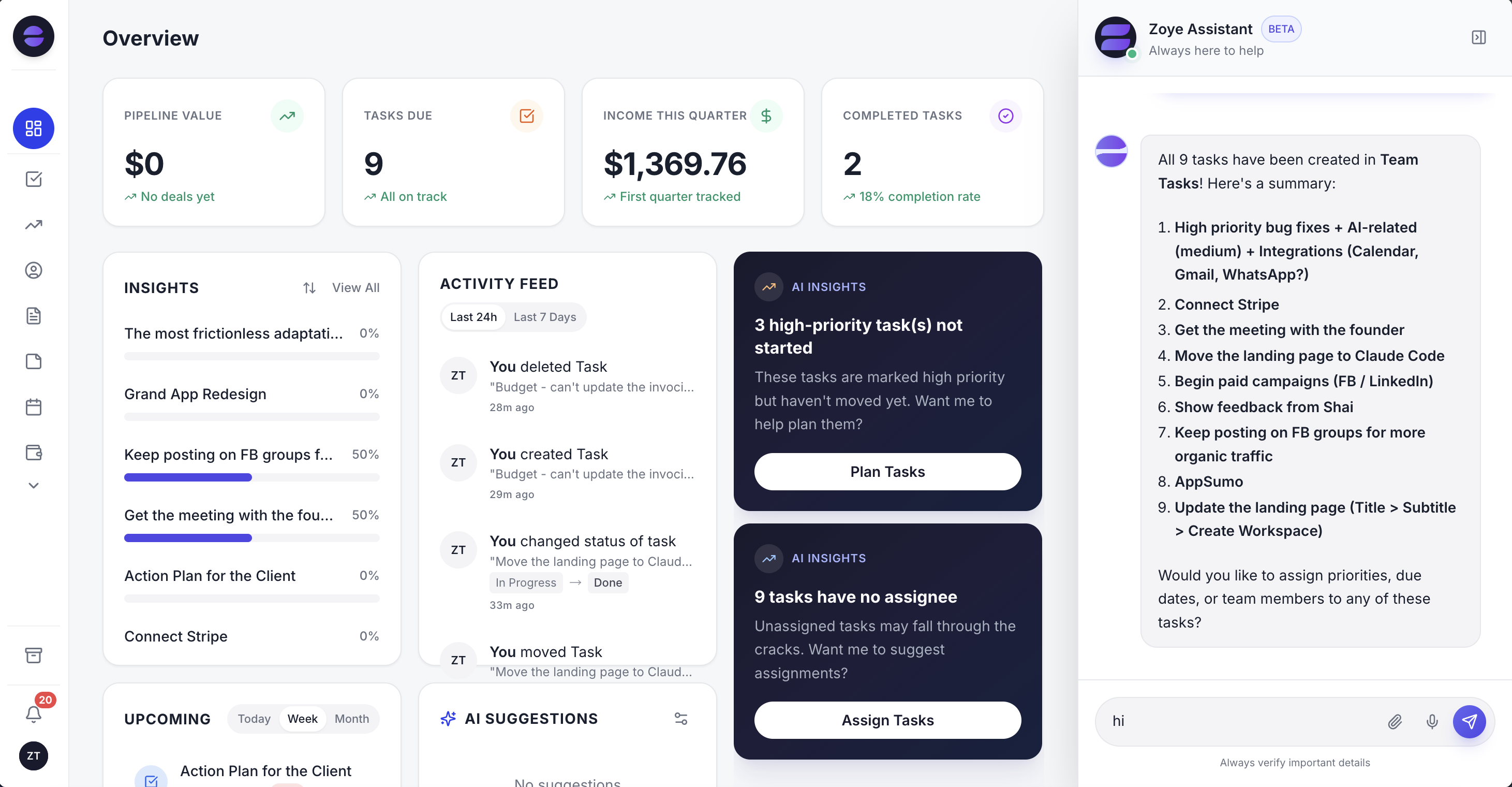 The overview shows new leads, open deals and waiting chats together, so the team sees who still needs a first reply.
- Every source lands in one place. Website forms and Facebook and Instagram lead ads become contacts within seconds, with the campaign and ad attached. Instagram and Facebook DMs and comments arrive in Chats, one inbox shared by the team, matched to the existing contact or saved as a new one.
- The first reply goes out in seconds. The new-lead auto-message has a switch for each source (ads, forms, website, API, manual) and sends one message per person, never a duplicate. A comment gets a public reply and a private DM within seconds, and DMs and story replies are answered right away; anything the automation should not handle goes to a person.
- Qualification starts before you are free. The lead qualification bot asks your questions on WhatsApp and writes the answers into the contact's fields, so whoever picks up the chat knows what the lead needs. Our article on AI lead qualification covers how to choose those questions.
- A person is always in the loop. The "instant lead follow-up" rule assigns an owner, sends the first reply and creates a follow-up task due in 24 hours. You can ask Zoye to tell you when a customer has waited more than an hour, and the handover keeps the whole chat on the lead's card.
- You set it up by describing it. Tell Zoye the reply you want and when it should go out, from the app, WhatsApp or Slack. She drafts the rule, lays it out for you to check, and nothing is sent before you say yes.
Honest limits: Zoye does not answer phone calls and has no website chat widget (a click-to-chat button and QR code send website visitors to WhatsApp instead). Today Zoye holds the WhatsApp conversations with your leads; connecting your own business WhatsApp number is coming soon. Zoye does not run ads; it captures and works the leads your ads produce.
Pricing (as of October 2026): the entry plan, Almost Free, costs $5 monthly or $4 a month on a yearly bill and covers one person with the core tools, 15 AI prompts each month and the Google integrations. Automations are not part of Almost Free, so the instant first replies above are not included in it. Starter costs $29 monthly ($23 a month yearly) for a team of up to 5; Growth is $59 ($47) for up to 10 people; Scale is $119 ($95) for up to 30; Customize is priced on request. See the pricing page for each plan's contents.
A 7-day plan to fix your speed to lead
You can move from "whenever someone notices" to a measured, fast first reply in one week without hiring: day one measuring, days two to five fixing channels, day six on after-hours, and day seven setting targets you review weekly.
Day 1: measure the starting point. Send a test enquiry through every channel you use: form, WhatsApp, Instagram, Messenger, phone, email. Do one in working hours and one in the evening, and time the replies. Add the last 30 leads with when they arrived and when they got a first reply. This is your baseline.
Day 2: one destination. Make every channel feed the same list of leads, with the source and the time in. If a channel cannot be connected yet, decide who checks it and how often.
Day 3: write the first replies. One per channel, short and useful. For a form lead on WhatsApp, for example: "Hi {first_name}, thanks for your request about {service}. Most jobs like this cost {price_range}. What day suits you for a quick call?" For an Instagram DM: an answer to the most common question, then "What are you looking for?". Keep a version for after hours that names when a person will reply.
Day 4: switch on instant replies. Turn on the first reply for your two busiest channels. Test it from a phone that is not yours: the reply reads well, the lead is saved, the right person is alerted.
Day 5: the phone and email routine. Agree the missed-call rule (call back within 5 minutes in working hours, then a text), update the voicemail greeting, and give the shared mailbox an owner each day. Add calls and emails to the same lead list.
Day 6: after hours and handover. Decide what the automated reply can do at night (answer, qualify, offer a booking) and what it must hand to a person. Decide who works the overnight queue first thing.
Day 7: targets and the weekly review. Set your targets: first useful reply within 5 minutes, a person within the hour in working hours, overnight leads answered by a set time. Repeat the day-one tests and compare. Book 15 minutes every week to look at the median, the buckets by channel and the leads that got no reply at all.
Ready to hand off the busywork?
Zoye brings AI-powered CRM, task management, and automation into one workspace.
Get StartedWhat should you do first?
Start by measuring, because most businesses think they reply faster than they do. Send yourself an enquiry on every channel today, note the times, and fix the slowest channel first; then automate a useful first reply and keep a person close behind it.
The exact multipliers belong to phone sales in the 2000s, but the direction has held in every newer test we found. For a team of one to ten, the win is not heroics at the phone. It is a system where every lead lands in one place, gets a useful reply in seconds, and reaches a person within the hour.
If your leads arrive on WhatsApp, Instagram, Facebook and web forms, book a Zoye demo and see the first reply, the qualifying questions and the handover working on your own channels.