
Hostaway Pricing in 2026: What a Hostaway Stack Really Costs
You went looking for Hostaway pricing and found a demo form. That is not a broken page or a missing link. It is the pricing model.
Hostaway does not publish public rates. There is no pricing table to screenshot, no plan comparison to send your business partner, no per listing figure you can drop into a spreadsheet before you have spoken to a salesperson. Access to a number runs through a demo, and the number that comes back is built around how many listings you operate. That is a legitimate way to sell software to growing management companies, and it is also the single reason this search term exists in the volume it does. Operators are not trying to be difficult. They are trying to build a budget.
So this article does two things that a pricing page cannot. First, it is honest about what is knowable: what independent reviewers and operators discussing their own quotes actually report, presented as third party estimates and dated, never dressed up as Hostaway's published price. Second, and more usefully, it does the maths that matters, which is not the PMS subscription at all. It is the whole stack at 5, 20 and 40 units, because nobody runs a portfolio on one piece of software, and the line item people forget is usually the one that costs them the most in lost revenue rather than in fees.
Hostaway does not publish public pricing. Every figure in this article that is attached to Hostaway is a third party estimate reported by independent reviewers or by operators discussing their own quotes, accurate to the best available reporting as of August 2026, and it is not a published rate. Other vendors' models are described as they publish them. Confirm all current figures with each vendor directly, and get your own quote in writing.
Why quote only pricing exists at all
It is tempting to read a hidden price as something to be suspicious of. Usually it is simpler than that, and understanding the logic helps you negotiate.
Software priced on listing count has an enormous spread between its smallest and largest customer. A co-host with 4 cabins and a management company with 400 doors are buying the same product with a hundredfold difference in scale, in support load, in onboarding effort and in willingness to pay. A published table either has to be so coarse that it misprices most customers, or so granular that it becomes unreadable. Quoting solves that, in the vendor's favour.
There is a second reason, and it is the honest commercial one: a demo converts far better than a pricing page. When you see a platform driven well by someone who knows it, the features do the selling. A number on a page invites you to compare it against a cheaper number on someone else's page before you understand what you would be giving up. Vendors know which of those two conversations they win.
The consequence for you is asymmetry. The salesperson knows their price bands, their discount latitude and roughly what you are worth. You know nothing except what a forum post told you. Everything in the next few sections exists to close that gap before you take the call.
What independent reviewers actually report
Here is the knowable part, and the framing matters as much as the figures.
Across independent review sites, comparison guides and operators discussing quotes they received, the recurring shape of Hostaway's pricing is a per listing monthly rate with a one-time onboarding charge on top. As of August 2026, the figure most commonly reported at small portfolio sizes is in the region of 40 US dollars per listing per month, with reported rates falling toward the high teens per listing as portfolios grow into the dozens. In other words, third party reporting describes a volume curve rather than a flat rate: the per door cost comes down as door count goes up, which is the normal shape for this category.
The onboarding charge is reported consistently but rarely with a figure, because it appears to be quoted case by case according to portfolio size and migration complexity. Nobody outside the company can tell you what yours will be, which is precisely why it belongs on your list of questions rather than in your spreadsheet as an assumption.
| Line | What third party reporting describes | Confidence |
|---|---|---|
| Pricing basis | Per listing, per month, quoted after a demo | High, consistently reported |
| Small portfolio rate | Around 40 US dollars per listing per month | Moderate, reported estimate only |
| Larger portfolio rate | Falls toward the high teens per listing | Moderate, reported estimate only |
| Onboarding | One-time charge in addition to the subscription | High that it exists, no reliable figure |
| Contract | Commonly annual commitments, terms vary | Varies, confirm in writing |
| Public price page | None as of August 2026 | High |
Read that table as a planning range, not as a quote. It is assembled from what other people report, it is dated August 2026, and it is exactly the kind of number a vendor is entitled to move. Its only job is to stop you walking into a call with no anchor at all. If your quote comes back near the reported range, you are in normal territory. If it comes back far outside it in either direction, you now know to ask why.
While you are building that budget, there is a second question worth asking early: which parts of your operation is the PMS actually going to run, and which parts will still be yours? A property management system is built around the reservation. The homeowner pipeline, the enquiry that arrives before anyone has booked anything, and the paperwork behind a management agreement sit outside it, which is what a vacation rental CRM is for. Hold that thought, because it becomes a real line in the stack maths below.
Want to see it in action?
Watch how Zoye automates your daily workflow - from lead management to team collaboration.
See How It WorksWhat counts as a listing, and why it decides your bill
This is the single most underestimated variable in per listing pricing, and it is where two operators with identical portfolios end up with different quotes.
A duplex that you list as two separate units may be two listings. A six bedroom villa that you sometimes sell whole and sometimes sell by the room may be counted as one listing or as seven, depending on how the platform models it and how you configure it. A property listed on three channels is normally still one listing, but a multi unit building configured as a parent listing with children can be counted either way. None of this is deception; it is a genuine modelling question. But it can move your bill substantially, so it has to be a question you ask out loud, in the demo, before the quote is prepared.
Two more billing mechanics to pin down while you are there. First, seasonality: if you take four cabins offline for the winter, do you pay for them? Some vendors bill on active listings, some on configured listings, and for a seasonal operator that difference is a meaningful part of the annual figure. Second, growth mid term: if you sign for 18 units and take on 6 more in April, does the additional cost land at your existing per listing rate, at a fresh band, or only at renewal? Ask now and it is a clause. Ask in April and it is a negotiation you are losing.
The stack, not the subscription
Here is the part that reframes the whole budget. Nobody runs a managed portfolio on a PMS alone, and if you budget only for the PMS you will be wrong by roughly half.
A working short term rental operation typically pays for five layers, and it is worth naming what each one is actually for.
The property management system. Reservations, calendars, guest records, rates, tasks and reporting. Hostaway lives here, as do Guesty, Lodgify, OwnerRez, Smoobu, Hostfully and Beds24. This is the layer everyone budgets for.
Channel distribution. Pushing availability and rates to Airbnb, Booking.com and Vrbo and pulling reservations back. In practice this is bundled inside most modern PMS products rather than bought separately, which is why "channel manager" rarely appears as its own invoice any more. It still deserves a line in your thinking, because the quality of that sync is what stops you double booking.
Dynamic pricing. Tools in this layer, PriceLabs being the category standard for operators of this size, set nightly rates against demand, seasonality, lead time and local events. They publish per listing monthly pricing and they are the one line in the stack that reliably pays for itself inside a season, because a few percent of extra RevPAR on a portfolio dwarfs the subscription.
Cleaning and turnover operations. Scheduling turnovers, checklists, photo verification, contractor coordination. Breezeway is the best known specialist. Some operators run this from their PMS task module instead and accept a thinner result.
The business layer. Winning homeowners, catching enquiries before they become reservations, holding management agreements and owner documents, chasing follow ups, invoicing owners. This is the layer that almost nobody buys, which is why it is almost always running on spreadsheets, a shared drive and someone's memory.
Third party reporting across the category commonly describes a fuller stack of those layers as totalling roughly 80 to 120 US dollars per unit per month all in. Again: that is a reported range from independent sources, not any single vendor's price, and it moves with region, portfolio size and how much you choose to automate. But it is a far more useful planning number than a PMS quote on its own, because it is the figure your management fee actually has to cover.
The maths at 5, 20 and 40 units
Now put it together. The numbers below are illustrative planning ranges built from reported third party estimates, not quotes and not published prices from anybody. Their value is in the shape, not the decimals.
| Layer | 5 units | 20 units | 40 units |
|---|---|---|---|
| PMS, at reported per listing rates | Highest per door cost of the three | Mid band | Lowest per door cost, high total |
| Dynamic pricing | Per listing, published rates | Per listing, published rates | Per listing, often banded down |
| Cleaning and turnover ops | Often skipped at this size | Usually the first addition | Normally essential |
| Business layer | Spreadsheets, and it shows | Spreadsheets, and it hurts | Spreadsheets, and it costs deals |
| Reported all in range per unit | Near the top of the 80 to 120 band | Middle of the band | Toward the lower end per unit |
| The line that dominates | The PMS subscription | The PMS plus pricing tools | Staff time, not software |
Three things fall out of that, and they are the actual conclusions of this article.
At 5 units, software is your biggest controllable cost and your worst value. Per door pricing is at its least favourable, and much of a scaling platform's depth is capability you will not open. This is the size at which a published price from a lighter vendor genuinely competes, and where a quote only platform is hardest to justify.
At 20 units, the stack overtakes the subscription. You are now paying for pricing tools and probably turnover software, the PMS is no longer the whole bill, and the business layer has started to cost you real money in leads you did not follow up on. This is the size where operators tend to discover that their software spend was never the problem.
At 40 units, software stops being the expensive part. The per door rate has come down, the tools have earned their place, and the dominant cost in your operation is now people and their time. The right question flips from "what does this cost per month" to "how many hours a week does this remove from my staff", which is a completely different purchasing conversation and a much better one.
See what Zoye can do for you
From CRM and deal tracking to AI-powered task management - explore everything Zoye offers in one workspace.
Explore FeaturesHow to prepare for the sales call
You will get a better price and a better contract by treating the demo as a structured interview. Bring your numbers and bring this list.
Know your own figures before you dial in. Exact listing count. How many of those are multi unit or room let properties. Your seasonality profile. Your realistic 12 month growth plan. An operator who states their portfolio precisely gets quoted precisely; one who is vague gets quoted defensively.
Ask how a listing is counted for billing purposes. Then ask the awkward follow up: how a duplex, a multi room villa and a seasonally closed cabin are each counted. Get the answer in the written quote, not just the call.
Ask for the total first year cost in writing, onboarding included. This is the most important sentence in this article. A one-time setup charge lands entirely in year one, so year one is always the expensive year. Compare vendors on the 12 month total, not on the monthly rate, or you will pick wrong.
Ask what the contract term is and what happens at renewal. Annual commitment or monthly rolling. Any renewal uplift and whether it is capped. What happens if you shrink rather than grow. Notice periods.
Ask which features shown are native and which are partner integrations. Demos flow smoothly across integrations without pausing to say "this one is a separate subscription with its own support queue". Get a written list splitting native from partner, with the partner costs named.
Ask what onboarding actually includes, and how long it takes. Data migration from your current system, channel reconnection, staff training, and who does the work. An onboarding fee that buys a real migration is good value. One that buys three calls is not.
Ask what your price becomes at plus 10 listings. You are buying for the portfolio you intend to have, and the answer tells you whether growth is priced fairly or punished.
Get a written scope of what is not included. The cheapest question in the entire process, and the one people never ask.
Where the money actually goes
Strip the invoices away and a managed portfolio spends on four things: distribution, rate optimisation, physical turnover, and the business of getting and keeping owners. Software is only ever a proxy for one of those.
Distribution and rate optimisation are the two that are genuinely well served by the market. A competent PMS plus a dynamic pricing tool will measurably increase what you earn per unit, and both are easy to justify in a sentence to a homeowner. Physical turnover is where software helps but people do the work, so the spend is mostly labour with a coordination layer on top.
The fourth one is where the money quietly leaks. Not in fees, in lost deals. Three homeowners met at a viewing, none called back in week three, one of them signed with the manager down the road. An enquiry that arrived at 11pm on Instagram and got a reply at noon the next day, by which point they had booked elsewhere. Management agreements in two inboxes and a shared drive, so renewals arrive as a surprise. Owner invoices four days late, every month, which is exactly how owners start wondering whether you are organised enough to keep their property.
None of that appears on a software invoice, which is why it never makes it into the budget comparison. It is usually the largest number in the whole operation.
The line item that is not a PMS
This is the part of the stack that is worth being extremely clear about, because in a cost article the tempting reading is that a cheaper tool can replace an expensive one. It cannot, and pretending otherwise would cost you a season.
Zoye is not a property management system and it does not replace one. It has no channel manager and no sync with Airbnb, Booking.com or Vrbo. It holds no availability calendar and no nightly rates. There is no booking engine, no OTA guest inbox, and no trust accounting for owner payouts. Whatever you decide about Hostaway, you still need a PMS, and every figure in the sections above still applies. Zoye is a different line item, sitting next to it, running the business layer that no PMS was built for.
What it does there is act rather than store. You tell it in plain language, and it does the thing: "log the owner from the harbour viewing, three apartments, remind me Thursday" creates the record and the reminder. Ask which owner conversations have gone quiet for more than ten days, get the list, then tell it to message them all, and they get messaged. An enquiry from WhatsApp, Instagram or a website form arrives as a lead with its source attached, and the follow up sequence runs on schedule whether or not you are at a desk. You can drive all of it from WhatsApp, which matters when your working day happens inside properties rather than in front of a laptop.
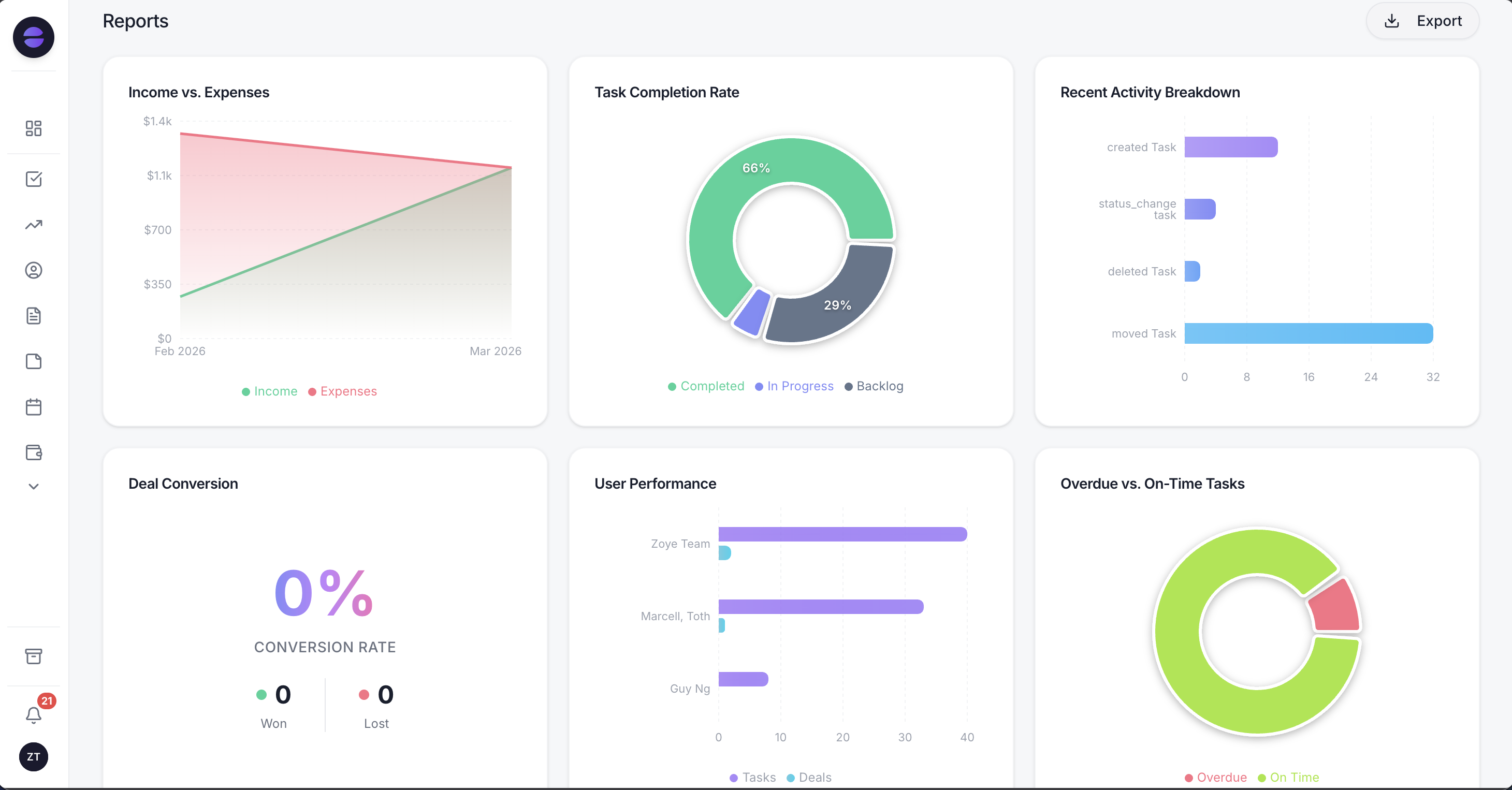 Owner pipeline, enquiry follow ups and per property costs as numbers you can actually report on, next to the system that runs your calendars
Underneath sit the things the spreadsheets were holding: management agreements and owner paperwork attached to the owner they belong to, turnover and maintenance tasks assigned and chased automatically, per property expenses and owner invoicing, and reports you request in a sentence rather than rebuild by hand each month.
The cost logic is the part that belongs in this article. Zoye is priced as flat monthly plans for the whole workspace rather than per unit or per seat, so adding a cleaner, a virtual assistant or ten more doors does not move the bill. In a stack where almost every other line scales with door count, a fixed line behaves differently as you grow. Current plans are on the pricing page.
Ready to streamline your business?
Zoye brings AI-powered CRM, task management, and automation into one workspace.
Get StartedDoes the spend fit your portfolio?
Work it out against your own revenue rather than against someone else's opinion.
Start from your management fee income. Take your gross monthly management fees, or your own rental income if you self manage. Total software spend somewhere in the low single digit percentage of that is normal and healthy. Approaching double digits at a small portfolio size is a signal you have bought for a company you are not yet running.
Judge each layer on what it returns. Dynamic pricing that lifts revenue by a few percent pays for itself immediately. Turnover software that removes a day of coordination a week pays for itself in your own hours. A PMS tier bought for reporting depth nobody reads does not.
Count the deals you are losing, not just the fees you are paying. One extra signed homeowner in a year is usually worth more than your entire annual software bill. If the reason you are not signing them is that nobody follows up, the cheapest fix in your stack is the business layer, not a different PMS.
Then decide on shape, not on price. If your portfolio is small and your operation is simple, a vendor that publishes rates is easier to buy and easier to leave. If you are scaling and want depth and automation, a quote only platform is a reasonable trade as long as you get the first year total in writing. The full comparison by category is in our guide to the best vacation rental software, and if you have already decided Hostaway is the wrong shape, the options are sorted by operator type in our Hostaway alternatives roundup.
Frequently asked questions
Hostaway does not publish public pricing, so there is no official monthly figure to quote. Independent review sites and operators discussing their own quotes commonly describe a rate of roughly 40 US dollars per listing per month at small portfolio sizes, falling toward the high teens per listing as door count grows into the dozens. As of August 2026 those remain third party estimates rather than published prices, and the quote you receive depends on your listing count, your region and what is bundled. Treat any number you find online as a planning range and get your own figure in writing.
No. As of August 2026 Hostaway routes pricing through a demo rather than a public pricing page, and the quote is built around how many listings you operate. That is a deliberate sales model, not an oversight, and it is common among property management platforms aimed at growing management companies. The practical consequence is that you cannot line Hostaway up against a vendor that publishes rates without first booking a call, which is exactly why so many comparison searches end in frustration.
Operators and independent reviewers consistently report a one-time onboarding or setup charge alongside the recurring subscription, quoted case by case rather than published. Because it is not a public figure, the only reliable way to know yours is to ask for it in writing before you sign. It matters more than it sounds: a one-time charge lands entirely in year one, so the first twelve months of a Hostaway based stack usually cost noticeably more than twelve times the monthly rate you were quoted.
Third party reporting across the category commonly puts a fuller stack at roughly 80 to 120 US dollars per unit per month all in, once you add the property management system, channel distribution, dynamic pricing, cleaning and turnover operations and the business layer on top of each other. That is a reported range rather than any single vendor's price, and it varies with region, how much you automate and how much you still do by hand. The useful exercise is to price your own stack line by line rather than budgeting from the PMS subscription alone.
Go into the demo with numbers and questions rather than curiosity. State your exact listing count and how many of those are multi unit properties, ask how a listing is counted for billing, ask for the total first year cost including onboarding in writing, ask what the contract term and renewal uplift are, and ask which of the features you were shown are native and which are partner integrations billed separately. Then ask what happens to your price when you add five listings mid term. A vendor confident in its value answers all of that plainly.
No, and swapping one for the other would break your operation. Zoye has no channel manager, no Airbnb, Booking.com or Vrbo sync, no availability calendar, no nightly rates, no booking engine, no OTA guest inbox and no trust accounting for owner payouts. Your property management system keeps every one of those jobs. Zoye is a separate line item that runs the business around the bookings: the homeowner pipeline, enquiry capture and follow up, management agreements and owner documents, staff and turnover tasks, and owner invoicing. It is priced flat per workspace rather than per unit, so it does not scale with your door count.
The bottom line
Hostaway pricing is quote only, priced on listing count, and commonly reported to carry a one-time onboarding charge. As of August 2026 the going rate described by independent reviewers sits somewhere around 40 US dollars per listing per month at small scale and drifts toward the high teens per listing as portfolios grow, but those are other people's reports rather than published prices, and yours will be whatever you negotiate.
The more useful conclusion is that the PMS quote is not your software budget. A fuller stack is commonly reported at roughly 80 to 120 US dollars per unit per month all in, and the layer that goes unbought is the one that decides whether you sign the next three homeowners or lose them to the manager down the road. Get your first year total in writing, price the stack rather than the subscription, and put a real system behind the owner and enquiry side instead of a spreadsheet.
Further reading: the vacation rental CRM for property managers, the sorted roundup of Hostaway alternatives, the category by category guide to the best vacation rental software, the head to head on Guesty vs Hostaway, and the rest of the Zoye blog.