
Most recruiting tools were built to store data, not to move deals forward. They give you a place to park candidate profiles and client contacts, and then they wait for you to do everything else: send the outreach, book the interviews, chase the feedback, nudge the candidate who went quiet, and remind the client who never confirmed the shortlist. For a solo recruiter or a two-person staffing desk, that is the whole job, and the software sits on the sidelines while you do it in your inbox and on WhatsApp.
The result is the pattern every recruiter knows. A strong candidate slips through because the follow-up email never got sent. A client goes cold because nobody chased the interview feedback. A placement almost closes and then stalls for a week because you were buried in a different search. The database was never the problem. The problem is that a database cannot chase anyone, and a busy recruiter cannot chase everyone.
This guide compares the seven best CRM options for recruiters in 2026, ranked for solo recruiters and small agencies who want less admin and more placements. We lead with the tool that actually does the chasing for you, then cover the specialist recruiting platforms and the generic CRMs, honestly, so you can pick the right fit for your desk.
Pricing reflects published rates as of July 2026; check each vendor's pricing page for current figures.
Why recruiters are rethinking their CRM in 2026
Three shifts are pushing solo recruiters and small agencies to look past the traditional recruiting database.
A database you have to feed is a database you stop feeding. Every recruiter has started a new tool with good intentions and abandoned it three weeks later because keeping it current was another job on top of recruiting. The moment logging a call or updating a stage becomes manual work, it stops happening, and the CRM quietly becomes software you bought and stopped using. The tools winning in 2026 keep their own records instead of asking you to.
The work is follow-ups, and follow-ups are where placements are lost. The value in recruiting is not the profile in the database, it is the timely nudge: the candidate reminded before the interview, the client chased for feedback, the placed candidate checked on at day 30, the past candidate re-engaged when a matching role opens. These are simple, repeatable, and almost never done consistently by hand. This is exactly the work an AI operator is built to run.
Candidates and clients live on WhatsApp now. Recruiters increasingly close over WhatsApp, not just email. A tool that only manages email leaves half the conversation untracked. Recruiters want one place where email and WhatsApp threads sit against the candidate and the role, and where the assistant can draft and send the reply.
The 7 best CRM tools for recruiters in 2026
1. Zoye - the operator that runs your recruiting desk
Zoye is the strongest pick for solo recruiters and small staffing agencies because it does not just store your candidates and roles, it runs the work around them. Zoye is an AI Business Operator: it tracks your candidate pipeline and open client roles, schedules interviews, and chases candidate and client follow-ups automatically, so your desk keeps moving even on the days you are heads-down on a single search.
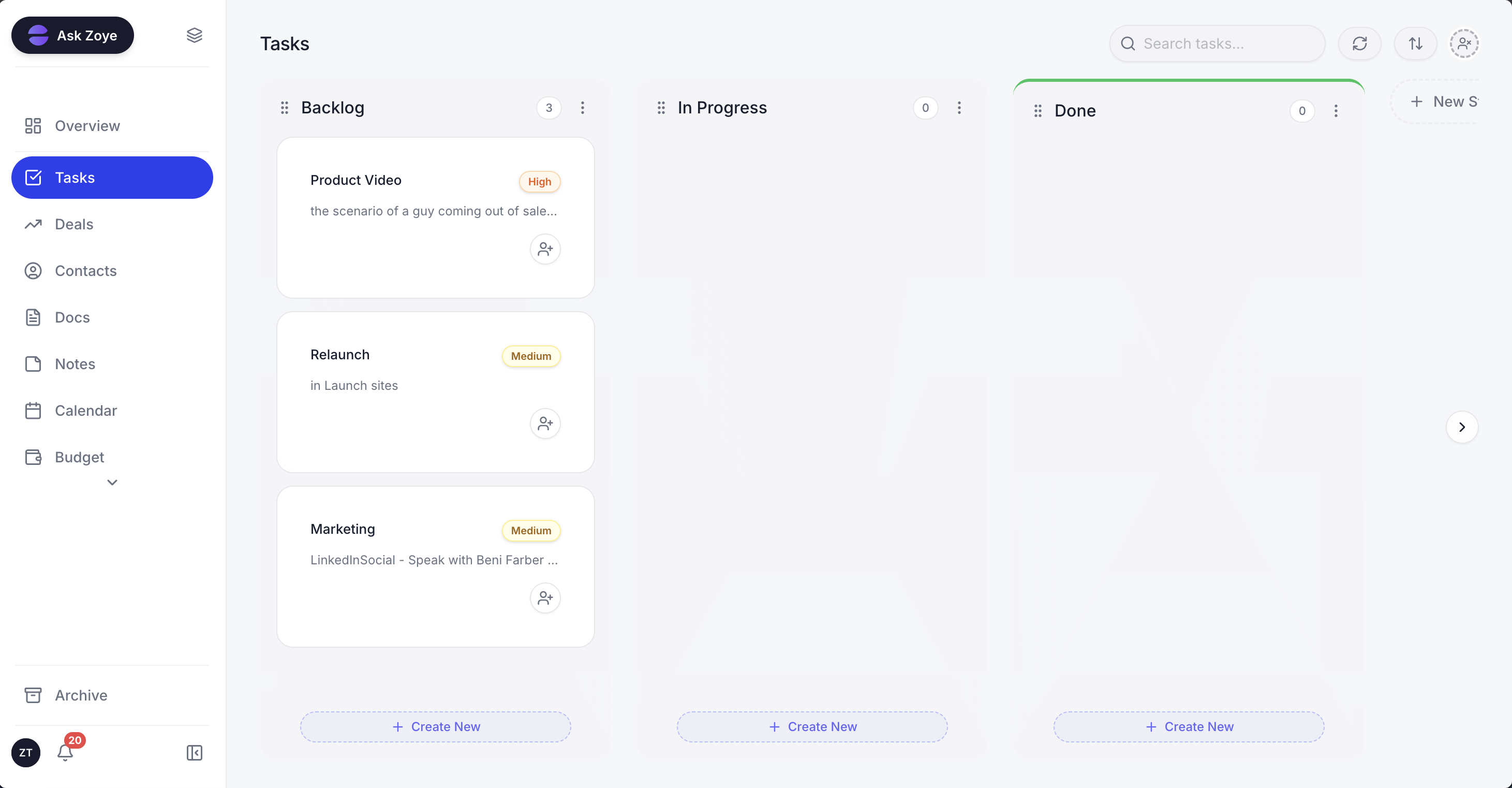 A recruiter's pipeline on a Zoye board: candidates and roles move through clear stages, and the assistant keeps every follow-up on schedule.
Start with the pipeline. Every candidate and every open role sits on a board you can actually read at a glance, moving through the stages that match how you work: sourced, screened, submitted, interviewing, offer, placed. You do not build this from a blank template or wrestle with custom fields for an afternoon. It is ready when you open it, and you shape it as you go by telling Zoye what to change.
The difference is what happens between the stages. Where a normal CRM waits for you, Zoye acts. When a candidate has been submitted and the client has not responded in two days, Zoye sends the chase itself. When an interview is booked, it sends the confirmation and the reminder to both sides. When a candidate goes quiet after a first-round, it follows up on the cadence you set, logs the reply, and flags only the ones that need a human decision. You describe the follow-up once, and Zoye runs it on schedule from then on, over email and over WhatsApp, so the conversation stays in one place instead of scattered across your phone.
It captures leads too. When a new candidate messages you on WhatsApp or a client enquiry lands from your website, Zoye creates the record itself, so you are not copying details into a database at 9pm. And because Zoye is a full workspace, the candidate, the role, the interview on the calendar, the notes, and the follow-up thread all live together, not in five different apps.
Want to see it in action?
See Zoye catch a new lead, answer on WhatsApp and set up the follow-up, all from one message.
See How It WorksBeyond the pipeline, Zoye is the broader operational workspace a growing desk needs: tasks, a built-in CRM for candidates and clients, a calendar that holds your interviews and screens, budget and placement-fee tracking, and reports that pull the whole picture into one dashboard. The assistant works across all of it, drafting messages, booking calls, surfacing the roles that have gone quiet, and producing your weekly desk summary on demand.
Pricing: Almost Free from $5 per month ($4 per month billed annually) for 1 member with the core tools. Starter from $29 per month (10 members). Growth from $59 per month (20 members).
Best for: Solo recruiters and small staffing agencies that want the follow-ups and scheduling handled for them, not just stored.
2. Bullhorn - the enterprise staffing platform
Bullhorn is the long-established recruiting platform for staffing agencies, with a deep applicant tracking system, CRM, and back-office features. For larger agencies with dedicated operations staff, it is comprehensive.
The trade-off for a solo recruiter or small desk is weight and cost. Bullhorn is built for agencies with an admin team to configure and maintain it, and the pricing and onboarding reflect that. Most one-person and two-person desks find it more system than they can justify.
Pricing: Custom quote-based pricing; typically enterprise-tier and not published. Check with Bullhorn for current figures.
Best for: Established mid-size and larger staffing agencies with operations support.
3. Recruit CRM - the recruiting-first CRM and ATS
Recruit CRM is purpose-built for recruitment agencies, combining an applicant tracking system with a client CRM and candidate sourcing tools. It is genuinely designed for recruiters, which makes it a natural fit for many small agencies.
The trade-off is that it remains a database you drive. It stores candidates, roles, and clients well, but the follow-ups, the chasing, and the scheduling are still largely on you unless you build and maintain the automations yourself. It is a solid recruiting record system rather than an operator.
Pricing: Paid plans typically start around $85 per user per month; check the pricing page for current figures.
Best for: Small and mid recruiting agencies that want a recruiting-specific record system.
4. Zoho Recruit - the recruiting arm of the Zoho suite
Zoho Recruit is the recruiting product inside the broader Zoho ecosystem, offering an ATS and CRM with reasonable entry pricing. For recruiters already invested in Zoho tools, the integration is convenient.
The trade-off is the familiar Zoho experience: capable but sprawling, with a learning curve and a fair amount of configuration to get it working the way a specific desk needs. The automation exists but you assemble it.
Pricing: Free tier for a single recruiter with limits. Paid plans from around $30 per user per month.
Best for: Recruiters already using the Zoho ecosystem who want a low entry price.
5. Manatal - the affordable AI-assisted ATS
Manatal is a modern, affordable applicant tracking system with AI candidate-scoring features and a clean interface. For a small agency that wants a straightforward ATS at a low price, it is an approachable option.
The trade-off is that its focus is candidate tracking and sourcing rather than running the full client relationship and the ongoing follow-up cadence. The AI helps rank candidates, but you are still the one doing the outreach and the chasing.
Pricing: Plans from around $19 per user per month; check the pricing page for current figures.
Best for: Small agencies wanting a low-cost, easy ATS with candidate scoring.
6. HubSpot - the generic CRM adapted for recruiting
HubSpot is a well-built general CRM that some recruiters adapt into a candidate and client pipeline. The free tier is generous, the interface is polished, and the pipeline views are strong.
The trade-off is that HubSpot knows nothing about recruiting out of the box. There is no native concept of a candidate, a role, or a submission, so you bend contacts and deals into recruiting shapes and maintain that structure yourself. And the automation that matters lives in higher paid tiers that add up quickly.
Pricing: Free CRM tier. Paid Sales Hub plans from around $20 per seat per month, with meaningful automation on higher tiers.
Best for: Recruiters who want a polished generic CRM and will build the recruiting structure themselves.
7. Pipedrive - the simple sales pipeline for recruiting desks
Pipedrive is a simple, visual sales CRM that solo recruiters sometimes use as a lightweight candidate-and-client pipeline. It is easy to learn and pleasant to use for stage-based tracking.
The trade-off mirrors HubSpot: it is a sales tool, not a recruiting tool. It has no native candidate or role model, and its automation is reminder-based rather than an assistant that acts. You get a clean pipeline, but the chasing stays manual.
Pricing: Plans from around $14 per seat per month; check the pricing page for current figures.
Best for: Solo recruiters who want a simple visual pipeline and minimal setup.
Best CRM for solo recruiters and one-person desks
If you are a desk of one, the deciding factor is not how many fields the tool has, it is how much work it takes off your plate. A solo recruiter does not have an operations assistant, so the follow-ups, the scheduling, and the record-keeping either happen in the cracks of your day or they do not happen at all.
This is where Zoye pulls ahead of the specialist ATS platforms and the generic CRMs alike. Bullhorn and Recruit CRM are strong databases but they still expect you to drive every action. Zoye runs the actions itself: it chases the quiet candidate, confirms the interview, and re-engages a past candidate when a matching role opens, without you scheduling each message. For a solo recruiter, that is the difference between a tool you maintain and a tool that maintains your desk.
See what Zoye can do for you
CRM, deals, tasks and your Instagram, Facebook and WhatsApp automations in one workspace. Just ask Zoye and it sets any of it up for you.
Explore FeaturesBest AI-powered CRM for recruiters
Several tools on this list now carry an "AI" label, but there is a real difference between AI that scores and AI that acts. Manatal and Zoho use AI to rank and match candidates, which is useful at the sourcing stage. That is suggestion-level AI: it points at something and leaves the doing to you.
Zoye is the operator on this list. Its assistant does not just surface a candidate who fits a role, it drafts the outreach, books the interview, sends the reminders, and chases the feedback, then logs what came back. When you want a new follow-up rhythm, you tell Zoye the cadence you want and it builds and runs it, including over WhatsApp. For a small recruiting business, an assistant that takes action beats an assistant that only advises, because the bottleneck was never knowing what to do, it was finding the time to do it.
How to choose the right recruiter CRM for your desk
Three questions narrow the choice quickly.
1. Are you a solo desk or a larger agency with support staff? If you have an operations team to configure and feed a heavy system, Bullhorn or Recruit CRM can pay off. If you are solo or a two-person desk, you want a tool that runs itself, which points to Zoye.
2. Do you want a database, or do you want the follow-ups handled? If you genuinely just need an organized candidate record and you are happy to do all the chasing yourself, a generic CRM or an affordable ATS works. If the follow-ups and scheduling are where you lose placements, choose the operator that does them: Zoye.
3. Where do your candidates and clients actually talk to you? If a lot of your closing happens on WhatsApp, prioritize a tool that treats WhatsApp as a first-class channel with the assistant able to draft and send replies, not a bolt-on. Zoye centralizes email and WhatsApp against the candidate and role.
Migrating to a recruiter CRM without losing momentum
The good news for a small desk is that switching does not mean a painful data project. Most solo recruiters and small agencies are moving from spreadsheets, an inbox, and a phone full of WhatsApp threads rather than a heavy legacy system, so there is little to export and reformat.
The pragmatic approach is to bring only the live work forward. Take the candidates in active processes and the open client roles, drop them onto the pipeline board, and let the rest stay archived until a matching role brings a past candidate back into play. With Zoye, you talk it through your desk and your usual follow-up cadence, and it sets up the pipeline stages and the chasers with you, so you are running placements within the first hour rather than configuring fields for a week.
From there, the assistant keeps the records itself as calls and messages come in, which is the part that makes the new tool stick where the old one was abandoned. You are not maintaining a database on top of recruiting; the database maintains itself while you recruit.
Ready to hand off the busywork?
Zoye brings AI-powered CRM, task management, and automation into one workspace.
Get StartedWhy recruiters pick Zoye as their CRM
A few themes come up consistently for solo recruiters and small agencies.
The follow-ups finally happen. The quiet candidate gets chased, the client gets nudged for feedback, and the past placement gets re-engaged, because the assistant runs the cadence instead of relying on you to remember.
The records keep themselves. Candidates, roles, interviews, and message threads update as the work happens, so the tool stays current instead of becoming another abandoned database.
Everything lives in one place. The pipeline, the calendar, the email and WhatsApp threads, and the placement-fee tracking sit together, so a solo recruiter runs the whole desk from one workspace instead of stitching apps together.
Try Zoye for your recruiting desk. The entry Almost Free plan starts at just $5 per month ($4 per month billed annually), with the core tools, and you can cancel or upgrade anytime.
For more context, see the best CRM for small business, the easiest CRM for small business, and our guide to AI lead management.