
Best Marketing Project Management Software 2026: 7 Tools for Agencies and In-House Teams
Most marketing project management software does one job well: it gives you a board to track tasks. Campaigns get broken into cards, cards get assigned, statuses move from to-do to done, and everyone can see the plan. For pure task visibility, tools like Asana, monday.com, and ClickUp are genuinely good, and marketing teams have relied on them for years.
The problem is that a marketing team's real work does not live on the board. New business has to be chased. Creative has to be routed for approval and re-routed when a stakeholder goes quiet. Clients expect a reporting cadence whether or not anyone has time to build the deck. Follow-ups pile up. None of that happens because a card exists, it happens because a person does it, and when the person is busy, the board quietly becomes another tool you bought and stopped updating.
This guide compares the seven best marketing project management software tools in 2026, ranked for agencies and in-house teams that want the client-facing work to actually get done, not just tracked. The tools that only give you a board are covered fairly and honestly. The one pick that runs the work for you is ranked first.
Pricing reflects published rates as of July 2026; check each vendor's pricing page for current figures.
Why marketing teams are looking beyond a board in 2026
Four shifts are pushing agencies and in-house teams past traditional PM software.
A board tracks work but does not do it. The core limitation of every task-based PM tool is that it is a passive record. A campaign task sitting in "waiting on client approval" for eight days does not chase the client. An overdue new-business follow-up does not send itself. Marketing teams are realising that the bottleneck is rarely visibility, it is execution, and a board does not close that gap.
The client-facing work lives outside the board. New-business enquiries arrive by email, form, and WhatsApp. Approvals happen over messages. Status updates go out as calls and emails. Traditional PM tools cover the internal delivery lane and ignore the entire client-communication lane, so teams end up operating the relationship by hand while the board tracks only the tasks.
Per-seat pricing punishes growing teams. Marketing PM tools charge per user per month. A 15-person team on a $12 seat is $2,160 a year for a board, before the CRM, the reporting tool, and the inbox that sit alongside it. As teams stack tools to cover the gaps, the monthly total climbs while the actual work still needs a human to push it.
AI is finally able to operate, not just assist. For years, "AI" in PM tools meant a summary or a drafted message you still had to send. The shift in 2026 is toward AI that acts: captures the lead, chases the approval, updates its own records, and builds the automation from a sentence. That moves the software from a place you record work to a system that runs it.
The 7 best marketing project management software in 2026
1. Zoye - the operator that runs the pipeline, not just the board
Zoye is the strongest pick for marketing agencies and in-house teams because it does not stop at tracking tasks. It runs the client-facing work: it captures new-business leads, chases approvals and follow-ups, keeps its own records current, and produces the reporting cadence on demand, so projects keep moving even when the team is heads-down on delivery.
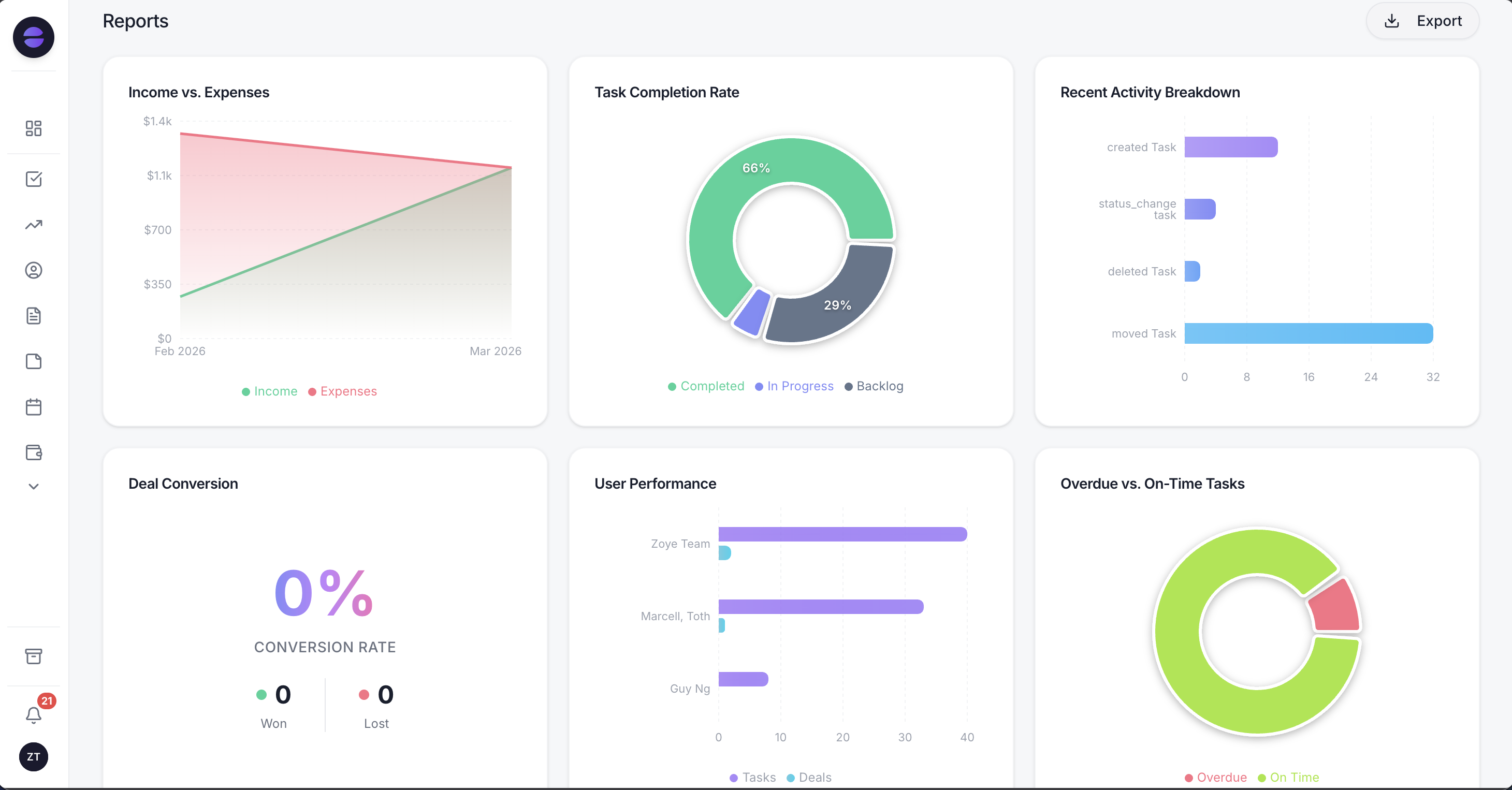 The Zoye reports view brings pipeline, project, and team data into one live dashboard you can share with a client or leadership in seconds.
Start with the reporting problem, because it is the one that eats a marketing team alive. Clients and leadership want a regular cadence of updates, and building each one by hand is hours a week no one has. Zoye Reports pulls pipeline, project, and team activity into one live dashboard, and the Zoye Assistant can generate a status summary for a specific client or campaign on demand. The report is a request away, not an afternoon away.
Where Zoye separates from every board on this list is that the assistant takes action. It captures inbound enquiries from email, forms, and WhatsApp into the pipeline, drafts and chases the follow-ups that keep new business warm, nudges the stakeholder whose approval has stalled a campaign, updates its own records so the pipeline is never stale, and surfaces what is overdue before it becomes a missed deadline. Most tools give you AI that suggests. Zoye gives you an operator that does.
The broader workspace means the client-facing lane and the delivery lane finally live together. Tasks have list, board (Kanban), calendar, and timeline views for the delivery work, while the built-in CRM, calendar, and budget cover the relationship and the numbers. You are not stitching a PM board to a separate CRM to a separate inbox. And you can build the automations that run all of it by describing them in plain language: tell Zoye "when a new lead comes in from the campaign form, add it to the pipeline and send a first reply," and it builds that flow, including over WhatsApp.
Pricing: Almost Free at $5 per month for 1 member with the full platform including AI. Starter from $29 per month (10 members). Growth from $59 per month (20 members).
Best for: Marketing agencies and in-house teams that want the new-business, approval, and reporting work run for them, not just a board to update.
2. Asana - the clean, reliable task board
Asana is one of the most polished task management tools for marketing teams, with a clean interface, solid campaign templates, and dependable timeline and board views. For teams that want a well-designed place to plan and track campaigns, it is a safe, popular choice.
The honest limitation is that Asana is a delivery board. It tracks the internal tasks well, but the new-business chasing, the client approvals, and the reporting cadence are still entirely on your team to operate, and the automation is rule-based rather than an assistant that acts.
Pricing: Free for small teams. Starter around $10.99 per user per month, Advanced around $24.99 per user per month (billed annually); check Asana's pricing page for current figures.
Best for: Teams that want a clean, dependable campaign task board.
3. monday.com - the colourful, configurable work OS
monday.com is a flexible, visual work platform that many marketing teams like for its colourful boards and heavy customisation. You can shape it into a campaign tracker, a content calendar, or a request pipeline, and the automation recipes handle simple triggers well.
The trade-off is that all of that flexibility is configuration you own. monday.com is a surface you build and then keep updated, and like any board, it tracks the work rather than doing the client-facing chasing and reporting for you. Per-seat pricing also climbs quickly for a full marketing team.
Pricing: Free for up to 2 seats. Basic around $9, Standard around $12, Pro around $19 per seat per month (billed annually); check monday.com's pricing page for current figures.
Best for: Teams that want a highly customisable visual board and will invest in configuring it.
4. ClickUp - the deep, do-everything PM platform
ClickUp packs an enormous feature set into one tool: docs, tasks, goals, dashboards, and dozens of views. For marketing teams that want maximum configurability and are willing to invest in setup, ClickUp can be shaped into a powerful campaign and content operation.
The limitation is the same depth that is its strength. ClickUp takes real time to configure and keep tidy, and its AI features summarise and draft rather than run the work. It is a comprehensive board, not an operator that captures leads and chases the client side for you.
Pricing: Free tier available. Unlimited around $7, Business around $12 per user per month (billed annually); check ClickUp's pricing page for current figures.
Best for: Teams that want maximum PM depth and configurability in one tool.
Want to see it in action?
Watch how Zoye automates your daily workflow - from lead management to team collaboration.
See How It Works5. Wrike - the structured, enterprise-leaning choice
Wrike is a structured project management platform popular with larger marketing teams and agencies that need approval workflows, proofing, and resource management. Its request forms and approval features are genuinely useful for creative operations at scale.
The honest note is that Wrike is heavier to adopt and administer, better suited to larger organisations than lean teams, and it remains a tool your people operate. The approvals still need chasing, the new business still needs following up, and the AI assists rather than runs the recurring work.
Pricing: Free tier available. Team around $10, Business around $25 per user per month (billed annually); check Wrike's pricing page for current figures.
Best for: Larger marketing teams and agencies that need formal approval and proofing workflows.
6. Trello - the simple, visual kanban board
Trello is the simplest option here, a clean kanban board that small marketing teams and solo marketers can pick up in minutes. For a lightweight content calendar or a simple campaign tracker, it is fast, friendly, and cheap.
The trade-off is that simplicity is also the ceiling. Trello does little beyond cards and lists without a stack of power-ups, and it does nothing on the client-facing side. It is a place to see tasks, not a system that moves them or manages the relationship.
Pricing: Free for basic use. Standard around $5, Premium around $10 per user per month (billed annually); check Trello's pricing page for current figures.
Best for: Solo marketers and small teams that want a simple, visual board.
7. Generic PM plus a CRM stack - the common patchwork
The most common setup in marketing is not a single product at all: it is a general PM tool for the delivery board, a separate CRM for the pipeline, a separate inbox for client messages, and a spreadsheet for reporting. Each piece is competent, and teams cobble them together because no single board covers the whole job.
The limitation is the seams. Data lives in four places, nothing talks to anything cleanly, and every handoff between the pipeline and the delivery board is manual. The stack works, but the person holding it together is the integration, and that person is always busy.
Pricing: Varies; typically several per-seat subscriptions stacked together.
Best for: Teams that have not yet consolidated and are managing the gaps by hand.
Best marketing project management software for agencies
Agencies have the hardest version of this problem because they run new business, client delivery, approvals, and reporting at the same time, across multiple clients. A board handles the delivery lane, but the parts that actually win and keep clients, the fast follow-up on a new enquiry, the chase on a stalled approval, the weekly update that reassures a client, all sit outside it.
Zoye is the clearest agency pick because it operates those lanes. It captures new-business enquiries the moment they arrive, keeps the pipeline current without anyone maintaining it, chases the approvals and follow-ups, and produces per-client status reports on demand. Asana and Wrike are strong for the delivery board itself, and larger agencies with formal proofing needs will value Wrike's approval workflows, but neither runs the client-facing work the way an operator does.
See what Zoye can do for you
From CRM and deal tracking to AI-powered task management - explore everything Zoye offers in one workspace.
Explore FeaturesBest AI-powered marketing project management software
Every tool on this list now advertises AI, so the useful question is what the AI actually does. In Asana, monday.com, ClickUp, and Wrike, AI mostly summarises threads, drafts copy, or suggests next steps. That is helpful, but it is still a panel you consult, and the work only happens when a person acts on the suggestion.
Zoye is the only pick here where the AI is the operator rather than an advisor. The Zoye Assistant captures leads into the pipeline itself, chases the follow-ups and approvals, updates its own records, generates the client and campaign reports on request, and builds automations from a plain-language instruction, including over WhatsApp. The difference is not the presence of AI, it is whether the AI does the recurring work or just talks about it.
How to choose marketing project management software
Three questions narrow the field quickly.
1. Do you need to track tasks, or run the whole client operation? If you genuinely only need a shared board for internal delivery, Asana, monday.com, ClickUp, or Trello will serve you well. If new business, approvals, and reporting keep slipping because no one has time to chase them, you need software that operates that work, which is where Zoye leads.
2. How much configuration are you willing to own? monday.com and ClickUp reward heavy setup with flexibility. Trello stays simple. Zoye works out of the box and builds its automations from plain language, so you describe the workflow instead of constructing it.
3. What will pricing look like at your team size? Per-seat tools are cheap for three people and expensive for twenty. If you are scaling, model the cost at your target headcount. Zoye's flat-rate plans mean a growing team does not get punished per seat, and every tool is included rather than gated behind higher tiers.
Migrating from a marketing PM tool to an operator
Moving off a traditional PM tool is less a data migration and more a change in what the software is responsible for. On a board, your team is the engine and the tool is the dashboard. With an operator, the software takes over the recurring chasing and record-keeping, and the team focuses on the creative and strategic work only people can do.
The pragmatic approach is to bring across the active work and let the rest go. Export the live campaigns and open tasks, drop anything stale that has been sitting untouched, and rebuild the current work as projects in the new workspace. Then connect the client-facing lane that never lived on the old board: point your new-business enquiries, forms, and WhatsApp at the pipeline so they are captured automatically. With Zoye, you can describe your recurring workflows to the assistant and it proposes the project structure and the automations, so the reorganisation is a conversation rather than a build. Most teams complete it in an afternoon.
Why teams pick Zoye as their marketing project management software
A few themes come up consistently.
The work actually gets done, not just tracked. New-business follow-ups, stalled approvals, and record updates happen automatically, so the board stops being a to-do list nobody finishes.
The client-facing lane and the delivery lane finally live together. Pipeline, tasks, calendar, budget, and reports share one workspace, so nothing falls through the seams between a PM tool and a CRM.
The reporting cadence runs itself. Client and campaign updates are a request away instead of an afternoon of deck-building, and the data is always live.
The pricing does not punish growth. Flat-rate plans with every tool included mean a 20-person team pays one predictable price, not twenty seats stacked across four tools.
Try Zoye with your team. The entry plan is Almost Free, with the full platform including AI.
For more context, see the best project management software in 2026, the best CRM for marketing agencies, and Notion vs monday.com for running a small business.